
.avif)
TL;DR
- Sales performance optimization helps revenue teams raise quota attainment and shorten sales cycles. It aligns rep behavior with incentive plans to improve forecast accuracy.
- Spot pipeline bottlenecks before they reach revenue. Use CRM and performance data to guide coaching and deal prioritization.
- Align KPIs and incentive plans so reps focus on revenue behaviors instead of raw activity volume.
- Give leaders and reps real-time visibility into goal progress and payouts.
- Build a repeatable operating rhythm for continuous performance gains across RevOps and finance teams
Your sales team works hard, but the numbers fall short of target. Deals drag on. Reps miss follow-ups, and forecasts miss the final results. The potential is clearly there, but it stays hidden in the outcomes.
Sales performance optimization goes beyond a sales process exercise. It connects pipeline visibility with incentive plans so the revenue engine works toward shared outcomes. Sellers see how their actions affect earnings. Leaders see how incentives shape revenue, which makes performance easier to manage and scale.
Misalignment drives the gap for most teams. Reps get measured on one set of goals but compensated on another. Coaching often relies on data that arrives too late. Sales performance optimization works best when quota progress and incentive compensation connect in real time.
RevOps teams, finance teams, and sales compensation teams gain the most here, especially those managing quota-carrying reps and variable pay plans.
The right tools and automation make your sales process smoother and shorten the sales cycle. They free reps to focus on closing deals and improving customer experience.
This guide explains what sales performance optimization is and why teams miss targets. You'll also learn to build an operating rhythm that improves quota attainment and forecast reliability.
What Is Sales Performance Optimization?
Sales performance optimization improves how a revenue team plans and manages sales execution. It sharpens how your team uses data and processes to close deals faster and hit targets consistently.
It combines a clear sales process with the right automation tools to remove friction and lift results. When CRM activity and incentive data connect, leaders see which behaviors drive revenue and which compensation mechanics need adjustment.
Here's what an effective sales process optimization delivers:
- Faster sales cycles and smoother deal flow.
- Higher conversion and win rates.
- Stronger customer relationships and customer retention.
- Clear KPIs and dashboards that drive action.
- Better alignment between sales efforts and business goals.
To start, look at your sales pipeline and find where deals slow down. Use that insight to fix weak spots and coach reps where needed. Keep testing and improving. That habit keeps top-performing teams ahead.
Sales Performance Optimization vs. Related Concepts
Teams use the terms below interchangeably, but each plays a distinct role. This comparison clarifies how they fit together.
How sales performance optimization compares with related concepts and their primary owners.
Essential Metrics to Measure Sales Performance Optimization
You prove optimization works by tracking the right metrics. Track leading indicators that predict outcomes and lagging indicators that confirm results. Review them on a consistent cadence and act fast when they slip.
Leading and lagging sales metrics with their review frequency.
The Core Pillars of Sales Performance Optimization
A strong sales performance strategy needs four connected pillars. When all four work together, performance becomes predictable and repeatable instead of reactive.
The four pillars of sales performance optimization with problems and fixes.
Common Sales Performance Optimization Challenges and Root Causes
When your sales numbers dip, the cause usually sits in your process instead of effort. The real problem hides inside your process and tools, the parts of selling that quietly slow progress. Here are the most common causes and what you can do about them:
- Unclear sales process: When everyone follows their own steps, deals stall or disappear. Map out each stage of the customer journey, from lead generation to closing, so reps know exactly what to do next.
- Weak lead qualification: A full pipeline can still be an unhealthy one. Focus on high-quality leads using clear qualification criteria and lead scoring so reps spend time where it matters most.
- Too many tools and messy data: Disconnected systems waste time and create confusion. Audit your tech stack and clean up your CRM, then use automation to simplify data tracking.
- Minimal coaching: Without guidance, reps repeat the same mistakes. Regular sales coaching sessions and call reviews help sharpen skills and lift conversion rates.
- Misaligned goals and incentives: When compensation plans reward the wrong behaviors, reps may chase activity volume instead of profitable revenue or strategic accounts. For finance and compensation teams, misaligned incentives also raise commission costs and trigger disputed payouts. Align KPIs and incentive mechanics so every rep sees which actions improve business outcomes and personal earnings.
- Poor follow-up habits: Even strong leads can go cold without consistent outreach. Set clear follow-up rules and automate reminders, then hold reps accountable for every opportunity.
- Lack of cross-team communication: When SDRs and AEs work in silos, leads get lost. Build shared dashboards and handoff processes to keep your pipeline smooth and messaging consistent.
Small process gaps like these can quietly drain sales productivity and morale. Once you pinpoint the broken parts, you can rebuild stronger systems and coach smarter. That work keeps performance and revenue growing.
How to Analyze Sales Performance and Spot Underperformance
Before you can fix poor sales performance, you need to know exactly where things break down. Most teams realize there's a problem only after they've missed their targets, but the warning signs show up long before that.
Look beyond lagging results and focus on early signals that reveal how your sales process performs.
- Start with your data. Review your team's activity in the CRM to see if opportunities move through the pipeline as expected. A healthy sales pipeline has a steady flow of qualified leads progressing from one stage to the next. If deals sit too long in one stage or vanish, that signals a problem.
- Look at your conversion rates. Compare performance at each funnel stage, from discovery through close. Consistent drops at a stage point to training or messaging gaps that need attention.
- Pay attention to sales activity quality. Numbers alone tell only part of the story. Review call notes and email engagement to see how well reps connect with prospects. Low engagement or poor follow-up usually signals weak discovery or unclear value messaging.
- Check your performance metrics against team KPIs. Declining win rates or longer sales cycles point to process gaps or coaching needs. Even small dips in these metrics can predict larger problems ahead.
- Use real-time dashboards to monitor trends across your team. Visual reports give sales managers and leaders instant visibility into where performance is strong and where it slips. They help you spot issues early so you can act before they hit revenue.
For finance and sales compensation teams, this visibility also reduces payout disputes and improves confidence in commission accruals. When you identify underperformance quickly, you build a stronger, more predictable sales operation. The sooner you see what works, the faster you can optimize and coach your team to its best.
10 Sales Performance Optimization Strategies That Drive Results
Improving performance starts with better systems instead of harder work. These 10 strategies combine process improvements with incentive alignment. That last piece matters. When your strategy shows up in how reps get measured and rewarded, behavior changes consistently.
1. Set Clear Revenue Goals and Operating KPIs
You optimize only what you measure. Begin by defining revenue goals that match your sales capacity and customer segments. Use CRM data to calculate win rates and quota coverage so targets stay realistic.
Establish key performance indicators that reflect leading activities and lagging outcomes. Track metrics like pipeline coverage ratio (aim for 3 to 4x quota) and conversion rate by stage.
Tools like Everstage connect CRM performance data with quota attainment and incentive-plan visibility. Sales and RevOps leaders see how compensation plans shape rep behavior. Reviewing dashboards weekly helps sales managers catch performance dips early and coach proactively.
2. Tighten Your Ideal Customer Profile and Lead Routing
High-performing sales organizations focus on quality over quantity. Refine your Ideal Customer Profile using your top 20% of customers who contribute 80% of revenue. Look at factors like company size and buying triggers to define a best-fit account.
Build your lead scoring model on firmographics and purchase intent. Integrate this with marketing automation so only qualified leads reach your sales team.
Automate lead routing to ensure every inbound lead gets followed up within 24 hours. Fast response times and strong ICP alignment improve conversion rates while reducing wasted rep effort.
3. Standardize Sales Stages and Qualification
A consistent sales process helps teams forecast accurately and coach effectively. Define each funnel stage with clear exit criteria so deals move on objective progress instead of personal judgment.
Implement a qualification framework such as MEDDICC or BANT to validate every opportunity. Add mandatory CRM fields that capture budget approval and decision makers.
Review stage accuracy weekly to identify misclassified deals. When data is clean and stages are clear, your forecasts become reliable and your pipeline more predictable.
4. Build a Pipeline and Capacity Plan
Pipeline health determines future revenue. Start by calculating the number of leads and meetings required to hit your sales goals based on historical conversion rates. For example, if your average win rate is 25% and your quota is $500K, you need $2M in qualified pipeline coverage each quarter.
Use this data to set rep activity targets for calls and demos. Balance inbound and outbound channels so your pipeline draws from more than one source.
Revisit capacity plans monthly to account for headcount and seasonality changes. A structured plan keeps your pipeline full and your team focused on revenue-generating activities.
5. Deploy Playbooks and Sales Enablement Content
Your sales team performs best when they have clear direction and strong resources. Create sales playbooks that outline the steps for each stage, from discovery to close. Include key messaging and follow-up sequences.
Build a content library with current case studies and competitive battlecards. Track how often reps use each asset and link content performance to win rates.
Regularly update playbooks based on customer feedback and successful deal patterns. Well-organized enablement content reduces ramp time and improves rep confidence in every conversation.
6. Run Data-Backed Coaching Cadence
Coaching based on real data turns average sales reps into top performers. Schedule recurring 1:1 sessions to review each rep's call analytics and deal progression.
Use conversation intelligence tools to analyze talk ratios and objection handling. Focus on leading indicators like meeting quality and opportunity advancement instead of closed deals alone.
Platforms like Everstage help sales managers connect performance trends with quota attainment and incentive outcomes, and track improvements over time. Coaching conversations can move beyond activity reviews to the behaviors that improve revenue and earnings.
7. Optimize Your CRM and Sales Workflows
Your CRM is the engine of your sales operation. Keep it clean and automated so your team spends more time selling and less time typing. Automate contact logging and activity tracking through email and call integrations.
Define standard workflows for deal updates and follow-ups. Set up notifications for stalled opportunities or missing next steps.
Connect your CRM with your compensation system so closed-won data and commission calculations flow without manual reconciliation. That link reduces disputes and gives sales leaders an accurate view of performance.
Want to connect sales performance with incentive outcomes?
Everstage helps teams track quota attainment and automate commission visibility, so you see which incentives drive the right behaviors.
8. Strengthen Deal Execution and Collaboration
Every deal needs a clear plan and aligned stakeholders. Use Mutual Action Plans (MAPs) that define timelines and responsibilities for buyer and seller. Share these plans within your CRM or deal management tool so progress stays visible to everyone.
Encourage multi-threading by engaging multiple contacts within the buying organization. Multi-threading reduces risk when a champion leaves or priorities shift.
Hold deal reviews where reps and managers judge opportunity health on decision power and budget approval. Collaboration between sales and customer success teams keeps messaging consistent and handoffs smooth.
9. Improve Pipeline Velocity and Forecast Accuracy
Slow deals drain resources and distort forecasts. Measure the average time opportunities spend in each stage and identify bottlenecks. Set time-in-stage benchmarks and coach reps on how to move deals faster without sacrificing quality.
Forecast accuracy improves when CRM data and quota targets stay visible together. Everstage's performance dashboards and modeling help leaders see how different payout scenarios affect revenue and compensation cost.
Compare forecasted results against actuals each quarter to refine assumptions and strengthen predictability.
10. Iterate with Experiments and Quarterly Reviews
Sales performance optimization is never finished. Treat it as a cycle of testing and learning. Experiment with new messaging and outreach cadences. Track each test's impact on conversion rate and deal size.
Use Quarterly Business Reviews (QBRs) to analyze what worked and what fell flat. Combine qualitative feedback from reps with quantitative insights from CRM data and Everstage reports.
Scale tactics that show measurable lift and retire the rest. Continuous improvement keeps your sales strategy competitive and your team adaptable in changing markets.
How to Optimize Sales Performance: A 5-Step Action Plan
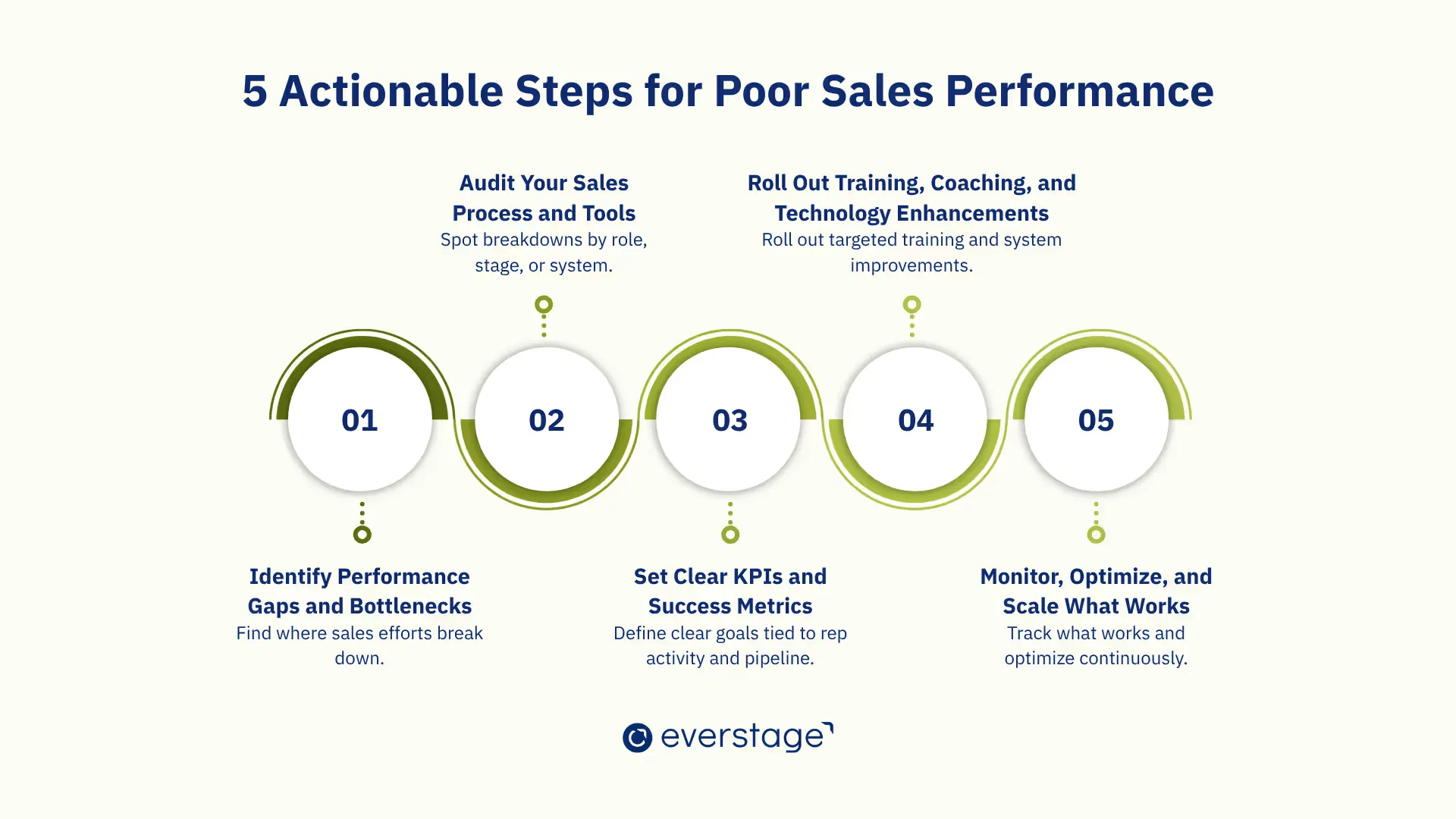
If your sales numbers fall short, motivation alone leaves the problem in place. You need a diagnostic plan that shows where performance breaks down across pipeline and rep behavior. Here's a practical five-step roadmap to rebuild momentum and hit your revenue goals faster.
Five diagnostic areas to check when sales performance falls short.
Step 1: Identify Performance Gaps and Bottlenecks
Start by figuring out where things slow down. Look at metrics such as win rates and deal velocity. Check your CRM for stalled deals and missing data. Add incentive plan alignment and payout visibility as diagnostic areas, since motivation gaps trace back to misaligned compensation.
Then talk to your sales reps. Ask what feels unclear or repetitive. Slow approvals and poor lead quality usually surface first. Combining these insights helps you pinpoint the real blockers instead of guessing.
The goal here is clarity. Once you know which parts of your sales process leak time or value, you can start fixing them systematically.
Step 2: Audit Your Sales Process and Tools
Next, map your entire workflow from lead generation to closing. Identify low-value tasks or tools that overlap. Disconnected systems create chaos, forcing reps to update multiple platforms instead of selling.
Run a tech audit to see which tools your team uses and which you can remove. Include CRM-to-compensation integration as a systems audit item so closed-won data and payouts stay in sync. A streamlined process with a unified CRM and connected dashboards speeds up workflows and improves data accuracy.
Every tool should exist for one reason: to help your sales team sell smarter and faster.
Step 3: Set Clear KPIs and Success Metrics
Improvement needs measurable targets. Define KPIs that reflect productivity and outcomes, such as pipeline coverage and forecast accuracy.
Break goals down by role so every sales rep knows what success looks like. SDRs might track qualified meetings booked, while AEs focus on win rates or revenue closed. Make progress visible with real-time dashboards that show where each rep stands.
Platforms like Everstage connect these KPIs to incentive plans. Sales managers get a clear view of payout visibility and quota attainment, and reps stay motivated through transparent rewards. When goals and recognition align, accountability follows naturally.
Step 4: Roll Out Training, Coaching, and Technology Enhancements
Skill gaps are a common hidden cause of poor performance. Focus on targeted training and personalized coaching sessions based on data. If discovery calls are weak, train on qualification. If deals stall after demos, coach on objection handling and closing strategies.
According to Qwilr, structured sales training delivers an average ROI of 353%. Still, 70% of sales reps lack formal training, which leads to inconsistent performance and higher turnover. Investing in continuous enablement pays for itself through stronger conversion rates and better rep retention.
Use technology that supports coaching at scale, such as call-recording tools and CRM automation that frees up selling time. Consistent feedback and real-time visibility turn training into measurable progress.
Step 5: Monitor, Optimize, and Scale What Works
Sales optimization is never one-and-done. Review your metrics weekly to see which strategies improve outcomes. Track conversion rates and forecast accuracy to spot patterns. Add plan effectiveness and payout outcomes to your quarterly review process.
Many organizations now rely on Sales Performance Management (SPM) systems to stay proactive. According to WorldatWork, 46% of global firms have already adopted SPM platforms, and over 80% report strong ROI from improved transparency and incentive alignment.
Tools like Everstage make this easier by centralizing performance data and automating commission tracking. Once you find what drives consistent results, document those processes and scale them across the team.
A strong sales recovery plan combines visibility with accountability. Start with diagnostics and fix the bottlenecks, then use data-backed tools to reinforce what works.
Turn Sales Performance Optimization Into a Continuous Revenue System
Sales performance optimization makes every revenue motion measurable and repeatable. When your sales process and incentive plans work together, reps know where to focus. Leaders see where performance slips, and finance teams trust the numbers behind payouts.
Start small. Tighten your KPIs and coach where it matters most. Those simple changes can spark big results.
Everstage helps teams connect quota attainment and commissions with real-time performance insights, so sales performance gets easier to manage.
Take the first step to see how Everstage connects sales performance and incentive compensation in one platform.
Questions worth asking
The things most people want to know before they commit.
How are sales performance optimization and sales process optimization different?
Sales process optimization is one part of broader sales performance optimization. Process optimization streamlines stages and handoffs within the sales cycle. Performance optimization is wider. It spans coaching and incentives across the entire sales ecosystem. In short, you optimize the process as a component of optimizing overall performance.
What is the difference between sales performance optimization and sales enablement?
Sales performance optimization improves the entire sales ecosystem, from processes and KPIs to incentives. Sales enablement equips reps with the content and training to perform better. In short, enablement supports daily execution, while optimization measures and refines the overall performance strategy.
How do incentives affect sales performance optimization?
Incentives influence which deals reps prioritize and how closely they follow the sales process. When incentive plans connect to clear KPIs and real-time payout visibility, reps see which behaviors drive revenue and earnings. That clarity makes incentives a critical part of sales performance optimization.
When should a team use a sales performance management platform?
A team should consider an SPM platform when spreadsheets and manual commission calculations make it hard to track performance or explain payouts. An SPM platform centralizes performance data and automates commission workflows, giving leaders better visibility into revenue outcomes.
What role does AI play in optimizing sales performance in 2026?
AI improves sales performance optimization with predictive insights and automated coaching recommendations. Modern SPM and CRM systems use AI to identify high-potential leads and suggest next-best actions, helping teams sell more efficiently.
How can data analytics improve sales performance optimization?
Data analytics helps sales leaders understand what drives conversions and where deals stall. Tracking metrics like deal velocity and conversion rate by stage gives insights to improve forecasting and coaching. Data-driven decisions lead to consistent, scalable sales performance improvement.