
TL;DR
- Everstage automates complex commission calculations, approvals, reporting, and rep payout visibility.
- It best suits mid-market and enterprise teams managing multiple plans and roles.
- Finance and RevOps gain stronger audit trails, accrual visibility, and workflow control.
- Pricing is quote-based and depends on users, plan complexity, integrations, and support.
- Successful implementation requires clean data, documented plans, testing, training, and clear ownership.
Book a demo with Everstage to see the results yourself.
If you’re searching for Everstage reviews, you’re likely trying to look beyond the feature list and understand how the platform performs for actual sales reps, Finance teams, and compensation administrators.
As of July 15, 2026, Everstage holds a 4.8/5 rating based on 2,029 G2 reviews. Users frequently highlight its ease of use, commission visibility, real-time tracking, detailed payout breakdowns, and calculation accuracy. Recurring concerns include the initial learning curve, configuration effort for complex plans, occasional data delays, and limited flexibility in certain dashboards or reports.
Those themes provide a useful starting point, but ratings alone cannot determine whether Everstage fits your organization.
This review examines its features, pricing approach, implementation requirements, strengths, tradeoffs, and alternatives to help you evaluate it against your sales compensation complexity, technology stack, and governance needs.
Everstage at a Glance
Everstage is an AI-first Sales Performance Management platform that helps businesses calculate commissions, manage incentive plans, review payouts, resolve disputes, and provide earnings visibility to sales teams.
It is primarily designed for organizations that need more control and scalability than spreadsheets or basic commission-tracking tools can provide.
As Brian Le, Global Sales Compensation Partner at Notion explains, Everstage became the commission source of truth for RevOps and helped the company scale sales compensation from 80 to 350 payees.
Everstage Product Suite
While Everstage is widely recognised for incentive compensation management, the platform has expanded into a broader Sales Performance Management (SPM) suite.
Together, its products help revenue teams design compensation plans, plan sales capacity, streamline quoting, and manage revenue operations from a shared platform.
Organizations can adopt individual products or use them together to manage compensation, planning, quoting, and revenue operations from a single platform.
What Problems Does Everstage Solve?
Organizations usually begin evaluating sales performance management software when manual processes become difficult to scale, commission plans become more complex, or revenue teams need better visibility into sales performance.
1. Manual commission administration
Everstage Incentives automates commission calculations, approvals, adjustments, and payout workflows. Instead of relying on spreadsheets and manual reconciliations, compensation teams can manage complex incentive plans through structured workflows and centralized reporting.
2. Limited visibility into sales earnings
Sales representatives often maintain their own commission spreadsheets because they lack confidence in payout calculations. Everstage provides deal-level earnings visibility, quota progress, payout statements, and commission breakdowns that help reduce shadow accounting and improve trust.
3. Difficult sales planning
As organizations grow, territory assignments, quota allocation, and capacity planning become increasingly difficult to manage manually. Everstage Planning enables revenue leaders to model different planning scenarios, optimize territory coverage, and allocate quotas more effectively before a sales cycle begins.
4. Slow quote approvals
Sales teams can lose momentum when pricing approvals require multiple manual reviews. Everstage CPQ helps standardize quote creation, pricing rules, and discount approvals so sellers can generate accurate quotes while maintaining pricing governance.
5. Limited operational visibility
Revenue teams often rely on disconnected CRM, ERP, payroll, and finance systems. The Everstage Platform connects these systems through integrations, reporting, AI-powered workflows, and shared analytics, providing a single source of truth for revenue operations.
Who Should Consider Everstage?
Everstage is best suited for RevOps, Finance, Sales Operations, and compensation teams that need greater control over complex commission processes.
It may be worth evaluating when:
- You manage multiple roles, plans, territories, splits, accelerators, SPIFFs, clawbacks, or changing quotas.
- Reps and managers need clearer payout visibility before payroll closes.
- Finance requires stronger approval workflows, accrual support, reconciliation, and audit trails.
- Your team has outgrown spreadsheet-based commission management.
Everstage may be more than you need if you have a small sales team, one simple flat-rate plan, low payout volume, or only require a basic commission calculator.
It is also important to clean up inconsistent CRM, billing, ownership, and quota data before implementation, as commission software cannot correct unreliable source data on its own.
Who Uses Everstage?
Different teams use different parts of the Everstage platform depending on their responsibilities.
1. Sales teams
Sales representatives primarily use Everstage Incentives and Everstage CPQ to track earnings, monitor quota progress, understand payout calculations, and generate customer quotes. Better visibility into commissions helps reduce payout disputes while standardized quoting shortens sales cycles.
2. Revenue Operations
RevOps teams typically manage the platform's configuration, commission plans, territory structures, quota planning, reporting, and integrations. Everstage Planning helps these teams model different scenarios before implementing changes across the sales organization.
3. Finance
Finance teams rely on Everstage to improve payout governance, commission accruals, reconciliation, audit readiness, and payroll preparation. Structured approval workflows and centralized reporting help reduce manual effort during month-end close.
4. Sales leadership
Sales leaders use Everstage Planning to evaluate territory coverage, headcount needs, quota allocation, and sales performance. Combined reporting across Incentives, Planning, and the broader platform provides greater visibility into how compensation and planning decisions influence revenue performance.
What Do Recent Everstage Reviews Say?
Everstage receives consistently strong ratings across major software review platforms.
What Does Everstage Do Well?
Users consistently highlight four strengths:
- Clear commission and quota visibility for sales reps
- Accurate, rules-based commission calculations
- Reduced spreadsheet work and manual administration
- Easy-to-use dashboards with responsive customer support
Let’s look at each of these areas in more detail.
1. Clear Commission Visibility for Reps
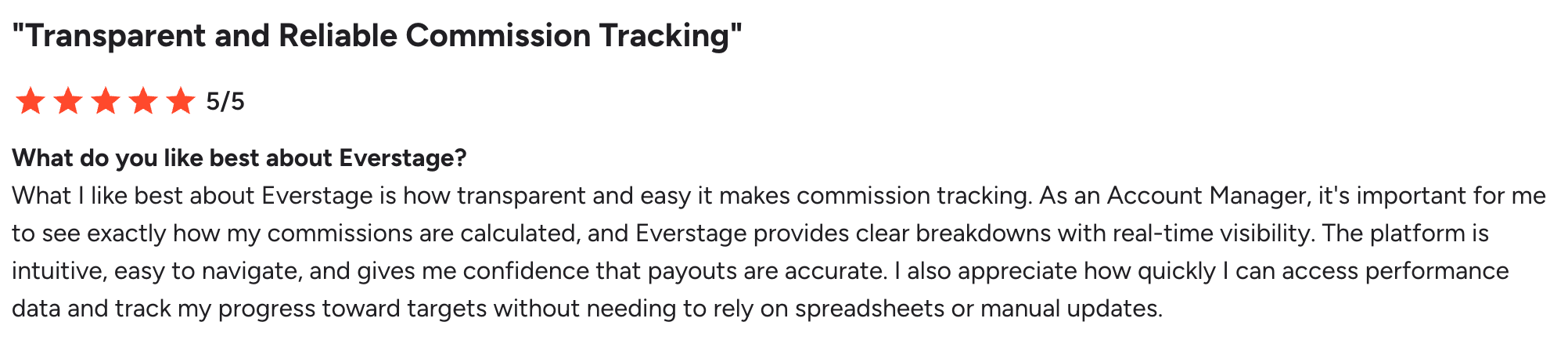
Alt text: Everstage review praising transparent and reliable commission tracking.
Source: https://www.g2.com/products/everstage/reviews/everstage-review-12960152
The most consistent positive theme is transparency. Sales reps say Everstage helps them understand how commissions are calculated, track quota progress, and see expected payouts without maintaining separate spreadsheets.
One reviewer highlighted clear payout breakdowns, real-time visibility, and greater confidence in commission accuracy.
Another reviewer notes that the CRM-connected view removed the need for shadow-accounting spreadsheets and helped model potential deal earnings.
This is where Everstage’s payee experience appears to deliver the clearest everyday value.
2. Accurate Calculations and Reduced Manual Work
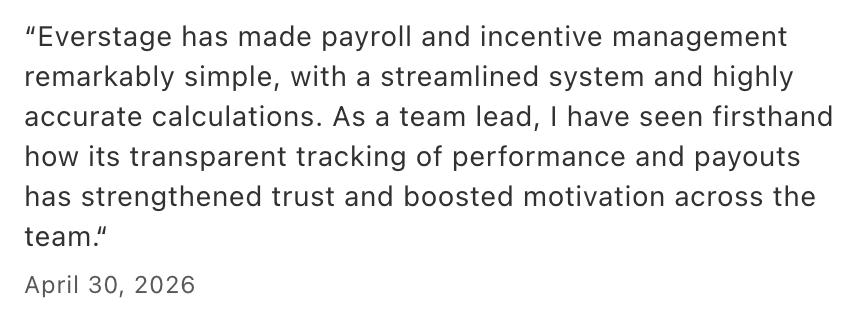
Source: https://www.capterra.com/p/232182/Everstage/reviews/#:~:text=SK,across%20the%20team.%E2%80%9C
Finance, RevOps, and sales users frequently mention calculation accuracy and time savings. Capterra reviewers describe fewer spreadsheets, reduced payout confusion, and less manual back-and-forth once the platform is configured.
TrustRadius reviews from 2026 similarly mention accurate commission calculations, easier manager dashboards, reduced manual input, and faster access to performance information.
These benefits align closely with Everstage’s sales compensation automation capabilities.
3. Stronger Controls for Finance and Compensation Teams
Admin-focused reviews highlight plan management, structured calculations, dashboard visibility, integrations, and the ability to trace compensation logic.
A June 2026 G2 reviewer said Everstage made complex logic and data flows easier to build and explain without requiring SQL knowledge. Other reviewers highlighted smooth integrations, responsive support, and clearer compensation reporting.
For Finance teams, the value extends beyond dashboards to more structured reporting and analytics, payout governance, and reconciliation.
4. Reporting, Syncing, and Configuration Are Common Tradeoffs
The reviews are not universally positive. The most common concerns relate to:
- Advanced reporting and dashboard customization
- Occasional CRM or data-sync delays
- A learning curve for complex configurations
- Reliance on support for certain changes
- Additional clicks or repetitive admin actions
- Historical-data migration and change management
A Capterra reviewer praised the interface and customer support but reported limitations in report customization and long daily sync times.
A G2 reviewer similarly mentioned CRM-sync delays and a steep learning curve for advanced reporting.
One enterprise G2 reviewer also described an implementation problem caused by incomplete stakeholder involvement, reinforcing the importance of documented requirements and internal ownership during rollout.
Buyers should therefore assess potential implementation challenges alongside the product’s features.
Overall Review Takeaway
Everstage performs best for teams that need accurate commissions, clearer payout visibility, and less spreadsheet work.
The main tradeoffs are reporting flexibility, complex setup, data migration, and implementation effort.
Everstage Pros and Cons
Key advantages and limitations to consider when evaluating Everstage.
Everstage Features to Evaluate
Everstage brings together commission automation, payee visibility, reporting, dispute management, and integrations within one platform.
The following features are the most important to assess based on your compensation structure, team size, and operational requirements.
1. Commission Plan Design and Automation
Source: https://www.everstage.com/products/incentives/sales-compensation-automation
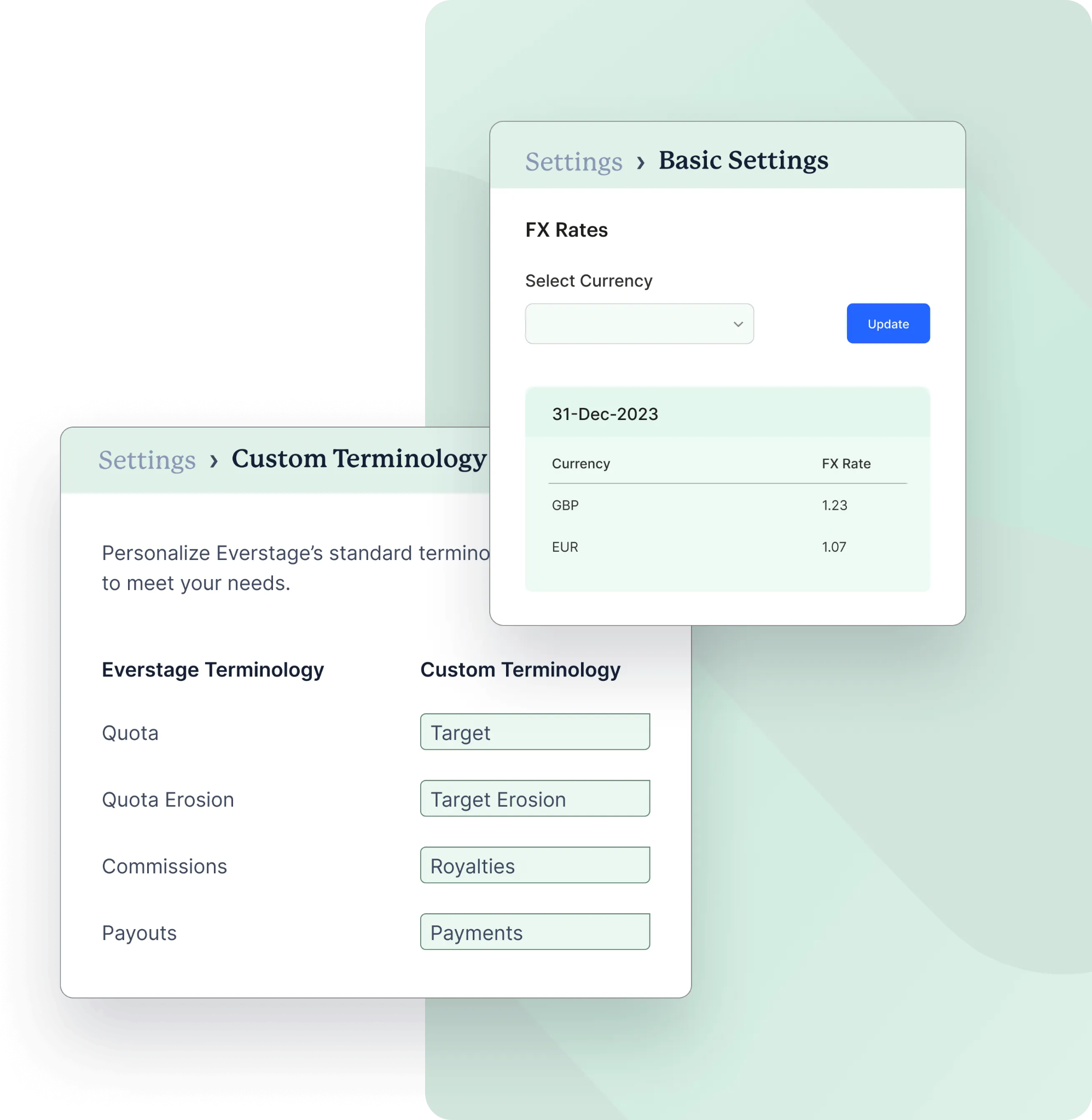
Everstage supports complex rules such as tiers, splits, accelerators, clawbacks, quotas, draws, and manager rollups. Its sales compensation automation reduces manual calculations and recurring spreadsheet work.
During a demo, test whether it can accurately model your most complex compensation plan and handle mid-cycle changes without rebuilding the entire process.
2. Commission Visibility for Reps
Source: https://www.everstage.com/products/incentives/payee-experience
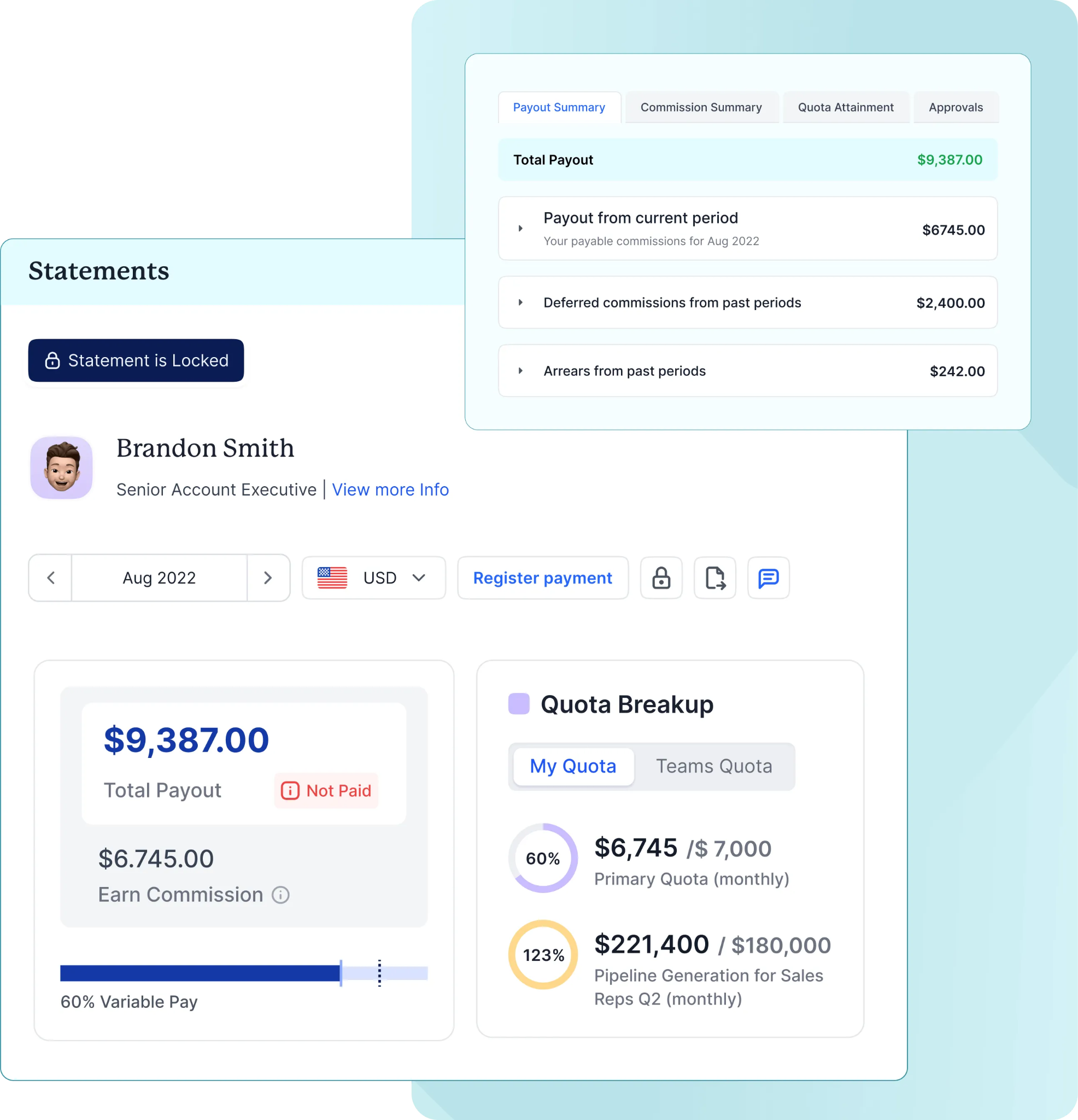
Reps and managers can track estimated earnings, quota progress, payout status, and the deals influencing their commissions.
The payee experience is particularly valuable for teams looking to reduce payout questions and improve trust before payroll closes.
3. Disputes and Approval Workflows
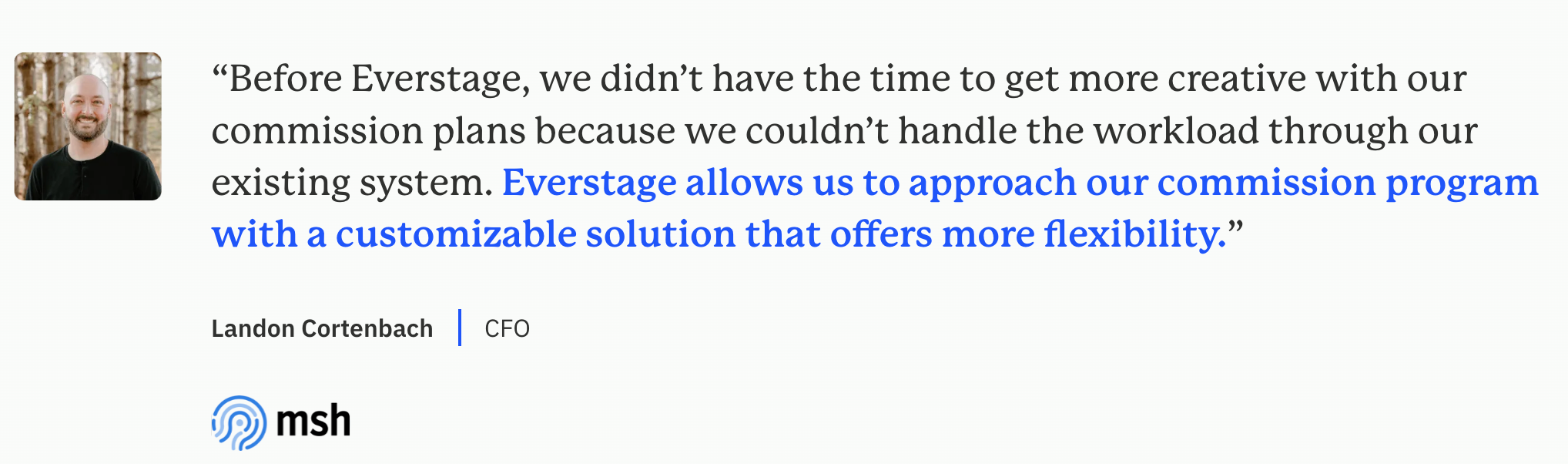
Alt text: MSH CFO Landon Cortenbach shares how Everstage enables more flexible commission plans.
Source: https://www.everstage.com/products/incentives/commission-processing
Everstage allows reps to submit payout disputes, attach supporting information, and route requests to the appropriate reviewer.
Structured commission processing also helps teams track approvals, adjustments, and payout decisions in one place.
4. Reporting, Accruals, and Forecasting
Everstage also provides AI-powered forecasting capabilities through Crystal, helping RevOps and Finance teams model future commission expenses based on pipeline changes, quota attainment, and projected sales performance. This gives leaders greater visibility into expected payout obligations before commissions are finalized.
Finance and RevOps teams can review commissions owed, plan performance, individual earnings, and expected payouts through centralized reporting and analytics.
Watch how Everstage Crystal helps forecast commission payouts and improve compensation planning:
Sales Commissions Forecasting with Everstage's Crystal
Alt text: Video explaining how Everstage streamlines commission tracking with QuickBooks.
Caption: See how Everstage simplifies commission calculations, approvals, and payout visibility.
Its commission forecasting capabilities can also help leaders understand future payout exposure before the period closes.
5. Integrations and Data Workflows
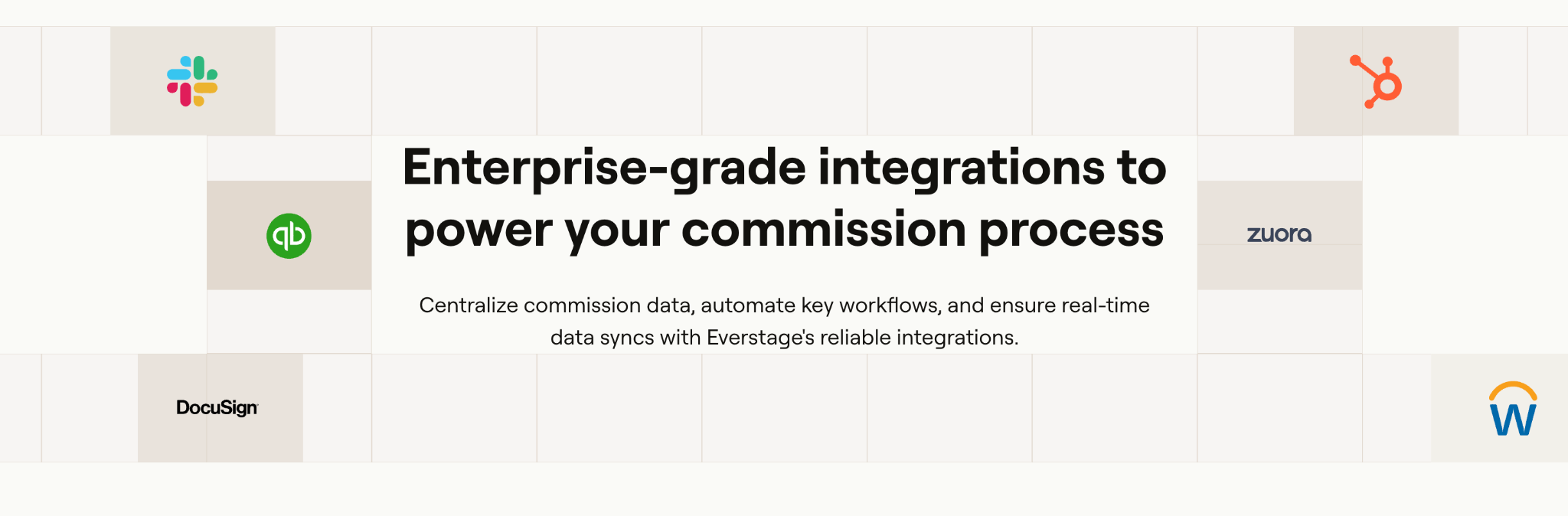
Alt text: Everstage integrations with QuickBooks, Slack, HubSpot, Zuora, DocuSign, and Workday.
Source: https://www.everstage.com/integrations
Everstage connects commission processes with CRM, billing, payroll, HRIS, ERP, and data warehouse systems through its integrations.
Buyers should confirm whether their required systems, fields, refresh schedules, and historical data can be supported before implementation.
What Results Have Everstage Customers Achieved?
Customer stories provide additional context on how Everstage performs after implementation. The outcomes vary based on compensation complexity, team size, data quality, and the processes being replaced.
1. Notion Reduced Commission Queries by 90%
As Notion expanded its sales organization, it needed a commission management process that could scale without increasing administrative work at the same rate.
After implementing Everstage, Notion reported a 90% reduction in commission-related queries, supported four times the previous sales-team scale, and reached 100% payee satisfaction. Sales representatives gained clearer access to their commission information, while the compensation team gained analytics that could support broader business decisions.
Read the Notion customer story.
2. Chargebee Reduced Questions to Administrators by More Than 95%
Chargebee used Everstage to automate commission management for more than 300 representatives across 50 teams.
Detailed earning statements and accessible dashboards gave representatives greater visibility into how their commissions were calculated. According to the customer story, this reduced commission-related questions to administrators by more than 95%.
Chargebee also used Everstage’s DocuSign integration to distribute commission contracts, reducing the internal effort required to coordinate plan documents across different teams.
Read the Chargebee customer story.
3. Hood Container Saved Hundreds of Hours Each Month
Hood Container previously relied on plant-level controllers to calculate commissions through Excel-based processes. Processing could take between eight and ten hours per representative at each plant.
Everstage replaced much of this work with batch uploads and automated calculations. Hood Container reported saving hundreds of hours each month while giving representatives and managers dashboards tailored to their roles.
The implementation also helped the company identify errors in its previous spreadsheet-based calculations and improve visibility across customers, products, plants, commission payments, and accounts receivable.
Read the Hood Container customer story.
4. LeadVenture Improved Payout Accuracy and Rep Self-Service
LeadVenture used Everstage to replace manual commission workflows and improve access to performance information.
The company achieved near-perfect pay accuracy and enabled all its sales representatives to track payouts independently. Its leadership team could also access dashboards directly instead of depending on manually prepared performance updates.
This reduced operational follow-ups and gave sales representatives, managers, and leadership a shared view of commission and performance data.
Read the LeadVenture customer story.
These results show where Everstage can create measurable value: reducing commission administration costs, improving payout accuracy, increasing representative self-service, and giving leadership better access to compensation and performance data.
However, buyers should treat customer results as examples rather than guaranteed outcomes. Implementation quality, source-data accuracy, plan complexity, user adoption, and internal ownership will influence the results each organization achieves.
Everstage Pricing
Everstage does not publish fixed prices on its website. Businesses must request a customized quote based on the products selected and the scope of implementation.
Pricing may vary based on:
- The number of payees, administrators, and other users
- The number and complexity of compensation plans
- Whether the organization selects Incentives, Planning, CPQ, or a combination of products
- The number of integrations and data sources required
- Historical-data migration requirements
- Implementation, testing, training, and support needs
- The number of teams, regions, currencies, and legal entities involved
For example, a business using Everstage Incentives for one sales team will have different requirements from an enterprise implementing Incentives, Planning, and CPQ across several regions.
1. How to Evaluate the Cost
It is best to evaluate the total cost of your current process, including administrative hours, payout corrections, disputes, reporting work, and month-end reconciliation, alongside the license fee.
Use the expected time savings, improved accuracy, and reduced manual effort to assess the platform’s potential return on investment.
Questions to Ask During the Pricing Discussion
- What is included in implementation and onboarding?
- Are data migration, integrations, and plan configuration included?
- How does pricing change as users, plans, or entities increase?
- Which support services are included?
- Are there separate charges for additional modules or custom work?
- How are renewals and future price increases handled?
2. Is Everstage the Right Fit for Your Commission Process?
Before implementing Everstage, define the data and processes the platform will manage:
- Commission rules, exceptions, and payout triggers
- CRM ownership, deal splits, and crediting fields
- QuickBooks invoice and payment data
- Approval owners and payout schedules
- Historical commission data that needs to be retained
Documenting these inputs helps reduce implementation gaps and ensures each payout can be traced from the original deal and invoice through to approval and payment.
Everstage Alternatives to Consider
Commission platforms vary in scope, administrative model, integration depth, and sales-planning capabilities.
Here is a comparison on how Everstage stacks up against these alternatives
Give each vendor the same source data and one difficult compensation plan, then assess calculation accuracy, traceability, administrative effort, rep experience, and approval time.
Is Everstage the Right Fit for Your Commission Process?
Everstage is a strong option for mid-market and enterprise teams that need to manage complex commission plans, multiple data sources, approvals, and rep payout visibility in one system.
Its value is likely to be highest when spreadsheet administration, payout questions, and reconciliation work are consuming significant time. Smaller teams with straightforward plans may find a simpler tool sufficient.
Before deciding, test Everstage using your actual compensation rules, integrations, and historical payout data. Confirm that it reproduces accurate results and makes every calculation easy to trace.
To see how Everstage would handle your commission process, book a demo with Everstage.
Frequently Asked Questions
1.Can Everstage support global sales teams and multiple currencies?
Everstage may suit global teams, but buyers should confirm how it handles exchange rates, local currencies, multiple legal entities, regional plans, and country-specific payout rules. Test these requirements using actual transactions before implementation.
2.Can Everstage manage retroactive commission adjustments?
Complex commission processes often require corrections after a period closes. During evaluation, confirm whether Everstage can recalculate affected payouts, preserve the original calculation, document the adjustment, and carry differences into a future payout cycle.
3.Does Everstage support commissions for contractors and channel partners?
The platform may be able to manage non-employee payees when clear transaction, ownership, and payout data are available. Confirm support for contractor plans, partner commissions, approval requirements, tax workflows, and payment-system integrations.
4.What happens to commissions when an employee leaves the company?
This depends on the organization’s commission policy and applicable employment rules. Buyers should test how Everstage handles pending payouts, post-termination collections, clawbacks, account transfers, and access to historical statements.
5.Can historical commission data be imported into Everstage?
Historical data may be useful for opening balances, unpaid commissions, comparisons, and audit records. Confirm which records can be migrated, how much history is supported, and whether past statements remain searchable after implementation.
6.Can Everstage support ASC 606 commission accounting?
Finance teams should confirm whether the platform supports their required accrual, capitalization, amortization, and reporting workflows. They should also test how commission data moves into the ERP or accounting system used for ASC 606 reporting.