

TL;DR
Key Takeaways
- Sales process optimization improves revenue flow by reducing friction across buyer and rep journeys.
- Strong processes come from identifying real bottlenecks instead of increasing pipeline volume.
- Clear qualification, structured handoffs, and CRM clarity improve forecast accuracy and conversion rates.
- Data driven coaching helps isolate performance gaps across pipeline stages and rep behavior.
- Everstage helps teams connect performance visibility and incentives to improve execution and reduce operational friction.
Pipeline is becoming more expensive to build. Buyers are harder to reach, take longer to decide, and expect more informed interactions. At the same time, sales teams are being asked to deliver higher quotas with fewer resources.
Most teams are also losing valuable selling time. Salesforce’s State of Sales research shows that reps spend only 28–30% of their week on direct selling, with the rest absorbed by admin work, CRM updates, and internal coordination.
This is why the sales process matters more than ever. When the system is unclear, reps spend more time figuring out what to do next than actually selling.
A well-designed sales process removes that friction. It ensures the right checks happen at the right stage, handoffs are smooth, and reps always know the next best action.
For RevOps and sales leaders, the goal is to understand how the process actually runs today, pinpoint where deals slow down, and eliminate steps that don’t improve outcomes.
This guide walks through that process end-to-end, from diagnosing what's actually broken today to building a system that stays clean as you scale.
What Is Sales Process Optimization
Sales process optimization is the practice of improving how deals move from initial lead through to closed revenue by removing friction across the buyer and rep journeys.
The work starts by mapping how the sales process actually runs, then finding the points where deals stall, and fixing the stages that affect revenue most. It covers clear qualification rules, smooth handoffs between marketing, sales, and customer success, clean CRM data, and automation for repeatable tasks.
The goal is a system where reps always know the next step and managers can see where deals are stuck. When done well, it improves forecast accuracy, speeds up the pipeline, and gives reps more time to sell.
Why Optimize Before Adding More Pipeline?
When attainment drops, the instinct is often to add more leads. But more leads don’t fix a broken system. They just expose the same issues across a larger pipeline.
Improving performance starts with fixing how the system works. When the process is clear, efficiency improves in practical ways:
- Speed: Reps move faster when routing and next steps are clearly defined
- Consistency: Managers coach against a shared process instead of individual interpretation
- Forecast quality: leaner stages and CRM fields make pipeline data easier to trust, which is the same discipline behind a reliable sales performance dashboard.
- Rep capacity: Less administrative work means more time selling
1. The Hidden Cost of a Messy Process
Process issues show up as small friction points that compound over time. It can be anything, such as a slow lead response, duplicated ownership, weak qualification, or inconsistent CRM usage.
For example, a lead from your pricing page might sit unworked for hours, get routed to the wrong rep, and enter discovery without proper context. Though each step feels minor and simple on its own, together they create a poor buyer experience and put the rep in catch-up mode from the start.
2. What “Optimized” Actually Looks Like
Optimization is all about removing enough friction so deals can move without unnecessary delays.
In a well-functioning process, buyers progress smoothly, reps always know the next step, and managers can see where deals are stuck without needing constant check-ins.
When these are done, the system is one where work moves forward naturally, and teams don’t need constant coordination just to keep deals on track.
The End-to-End Sales Process Optimization Framework
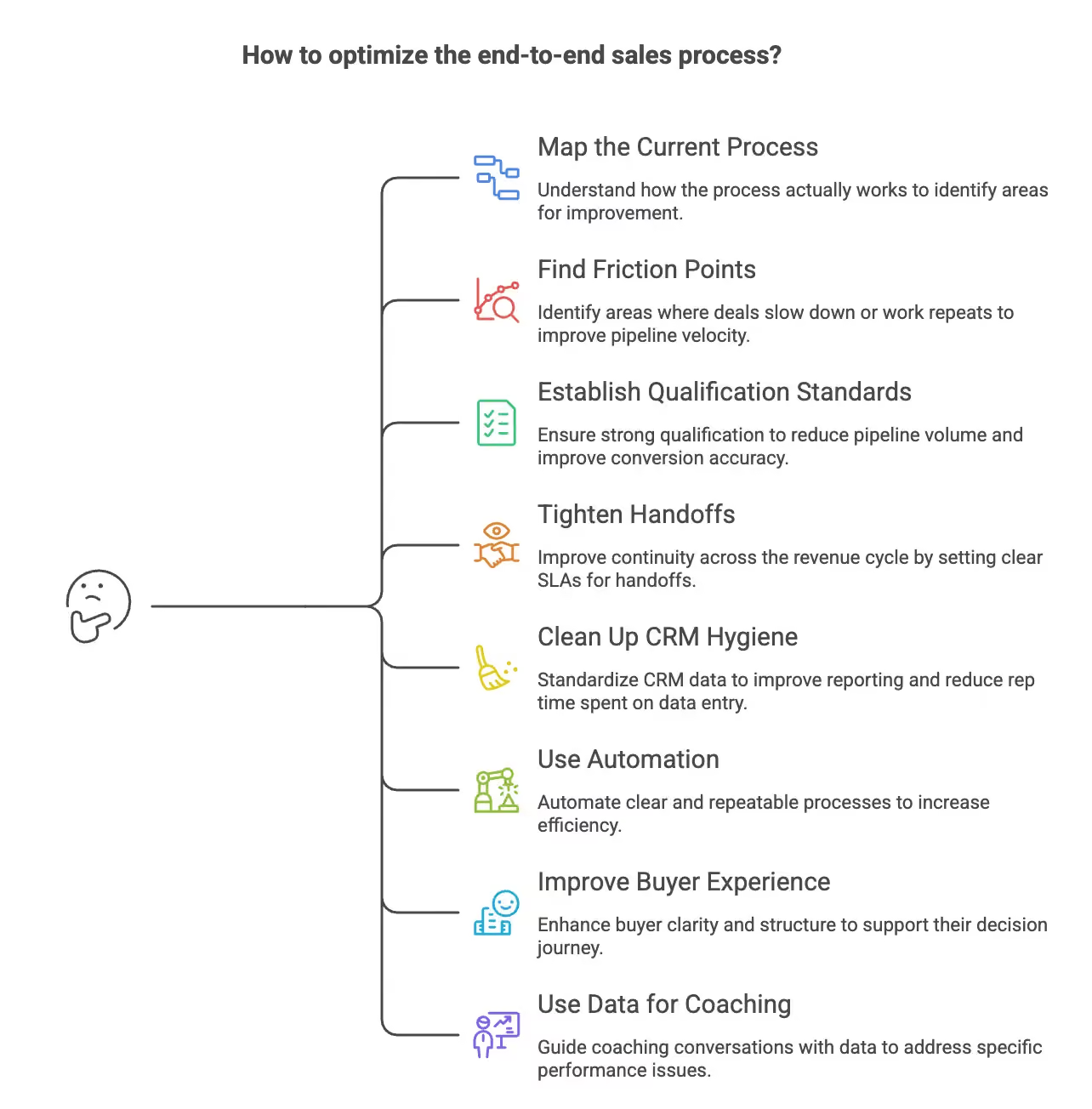
Think of this as a sequence instead of a maturity model.
The order matters. Reviewing CRM data before understanding where deals slow down produces clean data without clear insight. Start by understanding the real process, then improve the areas that most influence revenue.
Step 1: Map the Current Process as It Actually Works
Process documents describe how the workflow is expected to run. Execution during active sales cycles reflects how reps adapt the process to real-deal conditions.
Start by observing day-to-day execution. Spend time with reps, review deal history, and track the journey from lead source to routing, from SDR to AE handoff, through discovery, opportunity creation, proposal, procurement, and closed-won, with commission crediting.
The final stage often receives less attention but strongly influences trust. For each step, capture four layers
- Buyer steps: What the prospect has to do to move forward.
- Rep steps: What the seller does in CRM, email, calls, and meetings.
- System steps: What automation, routing, and notifications handle.
- Manager steps: Where approvals and deal reviews happen.
Placing these together highlights issues and missing context between stages.
Step 2: Find the Friction Points That Slow Pipeline Velocity
Focus on areas where deals slow, work repeats, or progress stalls. Here are a few metrics that point you there:
- Speed-to-lead: How quickly new qualified leads get a first touch.
- Routing accuracy: Whether the right rep owns the right account.
- Stage aging: How long deals sit in each stage before moving.
- Conversion by stage: Where opportunities drop off.
- No-show and rebook rate: Whether booked meetings turn into real conversations.
Review these together. Strong early-stage performance with weak late-stage performance often stems from challenges in buyer alignment, pricing clarity, or internal stakeholder coordination.
This approach aligns with the principles outlined in The Sales Acceleration Formula by Mark Roberge, where sales performance improves through structured measurement and systematic improvement.
Step 3: Establish Qualification Standards Early
Weak qualification increases pipeline volume, reduces conversion accuracy, and impacts forecasting reliability.
Good qualification covers ICP fit, use case fit, urgency, the buying committee, and commercial fit. Strong qualification signals include:
- Fit criteria: Is this the kind of company you actually win with?
- Intent criteria: Is there a real reason to act now, or is this research?
- Access criteria: Are you talking to someone who can create momentum?
- Value criteria: Can your solution tie to a business outcome they care about?
The objective is clarity that can be captured after meaningful discovery.
This becomes important in environments where sales territory structures include multiple stakeholder groups and account ownership models.
Step 4: Tighten Handoffs Between Marketing, SDRs, AEs, and CS
Handoffs influence continuity across the revenue cycle. Each transition carries forward context that supports the next stage of engagement.
Look at four points: marketing-qualified lead to SDR, SDR-accepted lead to AE, AE closed-won to customer success, and expansion signal from CS back to sales. Each one needs a simple SLA:
- Response SLA: How quickly the next owner has to act.
- Context SLA: What information must travel forward with the deal.
- Fallback SLA: What happens if the first owner doesn't act in time.
Fallback structure supports continuity in high-velocity pipelines. SLA design also connects to available sales capacity planning and workload distribution.
Step 5: Clean Up CRM Hygiene Without Making Reps Hate You
CRM systems perform best when aligned with how reps naturally work.
Standardize what drives real decisions. It includes stage definitions, required fields by stage, exit criteria, closed-lost reasons, and source attribution. Then prune ruthlessly:
- Remove dead fields: If no one reports on or acts on it, ask why it exists.
- Move fields to the right moment: Ask for data when the rep naturally knows it.
- Use picklists carefully: Cleaner reporting beats 47 slightly different free-text answers.
- Audit exceptions: Where reps work around the process, the process is unclear.
Data capture aligns with moments where information becomes naturally available during deal progression. Clean data is the foundation of any credible sales performance analysis, and every field you cut buys back real selling hours.
Step 6: Use Automation Where the Process Is Already Clear
Automation works best when applied to established workflows. Automate where the process is already clear and repeatable. It could be anything like lead routing, meeting scheduling, data enrichment, renewal reminders, approval workflows, commission visibility and payout status. As these are settled decisions, let software handle them.
Resist the urge to solve every gap with a new tool. If each problem spawns another point solution, RevOps slowly turns into a full-time system janitor.
When reps don't understand how a deal affects quota credit or commission, they lose time chasing answers in Slack instead of working on the pipeline. That's one place tools like a well-structured sales performance incentive fund can cut the back-and-forth by giving reps clearer visibility into what they'll earn and why.
Step 7: Improve Buyer Experience Alongside Internal Execution
Buyer progress depends on clarity and structure throughout the decision journey.
Key assets include discovery documentation, mutual action plans, digital sales rooms and procurement guides.
A strong sales enablement plan makes this repeatable instead of reinvented deal by deal. These elements support alignment across complex deal cycles involving multiple decision makers.
Step 8: Use Data to Guide Coaching Conversations
Coaching becomes more effective when supported by structured data.
The data tells you where to aim: stage conversion by rep, average stage age by rep, activity-to-meeting conversion, and win/loss reasons. Together, they show whether the problem is in pipeline creation, discovery quality, multi-threading, or follow-up discipline.
Picture two reps who both miss quota. One has a strong pipeline but weak discovery conversion. The other converts most opportunities but lacks enough qualified meetings. The outcomes look similar, but the underlying problems are different. Structured sales performance coaching starts with a clear diagnosis of where performance is breaking down across the sales process. Coaching both in the same way does not address either situation well.
Sales Process Optimization Strategies by Funnel Stage
The framework outlines the approach. The next layer is execution, broken down by each stage of the sales funnel.
- Top of Funnel: Make Prioritization and Response Faster
- Tighten intent-based routing, clean up lead scoring, set firm speed-to-lead SLAs, and make SDR ownership rules unambiguous. Watch: lead response time, connect rate, meeting booked rate, meeting held rate.
- Middle of Funnel: Improve Discovery and Opportunity Quality
- Strengthen qualification, give reps discovery templates, define clear opportunity creation rules, and set explicit exit criteria so deals can't drift forward on hope. Watch: discovery-to-opportunity conversion, stage 1 to stage 2 conversion, disqualified-reason trends, stage aging.
- Bottom of Funnel: Reduce Slips, Discounts, and Approval Chaos
- Standardize mutual action plans, build procurement checklists, set up a deal desk workflow, and define a clear sales commission policy for discount and pricing approvals. Watch: proposal-to-close conversion, average discount, slipped deal rate, sales cycle length.
Build a clean handoff to customer success, flag implementation risk early, and route expansion signals back to sales. A clearly defined CSM variable compensation structure keeps ownership of renewals unambiguous.
How to Know If Your Sales Process Optimization Is Working
Sales process optimization is validated through measurement that shows how the system performs after changes are applied.
Here are five metrics to track:
- Sales efficiency: How much revenue you create relative to sales cost.
- Pipeline velocity: How quickly a qualified pipeline moves toward revenue.
- Stage conversion: Where deals move forward or fall out.
- Rep capacity: How much time reps spend selling versus administering. Recent sales productivity statistics show this split shifting further from selling across B2B teams.
- Forecast accuracy: Whether your pipeline stages reflect reality.
RevOps gets the most from reviewing these monthly trends and running a deeper diagnostic each quarter. The monthly view catches drift early. The quarterly view tells you whether the system itself needs a redesign.
1. Build a Simple Operating Rhythm
A cadence keeps optimization from becoming a one-time cleanup that decays the moment you stop looking. Instead of one big review, run three separate ones, each at its own frequency:
- Weekly: Routing issues, SLA misses, and hot leads stuck without a next step.
- Monthly: Stage conversion, stage aging, rep adoption, and data quality.
- Quarterly: Process design, tool usage, territory changes, and compensation alignment with the strategy you're actually running.
If a metric doesn't lead to an action, then cut it.
Common Mistakes to Avoid When Optimizing the Sales Process
Sales process optimization breaks down due to specific execution choices made along the way. The patterns below show up across teams when improvements do not translate into sustained adoption or performance gains.
- When changes are designed for reporting first, reps slow down in execution: Managers gain cleaner dashboards while reps spend more time updating systems than moving deals forward.
- When automation is applied before alignment, teams follow different versions of the same process: One rep follows the intended workflow, while another adapts it differently, creating inconsistent outcomes.
- When multiple stages are redesigned together, reps lose clarity on what changed: Pipeline movement pauses as teams adjust, and previous selling patterns take longer to replace.
- When incentives reward behavior that differs from the process, reps prioritize compensation over workflow design: Activity shifts toward what gets paid, even if it does not reflect the intended sales motion. This is one of the most common mistakes in sales commission structures that undo a good process redesign.
- When CRM standards focus only on compliance, data quality drops over time: Fields get completed without context, reducing the usefulness of reports for forecasting and decision-making.
Sales Process Optimization Checklist
Use this checklist to evaluate and improve your sales process step by step. Each item focuses on a specific area of execution clarity and revenue impact.
Map the Real Buyer and Rep Journey
Document how deals actually move through the funnel in practice. Include buyer actions, rep activities, system workflows, and manager involvement to understand how the process runs today.
Identify the Top 3 Friction Points by Revenue Impact
Analyze where deals slow down or drop off. Focus on areas that directly impact revenue outcomes such as stalled stages, delayed responses, or repeated rework.
Clean Up Qualification Criteria
Define clear qualification rules based on fit, intent, access, and value. Ensure reps can apply these criteria consistently after initial discovery conversations.
Define Stage Entry and Exit Rules
Set clear conditions for when a deal enters or moves out of each pipeline stage. This helps standardize pipeline progression and improves forecast consistency.
Tighten Routing and Handoff SLAs
Establish clear ownership rules and response timelines between marketing, SDRs, AEs, and customer success. Ensure context moves with the deal at every transition.
Remove Unnecessary CRM Fields
Keep only fields that support decision-making or forecasting. Remove or simplify fields that are rarely used or do not influence deal progression.
Automate Only Clear, Repeatable Workflows
Apply automation to processes that are already standardized such as lead routing, scheduling, enrichment, approvals, and commission tracking.
Add Buyer-Facing Tools Like Mutual Action Plans
Introduce shared plans, timelines, and documentation that help buyers navigate internal approvals and decision-making processes more effectively.
Coach Reps Using Stage-Level Data
Use conversion rates, stage aging, and activity metrics to guide coaching conversations. Focus on specific gaps in pipeline execution rather than general performance feedback.
Review Metrics Monthly and Refine Quarterly
Track key performance indicators regularly to detect drift early. Use monthly reviews for operational adjustments and quarterly reviews for structural improvements.
A Process That Holds Up Under Real Pipeline Pressure
Sales process optimization focuses on reducing friction so reps, managers, and buyers always understand the next step. The work begins with identifying one high-impact bottleneck, addressing it, measuring the outcome, and then moving to the next improvement.
If incentive visibility turns out to be one of the places your reps lose time, you can book a demo to see how Everstage helps teams make commission and performance signals easier to act on.
Questions worth asking
The things most people want to know before they commit.
What is sales process optimization in simple terms?
How do you know where to start optimizing a sales process?
What metrics matter most for sales process optimization?
How does CRM impact sales process optimization?
How does Everstage support sales process optimization?