


TL;DR
- HubSpot brought CPQ, contracts, billing, and payments into Revenue Hub in June 2026. This gives existing customers a complete quote-to-cash workflow within their current CRM.
- Pricing is publicly available, with Professional and Enterprise plans offered through per-seat subscriptions. Professional plan costs about $85 to $95 per seat monthly, while Enterprise plan costs around $140.
- Payment support includes Stripe and HubSpot Payments. Data-sync integrations connect finance teams with Xero, QuickBooks, and NetSuite.
- Users value direct access to deal and customer data inside the CRM. However, complex pricing models often require higher plans or additional customization.
- Everstage is the only CPQ that shows sellers what a deal pays while they build the quote because quoting and commissions run on the same platform.
- Everstage CPQ uses Eva, Everstage's AI assistant, to generate quote drafts from CRM, call, and email context. RevOps teams configure pricing rules, approval workflows, and discount guardrails in days, while native support for ramps, tiered pricing, usage-based pricing, and multi-year agreements helps manage complex sales models.
Book a demo with Everstage Today
HubSpot Revenue Hub introduced native CPQ capabilities in June 2026, bringing quoting, contracts, billing, and payments into the same CRM that already manages customer and deal data.
For teams already using HubSpot, this reduces the need to switch between separate tools during the sales process.
The question is whether those native capabilities continue to meet your needs as pricing models and deal structures become more sophisticated. Requirements such as tiered approval chains, usage-based pricing, multi-year agreements, and ramped pricing often lead teams to evaluate dedicated CPQ platforms with deeper configuration capabilities.
This guide covers HubSpot CPQ capabilities, pricing approach, integrations, limitations, and alternatives. It also explores when a dedicated CPQ platform like Everstage can help revenue teams manage complex quoting needs while staying connected with their existing CRM workflows.
Teams comparing checkout-first quoting tools against HubSpot's native workflow may also find a Cacheflow CPQ review useful for understanding self-serve billing and buyer experience tradeoffs.
How We Sourced This Review
This review draws on HubSpot's own Revenue Hub product and pricing pages, HubSpot's June 2026 launch materials, and G2 and Capterra reviews of Commerce Hub and Revenue Hub. We focused on feature depth, integration quality, pricing transparency, and how the native tool performs against complex quoting scenarios.
What is HubSpot CPQ?
HubSpot CPQ refers to the configure, price, quote capabilities available within the HubSpot ecosystem that help sales teams create accurate quotes, manage pricing, and move deals forward from a central CRM platform.
Unlike standalone CPQ platforms, HubSpot’s native quoting approach is built around existing CRM data. Sales teams can use customer records, deal information, product catalogs, and payment workflows to create quotes connected directly to their sales pipeline.
HubSpot CPQ capabilities support common sales workflows such as:
- Creating quotes from deal records
- Managing product and pricing information
- Applying discounts and payment terms
- Sending quotes for approval
- Connecting quotes with contracts and payments
For RevOps teams managing straightforward pricing, single-level approvals, and standard product catalogs, HubSpot's native tools are often sufficient for day-to-day quoting that stays inside your deal workflow.
However, teams managing complex product configurations, multi-layer pricing models, advanced approval workflows, or usage-based contracts may need dedicated CPQ software that adds deeper configuration and revenue management capabilities.
In short: HubSpot provides a strong CRM foundation for quoting workflows, while dedicated CPQ platforms help revenue teams handle more complex pricing and selling scenarios.
How HubSpot CPQ Works
HubSpot CPQ runs inside the deal record, so quoting picks up wherever the sales conversation already is rather than starting from a blank document. Here is how a quote moves from opening a deal to a closed transaction.
- Open the deal: A rep starts on an existing deal, where the contact, company, and any associated products are already attached. That context carries straight into the quote, so there is nothing to re-enter before building it.
- Build the quote: The rep assembles the quote from what the deal already holds, adds or adjusts line items as the conversation requires, and applies the template that fits the customer. The draft stays tied to the deal the entire time.
- Send it for review: The finished quote goes to the customer as a shareable document. From there the customer can read through the terms, ask questions, and move toward a decision without the rep having to chase separate files.
- Collect signature and payment: Once the customer agrees, they sign and pay in the same flow, so approval and collection happen in one place instead of handing off to a separate tool.
- Log activity back to the deal: Every action on the quote writes back to the originating deal, which keeps the record current for the rep, the manager, and anyone downstream in finance who needs to see where the transaction stands.
HubSpot CPQ Features, a Closer Look
HubSpot CPQ capabilities help sales teams manage quoting workflows within their CRM environment. The feature set is designed around connecting customer data, products, pricing, and deal management in one workflow. Core features include:
1. Product Catalog Management
HubSpot allows teams to maintain product records with pricing details, descriptions, and billing information. Sales reps can add products directly to deals and quotes without recreating data manually.
2. Quote Creation
Sales teams can generate professional quotes using information already stored in HubSpot. Customer details, deal information, products, and pricing stay connected throughout the sales process.
3. Pricing And Discount Management
HubSpot supports basic pricing adjustments and discount workflows for teams with standard sales models. Businesses with complex pricing logic may require dedicated CPQ tools for advanced rules and controls.
4. Payment And Billing Workflows
Through HubSpot’s commerce capabilities, teams can connect quotes with payment collection workflows. This helps create a smoother path from approved quote to completed transaction.
5. CRM Data Synchronization
Since quoting happens within the HubSpot ecosystem, sales teams can access quote activity alongside contacts, companies, deals, and pipeline data.
6. Reporting And Sales Analytics
HubSpot provides visibility into sales activity, deal progress, and revenue performance. Teams can use these insights to understand pipeline movement and sales efficiency.
HubSpot CPQ Integrations
Revenue Hub connects to HubSpot Payments natively in the US, UK, and Canada. In most other Stripe-supported countries, it connects to Stripe. A July 2026 update added automated sales tax calculation and buy-now-pay-later checkout through Klarna and Affirm.
On the accounting side, HubSpot ships native data-sync apps for Xero, QuickBooks, and NetSuite, syncing invoices and payment status in both directions. Coverage varies by system. NetSuite's sync handles core ERP-grade needs, but reviewers note that mapping subscription start dates, terms, and recurring revenue into NetSuite's revenue recognition module often takes custom field mapping beyond what the native connector fully covers. Sage is the exception, running through a third party or a custom build instead of a native connector.
For teams running a second CRM alongside HubSpot, or a CPQ workflow that needs to reach tools outside HubSpot's native list, Zapier and HubSpot's open API cover the gap, and HubSpot has also added a Claude connector so revenue data can be reached directly by AI tools working outside the CRM itself.
HubSpot CPQ Pricing
HubSpot brought CPQ, contracts, billing, and payments into Revenue Hub in June 2026, giving HubSpot users a native quote-to-cash workflow inside their CRM.
Revenue Hub pricing is publicly available. New Sales Hub and Revenue Hub customers can get Revenue Hub Professional for $57 per seat/month or Enterprise for $98 per seat/month when billed annually. Standard pricing is $95 and $140 per seat/month, respectively.
HubSpot connects quoting with its CRM, while payment workflows support HubSpot Payments and Stripe. Finance teams can extend data sync through integrations with accounting platforms like QuickBooks, Xero, and NetSuite.
Users appreciate the connection between deals, customer records, and revenue workflows. However, teams with advanced pricing structures, complex approvals, and usage-based models may require deeper CPQ capabilities.
Everstage CPQ is built for deal structures that go beyond HubSpot's native quoting capabilities, including multi-year agreements, ramped pricing, usage-based pricing, and complex approval workflows. RevOps teams configure pricing rules, approval logic, and discount guardrails directly, without relying on engineering teams or lengthy implementation cycles.
Because quoting and commissions run on the same platform, Everstage is the only CPQ that shows sellers what a deal pays while they build the quote.
Is HubSpot CPQ Easy to Use?
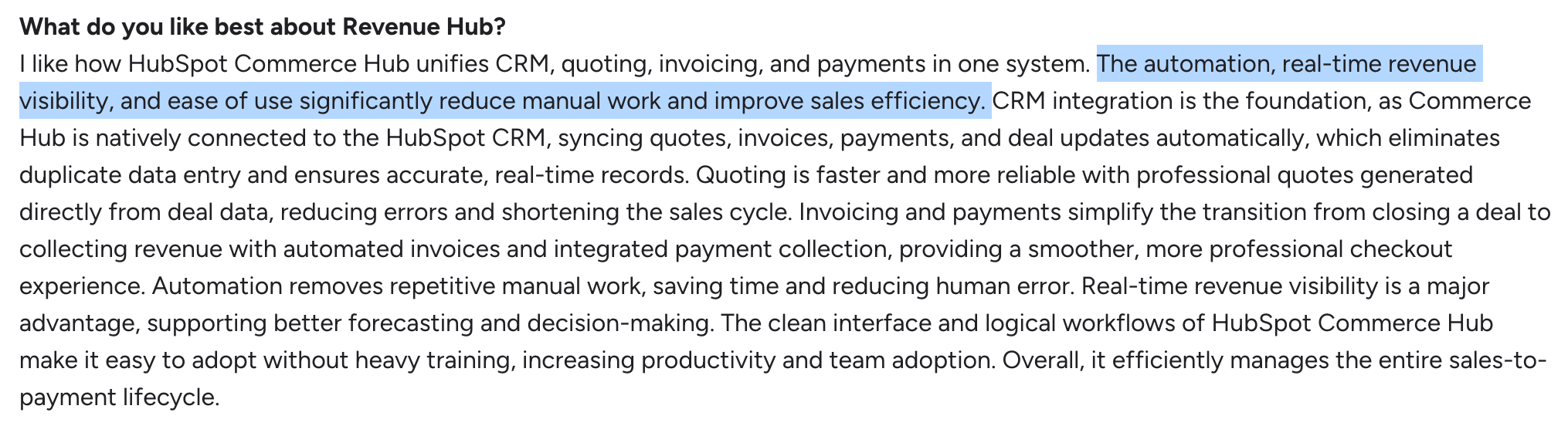
Ease of use is the most consistent theme across HubSpot Hub reviews generally, and Revenue Hub reviewers echo it specifically for quoting, crediting the tight tie to CRM data for cutting out double entry and keeping deal context in one place.
Customization is the recurring friction point. Reviewers across HubSpot's product line describe hitting a ceiling on layout, pipeline, and workflow customization at lower tiers, and several Commerce Hub and Revenue Hub reviewers specifically flag limited flexibility for complex pricing scenarios and advanced reporting gated behind Enterprise.
For a team with straightforward deals, that ceiling may never come up. For a team with tiered approval chains, usage-based pricing, or multi-entity billing, it's worth testing against your actual deal structures before committing.
Best HubSpot CPQ Alternatives
Here is how HubSpot's native CPQ compares against four other paths teams typically consider.
SolutionBuilt forConfiguration approachNotable strengthEverstage CPQTechnology and SaaS revenue teams replacing a tool they've outgrownRevOps configures pricing, approval rules, and templates directly, in daysAI drafts the first version of every quote from CRM and call context, with commission impact visible in the builder.DealHub CPQComplex, configuration-heavy B2B dealsAdmin-built rules with vendor-guided setupGuided selling and contract lifecycle management under one roofAgentforce Revenue Cloud (Salesforce)Teams standardized on Salesforce as their system of recordNative Salesforce configurationQuoting stays inside the CRM your reps already usePandaDocTeams wanting lightweight CPQ paired with document and e-signature toolsTemplate-based quote and proposal buildingFast adoption and strong document templates for smaller sales teams
Compare leading CPQ platforms based on their target users, configuration flexibility, and core strengths.
Of the four, Everstage CPQ is built specifically for the complexity reviewers say HubSpot native starts to strain under: deep approval logic, multi-year and usage-based pricing, and configuration a RevOps lead can own directly, while still connecting to HubSpot as your CRM.
Why Teams Are Evaluating Everstage CPQ
HubSpot Revenue Hub covers the core quoting workflow well for teams already running their sales process inside HubSpot. Keeping quotes, contracts, billing, and payments connected to the same CRM record is a strong advantage.
The need for a dedicated CPQ platform usually appears when revenue teams require deeper control over pricing, approvals, and complex deal structures. Native quoting relies on CRM data already stored on the deal. Everstage CPQ extends that context by using CRM records, call transcripts, and email conversations to draft quotes that reflect the full sales discussion.
If your pricing includes ramps, tiered pricing, or usage-based models, or if approvals need to route differently based on region, deal size, or business entity, native quoting workflows can become difficult to manage.
Your RevOps team configures pricing rules, discount guardrails, quote templates, and approval workflows directly. There is no need to rely on an implementation partner or lengthy implementation projects for routine changes.
Everstage CPQ also connects quoting with compensation visibility. Because it runs on the same platform as Everstage's incentive compensation management product, sellers can understand the commission impact of a deal while building the quote. This gives sales teams more visibility into deal outcomes before approval.
HubSpot remains a strong choice for teams looking for CRM-native quoting. Everstage CPQ works alongside HubSpot to add deeper configuration, complex deal support, and revenue visibility for teams that have outgrown simpler quoting workflows. It supports the journey from quote to signed deal, synced with billing systems and connected through integrations such as DocuSign for e-signature.
Where HubSpot Revenue Hub And Everstage CPQ Fit Differently
HubSpot Revenue Hub works well for teams that want quoting, contracts, billing, and payments connected within their CRM.
Everstage CPQ is designed for RevOps teams that need deeper control over pricing logic, approvals, complex deal structures, and quote creation.
HubSpot Revenue Hub vs Everstage CPQ comparison across key CPQ capabilities and workflows.
Is HubSpot CPQ Worth It?
HubSpot Revenue Hub works well for teams that want quoting, contracts, billing, and payments connected to their CRM. Its transparent pricing also makes evaluation easier compared with many CPQ platforms that require a sales conversation.
The gap appears when teams need more flexibility around complex deal structures, pricing rules, and approval workflows.
Everstage CPQ adds that depth while keeping HubSpot as the CRM. RevOps teams can manage configurations directly, use AI-assisted quote creation, and support deal models that require more control.
Book a demo to see how Everstage CPQ fits your pricing models and sales workflows.
Questions worth asking
The things most people want to know before they commit.
Is HubSpot CPQ free?
A basic quoting tool is free on any HubSpot plan. Configuration rules, smart approvals, and AI-assisted drafting require a Revenue Hub Professional or Enterprise seat, typically alongside a Sales Hub seat.
Who should consider a dedicated CPQ platform instead of HubSpot CPQ?
Companies with complex pricing rules, multiple approval layers, custom configurations, or advanced deal structures may benefit from dedicated CPQ software.
Does Everstage CPQ replace HubSpot CRM?
No. Everstage CPQ connects with HubSpot CRM, allowing teams to keep their existing CRM workflow while adding deeper quoting and configuration capabilities.
How does Everstage CPQ help RevOps teams manage pricing changes?
RevOps teams can configure pricing rules, approval logic, discount guardrails, and quote templates directly without depending on lengthy implementation cycles.
Can sales reps understand commission impact while creating quotes?
Yes. Everstage CPQ connects quoting with Everstage’s compensation platform, helping sellers understand deal impact while building quotes.
Is Everstage CPQ available today?
Yes. Everstage CPQ is built by the team behind Everstage's incentive-compensation platform, and a demo is the fastest way to see it against your own deal structures.