

TL;DR
- Revenue execution turns go-to-market strategy into the rules that govern territories, pricing, approvals, and commissions.
- It prevents rule drift when systems and spreadsheets are disconnected, slowing handoffs between teams.
- The Plan, Price, Pay framework connects what teams plan with how deals are priced and paid.
- Teams build it by giving RevOps control of policy changes, enforcing rules within deal workflows, measuring execution alongside revenue results, and feeding those results into the next planning cycle.
Get the key takeaways from this post with


In a recent survey involving 195 revenue leaders in North America, 80% said that they make revenue decisions before all the data arrives. In many cases, they do not have a complete view of the numbers at the time of the decision.
The cause usually comes down to where the rules are kept. Territory and quota plans live in one tool, while pricing rules live in another. Commission logic often sits in a spreadsheet, so a quota change or a new discount policy reaches one system weeks before the others.
Closing that drift is the job of revenue execution.
What Is Revenue Execution?
Revenue execution is the discipline of turning go-to-market strategy into the rules that plan, price and pay for revenue, then applying those rules accurately every day. Quoting and commission rules read from the same data as the plan, so every deal follows the current strategy.
Example: A mid-market rep requests a 22% discount on a three-year deal, and the segment cap is 15%. Under revenue execution, the quote automatically routes to the VP of Sales and shows the rep the adjusted commission before submission.
What Is a Revenue Execution Platform?
A revenue execution platform is a single system where quoting and commission rules share data with the sales plan. When RevOps edits a territory or a pricing rule, every quote and payout that depends on it updates from the same source.
The benefit is consistency, because a discount policy and the commission rate tied to it are read from one record. Finance and sales can then spend review meetings on strategy instead of reconciling numbers.
Why the term is showing up now
AI has handed sellers hours back, yet most teams haven’t reinvested that time into revenue. Gartner found that AI saves sellers 4.8 hours a week, while 72% of sales organizations report low reinvestment of that time in high-value work. That finding comes from a survey of 210 CSOs and senior sales leaders run in January and February 2026.
Faster tasks only help if the system around the seller is also moving faster on pricing and pay. Gartner's strategic sales imperatives for 2026 start with a unified commercial strategy, built on shared processes and shared metrics across go-to-market teams. Execution is how that unified strategy gets to each deal.
Revenue Execution vs Revenue Intelligence vs Revenue Operations
Each term answers a different question. Revenue intelligence is about what's happening in the pipeline. Revenue operations is the function that designs and runs the go-to-market engine.
The execution layer covers the rules that the engine follows on each deal. Sales execution sits one level down with the individual reps and their managers.
Revenue execution compared with related terms
A team can have accurate forecasts and a strong RevOps function but still pay a rep full commission on a deal that should not have been approved at that price. This happens when the pricing rules in the quote are not connected to the commission rules in the payout system.
You may also see the term revenue orchestration. It refers to coordinating the workflows and handoffs that move a deal through the go-to-market teams and tools. Its role is to make sure the right work reaches the right person or system at the right time.
Revenue execution is different because it governs the commercial rules within those workflows.
For example, orchestration can route a discount request for approval, while revenue execution determines what discount is allowed and how that decision affects commission.
The Revenue Execution Framework: Plan, Price, Pay
The framework treats the revenue decision as a single loop with three linked stages. Each stage passes data on to the next, and Pay feeds results back into Plan.
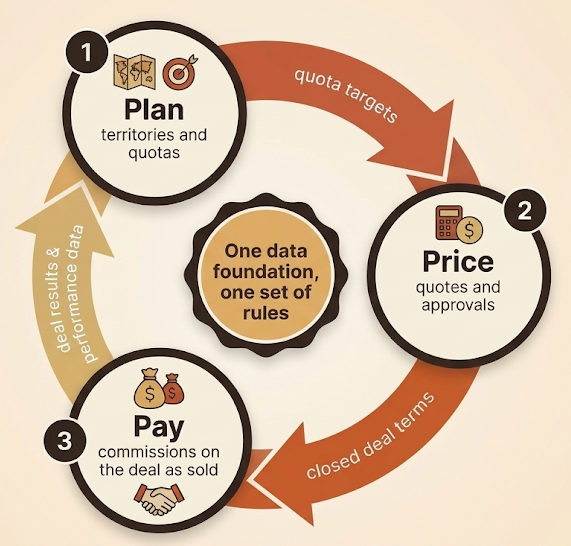
1.Plan where revenue comes from
Planning sets sales territories and quotas for the year ahead. Capacity planning then determines how many reps each segment needs and how fast new hires ramp.
Plans also change more often than annual cycles assume. According to Gartner, 66% of heads of sales struggle to adapt strategic plans to sudden change.
In a revenue execution model, quotas feed directly into comp plans, and territory assignments determine who earns credit on a deal. A mid-year change, such as a departing rep in the Northeast, then flows to quoting and commissions in the same week. Accurate sales forecasting and territory and quota planning keep capacity aligned with what you commit to.
2.Price every deal within guardrails
Pricing turns the plan into signed deals. Discount guardrails and approval routing decide which discounts a rep can offer independently and which require sign-off.
Pricing strategy most often breaks down at this stage. Simon-Kucher's Global Pricing Study, which surveyed more than 2,200 business leaders across 28 countries, found that companies realize less than half of their intended price increases on average.
Guardrails work best when they are built into the quote itself. Reps see their allowed discount range as they configure the deal, and anything above it automatically routes to the right approver.
With a CPQ system that RevOps can manage directly, teams can update pricing and approval rules without relying on a developer or ticket queue.
3.Pay on the deal as sold
Pay covers commission plans and the crediting rules that decide which rep earns credit on each deal. Accelerators and clawbacks then adjust what each rep earns as deals land or churn.
Commissions send the clearest signal of what the business values. When commission calculations rely on a separate export, a rep can earn full rate on a deal that violated the discount policy or lose credit after a territory change. Incentive compensation management that runs on the same deal data as quoting keeps every payout matched to the deal as priced and signed.
4.Close the loop
Once plans, pricing, and payouts run from shared rules, the results need to feed back into the next planning cycle. Otherwise, teams keep changing quotas and discount policies without knowing whether those changes improved revenue.
For example, raising the enterprise quota by 10% should update comp plans and capacity models in the same cycle and tightening a discount cap from 20% to 15% should change commission rules from the next quote onward.
Payout results then feed the next planning round with evidence on which territories and products produced revenue.
Where Revenue Execution Breaks
Revenue execution breaks at handoffs, most often when pricing changes wait in a queue or approvals happen outside the quote. Leaders also learn about trouble late, and 57% of them reported that they first hear about deal risk in a meeting or from a rep.
Also, 3 in 4 revenue leaders estimate, the lag between deciding and acting costs them 5% or more of revenue. This loss can show up as revenue leakage through unplanned discounts and unearned payouts.
57% of revenue leaders first hear about deal risk in a meeting or from a rep.
The vast majority of stalled revenue processes start with a workaround that was perfectly acceptable at the time. Over time, it becomes part of the way the team does things.
The four most common breakdowns:
- Rules in spreadsheets: Quota logic and rate tables live in files that one or two people fully understand. Each manual update gives the plan and the payout another chance to disagree.
- Pricing changes in ticket queues: RevOps decides to raise an approval threshold, then waits weeks for an admin or developer to ship it. Reps keep quoting on the old threshold in the meantime.
- Approvals routed around the quote: Slow approval flows push reps toward a Slack message or a verbal yes. The deal then closes on terms outside policy.
- Commissions on off-policy deals: The comp system pays full rate because the approval trail lives in another tool. The payout ends up rewarding the exact discount the pricing policy tried to prevent.
All four causes trace back to disconnected policies, so a decision made in one system reaches the others late, often after the quarter closes. The fix starts with putting those policies in one place, which the next section covers.
Register for Revenue Execution Week. Three sessions, Nov 17–19, on where 2027 plans break across pay, price and plan.
How to Build a Revenue Execution Model in 5 Steps
Building the model starts with knowing where you stand today. According to the Revenue Execution Survey, 33% of teams are manual, and 44% are partly automated. The remaining 23% are completely automated.
The five steps below move any team toward that group.
- Write strategy as rules: State each strategic choice as something a system can enforce. For example, "Protect margin" becomes a 15% discount cap on mid-market deals, with the VP of Sales approving anything above it.
- Use one data foundation: Price books and comp plans should use the same account and deal data as the sales plan. When systems keep separate copies of territory data, they drift.
- Give RevOps ownership of changes: The team responsible for pricing and compensation policy should be able to edit those policies directly. Otherwise, the strategy may have already changed by the time a developer makes the update.
- Enforce rules inside the workflow: Put guardrails in the quote and the approval request, where reps already work. Commission statements should apply the same policy, so reps see how each discount affects their pay.
- Measure execution alongside results: Track these five signals every quarter.
- Quote turnaround time
- Average discount rate
- Approval time
- Quota attainment
- Payout accuracy
Quick test: Change one discount threshold and count how many systems need a manual update. Any answer above one means your policy lives in too many places.
Run the five steps as a quarterly cycle, and let each quarter's metrics decide which rules to tighten or retire. Each review should end with a short list of rule changes and an owner for each one.
What is Real-Time Revenue Execution?
Real-time revenue execution applies pricing and commission rules while each deal is still moving, instead of reconciling them at month-end. Quotes check guardrails as reps build them, and reps see what a deal will earn before it closes.
AI is moving from reporting on work to helping teams complete it. By Gartner's estimate, 40% of enterprise applications will feature task-specific AI agents by the end of 2026, up from less than 5% in 2025. Revenue teams gain more when AI works inside their pricing and commission policies than when it adds another dashboard.
Eva, Everstage's AI teammate, follows this approach. Revenue teams delegate work to it in plain language, and it works within the same pricing and commission rules as the rest of the team. Teams also use Eva to automate recurring end-to-end tasks, such as weekly summaries of deals nearing close.
How Everstage Runs Revenue Execution
Everstage is a revenue execution platform built on one data foundation and one set of rules. Its three products cover the Plan, Price, and Pay stages of the revenue execution loop.
Plan: Everstage Planning models territories and capacity, then pushes finalized quotas straight to payees. Any mid-quarter change to the plan carries through to the comp plans built on it.
Price: With Everstage CPQ, RevOps can update pricing and approval rules without relying on a developer or ticket queue. A new discount policy can be live the same day it's decided. Deal intelligence drawn from past deal data guides rep strategy by showing which terms and discount levels tend to win in a given segment.
Approval rules live inside the quote, so every off-policy request reaches the right approver. Deals then close in a Deal Room with native e-signature, which keeps the signed version identical to the approved one.
Pay: Everstage Incentives calculates commissions from the same deal data. Credit and accelerators apply to the deal as priced and signed, keeping payouts tied to the approved terms.
CRM integrations: Everstage is CRM-agnostic and offers pre-built two-way sync with Salesforce and HubSpot. Opportunity and account data flows in, and quote and deal data flows back.
A RevOps team can then trace any payout back to the quote and territory behind it. Audit questions and rep disputes start from a single record.
Download the Revenue Execution 2026 report. See how 195 VP+ revenue leaders in North America plan, price and pay, and where their decisions stall.
Turn Revenue Strategy Into Execution
A go-to-market strategy pays off once it shows up in the quota a rep carries and the commission that rep is paid. The Plan, Price, Pay loop gives that strategy a structure RevOps can run every day.
When plans, pricing, and pay live in separate tools, the rules drift apart, and leaders end up deciding before the data arrives. A single platform with shared deal data keeps every stage consistent, so a strategy change reaches each new quote on the day it's made.
Questions worth asking
The things most people want to know before they commit.
Who owns revenue execution in a company?
RevOps usually owns revenue execution day to day, since that team maintains the pricing and commission rules. The CRO owns the outcomes, and finance co-owns margin and payout accuracy. Deal desk and sales comp leads run their parts of the loop within those shared rules.
Does a revenue execution platform replace your CRM?
It works alongside your CRM, which stays the system of record for accounts and pipeline. A revenue execution platform runs the deal rules on top of that data, covering quotes and commissions. Everstage, for example, is CRM-agnostic and offers pre-built two-way sync with Salesforce and HubSpot.
Can you run revenue execution in spreadsheets?
Spreadsheets work for a small team with one segment and a simple comp plan. Once you add approval tiers and more segments, versions multiply, and every change needs manual reconciliation. Errors then surface in payouts, often weeks after the deal closed.
Also Read: Reasons to stop using Spreadsheets for Commissions
What tools make up a revenue execution stack?
The core stack pairs a CRM with one tool for each stage of the loop.
- Territory and quota planning
- CPQ with approvals and e-signature
- Incentive compensation management
Forecasting and revenue intelligence often run alongside them. The deciding factor is whether the three-stage tools share one set of rules and data.
What is the difference between revenue coordination and revenue execution?
Revenue coordination aligns teams through meetings and shared goals. Execution turns those agreements into rules that apply to every deal. Coordination depends on people recalling what was agreed, while execution builds it into the quote and the commission statement.
How does revenue execution relate to sales performance management (SPM)?
Sales performance management covers planning and incentive compensation, which map to the Plan and Pay stages. Adding the Price stage gives you full revenue execution, with one set of rules governing how deals are quoted and paid.