

.avif)
TL;DR
CPQ trends in 2026 reflect a shift from basic quote automation to structured revenue governance, where pricing, approvals, and forecasting are tightly controlled from the start.
- Modern CPQ platforms now enforce pricing discipline and margin protection, not just faster quote creation
- Hybrid selling and subscription complexity demand a flexible, workflow-driven configuration
- AI is emerging as an assistive layer, guiding reps without replacing governance
- Revenue teams use CPQ as a control layer to improve forecasting accuracy and reduce downstream friction
When a deal closes with thin margins, finance flags discounting, RevOps questions approvals, and the sales team just wants the quote out faster.
That tension is exactly why CPQ (configure price quote) trends are being actively searched right now.
As subscription models grow, hybrid selling expands, and pricing strategies become more layered, quoting is simply about control. Margin pressure, rising pricing exceptions, and forecasting gaps are forcing companies to rethink how deals are structured before they’re signed.
And because B2B buyers are increasingly digital-first, quoting has to behave like a governed system. McKinsey found that 71% of B2B sellers offer e-commerce, and online sales already drive 34% of revenue.
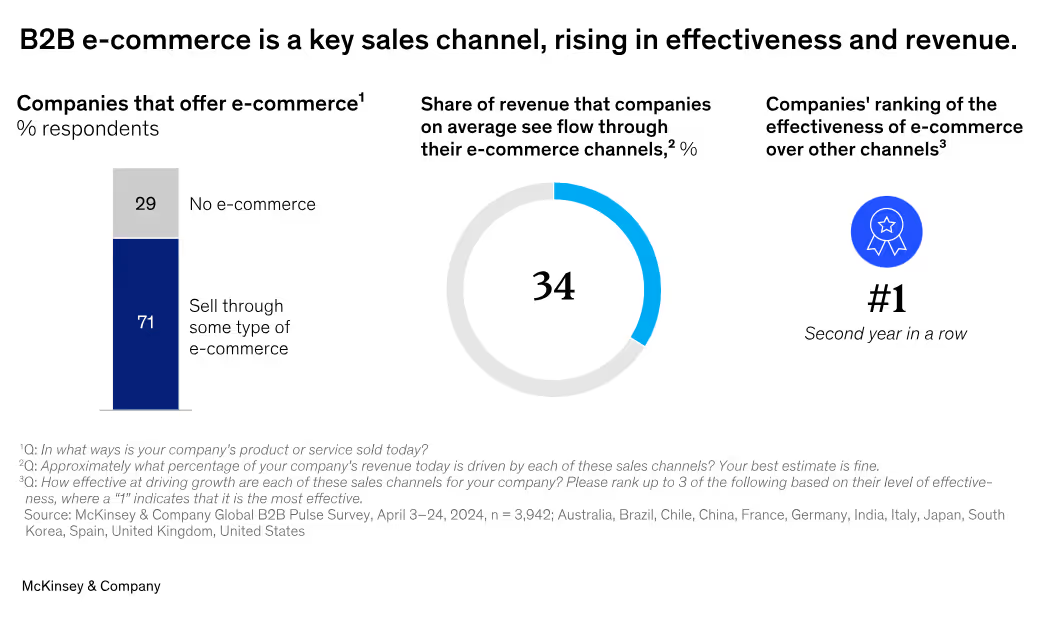
Image Source: McKinsey B2B Pulse Survey
Importantly, the latest CPQ trends reflect structural shifts in revenue operations: organizations are moving from quote acceleration to revenue control, often through advanced AI-powered CPQ solutions from various providers. CPQ is evolving into a governance layer that structures deals before they create downstream chaos.
To understand where this shift is headed, we first need to examine how CPQ itself is evolving beyond simple quote generation.
How CPQ Is Evolving Beyond Quote Generation
.avif)
Early CPQ software systems were often on-premise, built for speed with a simple primary goal: help reps configure products correctly and generate quotes faster. And in simpler sales environments, that was enough. If quotes went out quickly and errors were reduced, the system was considered successful.
But selling today isn’t simple anymore, and neither is pricing.
As product catalogs expand, subscription and usage-based models grow, and enterprise deals involve layered approvals, cloud-based CPQ has quietly evolved from a quote automation engine to a deal governance system.
Here’s how that evolution is showing up in modern revenue teams:
- From speed to structure: Early CPQ tools focused on reducing manual effort. Modern platforms prioritize guided configuration, ensuring reps build deals within predefined commercial guardrails.
- From rep-led discounting to governed pricing: Instead of relying on manual approvals after a quote is created, CPQ increasingly embeds pricing thresholds, approval logic, and margin protections directly into the workflow.
- From fragmented data to forecastable revenue: Structured quoting produces cleaner pipeline data, which improves forecasting accuracy and gives finance and RevOps greater confidence in projected revenue.
- From downstream correction to upstream enforcement: Rather than fixing pricing errors during billing or revenue recognition, CPQ enforces rules earlier in the sales cycle, before bad data spreads across systems.
It’s important to clarify what CPQ is not becoming. It doesn’t replace billing systems, ERP systems, or finance tools. Instead, it strengthens them by ensuring that the deal is structured correctly before it moves downstream.
When pricing logic, product configuration, and approval workflows are standardized at the quoting stage, revenue operations become more predictable and less reactive.
In short, CPQ has expanded from helping sales move faster to helping revenue teams operate smarter, streamlining sales processes.
This structural shift sets the stage for the specific CPQ trends now redefining how modern sales organizations structure, govern, and scale their deals, shaping the future of CPQ.
Key CPQ Trends Shaping the Future of Sales
CPQ trends reflect how revenue teams are restructuring control, visibility, and accountability inside the quoting process. Below, we break down the most important shifts shaping modern sales environments and what they signal for growing businesses.
Simplified Yet Structured Product Configuration
As complex product portfolios expand, configuration complexity rises with them. For instance, bundles grow, add-ons multiply, and regional variations emerge. And suddenly, reps are juggling spreadsheets, tribal knowledge, and Slack threads just to build a viable quote.
The trend is toward simplified flows with stronger structure underneath. Modern CPQ platforms are introducing guided selling logic that:
- Walk reps through configuration steps instead of relying on memory
- Recommend compatible add-ons or bundles automatically
- Block incompatible product combinations using rule-based logic
- Reduce reliance on manual checks or back-and-forth with product teams
This rule-based configuration prevents invalid product pairings before they reach the customer. Instead of catching errors during legal review or implementation, they’re prevented at the source, resulting in fewer late-stage deal revisions, less rework, and faster cycle times without sacrificing structural control.
Configuration becomes easier for reps but more disciplined for the business.
Hybrid Selling Requires Flexible CPQ Workflows
Sales is no longer confined to a single motion, because organizations now operate across:
- Direct sales teams
- Channel and partner networks
- Self-service or product-led growth environments
That makes pricing governance exponentially more complex. When different channels operate independently, pricing inconsistencies and margin leakage quickly follow.
One of the most important CPQ trends is the move toward centralized pricing logic with flexible execution layers.
Modern CPQ workflows now:
- Maintain consistent pricing guardrails across direct and partner channels
- Support distributed selling environments with role-based access
- Adapt approval paths based on channel type or deal origin
- Enable centralized governance without slowing local execution
Hybrid selling models require structured control behind the scenes, but enough flexibility at the front lines so sales teams can move confidently. CPQ is increasingly becoming the mechanism that balances both.
Governed Pricing Is Replacing Rep-Led Discounting
As margin pressure increases, CFO scrutiny around discounting practices has intensified. Rep-led pricing decisions, once considered part of “sales flexibility,” are now seen as forecasting risks. That is why another major CPQ trend is the rise of rule-based pricing enforcement. You can see the shift in how fast CPQ is scaling.
Mordor Intelligence estimates the CPQ market at $3.63B in 2026, reaching $7.55B by 2031 (15.74% CAGR), as more companies standardize pricing and deal controls.
Instead of allowing discretionary discounting, modern systems:
- Automatically adjust pricing ranges based on deal size or segment
- Tie discount thresholds to customer type or contract length
- Trigger approvals only when predefined guardrails are exceeded
- Enforce minimum margin protections directly in the quote
This reduces variability in pricing outcomes and improves forecasting reliability, leading to better pricing optimization. Revenue teams gain cleaner data, finance teams gain predictability, and sales teams gain clarity on what’s permissible before submitting a quote.
Embedded Approvals Inside the Quoting Flow
Traditional approval processes often live outside CPQ in email threads or disconnected workflows. That fragmentation creates delays, miscommunication, and audit gaps.
Modern CPQ trends show approvals becoming fully integrated within the quoting experience itself. Today’s systems increasingly:
- Route deals automatically based on risk factors
- Trigger conditional approvals for specific discount thresholds
- Provide real-time visibility into approval status
- Notify stakeholders directly within the platform
By embedding approvals directly into the quoting flow, risk control shifts earlier in the deal lifecycle. Instead of escalating issues after a contract is drafted, governance happens at the moment pricing decisions are made. That shift reduces friction while also strengthening oversight.
Subscription and Usage-Based Pricing Complexity
The rise of subscription and usage-based models, particularly prevalent in SaaS, has introduced ongoing pricing complexity that static quote structures simply can’t handle. Recurring revenue models bring new challenges:
- Renewals and mid-term amendments
- Proration across billing cycles
- Multi-term contracts with varied pricing tiers
- Usage-based thresholds that shift over time
Modern CPQ systems are evolving through continuous advancements to support this lifecycle complexity, essentially going beyond the initial quote to facilitate renewals and upsell opportunities.
Increasingly, platforms support:
- Structured renewals and expansion logic
- Automated proration calculations
- Multi-term contract modeling
- Pricing continuity across amendments
This lifecycle continuity is becoming essential for revenue predictability and optimization. Without structured logic, recurring pricing quickly becomes fragmented, and forecasting suffers.
AI as an Assistive Layer in CPQ Workflows
AI (artificial intelligence) is entering CPQ, leveraging sophisticated algorithms, but not as a replacement for governance logic. Instead, the role of AI in CPQ is emerging as an assistive layer that enhances decision-making while operating within predefined rules.
That momentum is part of a broader CPQ adoption wave, particularly within B2B sales. Overall, AI adoption has jumped to 72%, according to McKinsey, which is accelerating expectations for AI-assisted workflows across revenue teams.
Modern CPQ systems are using AI-driven capabilities to:
- Suggest pricing ranges based on historical deal patterns
- Recommend product configurations with a higher close probability
- Flag unusual discounting behavior
- Surface risk indicators tied to margin deviation
Importantly, AI augments rule-based enforcement instead of overriding it. Governance controls still define permissible structures. AI simply helps reps make smarter decisions within those boundaries.
This balance, often powered by machine learning, ensures intelligence without sacrificing control, ultimately enhancing customer satisfaction, understanding customer behavior, and improving the customer experience.
Quotes as Revenue-Ready, Structured Data
In the past, a quote was often treated as a document, like a PDF sent to the customer and archived. Now, one of the most significant CPQ trends is treating quotes as structured data assets.
Modern CPQ platforms output standardized deal structures that:
- Feed clean data into downstream finance systems
- Reduce revenue recognition corrections
- Improve forecasting reliability
- Support financial planning visibility
When quote data is standardized at creation, downstream reconciliation shrinks, revenue becomes more predictable, and cross-functional trust improves. This means that quotes stop being static files and become structured revenue inputs instead.
This push toward structured, system-ready data matches how teams are adopting AI, too. Gartner found 34% of respondents primarily use GenAI embedded in existing applications, reinforcing the need for quote data that’s clean enough to flow across tools without manual cleanup.
CPQ as a Revenue Stack Control Layer
Finally, CPQ is increasingly positioned as a governance layer within the broader revenue ecosystem. It now sits between CRM systems, such as Salesforce (where opportunities are tracked) and finance platforms (where revenue is recognized). That placement matters.
Revenue governance is shifting upstream into the quoting process, where:
- Pricing logic is enforced before contracts are signed
- Configuration rules prevent implementation risk
- Approval workflows document decision accountability
- Margin protection happens before revenue hits forecasts
Instead of correcting errors downstream in billing or accounting, businesses are preventing them upstream.
Taken together, these CPQ trends reflect a broader shift toward accountability in revenue operations. And for growing businesses, understanding which of these shifts are urgent, and which can wait, is the next critical step.
What These CPQ Trends Signal for Growing Businesses
.avif)
CPQ trends are signals that complexity is increasing, operational maturity is rising, and that revenue governance can no longer be informal.
If your deals are getting more layered, your pricing is more variable, or your approvals are more frequent, especially in complex sales scenarios, that’s not random noise. It’s structural growth pressure.
Here’s what these trends typically indicate:
- Increasing complexity demands structured configuration and pricing: As product lines expand and bundles multiply, spreadsheet-based quoting starts to break down. What once worked for a 5-product catalog won’t scale to 50 variations across segments.
- Scaling requires standardization: When headcount grows, and new regions or partners are added, informal pricing practices create inconsistency. Standardized configuration and governed pricing become essential to maintain alignment.
- Margin pressure elevates pricing governance: As finance teams focus more on profitability, uncontrolled discounting becomes harder to justify. Structured pricing is about protecting sustainable growth.
- Multi-channel selling requires unified control: Direct sales, partners, and self-serve models can’t operate on different pricing logic without creating channel conflict and forecasting gaps. Unified governance becomes strategic, not optional.
- Operational maturity is increasing: When companies start prioritizing audit trails, approval documentation, and clean forecasting inputs, it’s a sign they’re moving into a more disciplined revenue stage.
In short, CPQ trends often surface at the exact moment a business transitions from scrappy growth to scalable growth, emphasizing the need for scalability.
Businesses Likely to Feel These Trends First
Not every organization feels CPQ strain at the same time, but complexity accelerates it quickly.
If you manage a growing multi-product portfolio, configuration pressure builds fast. As bundles, add-ons, and regional variations increase, reps spend more time validating combinations and less time selling. What once felt manageable starts producing errors and rework.
In fact, subscription-heavy or usage-driven businesses feel it even sooner. Renewals, amendments, proration, and multi-term contracts introduce lifecycle pricing complexity that manual processes struggle to sustain.
Frequent pricing exceptions are another clear signal. When discount approvals are common and margin outcomes vary widely, governance gaps are already affecting predictability. And if you sell across direct, partner, and digital channels, inconsistent pricing logic can create internal friction and channel conflict.
In each of these scenarios, the issue isn’t speed, but structure. That’s when CPQ trends move from optional improvement to operational necessity.
When CPQ Trends May Not Be Urgent
That said, not every company needs advanced CPQ governance immediately. In some environments, flexibility still outweighs structure. For example:
- Simple pricing models with limited SKUs and flat-rate pricing don’t require complex rule engines.
- Low deal variance reduces the need for guided configuration. If most deals follow the same structure, manual quoting may still be manageable.
- Minimal approval layers lower operational friction. If discounting is rare and pricing is standardized, embedded workflows may not add immediate value.
- Early-stage organizations often prioritize experimentation and adaptability over strict enforcement. In these cases, too much structure too early can slow learning cycles.
The key takeaway isn’t that every business must adopt every CPQ trend immediately; rather, it's about aligning these trends with specific business needs. It’s understanding where you sit on the complexity curve, and recognizing when operational strain signals it’s time to move from flexibility toward governance.
From here, the final step is pulling these insights together and clarifying what they mean for the future of quoting, pricing, and revenue control.
Conclusion
Modern CPQ trends make one thing clear: quoting can no longer operate as a loosely managed sales activity.
As subscription models expand, hybrid selling becomes standard, and pricing variability increases, revenue teams need structured configuration, governed pricing, and embedded controls built directly into the deal flow.
Everstage CPQ helps revenue teams move beyond quote automation to structured deal governance. With guided configuration, rule-based pricing enforcement, embedded approval workflows, and clean, revenue-ready data flowing into your reporting systems, you gain visibility and control without slowing your sales team down.
Instead of reacting to pricing exceptions and margin surprises, you build a quoting engine designed for scalable, predictable growth.
If you’re ready to see how structured CPQ can strengthen your revenue operations, book a demo with Everstage and explore how your quoting process can evolve from reactive to revenue-ready.
Questions worth asking
The things most people want to know before they commit.
What are the latest CPQ trends in 2026?
The latest CPQ trends in 2026 focus on moving from simple quote automation to structured revenue governance. This includes rule-based pricing enforcement, guided product configuration, embedded approvals, AI-assisted deal recommendations, and stronger integration between CRM and finance systems. The emphasis is no longer just speed; it’s margin control, forecasting accuracy, and operational consistency.
How is modern CPQ different from traditional quote automation tools?
Traditional CPQ tools primarily helped reps generate quotes faster and reduce manual errors. Modern CPQ platforms go further by enforcing pricing guardrails, automating approval workflows, standardizing configuration logic, and producing revenue-ready data. They function as governance systems embedded within the sales cycle, not just document generators.
Why is pricing governance becoming more important in CPQ?
Margin pressure, discount variability, and forecasting challenges are increasing scrutiny on how deals are structured. Pricing governance ensures that discounts, bundles, and contract terms follow predefined rules, reducing margin leakage and improving predictability. Instead of correcting pricing issues downstream, modern CPQ systems prevent them upstream.
How do subscription and usage-based models impact CPQ complexity?
Subscription and usage-based pricing introduce lifecycle complexity, including renewals, amendments, proration, and multi-term contracts. Without structured automation, managing these changes manually becomes error-prone and inconsistent. Modern CPQ trends reflect the need for systems that support the full contract lifecycle, not just the initial quote.
Does AI replace pricing rules in CPQ systems?
No. AI in CPQ typically acts as an assistive layer rather than a replacement for governance logic. It may suggest optimal pricing ranges, highlight unusual discounts, or recommend configurations based on historical data. However, rule-based controls still define permissible pricing boundaries and approval thresholds.
When should a growing business invest in advanced CPQ governance?
Businesses should consider structured CPQ governance when deal complexity increases, pricing exceptions become frequent, multiple sales channels operate simultaneously, or forecasting accuracy begins to suffer. If quoting feels reactive or inconsistent, it’s often a signal that operational maturity has outgrown informal processes.