


TL;DR
- Tiered commission structures increase payout rates as reps achieve higher performance levels.
- Cumulative and incremental calculations significantly change final commission outcomes.
- Clear tier design depends on realistic quotas and well-defined performance bands.
- Proper cost modeling prevents unexpected payout spikes at higher attainment levels.
- Everstage helps teams operationalize tiered commission logic without manual calculation errors.
As a business grows, so does its product portfolio, and so do its selling motions. The straightforward path to quota that worked at 20 reps gets more nuanced at 100. That usually means a more complex comp plan, and tiered commission structures are often where that complexity first shows up.
The concept is simple enough: pay reps more as they sell more. The execution is where most teams find it challenging. Tier bands get picked arbitrarily instead of being grounded in real pipeline data, and almost nobody decides upfront whether tiers should be calculated cumulatively or incrementally, a choice that changes what reps actually get paid.
At the end of this guide, you will also receive a practical template to help you structure a tiered commission plan step by step, so you can apply the framework directly.
What is a tiered commission structure?
A tiered commission structure is a sales commission plan that offers different rates for different performance levels. Higher performance levels earn higher commission rates.
This structure is designed to motivate salespeople at every stage of a financial period and throughout the sales cycle by increasing their commission rates as they close more deals.
A tiered commission structure can be used in conjunction with a base salary or on its own for commission-only reps.
Why Tiered Commission Structures Work
A flat commission rate treats a rep who's at 60% of quota the same as one at 140%. That's not motivating once a rep has already secured most of their commission for the period.
Tiered structures fix this by raising the rate as attainment climbs, so the push to close one more deal in the final week of the quarter is worth more than the same deal would've been worth in week one.
This works alongside sales accelerators, which are the specific mechanism that makes tiering effective. The accelerator is the jump in rate. The tier is the threshold that triggers it.
Simple Cumulative vs. Incremental Cumulative Tiers
This is the part that actually determines what a rep gets paid.
There are two ways to calculate a tiered commission, and they produce different numbers for the exact same sale.
Simple cumulative tiers apply one rate to the entire amount once a rep crosses into a tier. If a rep hits the 100-125% tier, the higher rate applies to all their sales for the period, not just to the portion above 100%.
Incremental cumulative tiers apply each rate only to revenue within that specific band. The amount below the threshold is paid at the lower rate, and only the amount above it is paid at the higher rate.
Here's the difference, using a rep with a $100K monthly quota:
1. Simple cumulative calculation:
The rep moves into the 100–125% tier, which carries a 12% rate. In this model, the 12% rate applies to the entire $130,000.
Total commission = $130,000 × 12% = $15,600
2. Incremental cumulative calculation:
Each portion of revenue is paid at the rate of its respective tier.
The same rep with the same sales number receives a $1,850 difference in commission. This difference increases as deal sizes grow, which is why this decision needs to be defined and documented before the plan goes live.
Incremental cumulative tiers are widely used across B2B SaaS teams and are viewed as a more defensible structure because they avoid a cliff effect where a small increase in revenue results in a large jump in total commission.
Simple cumulative tiers fit well in short, high-velocity sales cycles where simplicity takes priority over precision, though they also make commission expense harder to forecast.
For the underlying formulas this builds on, see our guide on how to calculate sales commissions.
What to Include in a Tiered Commission Structure Template
Every tiered plan needs the same core fields, regardless of role or company size.
- Plan name and role Be specific. Plan name and role should clearly identify what the document covers and who it applies to, so there is no ambiguity when teams reference it across planning, approvals, or payouts.
- Base quota This is the number of tier bands that are measured against. If this isn't credible, nothing built on top of it matters.
- Number of tiers Most effective plans use 3 to 4 tiers. More than that, reps stop tracking which band they're in.
- Tier bands and rates The attainment range for each tier, paired with its commission rate.
- Calculation method Whether it is cumulative or incremental. It is always best to decide and write it down.
- Payout timing When commission is actually earned and paid, consistent with the rest of the comp plan.
- Cap or uncapped Whether there's a ceiling on what a rep can earn, or whether the top tier continues indefinitely. See our breakdown of commission caps and uncapped commissions to understand the trade-offs of each.
How to Build a Tiered Commission Structure, Step by Step
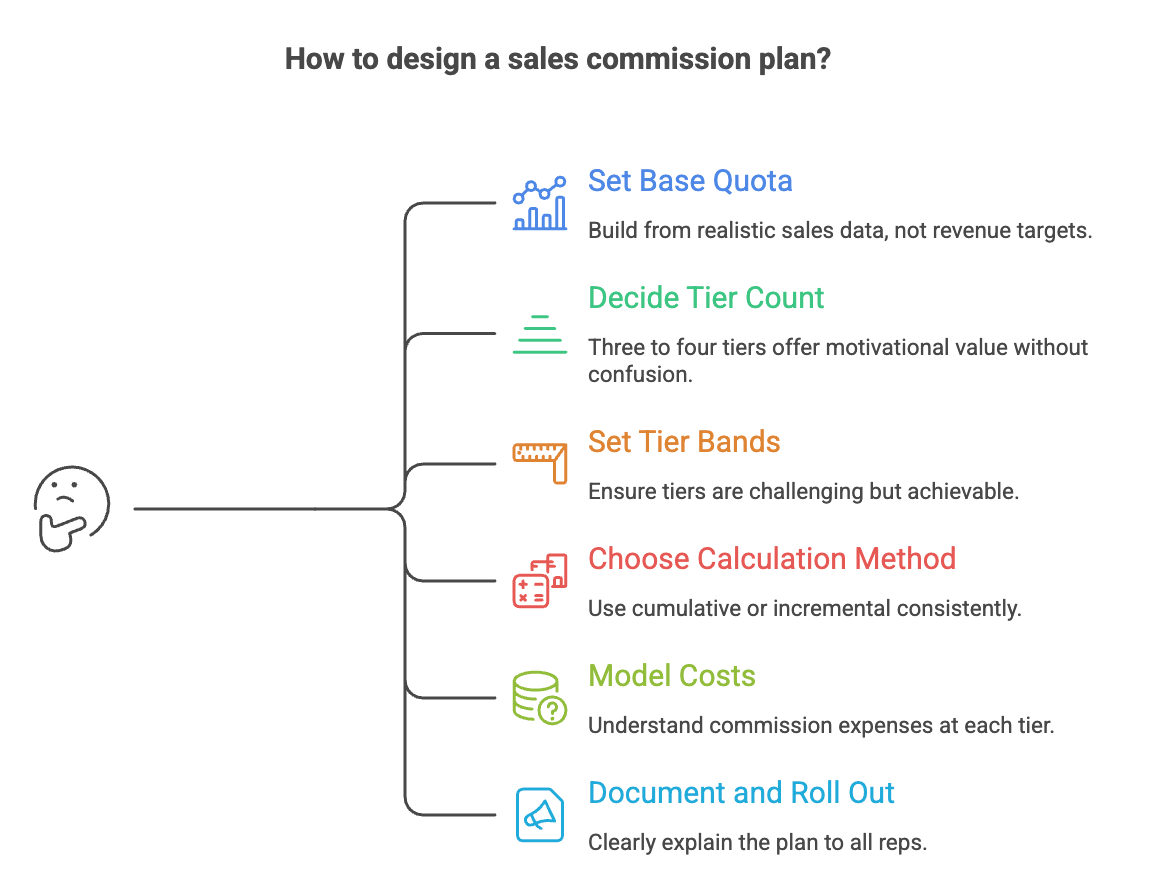
Step 1: Set the base quota.
Build it from realistic sales quota planning, such as historical attainment, pipeline coverage, and win rate.
Step 2: Decide how many tiers
Three to four tiers is the sweet spot. A common structure looks like 0-50%, 50-100%, 100-125%, and 125%+. More tiers than this rarely add motivational value and mostly add confusion.
Step 3: Set tier bands and rates
Define tier bands that align with realistic performance distribution and motivate incremental improvement across quota attainment levels. Each tier should clearly signal progression and support predictable behavior change in selling activity.
Step 4: Choose the calculation method
Select either cumulative or incremental calculation based on how you want commissions to accrue across tiers. Document the chosen method clearly in the plan and apply it uniformly across all reps to ensure consistent payout logic and interpretation.
Step 5: Model the cost at every tier, including the top one
Build financial scenarios across all tiers to understand total commission exposure under different attainment outcomes. Include mid-tier and top-tier performance cases to support accurate budgeting and planning.
Step 6: Document and roll out the plan
Convert the tier structure and calculation logic into clear, easy-to-interpret written documentation. Ensure every rep understands how earnings are calculated before the plan begins so expectations remain consistent across the team.
Tier Worksheet: Fill-In Template
Use this template to structure a tiered commission plan in a way that is clear, consistent, and ready for Finance, RevOps, and Sales alignment.
Complete this template before plan launch to ensure consistency in interpretation, payout logic, and financial modeling across all stakeholders.
Tiered Commission Examples by Role
These are illustrative starting points. Model the actual cost and behavior against your own numbers before using any of these as-is.
Example 1: Account Executive
Calculation method: Incremental cumulative.
At an $800K annual quota, this gives an AE a meaningful rate increase right when most reps start coasting once their quota feels secure.
Example 2: SDR
SDR tiers usually work better tied to a per-unit rate than a percentage of revenue, since SDRs influence pipeline, not closed deals.
This connects to the broader structure outlined in our guide to SDR variable compensation.
Example 3: CSM / Expansion
Tiering the expansion commission this way rewards CSMs for growing accounts without losing sight of the fact that renewal quality should be prioritized.
See our full breakdown of CSM variable compensation for how this fits into a broader plan.
Common Mistakes to Avoid
Tiered commission structures work well when the design is clear and consistent, but a few common mistakes often reduce their effectiveness in practice.
- Too many tiers: Past 4 tiers, reps stop tracking which band they're in, and the plan stops functioning as a motivator.
- Tier bands are too close together: If a rep crosses from one tier to the next without realizing it, the tier isn't doing its job.
- Switching calculation methods mid-period: Changing from cumulative to incremental (or vice versa) after the period has started invalidates all previously calculated commissions.
- Not modeling the cost at the top tier: If three reps blow past the highest tier in the same quarter, Finance needs to have already seen that number, not discovered it on the payout run.
- Building tiers on a quota that isn't credible: No amount of tier design fixes a quota that was never achievable in the first place.
For a deeper look at how these errors compound, see our guide to sales commission structure mistakes.
Designing Tiered Commission Plans That Drive Performance Without Payout Surprises
A tiered commission structure only works if the underlying math is consistent and the reps trust how it's calculated. The biggest source of disputes is an undocumented or inconsistently applied calculation method.
Get the base quota right, choose cumulative or incremental and stick to it, and model the cost before the plan goes live. From there, the structure does what it's meant to do: reward overperformance without surprising anyone with the payout.
For more starting points across commission models, see our full library of commission plan templates.
When tiered calculations start outgrowing a spreadsheet, book a demo to see how Everstage handles tier logic, accelerators, and payouts without manual formulas.
Questions worth asking
The things most people want to know before they commit.
When should a company switch from flat to tiered commissions?
Do tiered commissions work better for all sales roles?
Can tiered commission plans change mid-year?
What causes confusion in tiered commission payouts?
How do companies manage tiered plans at scale?