

.avif)
TL;DR
- Sales productivity climbs when teams protect selling time and automate commission tracking. Real-time visibility into quota progress and payouts keeps reps focused.
- Cut spreadsheet work and CRM friction so reps spend more time selling.
- Align sales and RevOps around shared productivity metrics and clean lead handoffs.
- Track KPIs like win rate and pipeline velocity instead of raw activity counts.
- Coach consistently and use incentive visibility to keep reps motivated and focused on the right deals.
If your reps spend more time updating spreadsheets and chasing approvals than talking to customers, you have plenty of company. According to Salesforce's 2024 State of Sales Report, sales reps spend nearly 70% of their time on non-selling tasks.
That lost time does more than slow pipeline. It drains motivation and weakens forecast accuracy. Strong productivity strategies help reps focus on the right opportunities and reduce manual work. They also show reps how their actions connect to goals and incentives.
This guide shows how to measure sales productivity and benchmark against key sales metrics. You'll learn to diagnose blockers like tool overload and low lead quality. The same pages cover strategies to automate repetitive work and optimize your CRM. Better coaching also helps new hires ramp faster.
What Is Sales Productivity?
Sales productivity measures how effectively a sales team converts time and effort into measurable results such as revenue or qualified pipeline. Productivity goes beyond saving time. It directs rep effort toward behaviors that generate profitable revenue. Incentives rank among the strongest tools leaders use to shape those behaviors.
A productive sales team spends most of its day on selling activities like discovery calls and demos, keeping manual updates to a minimum. According to Salesforce's 2024 State of Sales Report, sales reps spend only about 30% of their time selling, with the rest taken up by administrative work and internal coordination.
This time imbalance highlights how process design and tool choice directly affect productivity.
In short, sales productivity shows whether your team's energy goes where it matters most. It is the foundation for improving sales performance and scaling consistent results.
Sales Productivity vs. Sales Efficiency vs. Sales Effectiveness
Teams use these three terms interchangeably, though each describes something different:
- Sales productivity: The output a team generates from the time and effort it puts in. Focused on doing more of the right work in less time.
- Sales efficiency: How well resources, including time and budget, generate revenue. Focused on cost and resource use.
- Sales effectiveness: The quality of outcomes, such as win rate and deal quality. Focused on whether the work produces strong results.
Productivity, efficiency, and effectiveness work together. Productive teams use resources efficiently and convert effort into effective outcomes.
Why Sales Productivity Drives Revenue Growth
Sales productivity drives revenue growth by helping teams earn more in less time. Reps focus on high-value selling activities instead of administrative work. When reps spend more time connecting with customers and moving deals forward, performance and profitability rise.
Here's how stronger sales productivity directly impacts results:
- Higher ROI per rep: High-performing sales teams generate about 2.5× more gross margin per dollar invested than lower-performing ones. Using time effectively leads to better outcomes.
- More selling time, faster deals: Automating manual tasks frees up about 13% more selling time, helping reps close deals faster and hit targets with less friction.
- Better forecasting and visibility: Productive teams maintain cleaner data and pipelines. This improves forecast accuracy and helps managers plan confidently.
- Stronger customer relationships: Spending more time on discovery calls and outreach builds trust and increases win rates.
- Smarter investment in enablement: High-growth companies invest about 1.4× more in sales operations and enablement because they treat productivity as a growth driver instead of a cost center.
When your team focuses on the right activities, you boost conversion rates and shorten the sales cycle.
Broader Benefits of Boosting Sales Productivity
Improving sales productivity strengthens every part of your sales organization. When your team works smarter, the impact reaches far beyond hitting sales targets.
Here are some of the biggest benefits:
- Stronger rep retention and faster ramp-up: Reps who spend more time talking to customers and less time on admin work are happier and perform better. They hit quota faster and stay longer, cutting costly turnover and new-hire training.
- Better customer conversations: Productive salespeople have more time for discovery calls and meaningful outreach. This leads to richer conversations and higher-quality deals that close faster.
- Faster go-to-market adaptability: When your sales process is streamlined, teams can roll out new messaging or update pricing quickly. They can adjust the ideal customer profile (ICP), the buyer type you sell to best, without slowing pipeline progress.
- Cleaner data and more accurate forecasts: Productive teams keep their CRM data up to date. This helps managers and RevOps (Revenue Operations) teams forecast better and spot risks early.
- Stronger alignment across sales, marketing, and RevOps: Boosting productivity improves communication between teams. Shared definitions and SLAs (service-level agreements) help everyone move leads smoothly through the funnel.
When you boost sales productivity, you build a stronger, better-aligned team that performs consistently.
How to Measure, Calculate, and Benchmark Sales Productivity
Sales productivity measures how efficiently your team turns time and effort into revenue. In simple terms, it's output (deals or pipeline value) divided by input (time or cost). Tracking it helps leaders see what's working and where to invest next.
To improve productivity, leaders need three views. First, where time goes. Second, how performance compares to benchmarks. Third, whether each initiative creates measurable lift.
1. How to Calculate Sales Productivity
At its simplest, sales productivity is output divided by input. The cleanest way to apply this is to choose one output and divide it by one input that reflects time or cost.
Common productivity formulas include:
- Revenue per selling hour: Total revenue ÷ total selling hours.
- Opportunities created per SDR: Qualified opportunities ÷ number of SDRs.
- Pipeline generated per rep: Total pipeline value ÷ number of reps.
- Gross margin per sales cost: Gross margin generated ÷ total sales cost.
Worked example: If a rep generates $240,000 in revenue and spends 600 selling hours in a quarter, their revenue per selling hour is $400. If a process change adds 60 more selling hours at the same close rate, expected revenue rises to roughly $264,000 without adding headcount. This is how you quantify whether a productivity tip works.
Essential Sales Productivity Metrics and KPIs to Track
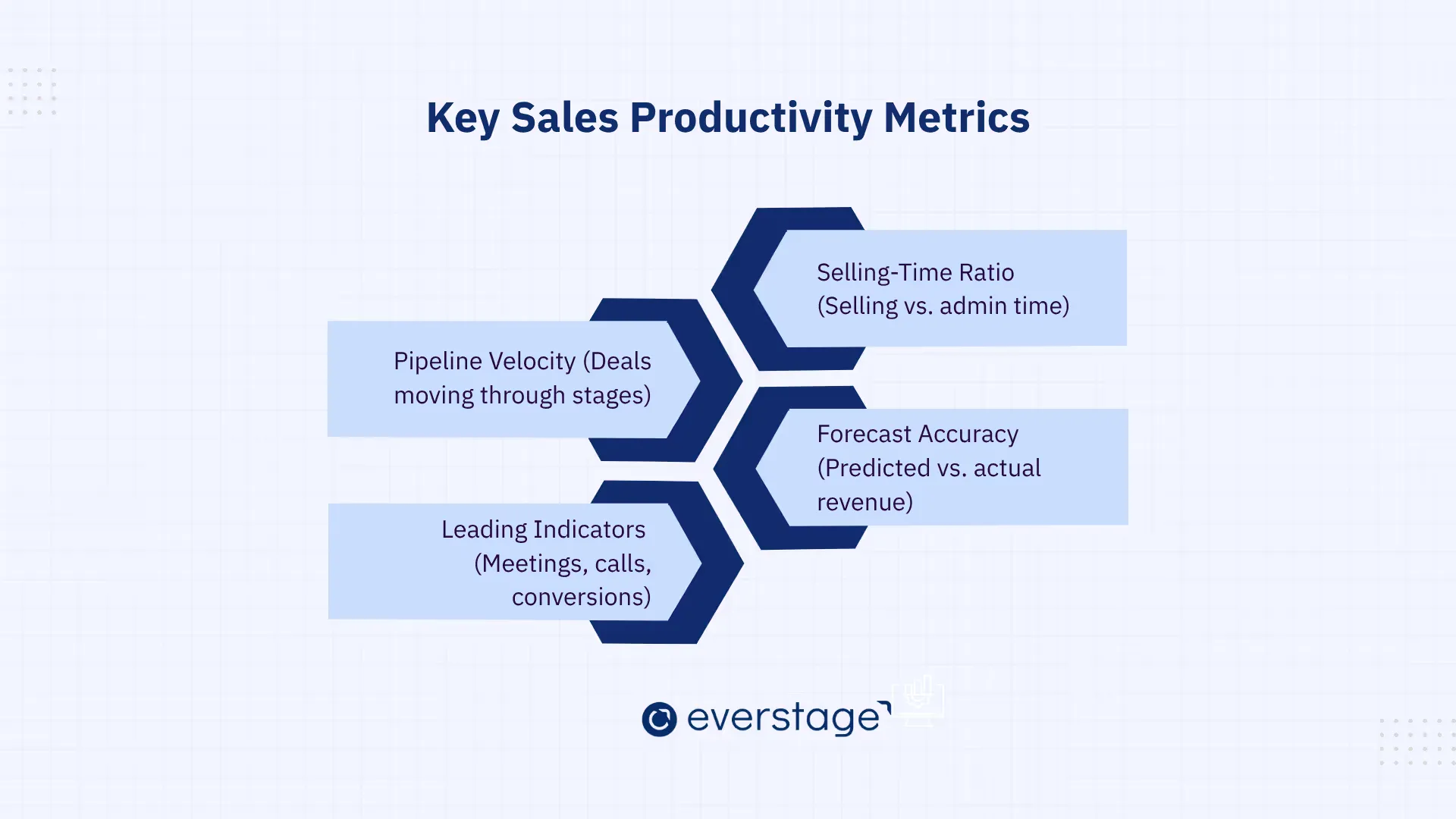
To measure sales productivity, focus on a few metrics that connect daily activity to revenue growth:
- Win Rate: Shows how many deals you close versus opportunities. According to Martal Group's 2024 B2B Sales KPI Report, average win rates hover around 20%, while top performers exceed 30%. Low win rates usually point to lead quality or closing skill gaps.
- Sales Cycle Length: Measures how long it takes to close a deal. Shorter cycles mean faster movement through the sales funnel. Martal's research shows that most B2B cycles average around 69 days. Audit your stages and approvals to remove friction.
- Pipeline Velocity: Reveals how quickly revenue moves through your sales process (Opportunities × Win Rate × Deal Size ÷ Cycle Length). The faster your pipeline moves, the higher your cash flow and forecast accuracy.
- Average Deal Size: Tracks the typical deal value and helps focus reps on strategic opportunities instead of small wins.
- Selling Time Ratio: Time spent selling versus admin work. Salesforce reports reps spend only 28% of their week selling; increasing that even slightly can improve productivity per rep.
- Lead Response Time: Measures how quickly reps follow up on new leads. Faster response times improve conversion and signal a healthy handoff process.
- Revenue per Rep: Total revenue divided by number of reps, a clean way to compare productivity across roles and territories.
- Demo and Proposal Volume: Tracks how many demos given and proposals sent each period, separating activity from outcomes so you reward results over busywork.
- Quota Attainment: Shows whether productivity improvements are translating into rep-level performance and more predictable revenue.
- Commission Query Volume: Tracks how often reps ask RevOps or finance to clarify payouts. High query volume can signal poor incentive visibility and hidden productivity loss.
- Time to Payout: Measures how quickly commission cycles are completed. Faster cycles improve trust and reduce operational drag for sales and finance teams.
Tracking these KPIs helps sales and RevOps leaders coach better and build a more productive organization.
How activity, efficiency, outcome, and qualitative metrics differ and when to use each.
RevOps teams: Track selling time and commission query volume to find where friction slows reps.
Finance teams: Measure payout accuracy and dispute volume to understand the operational side of productivity.
Sales leaders: Track quota attainment and win rate to connect productivity gains to revenue outcomes.
1. Setting Baselines and Performance Targets
To improve productivity, you first need a clear baseline. Here's how to set benchmarks that drive performance instead of pressure:
- Segment your team: Compare results by role (AE vs. SDR) or market (SMB vs. Enterprise) for fairer goals.
- Normalize by market potential: Adjust sales targets for territory size and seasonality.
- Use rolling 13-week medians: This three-month window smooths out short-term swings from seasonality or deal timing. You get a steadier view of performance trends.
- Benchmark against credible data: Use references like Salesforce's State of Sales report to set competitive, achievable targets.
- Tie goals to controllable inputs: Instead of only revenue, track meetings booked or selling hours, actions reps influence directly.
- Align targets with coaching: Help reps connect activities like calls and demos to quota progress so performance feels actionable.
A clear baseline turns sales metrics into meaningful coaching tools that boost motivation and consistency.
2. Calculating ROI of Productivity Initiatives
Every sales productivity initiative, from CRM upgrades to new training or automation tools, must prove its impact. Here's how to calculate ROI clearly and credibly:
- Start with a simple formula: ROI = (Revenue Gain or Cost Savings – Investment Cost) ÷ Investment Cost × 100. This shows how much return each improvement generates.
- Quantify time saved: When automation reduces manual work, it adds selling time. McKinsey estimates that AI and automation can lift productivity by 10–15% through reduced admin load and faster deal management.
- Track before-and-after metrics: Measure changes in win rate and pipeline velocity to see what's improving.
- Include all costs: Account for subscriptions and training so ROI reflects reality.
- Pilot before scaling: Test with a small team and expand only if results sustain.
- Connect ROI to impact: Translate data into business value, e.g., "Reducing our cycle by 10 days improved quarterly revenue by 12%."
Clear ROI tracking helps revenue leaders justify investments and scale what drives growth. Teams evaluating commission operations can also use Everstage's ROI Calculator to understand where automation and visibility may reduce operational drag.
Measuring sales productivity means more than tracking every activity. Choose metrics that show whether reps spend time on the right work. The best metrics reveal whether that work turns into revenue and payout clarity.
How to Increase Sales Productivity: Practical Tips for Sales Teams
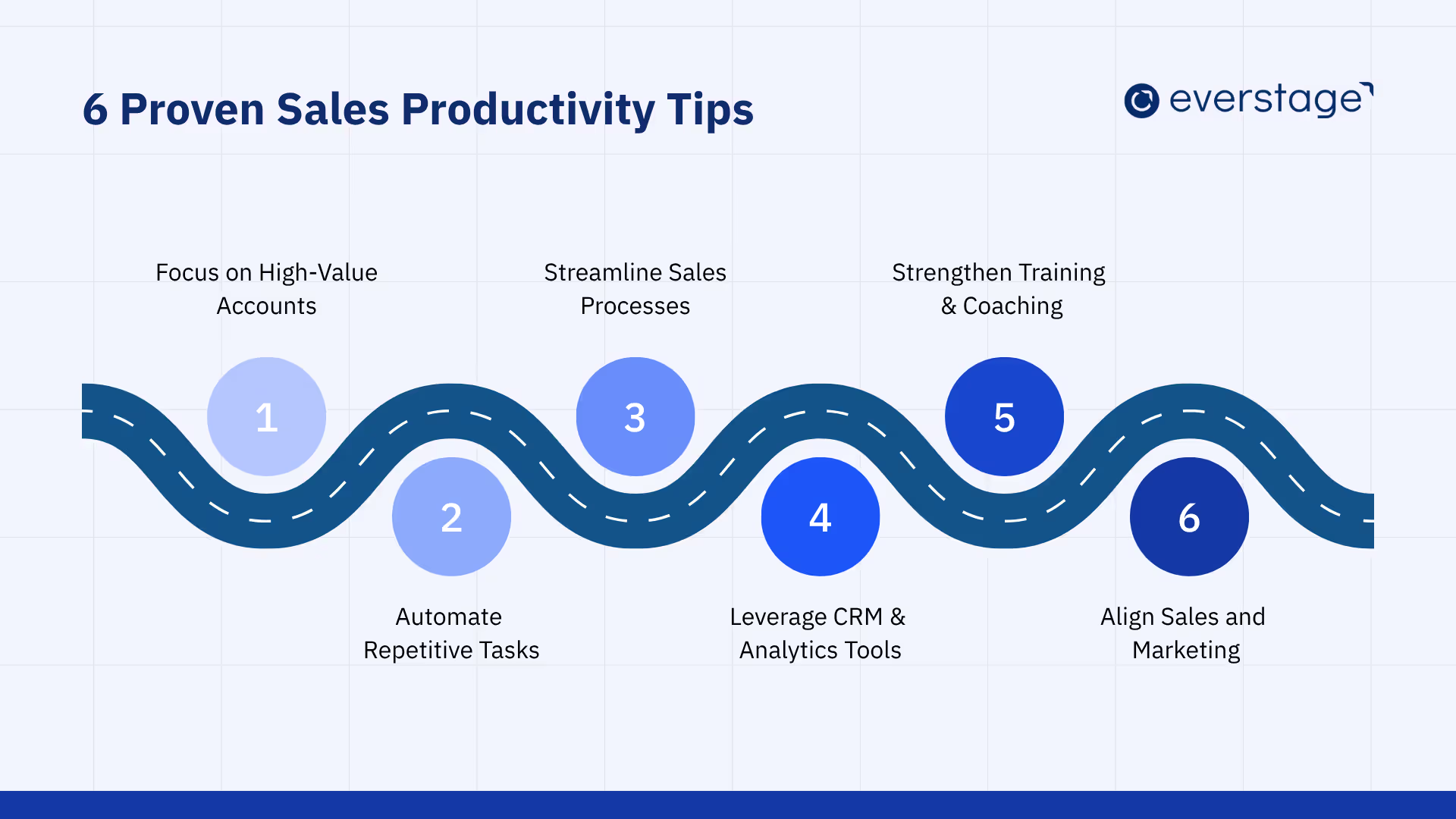
These sales productivity tips help your team close more deals in less time. Focus on high-value tasks and automate routine work. These strategies make every rep more efficient and drive measurable gains in revenue.
1. Focus on Revenue-Driving Actions
Some tasks deserve more of your time than others. To increase sales productivity, focus on actions that drive revenue, like engaging high-intent leads and running demos. These activities move deals forward faster and improve win rates.
Here's how to focus on what matters:
- Identify revenue levers: Pinpoint which actions, like calls and demos, generate the highest conversion rates.
- Prioritize pipeline stages: Spend more time on late-stage opportunities and qualified prospects.
- Review time allocation weekly: Track selling vs. admin hours and rebalance as needed.
- Coach for impact: Help reps focus on conversations that influence buying decisions over low-value follow-ups.
Aligning effort with revenue impact helps your team close more deals and shorten sales cycles without extra hours.
2. Automate Manual Sales Tasks to Free More Selling Time
If your reps are buried in admin work instead of talking to customers, automation is a must. Smart automation helps your sales team spend more time selling and less time logging activities or chasing approvals.
Here's how to make automation work for your team:
- Automate routine tasks: Use your CRM to auto-log calls and follow-ups so reps focus on real conversations.
- Set up triggers and workflows: Automatically move deals forward or route leads to the right rep.
- Delegate non-selling work: Shift data cleanup or quote creation to sales operations or shared deal desks.
- Use AI and automation tools: Platforms like Everstage help sales teams automate incentive tracking and commission visibility, giving reps instant clarity on their performance while saving hours on manual reporting.
When automation handles the busywork, your reps spend more time closing deals and hitting targets.
3. Standardize Processes and Sales Playbooks
If every rep runs their deals differently, your team's productivity will always hit a ceiling. Standardizing your process and playbooks gives everyone a proven framework, making selling faster and more predictable.
Here's how to build consistency that scales:
- Document every stage: Define what qualifies as an opportunity or a close so reps know their next step.
- Create a living playbook: Store discovery questions and top email templates in one place.
- Connect process with tools: Embed playbook links and checklists right inside your CRM for quick access.
- Update continuously: Use feedback from sales calls and win-loss reviews to refine your playbook regularly.
When everyone follows the same playbook, leaders get cleaner data and the organization performs more efficiently.
4. Strengthen Training, Coaching, and Onboarding
Even the best sales tools fall short without strong training. Without proper coaching, reps ramp slower and lose confidence. Strong enablement gives your team the skills and structure to perform at their best.
Here's how to build a stronger learning culture:
- Personalize onboarding: Tailor training by role; what a new SDR needs differs from what a senior AE needs. Set clear onboarding milestones to track ramp progress.
- Coach consistently: Use one-on-one sessions and recorded calls to help reps improve discovery and objection handling.
- Use peer learning and scorecards: Pair reps for role-play and score calls against a consistent rubric so coaching is specific and repeatable.
- Create a central hub: Store playbooks and talk tracks in an enablement platform for quick access.
- Measure progress: Track performance improvements using KPIs like win rate and sales cycle length.
Continuous coaching builds confidence and turns average sellers into high performers.
5. Align Sales and Marketing for Seamless Lead Handoffs
Even the most productive sales team struggles when marketing and sales work from different pages. Misaligned goals and poor handoffs waste time and hurt conversion rates.
Here's how to fix it:
- Set shared goals: Make sure both teams agree on what qualifies as a lead and what counts as success.
- Define SLAs for handoffs: Clearly outline how quickly reps should follow up and how marketing will pass leads to sales.
- Close the feedback loop: Hold regular syncs where managers share insights on lead quality and deal outcomes.
- Integrate data and tools: Connect your CRM and marketing platforms so both teams can access the same customer data and track the full sales funnel.
When sales and marketing move together, you eliminate lead leaks and build a smoother pipeline.
6. Keep Sales Teams Motivated and Accountable
Even the best sales teams can lose momentum without the right mix of motivation and accountability. Consistent focus and recognition help reps stay driven and aligned with their targets.
Here's how to keep motivation high and performance steady:
- Set clear goals: Make sure every rep knows what success looks like and how their daily efforts connect to team objectives. Clear visibility into sales metrics and progress builds ownership.
- Coach regularly: Schedule one-on-one check-ins to discuss challenges and celebrate wins. Coaching builds confidence and strengthens team performance over time.
- Use performance visibility tools: Platforms like Everstage give sales professionals real-time visibility into their commissions and progress, boosting engagement and cutting time spent on manual tracking. Real-time performance visibility turns compensation from a back-office process into an everyday productivity driver.
- Recognize effort consistently: A simple public shoutout on Slack or celebrating a personal milestone can go a long way in keeping morale high and preventing burnout.
When managers combine clear expectations with recognition, reps feel valued and stay accountable. The result is a motivated, productive sales team that performs better and sustains growth.
7. Use Incentive Visibility to Focus Reps on the Right Deals
Sales productivity improves when reps know exactly which actions move them closer to quota and payout milestones. Real-time commission visibility helps reps prioritize the right opportunities and stay motivated all quarter. RevOps and sales compensation teams also see fewer payout disputes and manual queries.
8. Protect Rep Wellbeing for Sustainable Productivity
Productivity gains fade when they burn reps out. Meeting overload and constant context switching reduce focus and raise turnover.
How to keep productivity sustainable:
- Protect selling blocks and reduce low-value recurring meetings.
- Set realistic quotas and activity targets grounded in capacity data.
- Recognize effort consistently and give reps autonomy over how they hit goals.
- Use asynchronous updates to cut meeting load and reduce context switching.
Sustainable productivity protects retention and the quality of customer conversations.
9. How AI Can Improve Sales Productivity
AI is one of the biggest productivity levers for 2026. Used well, it removes manual work and helps reps focus on the highest-impact deals.
High-value AI use cases include:
- Lead prioritization: Rank prospects by likelihood to buy so reps work the best opportunities first.
- Call summaries and CRM capture: Auto-generate notes and update records, reducing admin time.
- Next-best actions: Surface the right follow-up at the right moment.
- Email personalization: Draft tailored outreach faster while keeping a human review step.
- Forecasting and coaching insights: Spot pipeline risk early and identify coaching opportunities from real call data.
AI helps most with repetitive, data-heavy tasks. Human judgment still matters for relationship-building and high-stakes negotiation.
Common Challenges That Reduce Sales Productivity
Even strong sales teams lose efficiency when their tools and targets fall out of sync. The goal is to work on what moves deals forward. Let's break down the most common productivity challenges and how to fix them with simple, high-impact actions.
1. Too Much Time on Non-Selling Work
Many reps spend too little time selling. Manual commission tracking and CRM updates consume hours meant for customers.
How to fix it:
- Run a quick time audit to see where reps spend their hours and identify hidden time drains like manual reporting or status meetings.
- Automate repetitive admin tasks with sales tools that log calls and update deal stages automatically.
- Simplify your CRM by removing unnecessary fields and clicks so reps can update deals faster and stay focused on selling.
- Block meeting-free hours for prospecting and demos, and treat them as protected selling time.
These simple changes help reps reclaim hours each week, translating directly into more pipeline and higher sales performance.
2. Poor Lead Quality and Misaligned Targeting
Reps need better leads even more than they need extra volume. Low-quality leads drain morale and waste valuable selling time.
How to fix it:
- Define a clear ideal customer profile (ICP) with your marketing team so both sides agree on the same buyer criteria.
- Use lead scoring models and intent data to rank prospects and focus reps on those most likely to buy.
- Set up regular sales-marketing syncs to review lead quality and share insights on which campaigns drive real opportunities.
When your sales and marketing teams align, reps spend time with high-intent buyers, improving win rates and closing deals faster.
3. Inefficient Processes and Tool Overload
Disconnected tools and complicated workflows slow everything down. Reps lose minutes toggling between their CRM and spreadsheets.
How to fix it:
- Map your full sales process to identify unnecessary steps that slow deals or create duplicate work.
- Consolidate your tech stack so your CRM and analytics share data in real time.
- Standardize deal stages and activity logging to keep data clean and forecasts accurate.
When processes are streamlined and tools share data, sales teams move faster and close with confidence.
4. Gaps in Training and Sales Enablement
Even great sales strategies fail when reps lack the knowledge or confidence to execute them. Without consistent enablement, productivity stalls.
How to fix it:
- Run ongoing training that sharpens discovery and negotiation skills, going beyond product knowledge.
- Review call recordings to coach reps on tone and objection handling with real examples.
- Store playbooks and talk tracks in a central enablement hub so reps find what they need fast.
Continuous enablement builds confident, consistent performers, driving long-term sales productivity across the team.
5. Low Visibility Into Goals, Incentives, and Commissions
Reps work best when they can see quota progress, deal priority, and commission math. Hidden incentives slow them down. Unclear plans trigger manual payout questions and time lost checking spreadsheets instead of selling.
How to fix it:
- Give reps real-time visibility into quota progress and estimated commissions.
- Automate incentive calculations to reduce manual errors and payout disputes.
- Align compensation plans with the sales behaviors leadership wants to encourage.
- Review incentive performance with RevOps and sales leadership regularly.
6. Outdated Content and Poor Collateral Access
Reps lose time searching for assets and recreating decks when sales content is scattered or outdated.
How to fix it:
- Audit collateral and remove outdated assets that confuse buyers or slow conversations.
- Tag content by sales stage and persona so reps find the right asset fast.
- Govern content centrally so messaging stays consistent and current.
Once you know where time and deals slip, improvement becomes simple. Fix one process and one habit at a time.
Sales Productivity Tools: Categories, Use Cases, and Selection Criteria
The right tools help your sales and RevOps teams sell faster and focus on what drives revenue. CRM and automation tools reduce friction. Incentive management tools show reps which actions move them closer to quota and payouts. Here are the must-have tools every high-performing sales organization should use to increase productivity and team performance:
Sales productivity tool categories, their purpose, productivity impact, and example platforms.
When evaluating tools, weigh integration depth and ease of adoption. Check reporting quality and how well each tool supports clean data. A tool that integrates poorly or that reps avoid only adds to tool overload.
Quick Wins and a 30-60-90 Day Sales Productivity Roadmap
Improving sales productivity starts with the workflows that consume the most selling time. Find where reps lose hours to CRM updates and approval delays. Then prioritize changes that improve pipeline velocity and payout clarity.
Quick Wins to Boost Sales Productivity
Start small and measure progress as you fix what slows reps down:
- Add a "next step + date" for every deal: This single habit keeps your sales pipeline active and prevents deals from going dark.
- Close stale opportunities automatically: Clear out low-quality leads so your reps can focus on real prospects.
- Use a discovery call template: Create consistent, structured questions to improve call quality and shorten ramp time for new hires.
- Cut one recurring meeting: Replace it with async updates on Slack or CRM notes to reclaim selling hours every week.
- Automate repetitive admin work: Auto-log calls and schedule follow-ups so your team spends more time selling.
- Review dashboards weekly: Use your sales metrics to coach reps early and catch performance dips before they affect your targets.
Improve Sales Emails, Meetings, and Follow-Ups
Frontline reps can boost their own productivity with a few daily habits:
- Plan your top three revenue actions each morning.
- Research priority accounts before outreach.
- Write shorter, clearer emails and batch email responses.
- Use a structured agenda for every meeting and shorten low-value ones.
- Confirm next steps after every call.
- Update CRM records and review pipeline blockers daily.
Your 30-60-90 Day Sales Productivity Plan
Once the quick wins are in place, use this roadmap to build sustainable improvement:
A 30-60-90 day plan showing objectives, key actions, owners, and success metrics.
With each step, you build a sales culture that values clarity and accountability. Start small and scale the wins that matter most.
The Sales Productivity Checklist for GTM Teams
Turn this guide into an action plan by assigning ownership across stakeholders:
- Sales Leaders: Define productivity KPIs and launch coaching cadences that protect selling time.
- Sales Operations: Consolidate overlapping tools and standardize deal stages.
- Enablement: Refresh playbooks and set onboarding milestones.
- Marketing: Align ICP definitions and tighten handoff SLAs.
- RevOps + Finance: Automate commission tracking and review incentive visibility.
Turn Sales Productivity Tips Into a Repeatable Revenue System
Improving sales productivity comes from smarter work that targets real revenue drivers. When you track the right metrics and use tools like Everstage to simplify incentive tracking, your team spends more time closing deals.
Small, steady improvements in process and coaching lift performance over time. Everstage's RevOps 30-60-90 Guide includes a checklist to prioritize automation and process cleanup in your first three months. For more incentive-specific benchmarks, see Everstage's State of Sales Compensation 2025 report, based on insights from 200+ industry experts.
Ready to make productivity more measurable and motivation more consistent? Book a Demo to see how Everstage helps revenue teams automate incentive workflows and give reps real-time commission visibility.
Questions worth asking
The things most people want to know before they commit.
What is the difference between sales productivity and sales efficiency?
Sales productivity measures the output a team generates from its time and effort. Sales efficiency measures how well resources like time and budget produce that output. Sales effectiveness, a related term, focuses on the quality of outcomes such as win rate. The three work together: productive teams use resources efficiently and convert effort into effective results.
How can AI improve sales productivity?
AI improves sales productivity by handling repetitive, data-heavy work and helping reps focus on the best opportunities. Common use cases include lead prioritization and automatic call summaries. AI also drafts personalized emails and surfaces coaching insights from real calls. Human judgment still matters most for relationship-building and high-stakes negotiation.
Can incentive compensation software help reduce sales admin work?
Yes. Incentive compensation software automates commission tracking and payout calculations. This frees sales and RevOps teams from manual spreadsheet work and gives reps clearer visibility into performance.
What are the best sales productivity tips?
The best sales productivity tips focus on spending more time selling and less on admin work. Prioritize high-value activities and automate repetitive tasks. Streamline your CRM and align sales with marketing for faster lead conversion. Regular coaching and tracking metrics like win rate and pipeline velocity also drive consistent improvement.
How can a sales team reduce administrative overhead?
Sales teams can reduce admin overhead by automating reporting, simplifying CRM workflows, and standardizing proposal templates. Centralizing data entry and using integrated tools cuts manual tasks, freeing more time for selling activities and customer conversations.
What daily habits increase sales productivity?
Productive reps plan their day around selling time and block focus hours for outreach. They update the CRM consistently and review goals each morning. They also use automation to handle admin work, keeping their focus on building relationships and closing deals.