

.avif)
TL;DR
- Sales productivity goals define how teams achieve revenue. They improve efficiency and deal quality, while quotas measure only outcomes.
- Use SMART and OGSM frameworks with data-driven benchmarking to turn broad objectives into measurable, role-based goals.
- Apply the 17 SMART goal examples and KPI matrix in this guide to move from theory to execution fast.
- Connect productivity goals to incentives and compensation so reps see how attainment shapes earnings, beyond activity counts.
- Track progress with real-time dashboards and review cadences that keep goals relevant for RevOps and Finance teams.
Sales productivity goals matters because the pipeline on paper rarely matches closed revenue. You may have a strong pipeline and a capable team. Deals still stall and follow-ups slip. Look closer, and most of a rep's week disappears into admin work and internal meetings.
Findings from Salesforce's sixth State of Sales report show reps spend about 36% of their time selling. The rest goes to non-revenue tasks. This signals a goal problem more than a talent problem.
Complex territories and commissionable payees make productivity challenges more costly than missed revenue, leading to inaccurate forecasts, disputed payouts, and incentive plans that fail to drive the right behaviors.
Sales teams often miss targets when goals and incentives are not aligned with actual selling behavior. Quotas measure outcomes, while sales productivity goals define how those outcomes are achieved by improving efficiency and deal quality. Together, they help RevOps and Finance leaders connect performance, payouts, and revenue outcomes within a single operating system.
This guide shows how to define and sustain sales productivity goals that drive consistent growth. You'll see how they differ from quotas and KPIs. You'll learn the frameworks and metrics that make them measurable, plus the steps to track them across teams.
What Are Sales Productivity Goals?
Sales productivity goals are measurable targets that help sales teams improve efficiency and revenue outcomes. They align daily activities with business objectives. They focus on metrics such as conversion rate and average deal size.
Revenue quotas focus on financial results. Sales productivity goals measure efficiency, showing how activities contribute to pipeline growth and customer engagement.
Sales productivity goals turn broad business objectives into operational focus. They guide how salespeople spend time and prioritize prospects.
Structured well, these goals show leaders what drives results. Examples include time spent on qualified opportunities and conversion rates between sales stages. That insight supports smarter coaching and process decisions.
1. How They Differ from Sales Targets, Quotas, and KPIs
Sales targets, quotas, and productivity goals each serve a different purpose in performance management. Understanding these distinctions helps teams hit numbers and sustain performance efficiently.
- Sales Targets and Quotas define the destination. They represent the outcomes teams must achieve, such as generating $1 million in revenue or closing 30 new deals in a quarter.
- Sales Productivity Goals define the path to results. They measure how effectively teams reach those outcomes. Examples include improving lead-to-close conversion and shortening the sales cycle.
- KPIs (Key Performance Indicators) act as the scoreboard. They track metrics like call-to-meeting ratios and pipeline coverage. These show progress toward productivity goals and revenue targets.
The table below compares how goals, objectives, quotas, KPIs, and productivity goals differ in purpose and measurement:
How sales objectives, goals, quotas, KPIs, and productivity goals differ in purpose, owner, and measurement.
The key difference lies in focus:
- Targets tell you what to achieve.
- Productivity goals tell you how to achieve them efficiently.
- KPIs tell you how well you're performing along the way.
Without productivity goals, teams chase revenue without knowing which behaviors drive results. Increasing outreach volume can look productive while causing lower-quality engagement and rep fatigue.
Productivity goals prevent this by aligning daily actions with strategic outcomes, keeping growth measurable and sustainable.
2. Key Benefits of Well-Defined Productivity Goals
Well-structured sales productivity goals provide four key advantages that directly impact performance and revenue predictability:
- Efficiency Gains: Teams learn to focus on the highest-value activities instead of scattering effort across low-impact tasks. Tracking metrics such as selling time or lead-to-opportunity conversion helps leaders remove bottlenecks.
- Motivation and Accountability: Clear goals create a sense of ownership and progress. Reps can see how their efforts contribute to measurable outcomes, which builds motivation and fosters healthy competition.
- Clarity of Expectations: When each role, from SDR to account executive, has defined productivity goals, it eliminates ambiguity about what success looks like. This makes performance management fairer and more data-driven.
- Benchmarking and Continuous Improvement: Consistent measurement enables comparisons across individuals, teams, or regions. Leaders can identify top performers' habits and replicate them, turning anecdotal success into a repeatable strategy.
Tying productivity goals to operational metrics helps leaders spot where sales cycles slow and where forecasts break. Concrete, trackable goals move teams from reactive selling to a disciplined, improvement-focused culture.
Sales Productivity KPIs and Metrics to Track
Measuring sales productivity means blending activity metrics with outcome metrics. The aim is to connect effort with efficiency and results. These five categories capture a complete view:
- Activity Efficiency: Track meaningful sales activities like qualified calls, meetings, proposals sent, or demos completed. Quality matters more than volume; 10 well-targeted meetings beat 100 unqualified calls.
- Conversion Metrics: Analyze lead-to-opportunity and opportunity-to-close conversion rates. These ratios reveal whether sales activities are turning into pipeline and closed revenue.
- Time Metrics: Measure average sales cycle length and percentage of time spent on selling versus administrative work. Time allocation is one of the strongest indicators of productivity improvement.
- Revenue Efficiency: Track revenue per sales rep, per customer segment, or per selling hour to understand how effort translates into business outcomes.
- Data Quality Metrics: Monitor CRM completeness, pipeline accuracy, and forecast reliability. Poor data erodes productivity through rework and missed opportunities.
The KPI matrix below separates leading indicators, lagging indicators, efficiency metrics, customer metrics, and cost metrics so you can choose the right measure for each goal:
KPI matrix grouping leading, lagging, efficiency, customer, and cost metrics with formulas and what each reveals.
Combining these data points helps sales leaders diagnose inefficiencies, like underperforming lead sources or long follow-up delays, then adjust goals toward real performance levers.
A unified platform like Everstage centralizes activity ratios, conversion metrics, and deal velocity in one source. That clarity turns raw data into action, giving leaders visibility into productivity across roles and regions.
The table below maps productivity metrics to the outcomes each revenue team persona cares about most:
Productivity goal, metric, and incentive connection mapped to RevOps, Finance, Sales Compensation, and Sales Leader personas.
Types of Sales Productivity Goals
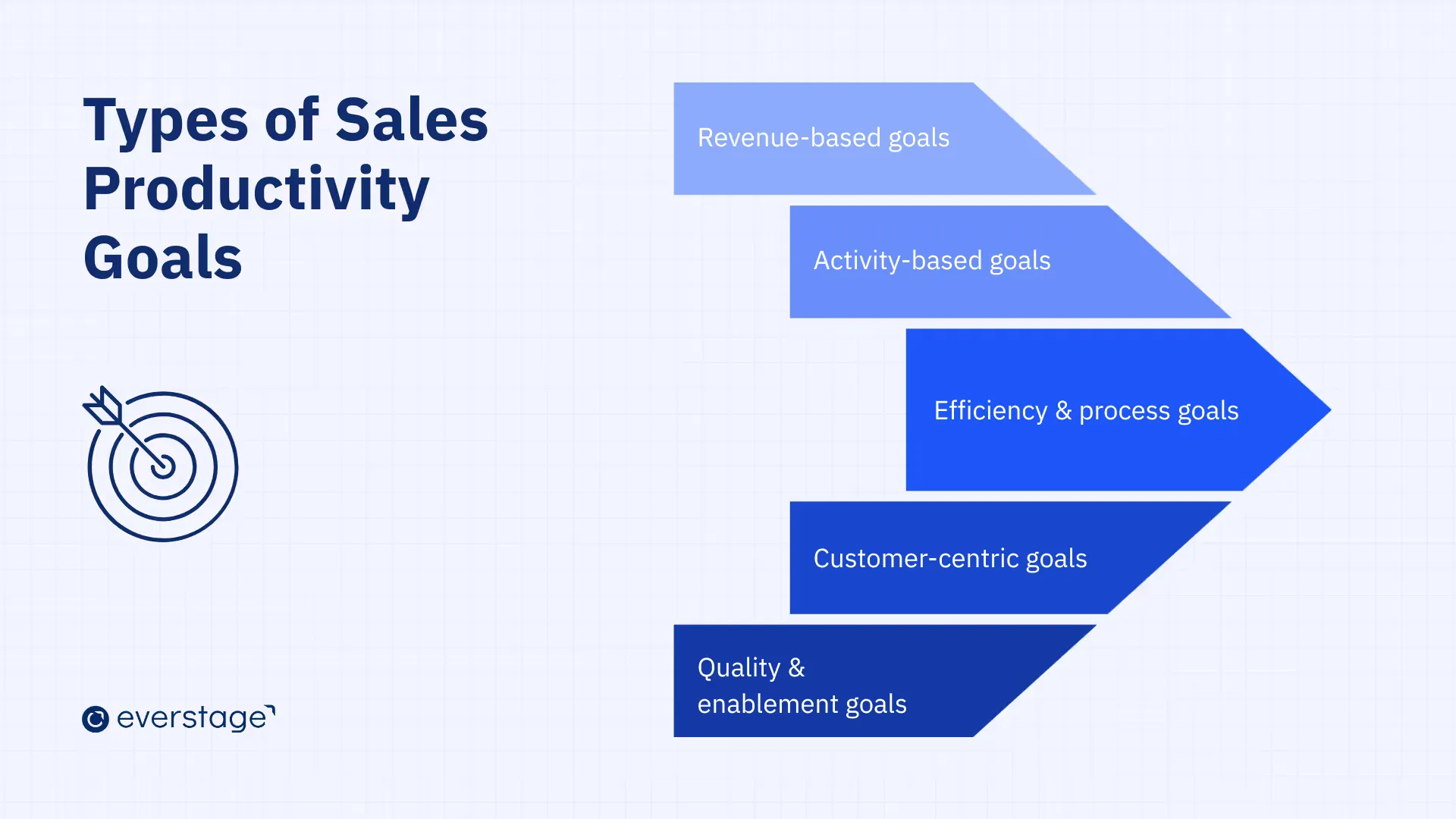
Sales productivity goals go beyond revenue targets. They align daily actions and customer relationships to build long-term performance. The strongest organizations balance goal types to drive short-term results and sustainable growth.
Below are six important categories of sales productivity goals, including incentive-linked goals that connect rep behavior to compensation outcomes.
1. Revenue-Based Goals
Revenue-based goals measure how effectively sales efforts translate into financial outcomes. They're essential for assessing performance impact but must be paired with productivity metrics to reveal how those results are achieved.
Common examples include:
- Revenue generated per rep or territory
- Average deal size or deal margin
- Upsell or cross-sell revenue
These goals highlight whether teams close the right deals, beyond simply closing more. Tracking deal size or upsell revenue shows how well reps find high-value opportunities and strengthen accounts.
2. Activity-Based Goals
Activity-based goals track the controllable actions that drive pipeline growth. They keep sales teams structured and consistent in outreach and follow-up.
Examples include:
- Qualified calls or meetings booked
- Demos delivered or proposals sent
- Follow-ups completed within a set timeframe
These goals work well in outbound-driven sales environments. They help managers spot engagement patterns and predict pipeline early. Quality stays key; ten meaningful conversations outperform a hundred unqualified calls.
3. Efficiency and Process Goals
Efficiency and process goals measure how effectively a team converts activity into outcomes. They reduce friction in the sales cycle and help reps spend more time selling instead of managing admin tasks.
Key metrics include:
- Average sales cycle length
- Conversion rate between stages
- Lead response and follow-up time
- Forecast accuracy
These goals reveal bottlenecks. Deals that stall in the proposal phase may signal unclear pricing or delayed approvals. Fixing these gaps through automation and CRM optimization improves throughput.
4. Customer-Centric Goals
Customer-centric goals measure how productivity contributes to retention, satisfaction, and lifetime value. They shift focus from transactions to relationships, which sustains revenue growth.
Common metrics include:
- Retention or renewal rates
- Customer satisfaction (CSAT) and Net Promoter Score (NPS)
- Account expansion or referral generation
These goals drive consultative selling and help teams deliver value beyond the initial purchase. For example, tracking renewal rates shows whether customers find lasting benefit, while satisfaction scores highlight relationship health.
5. Quality and Enablement Goals
Quality and enablement goals strengthen the foundation of productivity. They improve data accuracy, skills, and systems that help teams sell effectively.
Examples include:
- Lead qualification and pipeline hygiene
- CRM data accuracy and adoption
- Training or certification completion
- Onboarding success rate for new hires
These goals enhance consistency and scalability. For instance, improving lead quality ensures sales and marketing alignment, reducing wasted effort. Similarly, structured onboarding and coaching programs shorten ramp-up time for new reps.
6. Incentive-Linked Goals
Incentive-linked goals connect productivity improvements to compensation outcomes. They keep reps focused on the behaviors the business wants to reward.
Examples include:
- Increase qualified pipeline generated from target accounts
- Improve multi-product attach rate
- Reduce discounting while maintaining win rate
- Improve renewal or expansion motion
- Increase attainment visibility before quarter-end
When incentive-linked goals stay transparent, reps see how daily actions affect attainment and earnings. That visibility makes goals more motivating and easier to sustain.
Effective sales productivity goals come from structure and clear alignment. Next, let's review the frameworks that help sales teams set and execute these goals.
17 Sales Productivity Goals Examples for 2026
The examples below are SMART goals you can copy and adapt. Each links a measurable target to an owner and a review cadence, moving the goal from idea to execution.
17 SMART sales productivity goal examples with KPI, owner, timeframe, and review cadence for 2026.
Frameworks & Methodologies for Setting Strong Productivity Goals
Strong sales productivity goals rely on structure. Without the right framework, even ambitious targets can become vague or disconnected from business results.
SMART, OGSM, and data-driven benchmarking provide that structure. They turn broad objectives into measurable steps. Here's how each works:
1. SMART Goals (Specific, Measurable, Achievable, Relevant, Time-Bound)
Strong sales productivity goals rely on structure. Without the right framework, even ambitious targets can become vague or disconnected from business results.
SMART, OGSM, and data-driven benchmarking provide that structure. They turn broad objectives into measurable steps. Here's how each works:
1. SMART Goals (Specific, Measurable, Achievable, Relevant, Time-Bound)
SMART goals work because they remove ambiguity. Every rep knows what needs to change, how progress will be measured, and when success will be evaluated. Each element works together to keep objectives realistic and aligned with business priorities:
- Specific: Clearly define what you want to achieve (e.g., improve lead-to-close rate).
- Measurable: Include metrics to track progress (e.g., increase conversion rate by 10%).
- Achievable: Set goals that are challenging yet attainable given team capacity.
- Relevant: Ensure each goal supports broader sales and business outcomes.
- Time-bound: Establish a defined timeframe to maintain accountability.
For instance, instead of "improve sales efficiency," a SMART goal reads: increase conversion from qualified leads to closed deals by 10% within the next quarter.
The table below shows how vague goals become SMART sales productivity goals:
2. Stretch vs. Realistic Goals
The most effective sales organizations balance stretch goals and realistic goals to maintain motivation and drive continuous improvement.
- Realistic goals provide structure and achievable milestones that build momentum.
- Stretch goals encourage teams to go beyond comfort zones, sparking innovation and excellence.
The balance between the two is critical. Overly ambitious targets can lead to burnout and disengagement, while only setting safe goals can limit growth. Leading sales teams use a two-tiered approach: establish realistic goals first, then introduce stretch goals as teams build confidence and capacity.
3. OGSM Framework (Objectives, Goals, Strategies, Measures)
OGSM links sales productivity goals to overall business strategy. Where SMART focuses on goal clarity, OGSM emphasizes alignment and execution. The acronym stands for Objectives, Goals, Strategies, and Measures.
Here's how it works:
- Objective: Define the overarching aim (e.g., enhance sales productivity).
- Goals: Quantify what success looks like (e.g., reduce average sales cycle by 15%).
- Strategies: Identify the methods to achieve it (e.g., streamline CRM workflows, improve lead qualification).
- Measures: Determine how progress will be tracked (e.g., time-to-close metrics, win rate).
This structure ensures that every goal supports a strategic business outcome. Organizations using frameworks like OGSM achieve stronger alignment between sales and corporate strategy, resulting in better execution and long-term consistency.
4. Data-Driven Goal Setting: Benchmarking and Historical Data
The best sales goals rest on data, not assumptions. Data-driven goal setting uses past performance and benchmarking to create goals that are ambitious and achievable.
Key practices include:
- Analyzing historical data: Review sales performance over time to identify trends and performance bottlenecks.
- Benchmarking against peers: Compare team metrics with industry standards to reveal competitive gaps.
- Using analytics tools: CRMs like Salesforce, HubSpot, or Pipedrive offer dashboards that visualize pipeline health, deal velocity, and rep efficiency.
This evidence-based approach makes goals more accurate and adaptable. It also builds trust among teams, as expectations are based on proven performance, not arbitrary numbers. Over time, it encourages a culture of continuous improvement grounded in measurable progress.
Combining SMART goals, OGSM alignment, and data-driven benchmarking, sales leaders create goals that are clear, scalable, and strategic. These goals drive measurable productivity and sustainable growth.
With the right frameworks in place, the next step is putting them into action.
Individual vs. Team Sales Productivity Goals
Some goals belong to a single rep, others to a team, a manager, or a cross-functional group. Assigning ownership correctly keeps goals fair and makes attainment easy to track. The table below shows how goals map across roles.
Example goals, metrics, and incentive connections mapped to SDR, AE, AM, manager, leader, and cross-functional owners.
Individual goals focus on controllable behaviors. Team goals measure collaborative efficiency. Manager-owned goals center on coaching. Cross-functional goals keep sales and marketing aligned with RevOps on shared outcomes.
Short-Term vs. Long-Term Sales Productivity Goals
Daily, weekly, monthly, quarterly, and annual goals work together as a planning framework. Short-term goals build the activity rhythm that ladders up to long-term outcomes. The table below shows how each timeframe fits.
Example goals and best uses across daily, weekly, monthly, quarterly, and annual timeframes.
How to Set, Track, and Review Sales Productivity Goals
Setting and tracking sales productivity goals turns strategy into measurable progress. The key is a process that stays structured and flexible. It identifies performance gaps and keeps progress visible through data-driven monitoring.
The following steps outline how sales leaders can turn theory into consistent, goal-driven execution.
1. Initial Assessment: Audit Current Performance Metrics and Gaps
Every successful goal-setting process begins with a performance audit. Before setting new objectives, teams need their current baseline: where productivity stands and which areas lag.
Start by collecting and analyzing key performance metrics such as:
- Conversion rates (from lead to close)
- Average deal size and revenue per rep
- Sales cycle length and pipeline velocity
- CRM activity data (calls, meetings, follow-ups)
Identify inefficiencies by comparing individual and team performance against historical data or benchmarks. If reps spend excessive time on admin tasks instead of selling, automation or CRM cleanup becomes the first focus.
2. Prioritization: Identify Which Goals Move the Needle Most
Not all productivity goals have equal impact. Once you've mapped out performance gaps, the next step is prioritization, focusing on the metrics that directly influence revenue and efficiency.
To prioritize effectively:
- Assess which bottlenecks have the biggest effect on outcomes (e.g., long deal cycles vs. low lead quality).
- Rank potential goals based on impact, effort, and strategic alignment.
- Use data correlation, for example, if a higher call-to-meeting ratio leads to more closed deals, improving outreach quality may yield stronger results than increasing call volume.
Top-performing teams use the 80/20 principle to focus energy where it matters. Roughly 80% of results come from 20% of efforts. A small share of key accounts or territories generates most revenue.
3. Individual, Team, Product, and Territory Sales Productivity Goals
Sales productivity goals must be role-specific and context-aware. A one-size-fits-all approach leads to misalignment and frustration across teams.
- Individual goals focus on controllable behaviors, like conversion rates, outreach quality, or response times.
- Team goals measure collaborative efficiency, such as total pipeline value or collective quota attainment.
- Product-specific goals align with strategic priorities, emphasizing growth areas or underperforming product lines.
- Geographical goals account for regional market dynamics, competition, and customer preferences.
This segmentation keeps goals fair and relevant. It helps leaders pinpoint whether performance issues stem from individual execution, team dynamics, or market conditions.
For teams with hundreds of commissionable payees, segmentation must map to incentive eligibility, payout rules, and role-specific attainment paths. Without this layer, productivity goals look clear in a dashboard while reps stay confused about how goals affect earnings.
4. Time Horizons: Structuring Goals by Timeframe
Breaking down goals into time-based segments creates a rhythm of accountability. Instead of vague annual targets, sales teams perform best when they operate under layered time horizons:
- Daily: Track activity-based goals like calls made or follow-ups sent.
- Weekly: Measure short-term progress, such as meetings booked or opportunities created.
- Monthly or quarterly: Focus on conversion metrics, deal velocity, or revenue growth.
- Annually: Evaluate strategic outcomes like market expansion or retention improvements.
This structure keeps performance transparent and allows for faster course correction.
5. Tools and Dashboards: Using Data to Drive Visibility
Modern sales performance management depends on more than dashboards. Teams need systems that link the goals reps are measured against to the incentives tied to them. These systems show real-time progress before the period ends.
Recommended categories include:
- CRM platforms such as Salesforce or HubSpot capture activity and pipeline data. Everstage Incentives connects that data to goal attainment and earnings visibility, so teams see how performance affects motivation and payouts.
- Sales intelligence tools for activity insights and call analytics.
- Analytics dashboards like Tableau or Power BI to visualize KPIs and benchmark trends.
CRMs show sales activity. BI tools visualize performance. Everstage links performance to incentives. That distinction matters because productivity goals change behavior only when reps see how progress affects attainment and earnings in real time. Connecting CRM data, goal tracking, and incentive automation, Everstage moves teams from passive reporting to active performance management.
An effective executive dashboard should include:
- Real-time goal attainment by rep, team, and region
- Pipeline coverage and pipeline health
- Conversion rates between stages
- Deal velocity and sales cycle length
- Forecast variance against target
- Activity quality signals
- Incentive progress and payout exposure
Integrating these tools keeps goal and performance data centralized and reliable. When that visibility connects to incentive progress, managers coach from objective signals and reps see which actions affect attainment and earnings.
6. Monitoring and Feedback Loops
Setting goals is only half the work; continuous monitoring sustains improvement. Regular reviews let teams assess performance, spot emerging challenges, and refine goals from real-time data.
Effective feedback systems include:
- Weekly check-ins to review short-term activity metrics.
- Monthly performance reviews to evaluate progress toward quarterly goals.
- Quarterly retrospectives to recalibrate strategies based on market shifts.
Setting and tracking sales productivity goals goes beyond defining targets. It builds a culture of measurement, reflection, and adaptation.
With goals set and tracked, the next step is to see them in action. Real examples and templates show how sales productivity goals translate into measurable results.
How to Build an Action Plan for Each Sales Productivity Goal
A goal without an action plan rarely survives a busy quarter. Use this checklist to turn any productivity goal into tasks, owners, and review checkpoints:
- Define the goal: Write it as a SMART statement.
- Identify the baseline: Capture current performance from CRM or historical data.
- Choose the KPI: Select one primary metric to measure progress.
- Assign the owner: Name one accountable person or team.
- List the actions: Document the specific behaviors and tasks required.
- Set milestones: Break the goal into weekly or monthly checkpoints.
- Define the review cadence: Decide how often progress is reviewed.
- Identify risks: Note what could block the goal.
- Document corrective actions: Plan what happens if progress stalls.
Worked example: reduce sales cycle length by 15% in one quarter
- Goal: Cut average sales cycle from 60 to 51 days this quarter.
- Baseline: 60-day average over the last two quarters.
- KPI: Average days from opportunity created to closed-won.
- Owner: Sales manager, supported by RevOps.
- Actions: Automate proposal generation, set 24-hour follow-up SLAs, and clear stalled deals weekly.
- Milestones: 57 days by month one, 54 by month two, 51 by month three.
- Review cadence: Bi-weekly pipeline reviews.
- Risks: Approval delays and unclear pricing.
- Corrective actions: Escalate stuck deals and tighten discount approval rules.
Examples, Templates & Tracking Tools
Turning sales productivity goals into results requires more than theory; it needs structure, data, and consistency. This toolkit helps teams apply the earlier concepts. It moves you from goal-setting to forecasting and performance tracking.
1. Define Goals with the Sales Productivity Goal-Setting Worksheet
Start by defining productivity objectives across rep, team, and organization levels.
This Sales Productivity Goal-Setting worksheet helps you apply the SMART framework while balancing leading indicators (activities such as discovery calls or demos) with lagging indicators (outcomes like win rate or revenue per rep).
Each entry ties a measurable goal to ownership, review cadence, and enabling actions. It's built for real-world alignment, helping teams ensure every activity contributes directly to revenue outcomes.
Here's how to use this worksheet:
- Define goals that are Specific, Measurable, Achievable, Relevant, and Time-bound for each sales rep and team.
- Focus on activities that drive results (e.g., calls, meetings) while also tracking outcomes (e.g., win rate, revenue per rep).
- Ensure each goal has a clear owner and a set of actions or resources required to achieve it.
- Regularly track progress and adjust based on performance reviews to stay aligned with broader business objectives.
2. Connect Goals to Revenue with the Sales Forecast Template
Once goals are set, connect them to actual revenue outcomes. The Sales Revenue Forecast Template translates daily activity into financial projections. It shows how pipeline health and deal progress contribute to hitting revenue targets.
The numbers in this template are example figures, not real data.
Example sales revenue forecast showing deal value, close probability, weighted revenue, and target coverage by stage.
Here's how to use this template:
- List opportunity stages and define your sales stages (e.g., Lead Qualification, Proposal Sent).
- Enter the potential revenue for each opportunity.
- Enter the likelihood of closing for each stage (based on historical data).
- Calculate weighted revenue
- Add the weighted revenues to get the current forecast.
- Compare the forecast to your sales target to gauge how much of your goal is covered.
3. Track Progress with KPI Dashboards
After setting and connecting goals, visibility is key.
Integrate your CRM or BI platform to monitor deal velocity, conversion rate, and quota attainment in real time. Through Salesforce dashboards or a connected Tableau view, consistent tracking keeps goals actionable and relevant.
These dashboards turn data into daily decision-making tools, helping managers coach effectively and reps self-correct before performance dips.
These templates and frameworks form a complete system. Teams set smarter goals and monitor progress continuously.
Spreadsheets and dashboards provide structure. Integrating them into a real-time system like Everstage ensures continuous visibility. It removes manual updates and keeps goals transparent across teams and leadership.
Common Challenges & How to Overcome Them
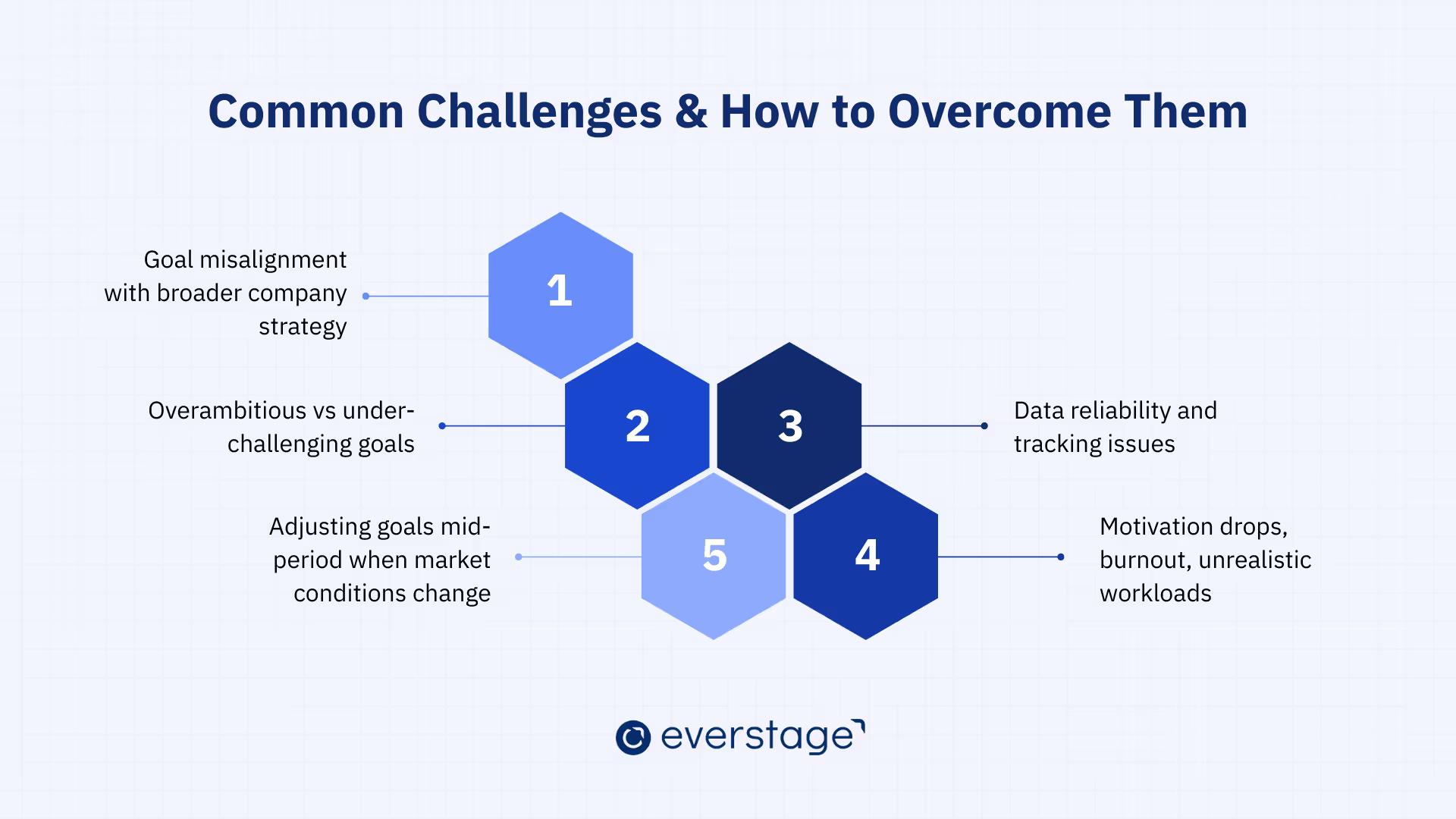
Even well-defined sales productivity goals fail when they lack alignment or realism. The strongest teams treat these challenges as chances to fine-tune how they plan and motivate performance.
The table below pairs common mistakes with better, incentive-linked alternatives:
Common goal-setting mistakes paired with better incentive-linked alternatives and why each works.
1. Goal Misalignment with Broader Company Strategy
When sales goals miss the company's strategic direction, teams work hard on the wrong things. Pushing more calls or demos can look productive. If the business prioritizes upselling or retention, those efforts fall flat.
How to fix it:
- Align every sales productivity goal with broader business objectives.
- Clarify how each role contributes to strategic priorities, for instance, SDRs focus on high-quality leads, while account executives target multi-year contracts.
- Revisit alignment quarterly so goals keep pace with business shifts.
When each metric directly supports company growth, productivity becomes purposeful instead of mechanical.
2. Overambitious vs. Under-Challenging Goals
Setting the right difficulty level is tricky. Overly aggressive goals create burnout and disengagement, while easy goals breed complacency. The key is to challenge without overwhelming.
What works best:
- Set a baseline goal that reflects achievable performance.
- Add a stretch goal to motivate top performers.
- Include a peak goal that rewards exceptional achievement.
This structure drives continuous improvement while keeping morale high, everyone has something attainable and something aspirational to aim for.
3. Data Reliability and Tracking Issues
Data quality is the backbone of any productivity system. When CRM entries are missing or outdated, managers lose visibility into what drives performance.
How to improve data trust:
- Standardize CRM fields and automate repetitive data entry.
- Use tools that sync activities (calls, emails, meetings) automatically.
- Schedule monthly pipeline reviews to catch and correct data gaps early.
Accurate data turns productivity measurement from guesswork into a reliable basis for decisions and coaching.
4. Motivation Drops, Burnout, and Unrealistic Workloads
When productivity goals push too hard on output, teams pay in morale and health. Burnout lowers creativity, raises turnover, and drags down results. According to Gartner, nearly 90% of B2B sellers report burnout, and more than half are seeking new jobs.
To sustain motivation:
- Tie goals to outcomes beyond raw activity volume.
- Celebrate progress along with final numbers.
- Provide regular coaching and skill-building opportunities.
- Encourage balance through realistic workloads and mental health support.
Sales productivity grows when teams feel supported and valued, not when they're running on empty.
5. Adjusting Goals Mid-Period When Market Conditions Change
Economic shifts, competitor moves, or strategy changes can make static goals irrelevant. The most agile teams adapt instead of clinging to outdated targets.
How to stay flexible:
- Hold mid-cycle reviews to evaluate progress and relevance.
- Adjust targets transparently when external conditions shift.
- Use scenario-based planning to account for different market outcomes.
Adaptability protects accountability; it keeps goals meaningful and achievable as conditions change.
Addressing these challenges turns sales productivity goals from rigid metrics into a living system of continuous improvement. That system supports growth and long-term success for the team and the business.
How to Sustain & Scale Sales Productivity Goals Over Time
Setting effective sales productivity goals is only the start. The harder work is sustaining them as teams grow, markets shift, and priorities expand. Long-term productivity needs a system that encourages reflection and adaptation while staying consistent across the organization.
1. Continuous Review & Quarterly Reset Processes
Sales productivity goals need regular updates. Market conditions, customer behavior, and performance benchmarks change too fast for "set it and forget it" planning. Regular reviews keep goals relevant and teams focused on what drives results.
Best practices for maintaining goal health:
- Quarterly resets: Revisit productivity metrics every 90 days to evaluate progress and recalibrate expectations.
- Mid-cycle reviews: Assess performance mid-quarter to catch early warning signs of missed targets or shifting market dynamics.
- Data-informed adjustments: Use CRM insights, conversion trends, and activity reports to refine goals instead of guessing.
Quarterly reflection builds a rhythm of accountability, keeping goals aligned with the business.
2. Coaching, Training & Enablement to Support Goals
Sales productivity grows beyond goal-setting when teams have the skills and resources to deliver. Enablement bridges that gap, equipping reps with knowledge, tools, and feedback loops that turn intent into consistent performance.
How to build a strong enablement layer:
- Offer role-specific training on discovery, negotiation, and time management.
- Use call recordings, win/loss analyses, and peer learning to reinforce real-world applications.
- Provide technology support, from CRM playbooks to AI-driven coaching insights, to guide reps toward efficient workflows.
3. Incentives, Recognition & Reward Structures
Motivation is the engine of sustained productivity. While clear goals create direction, recognition and rewards generate energy. Incentive programs that balance monetary rewards with intrinsic motivators help maintain engagement even during challenging periods.
Effective incentive strategies include:
- Tiered rewards: Mix short-term spiffs for quick wins with long-term bonuses for strategic outcomes (like renewal growth or process improvement).
- Non-monetary recognition: Celebrate achievements publicly, in team meetings, internal newsletters, or dashboards.
- Personalized incentives: Match rewards to what motivates each rep, from career growth opportunities to flexible time off.
Recognition turns goals from obligations into achievements worth pursuing. It sustains drive and reinforces positive behaviors.
Everstage Incentives lets managers design and track reward programs transparently. It links performance to payouts or recognition, reducing disputes and boosting motivation.
4. Scaling Across Teams, Geographies & Channels
As sales organizations expand, keeping consistent productivity standards gets harder. What works for one region may not transfer elsewhere because of market maturity or cultural differences.
Tactics for scalable goal management:
- Standardize frameworks, localize execution: Use a universal structure (e.g., SMART or OGSM) while tailoring metrics to regional contexts.
- Centralize reporting, decentralize ownership: Maintain unified visibility through dashboards, but let local leaders adapt tactics to fit their realities.
- Promote cross-team learning: Encourage best-practice sharing between regions and product lines through quarterly summits or playbook exchanges.
As organizations scale across regions, channels, and hundreds of payees, consistent goal management depends on transparent incentive logic. Reps need to understand the goal they own and how attainment affects recognition and payouts.
Sustaining and scaling sales productivity goals takes discipline, adaptability, and culture. With consistent reviews, strong enablement, and scalable frameworks, organizations build a sales system that hits targets and keeps improving how those targets are met, quarter after quarter.
Driving Sustainable Sales Productivity Through Clear Goals
Lasting sales productivity comes from building a system grounded in clarity, accountability, and adaptability, beyond setting goals once. The best teams focus on what they achieve and how they achieve it. They align daily actions with business outcomes to create consistent, scalable success.
Clarity gives direction, and consistency keeps momentum. Regular reviews keep teams agile as markets shift. Start simple: define two or three measurable goals, like improving conversion rates or shortening deal cycles. Track progress through monthly or quarterly reviews.
Technology makes this easier when goal tracking, incentive progress, and performance visibility live in one system. Everstage helps revenue teams connect the behaviors they want with the incentives that motivate them. Leaders and reps gain real-time clarity into attainment and growth opportunities.
The most effective productivity goals stay tied to compensation. They shape the behaviors reps prioritize, the incentives teams design, and the revenue leaders forecast. Ready to connect sales productivity goals to incentive performance? Book a demo with Everstage.
Clear, well-managed sales productivity goals do more than boost numbers; they build stronger, more adaptable organizations ready to grow sustainably.
Questions worth asking
The things most people want to know before they commit.
How do sales productivity goals differ from sales quotas?
Sales productivity goals measure overall efficiency and process effectiveness, while sales quotas focus on revenue outcomes. Productivity goals track how activities and strategies contribute to achieving quotas, making them a broader performance management tool.
How often should sales productivity goals be reviewed?
Review activity-based goals weekly, conversion and velocity metrics monthly, and strategic outcomes quarterly. Quarterly resets every 90 days let teams recalibrate targets as market conditions and headcount change, while mid-cycle reviews catch early warning signs before the period ends.
How many sales productivity goals should a team track at once?
Most teams perform best tracking three to five productivity goals at a time. Chasing ten metrics at once dilutes focus and makes it hard to act on insights. Prioritize the goals that most directly influence revenue and efficiency, then add stretch goals as the team builds capacity.
What tools help track sales productivity goals effectively?
CRM systems capture activity, BI dashboards visualize performance, and platforms like Everstage connect that data to goal attainment and incentive progress. This combination gives managers objective coaching signals and reps real-time visibility into how their actions affect both attainment and earnings.
How do sales productivity goals improve revenue performance?
Productivity goals direct effort toward behaviors that move deals forward, like qualified meetings and faster follow-up. Improving efficiency and conversion quality beyond raw activity helps teams close more of the right deals. They forecast more accurately and build repeatable revenue growth.
Why are sales productivity goals important in 2026?
In 2026, sales productivity goals matter as teams face shifting buyer behavior and fast AI adoption. Clear, data-driven goals optimize selling time, improve forecasting accuracy, and align sales performance with revenue growth.