

.avif)
TL;DR
CPQ automation streamlines the quoting, pricing, and product configuration processes, including quote automation itself, helping businesses deliver faster, more accurate quotes with minimal manual effort.
- Automates complex product configurations and pricing models to save time and reduce errors
- Ensures consistent, rule-based pricing and quote generation for better compliance
- Speeds up sales cycles by enabling quicker, more personalized responses to customer inquiries
- Enhances the overall customer experience with accurate, transparent, and timely quotes
For sales teams dealing with complex pricing, product configurations, and large catalogs, the quoting process can feel like a never-ending cycle of delays and errors.
As product offerings become more customizable and pricing models grow more dynamic, managing quotes manually becomes increasingly unmanageable.
This is where CPQ automation comes in.
Configure, Price, Quote (CPQ) software automates the process of configuring products, calculating pricing, and generating accurate quotes in just minutes.
By removing manual effort from these time-consuming tasks, CPQ ensures your sales team can focus on what really matters: closing deals and building customer relationships.
With the global CPQ market projected to grow from USD 3.2 billion in 2025 to USD 8.2 billion by 2032, it’s clear that businesses are recognizing the immense value of CPQ automation in driving efficiency and revenue.
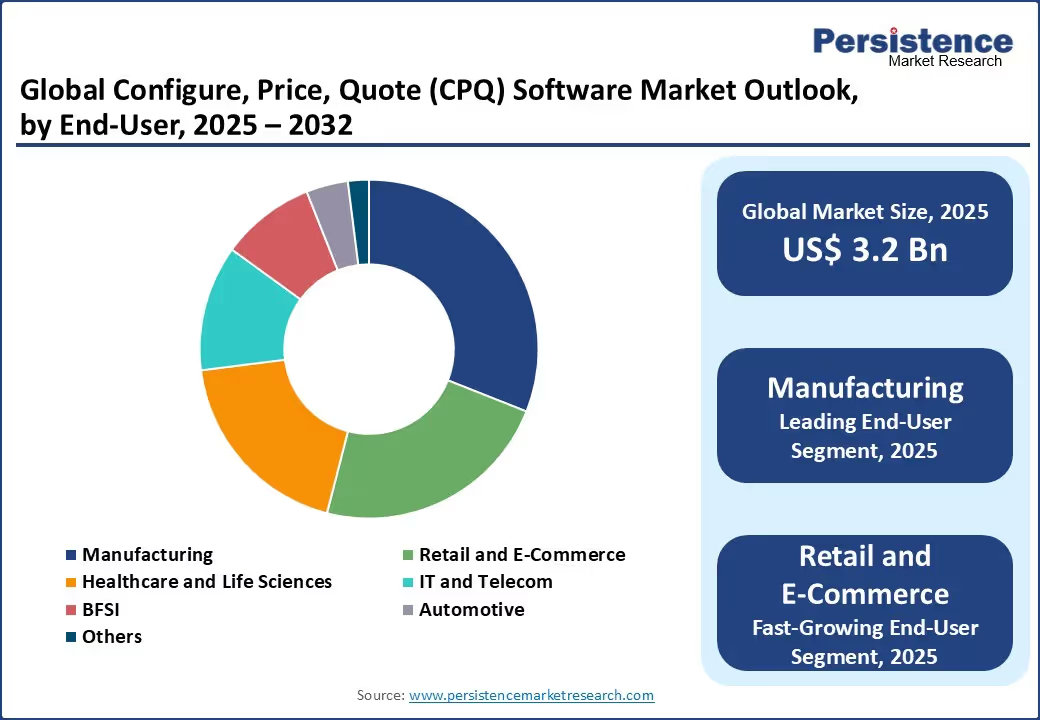
In this guide, we’ll break down how CPQ automation works, why it’s essential for modern sales teams, and how it can streamline your sales workflows, reduce errors, and boost productivity.
Whether you're in SaaS, manufacturing, or any industry with complex pricing models, this blog will show you how CPQ automation can help your team close more deals, faster.
What is CPQ Automation?
CPQ automation is a software that automatically handles product configuration rules, pricing calculations, and quote generation without manual intervention.
Instead of relying on spreadsheets, static price lists, or back-and-forth approvals, CPQ systems apply predefined business rules to configure valid product combinations, calculate accurate prices, and generate compliant quotes in real time.
By automating these repetitive and error-prone tasks end-to-end, CPQ automation improves quote accuracy, accelerates sales cycles, and ensures pricing consistency at scale.
Modern CPQ tools also integrate seamlessly with CRM systems, enabling real-time data flow so sales teams can configure complex products, apply dynamic pricing models, and deliver customer-ready quotes instantly.
This automation removes bottlenecks, supports scalability, and makes CPQ an essential capability for sales teams optimizing revenue workflows in 2026.
At its core, CPQ automation integrates three key components, product configuration, pricing logic, and quote generation, into one seamless system. Here's how each component works:
- Product Configuration
This step allows sales reps or even customers (in self-service scenarios) to select and customize product options, ensuring that all configurations meet business rules and product compatibility requirements.
For example, in the case of a manufacturer offering customizable machines, the CPQ system will ensure that only valid combinations of parts or features are selected, preventing costly errors in production or delivery.
- Pricing Logic
Pricing can vary widely based on product combinations, discounts, volume tiers, or contract terms. CPQ automation applies dynamic pricing rules automatically, adjusting the quote based on the customer’s specific configuration.
This can include real-time calculations for discounts, taxes, and even multi-currency support, ensuring that the final price is accurate. A well-configured CPQ system can handle even the most complex pricing models, from tiered pricing to subscription-based billing, all without needing manual intervention.
- Quote Generation
After configuring the product and applying pricing logic, CPQ systems generate professional, error-free quotes in seconds. These quotes are typically customizable, ensuring that they reflect the company’s branding and can include specific terms, conditions, and legal disclaimers.
This step not only accelerates the process but also ensures that quotes are always consistent, up-to-date, and aligned with company guidelines.
What sets CPQ automation apart is its integration with other business systems, such as CRM (Customer Relationship Management) and ERP (Enterprise Resource Planning).
By syncing with CRM systems like Salesforce, CPQ tools can access the most up-to-date customer data and history, ensuring that quotes are personalized and aligned with the customer’s specific needs.
This combination of automation and integration makes CPQ systems particularly valuable for businesses with complex, customizable product offerings or dynamic pricing structures.
Now, let's dive deeper into why CPQ automation is crucial for modern sales teams and how it can transform sales operations.
Why CPQ Automation Matters for Modern Sales Teams
Manual quoting for complex, customizable products is time-consuming and prone to errors.
Sales reps often spend hours configuring products, calculating pricing, and seeking internal approvals, delaying quotes and increasing the risk of mistakes.
CPQ automation addresses these challenges by streamlining the entire quoting process, allowing sales teams to quickly generate accurate quotes with minimal manual input.
- CPQ automation reduces the time spent on administrative tasks, allowing sales reps to focus on what matters most: selling and building relationships with customers.
- By automating the quoting process, CPQ systems accelerate the sales cycle, allowing reps to handle more leads and close deals faster. Quotes that once took hours or days can now be generated in minutes, reducing response times.
- With complex product catalogs, multiple pricing models, and constantly evolving customer requirements, maintaining consistent and accurate quotes manually becomes nearly impossible.
CPQ automation ensures that all quotes follow the same rules and guidelines, reducing pricing errors and maintaining brand consistency.
- CPQ automation easily scales with your business as it can manage large catalogs, dynamic pricing, and custom configurations without slowing down or compromising accuracy.
As sales teams aim to boost efficiency and scale operations, many are turning to automation-first revenue platforms like Everstage. These platforms integrate CPQ automation with other sales operations, such as compensation and performance tracking, creating a unified solution to eliminate inefficiencies across the board.
Let’s take a closer look at how CPQ automation works.
How CPQ Automation Works: Core Components & Workflow
.avif)
CPQ automation streamlines the entire quoting process by integrating three key steps, configuration, pricing, and quote generation, into one seamless workflow. This system simplifies even the most complex deals by ensuring consistency, reducing errors, and speeding up the sales cycle.
Here’s a deeper look at how each component functions:
1. Configure: Handling Product/Service Complexity
The “Configure” step is the first phase in the CPQ automation process, where users (sales reps or customers) select and customize products, services, or bundles.
This is particularly useful for businesses offering highly customizable or configurable products, like manufactured goods, enterprise software, or bundled services, where product offerings can vary widely based on customer preferences.
- Customization and Feasibility Checks:
The CPQ system ensures that customers or sales reps can only choose combinations of product features or options that are compatible and feasible.
For example, a customer may want to configure a server with specific hardware specifications, but CPQ ensures that incompatible options (e.g., a CPU that isn’t supported by a certain motherboard) are automatically blocked.
- Enforcing Business Rules:
CPQ software enforces configuration rules and constraints based on predefined business guidelines. This includes checking for compatibility between components, ensuring product configurations meet industry regulations, and ensuring the offerings are within the company’s pricing structure.
Example: A software company might only allow certain modules to be bundled together or enforce limits on the number of licenses per product tier.
- Efficiency in Customization:
In scenarios where product complexity and customization are high, manually configuring products can become both time-consuming and error-prone.
CPQ automation automates this process, allowing sales reps to quickly and accurately configure products according to the customer's exact specifications, without needing deep technical knowledge.
This step is a major efficiency booster, especially for businesses offering a wide range of customizable options that would be too difficult and slow to manage manually.
2. Price: Dynamic, Rule-Based & Accurate Pricing
Once the product configuration is complete, the “Price” component of CPQ automation comes into play. This step calculates the final price of the configured product based on a set of predefined rules and business logic.
- Applying Complex Pricing Models:
CPQ automation supports a variety of complex pricing models, ensuring that the final price reflects the unique needs of each customer. Some of these pricing models include:
- Tiered Pricing: Pricing based on the volume or quantity purchased, where the price per unit decreases as more units are bought.
- Volume Discounts: Customers receive discounts based on the number of units or the value of their order.
- Multi-Currency Pricing: For businesses with a global customer base, CPQ systems can handle multi-currency pricing, ensuring that quotes are provided in the correct currency based on the customer's location.
- Subscription-Based Pricing: For SaaS or service-based businesses, CPQ systems can apply subscription rates or recurring billing cycles.
- Contract-Based Pricing: Pricing tailored to long-term contracts with customized terms, such as enterprise agreements with negotiated discounts.
- Real-Time Pricing:
CPQ automation ensures that pricing is calculated in real time, pulling in the latest data from pricing models, inventory systems, or customer-specific discount tiers. This is critical in environments where prices fluctuate based on factors like demand, market conditions, or contract terms.
For example, if the cost of raw materials increases, the CPQ system will automatically adjust the price for future quotes, reflecting the latest cost structure without needing manual intervention.
- Error Prevention and Pricing Consistency:
One of the key advantages of CPQ automation is that it helps prevent manual errors in pricing.
With automatic calculations based on predefined rules, the CPQ system eliminates the risk of inconsistent pricing, ensuring that every quote is accurate and adheres to business guidelines.
This automation not only saves time but also ensures that pricing is always correct and reflects the true cost of the product, helping maintain profitability while also providing transparency for customers.
3. Quote: Fast, Accurate Quote Generation & Delivery
Once the product has been configured and priced, the “Quote” step is the final stage in the CPQ workflow. At this point, the CPQ system generates a professional, customized quote or proposal document that sales reps can quickly send to the customer.
- Automatic Document Creation:
The CPQ system automatically generates a fully formatted, professional quote, incorporating all product details, pricing, and terms.
These documents are usually branded to the company’s specifications, ensuring that every quote is consistent with the company’s style and compliance guidelines.
- Internal Approvals and Discount Authorization:
CPQ automation can be integrated with internal workflows to automate approvals for discounts or special pricing.
For instance, if a sales rep applies a discount beyond a certain threshold, the system can automatically route the quote for approval, speeding up the process and ensuring that pricing stays within approved boundaries.
- Quick Delivery and Real-Time Updates:
Once the quote is generated, the system can instantly send it to the customer, either as a PDF or through an online portal, allowing for faster responses.
This real-time delivery is crucial for businesses that operate in industries where customers expect quick, accurate quotes. It also allows sales reps to respond to customer requests immediately, reducing the chance of losing a deal to competitors who may have slower response times.
- Reducing Sales Cycle Time:
By automating the entire quoting process, from configuration and pricing to document generation, CPQ systems drastically reduce sales cycle time. Quotes that used to take hours or days can now be delivered in minutes, making it easier for sales reps to close deals faster and engage with more customers.
The ability to generate quotes quickly and accurately, while ensuring they meet internal policies, boosts sales team productivity and improves the overall buyer experience. Faster quotes also increase the chances of conversion, as prospects get the information they need when they need it.
By automating the product configuration, pricing, and quote generation steps, CPQ systems ensure greater speed, accuracy, and efficiency.
Whether you're dealing with highly customizable products, complex pricing models, or global customers, CPQ automation simplifies the process, reducing the risk of errors, accelerating sales cycles, and improving customer satisfaction.
Now, let's explore the key benefits that CPQ automation brings for businesses.
Key Benefits of CPQ Automation
.avif)
CPQ automation offers a wide range of benefits that dramatically improve sales processes, enhance customer satisfaction, and boost overall business profitability. Below are some of the most impactful advantages of implementing CPQ systems:
1. Efficiency & Speed: Faster Quotes, Shorter Sales Cycles
- Quick Quote Generation:
CPQ automation drastically reduces the time spent creating quotes. What once took hours or even days to configure products, calculate pricing, and draft proposals can now be completed in minutes. Sales reps can generate professional quotes instantly, making the entire process more agile.
- Accelerated Sales Cycles:
With CPQ automation, the quoting process is no longer a bottleneck. Reps spend less time on administrative tasks like checking product availability, applying discounts, or manually calculating prices.
This reduction in time spent on non-selling activities allows sales teams to engage more prospects, handle more leads, and ultimately close more deals. The faster you can quote, the faster you can close.
- Handling More Leads:
With automated quote generation, sales teams can handle a higher volume of leads without sacrificing quality or accuracy. As a result, businesses can scale their sales operations while maintaining or even improving efficiency, boosting overall sales productivity.
2. Error-Free Selling: Ensuring Accuracy and Pricing Discipline at Scale
- Automated Product Configurations:
Manual quoting is prone to errors, especially when sales reps are configuring complex product options or bundling services. CPQ automation automatically enforces configuration rules and ensures that only valid, compatible products are chosen.
For instance, in manufacturing, a rep can’t configure a machine with incompatible parts; CPQ systems ensure only feasible combinations are available. This greatly reduces human error and improves the consistency of product offerings.
- Accurate and Consistent Pricing:
Pricing errors, whether due to miscalculations or overlooked discounts, are common in manual systems. CPQ tools automatically calculate the price based on predefined rules, applying the correct base price, discounts, promotions, or contractual terms.
This ensures that every quote is consistent, compliant with company rules, and aligned with the current pricing strategy. By eliminating manual adjustments, CPQ reduces the risk of rogue discounting or pricing mistakes.
- Discipline in Discounting:
In many sales environments, discounting can quickly spiral out of control, leading to margin erosion. CPQ automation ensures that discounts are applied within predefined limits, reducing the likelihood of sales reps offering unauthorized discounts that could hurt profitability.
CPQ systems can also automate approval workflows for larger discounts, preventing revenue leakage and ensuring compliance with pricing strategies.
3. Built to Scale: Managing Complex Catalogs and Pricing
- Handling Product Complexity:
As product offerings expand or become more complex, managing configurations manually becomes increasingly difficult.
CPQ automation is designed to scale with your business. Whether it’s handling complex product catalogs with numerous variations or bundling services that require specific configurations, CPQ systems ensure that every quote is accurate, no matter how complicated the product mix.
Example: A SaaS company with various subscription models, features, and user tiers can use CPQ to automatically apply the correct pricing and configuration based on the customer’s needs.
- Dynamic Pricing Support:
Businesses often face the challenge of managing dynamic pricing structures that change based on customer type, region, volume, or contract terms.
CPQ systems excel at handling multiple pricing models simultaneously, whether it’s subscription-based pricing, tiered pricing, or volume discounts.
The ability to dynamically adjust prices in real time based on a customer's specific profile ensures that no matter how complex your pricing model is, CPQ can handle it without error.
- Seamless Growth:
As your business grows and your product catalog expands, CPQ automation scales effortlessly. It handles larger product catalogs, more complex pricing structures, and an increasing number of customer-specific variables without slowing down.
This scalability ensures that businesses, whether small or large, can continue to rely on their CPQ systems as they evolve.
4. Improved Customer Experience & Satisfaction
- Faster, More Accurate Quotes:
Today, customers expect quick responses to their inquiries. With CPQ automation, businesses can provide fast, accurate, and tailored quotes without delays.
This speed enhances the customer experience by showing that your business values their time, which can help build trust and increase the likelihood of a sale.
- Personalized, Transparent Quotes:
One of the biggest advantages of CPQ automation is the ability to create highly personalized quotes.
Sales reps can configure products based on customer preferences and apply custom pricing based on the customer’s contract terms or volume, ensuring that the quote is exactly what the customer needs. This level of personalization adds value and helps differentiate your offering.
Example: In the case of a telecommunications provider, CPQ can create tailored packages for each customer based on their service history, preferences, and contract terms.
- Transparency in Pricing:
CPQ systems not only speed up the quoting process but also improve transparency. Customers can be confident that the price they are receiving is consistent, accurate, and based on clear rules. This reduces confusion or uncertainty around pricing, improving customer satisfaction and building long-term trust.
5. Better Profitability: Margin Protection, Upsell & Cross-Sell Opportunities
- Protecting Margins:
CPQ automation ensures that pricing and discounts remain in line with company guidelines, protecting your profit margins. With automated pricing rules and discount controls, businesses can ensure that every quote is aligned with their profitability goals.
This prevents reps from offering discounts that could erode margins, ensuring that sales are made at the right price.
- Pricing Leakage Prevention:
CPQ systems prevent pricing leakage by enforcing discounting policies, pricing rules, and approval thresholds automatically. By applying rule-based pricing and structured approval workflows, CPQ automation ensures sales reps cannot underprice deals or apply unauthorized discounts outside predefined limits.
This built-in control eliminates inconsistent pricing, protects margins, and ensures every quote aligns with approved pricing strategies. Automated approvals for larger discounts also reduce delays while maintaining pricing discipline, helping businesses safeguard profitability without slowing down the sales process.
- Upselling and Cross-Selling:
One of the most powerful features of CPQ systems is their ability to identify upsell and cross-sell opportunities. Based on customer preferences and their configuration choices, CPQ systems can suggest relevant add-ons, upgrades, or complementary products.
These recommendations not only increase the average order value (AOV) but also help sales teams generate additional revenue from existing customers.
Example: For an enterprise software company, CPQ can automatically suggest premium features or extended licenses to customers based on their previous purchase history, increasing AOV and customer lifetime value.
CPQ automation revolutionizes the quoting process by dramatically improving speed, accuracy, and scalability. By automating routine tasks like product configuration and price calculations, CPQ enables sales teams to focus on relationship-building and closing deals, driving greater revenue and profitability.
Let’s dive into who can benefit most from CPQ automation and when it’s the right solution for your business.
When (and Who) Should Use CPQ Automation: Typical Use Cases & Ideal Scenarios
CPQ automation is essential for businesses facing specific challenges in their quoting and pricing processes. It offers significant advantages for organizations dealing with complexity, customization, and growth.
Below are the ideal scenarios and use cases where CPQ automation provides the most value:
1. Companies with Complex or Configurable Products/Services
Businesses offering customizable products, such as manufacturing firms, enterprise software vendors, or modular hardware companies, can benefit greatly from CPQ automation.
- The Challenge: Manually configuring products with numerous options is error-prone and time-consuming.
- How CPQ Helps: CPQ systems automate product configuration, ensuring only valid, compatible combinations are selected. This reduces errors and accelerates the quoting process.
For example, an enterprise software vendor with multiple configurable modules can automate product selection and pricing, ensuring accurate, tailored quotes every time.
2. Organizations with Large Product Catalogs, Variants, Bundles, or Custom Configurations
Companies with extensive product catalogs, complex configurations, or custom service offerings often struggle with traditional quoting systems, such as price lists or spreadsheets.
- The Challenge: As product offerings grow, manually managing pricing and configurations becomes inefficient and prone to mistakes.
- How CPQ Helps: CPQ systems manage large inventories, complex variants, and bundles, automatically applying the correct pricing and configurations to each quote.
For example, a company selling modular hardware with multiple options can quickly assemble and price custom configurations, streamlining the entire sales process.
3. Businesses Needing Dynamic Pricing, Contract-Based Pricing, Subscriptions, or Recurring Billing
For B2B businesses with dynamic pricing models, such as volume discounts, contract-based pricing, or recurring billing, CPQ automation simplifies complex pricing and ensures consistency.
- The Challenge: Managing diverse pricing models manually can lead to errors, inconsistent pricing, and slow response times.
- How CPQ Helps: CPQ systems automate pricing based on real-time data, ensuring accurate calculations for dynamic pricing, subscription models, and custom contracts.
For instance, a SaaS provider can use CPQ to apply the correct subscription rates and discounts based on customer profiles and contract terms, ensuring precise pricing with every quote.
4. Sales Teams Aiming to Scale Operations, Increase Quote Throughput, Reduce Errors, and Shorten Sales Cycles
As sales teams grow or sales volume increases, the manual quoting process becomes inefficient and difficult to scale.
- The Challenge: Manual quoting slows sales cycles, increases errors, and limits the number of deals a team can handle effectively.
- How CPQ Helps: CPQ automation speeds up quote generation, reduces errors, and enables reps to handle more leads without sacrificing quality, ultimately shortening sales cycles and increasing throughput.
For example, a growing enterprise can use CPQ automation to handle more quotes quickly and accurately, freeing up time for sales reps to focus on closing deals and building relationships.
5. Businesses with Complex Discount Structures and Approval Hierarchies
Companies with complex discount structures and multi-level approval hierarchies benefit significantly from CPQ automation.
- The Challenge: Managing discount approvals manually leads to delays, inconsistent pricing, and pricing leakage as sales reps rely on emails or spreadsheets for authorization.
- How CPQ Helps: CPQ systems automate discount rules and approval workflows, automatically routing quotes for approval based on predefined thresholds and updating pricing instantly once approved.
For example, an enterprise sales team can allow reps to approve standard discounts while automatically escalating higher discounts to sales leadership or finance, ensuring faster deal cycles and consistent pricing control.
CPQ automation is essential for businesses with complex product catalogs, dynamic pricing, complex discount structures, and large sales teams. Whether you're a manufacturer, SaaS provider, or growing enterprise, CPQ automation streamlines the quoting process, reduces errors, and accelerates sales cycles.
Let’s explore the best practices for successfully integrating CPQ automation into your sales operations.
Best Practices for Implementing CPQ Automation
Successfully implementing CPQ automation requires thoughtful planning and execution. These best practices will ensure you achieve maximum efficiency and accuracy with minimal disruption.
1. Start with a Clear Product Catalog and Rule-Based
Define your product catalog, pricing rules, and configuration constraints upfront. Establish clear guidelines for:
- List compatible and incompatible product combinations.
- Set base pricing, discounts, taxes, and special pricing conditions.
- Define discount thresholds and approval processes to maintain pricing discipline.
This ensures smooth automation, accurate quotes, and compliance with your pricing strategy.
2. Integrate CPQ with CRM and ERP Systems
Integrating CPQ with your CRM (e.g., Salesforce) and ERP systems ensures seamless data flow across departments:
- Pull in up-to-date customer information for personalized quotes.
- Sync with ERP to reflect accurate stock levels and product availability.
- Ensure that pricing is aligned across all systems.
This integration improves accuracy, reduces errors, and keeps all data consistent across sales and fulfillment teams.
3. Use Guided Selling and User-Friendly Interfaces
For complex products, provide guided selling tools that help sales reps and customers configure products correctly:
- Offer step-by-step prompts to guide users through configuration choices.
- Ensure CPQ systems are intuitive, even for reps with minimal product knowledge.
This ensures accurate configurations and better sales rep adoption, even in complex scenarios.
4. Implement Approval Workflows & Discount Controls
Set up approval workflows for discounts and special pricing to maintain margin discipline:
- Automatically route discounts above a predefined threshold for approval.
- Ensure pricing rules are followed across all sales reps.
This helps protect margins, reduce revenue leakage, and maintain consistent pricing standards.
5. Adopt Incremental Rollout & Training
Implement CPQ in stages to allow teams to adjust:
- Begin with a limited range of products or configurations and gradually expand.
- Use input from sales teams to optimize the system.
- Provide thorough training to ensure teams are comfortable with the new system.
A phased rollout helps smooth adoption and ensures a more successful implementation.
6. Monitor KPIs to Optimize the Process
Regularly track and analyze key performance indicators (KPIs) to measure the effectiveness of CPQ automation:
- Monitor how quickly quotes are generated and converted into orders.
- Track the number of errors in quotes to ensure accuracy.
- Assess how CPQ impacts sales throughput and deal size.
- Use data insights to continually optimize configuration rules, pricing, and approval processes.
Monitoring KPIs ensures CPQ is functioning optimally and helps refine processes over time.
Implementing CPQ automation requires a well-planned approach. By defining product catalogs, integrating systems, and focusing on usability and training, businesses can set up a seamless, efficient quoting process.
When evaluating CPQ solutions, prioritize platforms with a flexible rule engine and seamless CRM integration. Everstage CPQ offers modular automation frameworks that integrate smoothly into existing systems, minimizing customization needs while streamlining quoting processes
Looking ahead, let's explore the emerging trends in CPQ technology, including AI-powered tools and how they are shaping the future of automation in sales operations.
Emerging Trends: AI-Powered CPQ & Future of CPQ Automation
AI and machine learning (ML) are transforming CPQ automation, making it more intelligent and adaptable.
Here are the key trends shaping the future of CPQ systems:
1. AI-Powered Upsell, Cross-Sell, and Guided Selling
AI-enabled CPQ systems go beyond static rules by actively guiding sales reps through product configuration, pricing decisions, and deal structuring. These systems use AI to recommend upsell and cross-sell opportunities while also providing guided selling and configuration assistance, especially in complex product environments.
- How It Works: AI analyzes customer data, purchase history, usage patterns, and deal context to suggest relevant add-ons, upgrades, or higher-tier products.
At the same time, AI-driven guided selling helps reps select valid configurations, surfaces best-fit options, and flags incompatible choices in real time, reducing dependency on product experts.
- Example: A SaaS provider using an AI-enabled CPQ like Everstage CPQ can automatically recommend premium modules based on a customer’s current usage while guiding reps through correct bundle configurations and pricing logic.
This ensures accurate quotes, higher deal values, and faster turnaround without manual intervention.
By combining AI-powered recommendations with guided configuration, CPQ platforms help sales teams close larger, more accurate deals while reducing errors and ramp time. Everstage CPQ connects these AI-driven CPQ capabilities with performance visibility and incentive alignment, enabling revenue teams to optimize quoting, selling behavior, and outcomes in one unified platform.
2. Predictive and Dynamic Pricing with AI/ML
AI and ML are powering predictive pricing and dynamic pricing models, allowing businesses to adjust prices in real-time based on factors like demand, customer profile, and market conditions.
- Predictive Pricing: AI forecasts optimal pricing based on customer behavior and historical data, ensuring pricing aligns with customer needs.
- Dynamic Pricing: Pricing is adjusted in real-time, reflecting demand fluctuations, competitor prices, or seasonal trends.
- Example: A travel company could adjust hotel room rates based on booking patterns or competitor prices, while a SaaS provider could offer discounts for early renewals based on customer engagement.
This dynamic approach to pricing ensures businesses remain competitive while optimizing revenue.
3. Integration with Quote-to-Revenue Platforms
CPQ systems are increasingly integrated with quote-to-revenue platforms, unifying CPQ, billing, renewals, subscription management, and analytics into one seamless workflow.
- End-to-End Automation: Integration enables a smooth transition from quote generation to invoicing and renewals, streamlining the entire revenue lifecycle.
- Revenue Insights: Integrated systems provide valuable analytics, helping businesses track sales performance, predict churn, and optimize pricing strategies.
- Example: A subscription-based business can automate renewals, adjusting pricing based on contract terms and providing real-time insights into customer behavior.
This integration reduces administrative overhead, improves accuracy, and ensures consistency across the revenue process.
4. Growing Adoption Among Mid-Sized Companies
While large enterprises have traditionally dominated the CPQ space, mid-sized companies are increasingly adopting CPQ tools to scale their operations and manage complex sales processes.
- The Challenge: Mid-sized businesses often face the same complexities as large enterprises but lack the resources to manage manual quoting systems.
- How CPQ Helps: Modern cloud-based CPQ tools offer affordable, scalable solutions, allowing mid-sized businesses to handle complex pricing models, dynamic configurations, and integrations without overburdening their sales teams.
- Example: A mid-sized manufacturer can automate quoting for its diverse product offerings and dynamic pricing, allowing its sales team to generate accurate quotes faster and focus more on closing deals.
AI and ML are transforming CPQ automation, enabling smarter pricing, better upselling, and seamless workflows. These advancements help businesses optimize sales processes, increase deal value, and improve revenue management.
Platforms like Everstage CPQ offer flexible, AI-powered automation frameworks that help businesses drive growth by seamlessly integrating CPQ with their existing systems. With these advancements, CPQ automation will continue to be a vital tool for companies looking to remain competitive and fuel expansion.
Conclusion & Key Takeaways
CPQ automation is changing the way businesses manage quoting, pricing, and product configurations.
By automating key tasks, CPQ boosts speed, accuracy, and scalability, allowing sales teams to focus on closing deals instead of administrative work. This results in shorter sales cycles, higher productivity, and ultimately faster revenue growth.
When implemented correctly, CPQ automation becomes a powerful tool for driving business success. AI-powered CPQ takes this further, enabling dynamic pricing, personalized quotes, and streamlined revenue operations, helping businesses stay competitive and efficient.
The shift to automation-first revenue operations is clear, and solutions like Everstage CPQ are leading the way, helping organizations transition to integrated, automated systems that support growth.
As sales teams scale, automated CPQ is crucial for reducing errors, speeding up quote times, and improving profitability.
If you're ready to enhance your sales process and drive measurable growth, book a demo with Everstage today and see how CPQ automation can help your business thrive.
Questions worth asking
The things most people want to know before they commit.
What is CPQ automation, and how does it work?
CPQ (Configure, Price, Quote) automation is the use of software tools to automate the process of configuring products, calculating pricing, and generating quotes for sales. It helps businesses streamline their sales workflows by eliminating manual tasks, ensuring pricing accuracy, and speeding up the quoting process. By integrating with other systems like CRMs, CPQ automation enhances data flow and provides real-time, accurate information for sales teams.
How can CPQ automation improve sales processes?
CPQ automation improves sales processes by reducing errors, speeding up the quoting process, and enhancing sales efficiency. It allows sales teams to configure complex product offerings, calculate accurate pricing, and generate professional quotes faster. The automation of these tasks frees up sales representatives to focus on selling rather than administrative work, leading to better sales productivity and higher revenue.
What are the benefits of using CPQ tools for pricing and quoting?
CPQ tools offer several benefits for pricing and quoting, including increased accuracy, faster quote generation, and a more efficient sales process. These tools ensure that sales teams always use the correct pricing models, reducing manual errors and discrepancies. They also provide real-time updates and can be customized to meet specific business needs, ensuring that quotes are accurate and consistent across the organization.
How does CPQ automation integrate with CRM and ERP systems?
CPQ automation integrates with CRM and ERP systems to centralize data and improve workflow efficiency. By syncing with CRM systems, CPQ tools ensure that sales teams have access to up-to-date customer information, while integration with ERP systems allows for real-time pricing and inventory data. This seamless integration helps sales teams generate accurate quotes, track customer interactions, and manage pricing dynamically based on business data.
How can CPQ software help reduce errors in sales quoting?
CPQ software reduces errors in sales quoting by automating the pricing calculations and configuration processes. With predefined rules and pricing models, CPQ tools eliminate the risk of human error, ensuring that quotes are generated based on the correct product configurations and pricing tiers. This leads to more consistent, accurate quotes and a reduction in discrepancies or disputes with customers.
What industries can benefit from CPQ automation?
CPQ automation benefits a wide range of industries, including manufacturing, technology, SaaS, healthcare, and telecommunications. Any business with complex pricing models or a need to configure customized products can benefit from CPQ automation. By streamlining sales workflows and improving pricing accuracy, CPQ tools help companies in these industries accelerate their sales cycles and enhance customer satisfaction.