

.avif)
TL;DR
- CPQ configures products and applies pricing to generate accurate quotes quickly for sales teams
- Quote to Cash manages the full revenue lifecycle, from contract and billing through cash collection and revenue recognition
- CPQ sits inside the quote-to-cash process as one stage of it
- Understanding the difference helps teams avoid revenue leakage and poor tooling decisions
- For growing revenue teams, the practical approach is usually CPQ first, then a connected quote-to-cash workflow as billing and renewal complexity increase
Many revenue problems begin before billing or forecasting. They start at the quoting stage, when teams confuse CPQ with the broader quote-to-cash process. They then build the wrong workflow around it.
Sales teams use CPQ to create accurate quotes faster. Finance depends on quote-to-cash workflows to turn those quotes into clean contracts and recognized revenue. As organizations scale, RevOps gets stuck fixing the handoffs between CRM and billing systems.
When this turns into a CPQ versus quote-to-cash debate, teams end up with rework and revenue leakage. Data and ownership break across CRM and billing systems. McKinsey research shows that manual work across the quote-to-cash process can consume up to 50% of sales time.
The tools work fine. The gap is how teams understand them. CPQ supports sales execution, while quote-to-cash manages the full revenue lifecycle. Without this clarity, speed improves upstream, but accuracy breaks downstream.
To understand the Quote to Cash and CPQ difference, we first need to look at Quote to Cash as a complete revenue process.
What Is Quote to Cash?
Quote to Cash (Q2C) is an end-to-end revenue process that spans several teams and systems. It explains how a business moves from creating a quote to collecting cash. It keeps pricing and revenue accurate as the company scales.
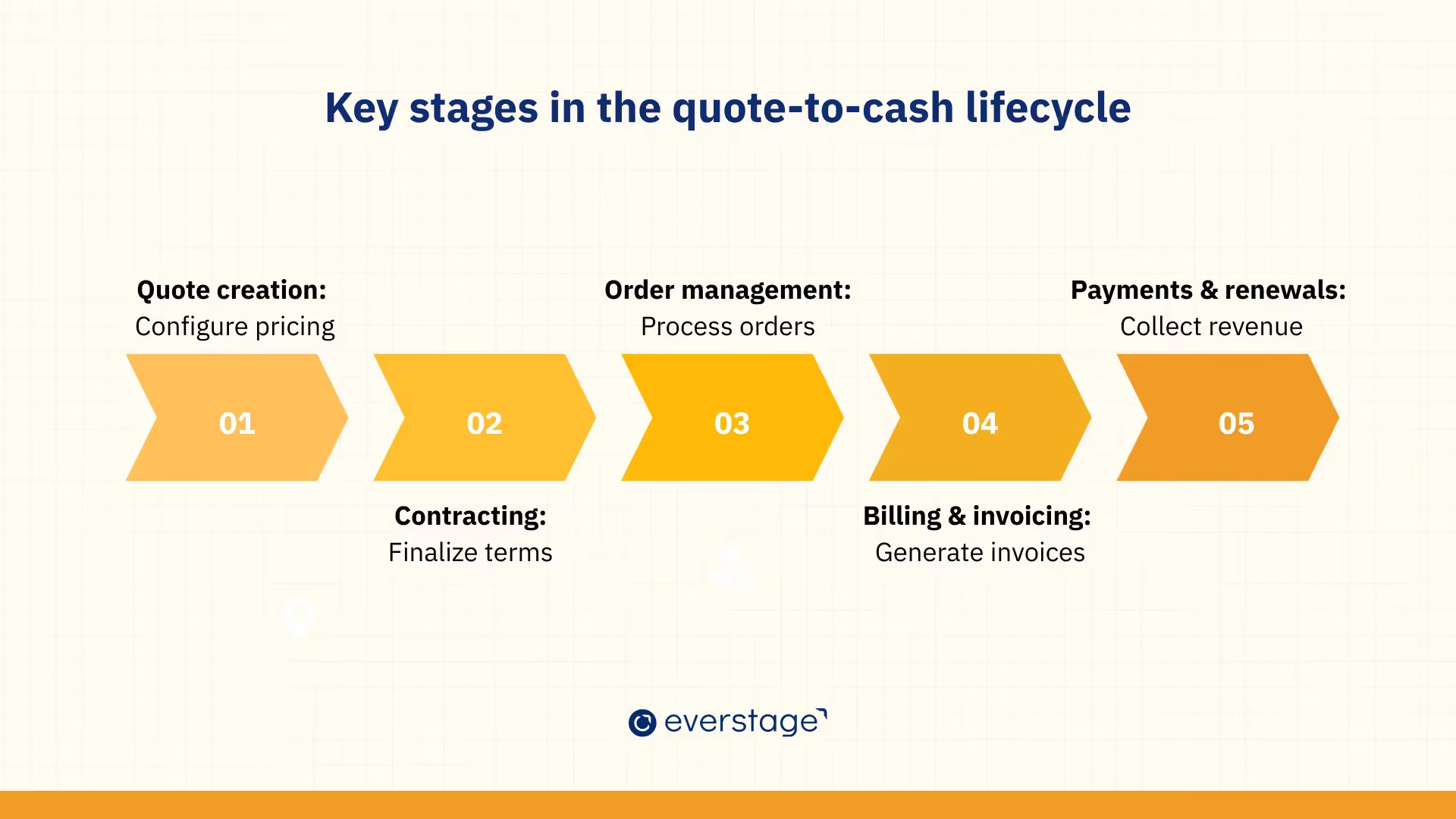
The quote-to-cash process covers the full path: Initial quote → signed contract → order → billing → cash collection → revenue recognition.
Key Stages in the Quote-to-Cash Process
- Quote creation: Sales teams create quotes using approved products and discount rules. This stage captures commercial intent and enforces guardrails early, which reduces downstream rework. Accurate quote creation ensures that what is sold can be contracted and recognized as revenue as deal volume grows.
- Contracting: Once a quote is accepted, legal and sales finalize contract terms such as payment schedules and renewal conditions. These terms govern downstream billing and revenue recognition. Contract accuracy keeps revenue predictable and lowers risk.
- Order management: Order management converts signed contracts into executable orders that downstream systems can process. It confirms that products, quantities, and timelines align with what was sold. It also supports upgrades and amendments. This stage connects sales intent to operational execution across fulfillment and billing systems.
- Payments & renewals: Finance teams manage cash collection and dispute resolution. For recurring revenue models, this stage also covers renewals and expansions across the customer lifecycle. Breakdowns earlier in the process appear here as delayed payments and churn risk.
- Billing & invoicing: Billing systems generate invoices from order data and contract terms, including billing schedules and proration. Accuracy at this stage directly affects cash flow and customer trust. Gaps between orders and billing surface as invoice disputes or delayed collections.
Why Handoffs Matter in Quote to Cash
Most delays and revenue leakage happen during handoffs between teams and systems. For example, a rep applies a custom discount in CPQ, but the billing system misses that discount logic. Finance then has to correct the invoice by hand, which delays cash collection and creates reporting risk.
In short, Quote to Cash manages the full revenue lifecycle. Sales initiates the deal and finance governs revenue. Legal supports contracts, and RevOps keeps workflows connected and scalable.
One of the earliest stages in Quote to Cash is quote creation. This is where CPQ comes into play.
What Is CPQ? (Configure, Price, Quote)
CPQ (Configure, Price, Quote) is a sales-focused automation tool that helps sales teams create accurate quotes faster. It supports the quoting stage of the sales process and stops short of the full revenue lifecycle. For how that quoting stage actually gets automated, from configuration logic to approval routing, see our guide to CPQ quote automation.
What CPQ Does in the Quote-to-Cash Process
CPQ improves quoting by breaking it into three steps:
- Configure: Applies product rules and compatibility checks so reps select the right products.
- Price: Automates discounts and approval routing for accurate pricing.
- Quote: Generates fast, customer-ready proposals with approved terms.
CPQ is mainly used by sales reps and sales operations teams. It streamlines quoting and shortens sales cycles.
What CPQ Does Not Cover in the Revenue Lifecycle
In the quote to cash versus CPQ discussion, teams mistake CPQ for a full revenue system. It covers only the quoting stage.
CPQ leaves these tasks to other systems:
- Billing and invoicing
- Contract management
- Revenue recognition
- Cash collection or renewals
Assuming CPQ manages these steps creates broken handoffs and downstream revenue risk.
CPQ output is an approved, accurate quote. The quote-to-cash process manages everything after that.
Now that we have defined both concepts individually, the real question becomes how they relate to each other.
Where CPQ Fits in the Quote-to-Cash Lifecycle
CPQ is a subset of the Quote to Cash process, one stage inside it. In the quote to cash versus CPQ discussion, this is the point most teams miss.
For teams evaluating CPQ, the key extends past quote creation. The test is whether quote data supports downstream execution across approvals and revenue visibility. This is where Everstage CPQ can help revenue teams build a more connected quoting workflow.
CPQ's Exact Role in the Lifecycle
CPQ operates at the front of the quote-to-cash process, during sales execution. Its job is to turn a sales opportunity into an approved, accurate quote that downstream systems can trust.
The full lifecycle looks like this:
Lead → CPQ (Quote) → Contract → Order management → Billing & invoicing → Cash → Revenue recognition
- CPQ supports sales teams by configuring products and applying pricing rules to generate accurate quotes in the CRM.
- Quote to Cash takes that quote through contracts and billing, then on to payments and revenue recognition.
Why This Placement Matters
Because CPQ sits upstream, its output becomes the input for billing and revenue systems. If pricing or product configuration is wrong in CPQ, those errors flow into invoices and compliance reporting.
This is where many growing SaaS companies see problems:
- Manual handoffs between CPQ, contract management, and billing systems
- Pricing mismatches between quotes and invoices
- Delayed invoicing and longer sales cycles
- Revenue leakage when quote data fails to carry approved products and billing schedules into downstream systems
Treating CPQ as a standalone tool instead of part of a connected quote-to-cash workflow increases operational risk as deal complexity and pricing models grow.
CPQ helps create the deal; Quote to Cash helps manage and monetize it. With that relationship clarified, we can now compare Quote to Cash and CPQ side by side.
Quote to Cash vs CPQ: Side-by-Side Differences
The easiest way to understand quote to cash versus CPQ is to compare them across how revenue flows through the business. The comparison comes down to ownership and scale.
How CPQ and Quote to Cash differ across scope, users, systems, and best-fit scenarios.
Evaluating CPQ for a growing revenue team?
See how Everstage helps teams standardize pricing, approvals, and revenue execution. Book a Demo
Why This Comparison Matters
Many teams evaluate CPQ versus quote to cash as a tool decision. In reality, it is a process maturity decision. CPQ helps sales teams close deals faster. Quote to Cash turns those deals into clean invoices and compliant revenue.
When CPQ is treated as a full revenue solution, gaps appear:
- Manual handoffs between quoting and billing
- Pricing mismatches between quotes and invoices
- Delayed invoicing and longer cash cycles
Understanding this difference helps teams avoid overbuying tools or underbuilding the revenue process.
Even with a clear comparison, misconceptions still exist. Let's address the most common ones.
What Quote-to-Cash vs CPQ Means for Each Revenue Team
For RevOps
CPQ is where pricing logic and approval rules begin. Quote-to-cash is where RevOps moves approved quote data into billing and commissions without manual re-entry.
For Finance
Finance should evaluate whether CPQ outputs can be trusted downstream. Incorrect discounts or missing billing terms can lead to invoice disputes and revenue leakage.
For Sales Leaders
CPQ helps reps quote faster and reduces approval delays. It creates value when reps adopt it consistently and downstream teams can execute what was sold.
For Sales Operations
Sales Operations should focus on rep usability and pricing rule enforcement. Clean approval routing keeps quoting fast without creating downstream cleanup.
For Legal
Legal should check whether approved quotes translate into contract terms that match what was sold. That includes payment schedules and renewal language.
Benefits of Optimizing the Quote-to-Cash Process
When quote-to-cash works as a connected lifecycle, the value shows up across every revenue team. Here are the benefits grouped by who feels them most:
- Sales: Faster quote approvals and shorter sales cycles.
- Finance: Cleaner invoices and stronger revenue recognition, with better cash flow visibility.
- RevOps: Cleaner handoffs between systems and less manual rework.
- Customer experience: Accurate, professional proposals and consistent billing that build trust and improve renewal management.
Benefits of CPQ Software in the Quote-to-Cash Workflow
CPQ delivers value at the front of the revenue lifecycle and improves the quality of every downstream stage. The main benefits include:
- Faster quote speed: Reps generate accurate, customer-ready quotes in minutes instead of days.
- Pricing accuracy: Automated rules eliminate manual pricing errors and inconsistent discounts.
- Discount governance: Approval workflows enforce guardrails before a quote reaches the customer.
- Proposal consistency: Every quote reflects approved products, terms, and bundles.
- Sales productivity: Reps spend less time on configuration and more time selling.
- Faster customer response: Quick turnaround keeps deals moving and reduces stalls.
- Cleaner upstream data: Approved quote data improves the reliability of billing, ERP, and revenue systems downstream.
Common Quote-to-Cash Challenges and How CPQ Helps Solve Them
Most quote-to-cash problems trace back to where ownership and data break across teams. Here are the common challenges and whether CPQ, Q2C, or both are needed to fix each.
- Inaccurate Quotes: Manual quoting introduces wrong products and prices. CPQ solves this by enforcing product rules and pricing logic at the source.
- Pricing Mismatches: Quotes and invoices disagree when discount logic stops before billing. CPQ creates clean data; Q2C integration ensures it reaches billing.
- Delayed Approvals: Slow, email-based approvals stall deals. CPQ automates multi-stage approval routing based on discount and term thresholds.
- Invoice Disputes: Customers dispute invoices that differ from what they signed. This is a Q2C problem solved by connecting CPQ output to billing without manual re-entry.
- Delayed Collections: Invoice errors delay cash. Both CPQ accuracy and clean Q2C handoffs are needed to shorten collection cycles.
- Revenue Recognition Errors: Misaligned contract and billing data create compliance risk. This sits with Q2C and finance systems, beyond CPQ alone.
- Missed Renewals: Renewals and expansions slip when lifecycle data is fragmented. Q2C workflows handle recurring revenue; CPQ supports renewal quoting.
- Poor Reporting: Disconnected systems produce unreliable forecasts. Both clean CPQ data and connected Q2C reporting are required.
Technology Stack for Quote-to-Cash and CPQ
CPQ is one part of a broader revenue technology architecture. Each lifecycle stage maps to a system category that produces data the next stage depends on.
How each quote-to-cash lifecycle stage maps to a system category, its users, and the data it produces.
Quote-to-Cash vs Order-to-Cash vs CPQ
These three terms overlap but cover different parts of the revenue lifecycle. Here is how they compare on starting point and final business outcome.
How CPQ, quote-to-cash, and order-to-cash differ across start point, owner, systems, and outcome.
Common Misconceptions About CPQ vs Quote to Cash
Confusion around quote to cash versus CPQ leads teams to make decisions that slow sales and create revenue risk. Below are the common misconceptions, explained as expert guidance.
Misconception 1: CPQ and Quote-to-Cash Are the Same
CPQ supports quote creation. Quote-to-cash manages the full path from quote through billing and revenue recognition. Treating CPQ as the full process blurs ownership between sales and finance.
Misconception 2: CPQ Can Replace Billing or ERP
CPQ leaves tax logic and revenue recognition to other systems. Without integration, finance reconciles quote data by hand when quotes differ from invoices.
Misconception 3: Quote-to-Cash Is Only a Finance Process
Quote-to-cash spans sales and finance, with legal and RevOps involved. When ownership is unclear, workflows break between CRM and billing.
Misconception 4: CPQ Is Only for Large Enterprises
Pricing complexity drives the need for CPQ more than company size does. Growing SaaS teams with discounts and renewals outgrow manual quoting quickly.
Misconception 5: Accurate Quotes Guarantee Accurate Revenue
Accurate quotes improve revenue data quality. They guarantee accurate billing and forecasting only when quote data flows cleanly into downstream systems.
Clearing up these misconceptions helps teams avoid overbuying tools and design workflows that scale cleanly.
Once these misconceptions are cleared up, the next step is deciding what your business actually needs.
When Should You Use CPQ, Quote to Cash, or Both?
Treat the quote to cash versus CPQ decision as a process design choice instead of a tool purchase. What you need depends on where complexity shows up in your revenue lifecycle, and which teams feel the pain first.
If your team manages 50+ reps, multiple product lines, and custom discounts, CPQ becomes more of a revenue control layer than a sales productivity tool.
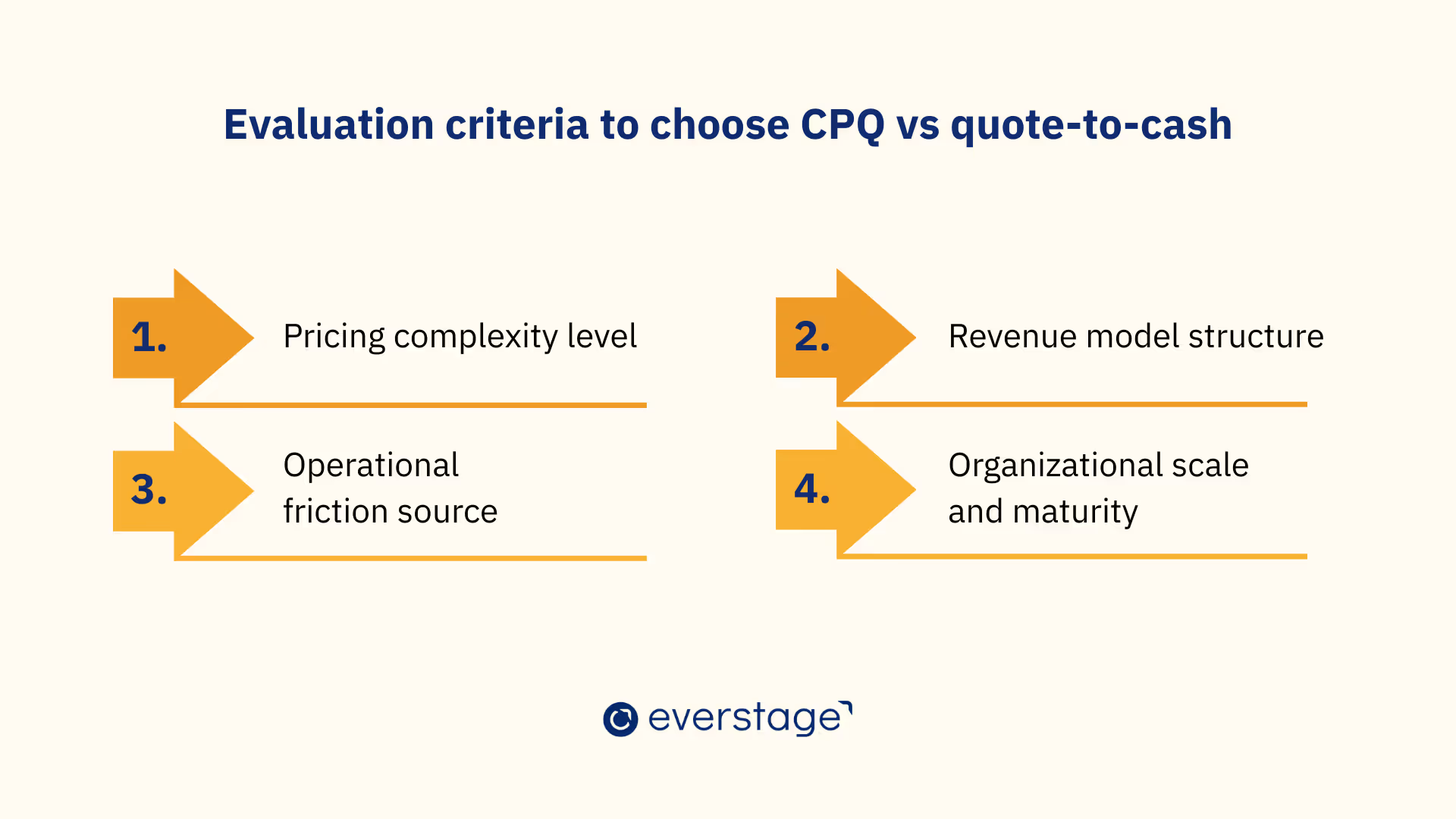
Evaluate Your Situation Across Four Critical Dimensions
1. Product and pricing complexity:
If you sell simple products with fixed prices, quoting is usually straightforward. As soon as you introduce configurable products and tiered pricing, manual quoting breaks down.
CPQ becomes essential to generate accurate quotes and enforce pricing rules. Quote to Cash becomes necessary only when those quotes must reliably flow into billing and fulfillment systems.
2. Revenue model structure:
One-time sales are easier to manage with limited automation. Subscription models and usage-based pricing increase downstream complexity. When revenue depends on billing schedules or consumption data, Quote to Cash manages invoicing and revenue recognition correctly.
3. Source of operational friction:
If sales teams struggle with slow quote generation or pricing errors, CPQ is the right starting point. If finance teams struggle with invoice mismatches or revenue leakage, the problem sits in the quote-to-cash process, beyond quoting alone.
4. Organizational scale and maturity:
Early-stage teams operate within a single CRM and manage billing by hand. As organizations grow into multiple teams and regions, handoffs between CRM, billing, and forecasting get harder to control. An end-to-end Quote to Cash workflow keeps them in check. The decision should involve RevOps, Finance, and GTM leadership. CPQ decisions affect billing accuracy and incentive payouts.
Common Decision Scenarios
Common symptoms mapped to whether CPQ, quote-to-cash, or both are the likely fix.
- CPQ-only is sufficient when the goal is to standardize pricing and shorten sales cycles, while billing and finance stay simple.
- Full Quote to Cash is required when issues appear after the deal closes, such as invoice disputes or compliance risk.
- CPQ first, Quote to Cash later is the common, practical path, where teams stabilize quoting early and expand into Q2C as revenue models and operational complexity increase.
This stays a layering decision, not a replacement. CPQ and Quote to Cash solve different problems at different stages. Most companies layer Quote to Cash around CPQ as their revenue operations mature.
If CPQ is the right starting point, the next question becomes how to implement it effectively within your Quote-to-Cash workflow.
How to Implement CPQ in Your Quote-to-Cash Workflow
Implementing CPQ works best when you treat it as part of your broader quote-to-cash (QTC) processes instead of a standalone front-end tool. The goal is to improve how sales teams configure and price deals, while those quotes flow cleanly into downstream revenue workflows.
Step 1: Assess Where Quoting and Approvals Break Today
Start by reviewing how your sales teams handle quote generation today, especially for complex products or custom deals. Many teams rely on manual steps that slow response times and increase errors. These issues show up as long quote turnaround times and missed cross-sell opportunities.
Step 2: Standardize Products, Pricing, and Discount Rules
Before implementing CPQ software, define how products get configured and how discounts get approved. This includes rules for bundles and upgrades tied to customer needs. Alignment across sales and finance helps CPQ produce accurate quotes that keep customers satisfied.
Step 3: Choose CPQ Software Based on Integration Readiness
Select CPQ tools that fit your existing tech stack, starting with CRM and extending into billing where needed. Early success depends less on advanced features and more on whether the system passes configure-price-quote data into downstream workflows as volume grows.
Integration readiness means the CPQ system passes approved quote data into downstream systems without manual re-entry. That data includes products and pricing. It also carries billing schedules and approval history.
Step 4: Connect CPQ to Downstream Quote-to-Cash Workflows
CPQ should feed approved pricing and deal terms into contract and billing systems without manual re-entry. When CPQ becomes the trusted front-end of the quote-to-cash solution, invoice accuracy improves and revenue leakage declines. Forecasting metrics get more reliable across finance and RevOps.
Step 5: Train Sales Teams and Reinforce Consistent Usage
Sales reps need to understand how CPQ supports both speed and accuracy. Training should focus on real-deal scenarios and how accurate quoting protects downstream teams. Consistent usage helps sales teams respond faster in real time while maintaining strong customer relationships.
Common CPQ Implementation Mistakes to Avoid
Teams over-customize CPQ systems early, which slows implementation and limits scalability. Ignoring finance alignment leads to gaps between quotes and revenue recognition. Treating CPQ as a standalone tool instead of part of integrated quote-to-cash processes leads to manual workarounds and broken workflows.
As CPQ stabilizes quoting and improves customer experience, many organizations need better visibility into what happens after deals close. That means clearer performance metrics and revenue outcomes.
Everstage CPQ helps revenue teams standardize quoting and pricing approvals so clean quote data moves downstream into billing and revenue workflows.
With the right implementation approach in mind, let's summarize the key takeaways.
How Everstage Fits Into the CPQ and Revenue Performance Workflow
Everstage gives revenue teams more control and visibility into how deals move from quote to approval to revenue performance. For RevOps and Finance teams, this means fewer disconnects between what sales quotes and what finance recognizes.
- Standardize pricing and approval workflows
- Improve visibility into deal and revenue performance
- Connect revenue execution with incentive outcomes
- Reduce manual effort across RevOps and Finance
Build a Connected Revenue Process That Reduces Rework and Risk
The quote to cash versus CPQ question comes down to building a revenue process that works end-to-end.
CPQ helps sales teams create accurate quotes faster. Quote to Cash turns those deals into clean contracts and accurate invoices, with predictable cash flow. When teams blur this difference, issues surface later as revenue leakage and forecast misses. Manual rework spreads across sales and finance.
Strong revenue teams take a lifecycle-first approach. They use CPQ to stabilize quoting early, confirming that products and pricing are accurate before a deal reaches the customer.
From there, the focus shifts to aligning what happens after the deal closes through a connected quote-to-cash workflow. When CPQ feeds clean data downstream, teams reduce rework and scale with confidence.
For RevOps and Finance teams, the goal is to connect these workflows so billing and revenue performance hold steady as the business scales.
Everstage CPQ helps revenue teams standardize quoting and connect quote accuracy with broader revenue execution.
Book an Everstage demo to see how your team can standardize quoting and connect CPQ with cleaner revenue execution.
Questions worth asking
The things most people want to know before they commit.
Is CPQ part of quote-to-cash?
Yes. CPQ is a subset of the quote-to-cash process. It operates at the front of the lifecycle during sales execution, turning opportunities into approved quotes. Quote-to-cash then manages contracts and billing through revenue recognition downstream.
Does CPQ support usage-based or consumption pricing?
CPQ supports usage-based pricing at the quote stage. It leaves usage tracking and revenue recognition to other systems. Those capabilities sit in the broader quote-to-cash process through billing and revenue systems.
What systems are usually involved in quote-to-cash?
Quote-to-cash typically involves a CRM for opportunities and CPQ for configuration and pricing. Contract lifecycle management handles terms, and order management handles fulfillment. Billing systems produce invoices, while ERP and revenue recognition systems handle finance and accounting. Analytics covers reporting.
When should finance be involved in CPQ decisions?
Finance should get involved early when pricing rules or revenue recognition are affected. Early alignment prevents gaps between quotes and reported revenue later in the quote-to-cash process.
When should a company implement CPQ before a full quote-to-cash process?
Implement CPQ first when the main pain is in quoting, such as slow generation or pricing errors, while billing and finance stay simple. This is the most common and practical path. Teams stabilize quoting early, then expand into a full quote-to-cash workflow as revenue models and operational complexity increase.
Can CPQ handle renewals and expansions?
CPQ helps with quote renewals and expansions. It leaves renewal billing and recurring revenue tracking to other systems. These functions belong to quote-to-cash systems that handle subscriptions and lifecycle revenue management