Build vs. buy, for AI-native teams
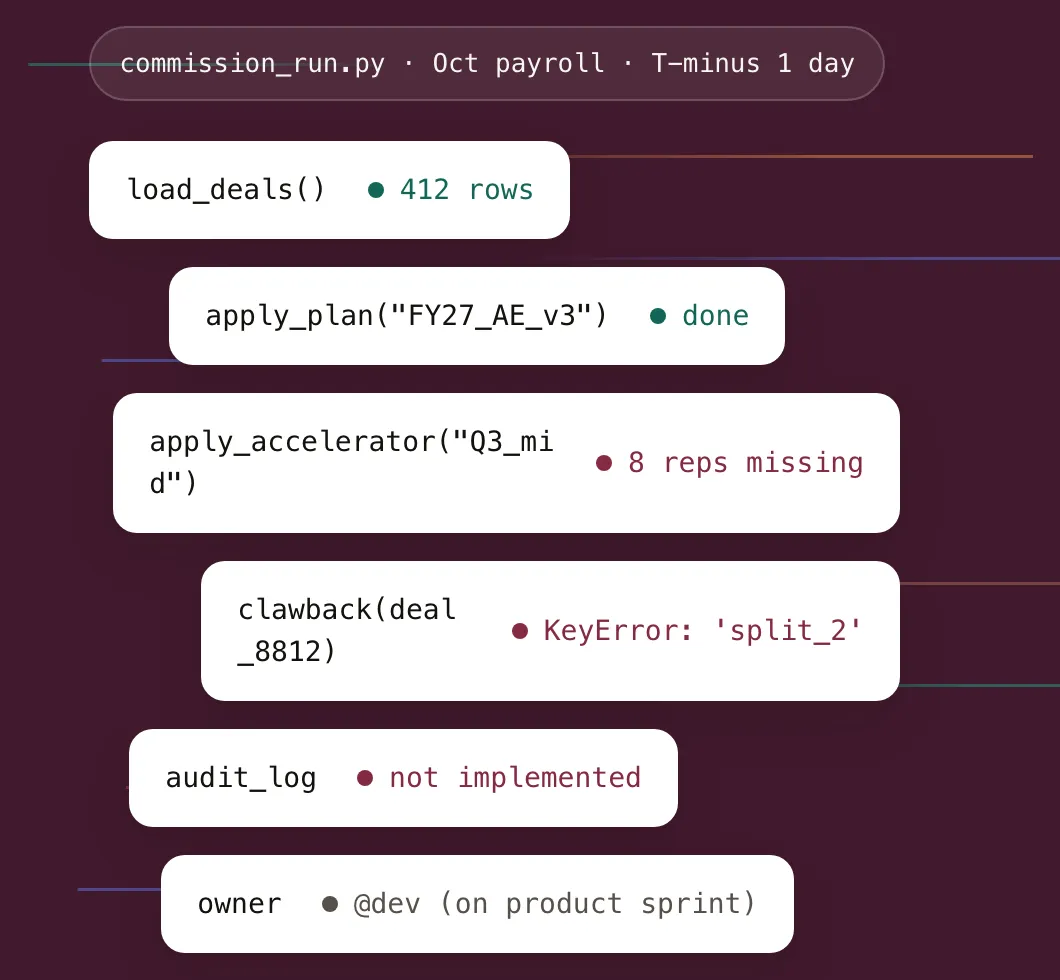
A vibe-coded commission tool works fine. Until payday hits.
Engineering ships the payout math in a week. Then come the mid-year plan change, the clawback on a paid deal, and a March dispute in July, with the builder back on the product.
AI-native teams that could have built it, and bought Everstage instead. 400+ companies run commissions on Everstage.









Based on 3,500+ customer reviews




From the WorldatWork Total Rewards 2026 stage
Perplexity built it first. Then they bought Everstage.
1
Built
A working comp model in about 1.5 weeks, with Claude and GPT on Snowflake and Salesforce data.
2
Learned
Production needs access controls, role-based visibility and someone maintaining it every quarter.
3
Decided
None of that made Perplexity’s product better. Comp wasn’t their edge.
4
Bought
Took the build to vendors as a spec, split must-haves from nice-to-haves, and chose Everstage.
"If it isn't core to your product or your edge, buy it, and make the vendor own the integrity."

Nathan Follen
Head of Enterprise Ops, Perplexity
The first 12 months of a vibe-coded comp system
Everyone loved the first demo of the vibe-coded tool. Here’s the rest of the year.
When
On the build
Who’s in your DMs
With

Week 1
The payout math works. Everyone's impressed.
Your CTO
"Told you. One week."
Same math, live in a few weeks, set up by our in-house Implementation Architects.
CTO
Fine. One less thing I own.
Month 2
A new accelerator for 8 reps, starting mid-quarter. It's a ticket to engineering.
Your CRO
"Can the new accelerator be live before Monday’s kickoff?"
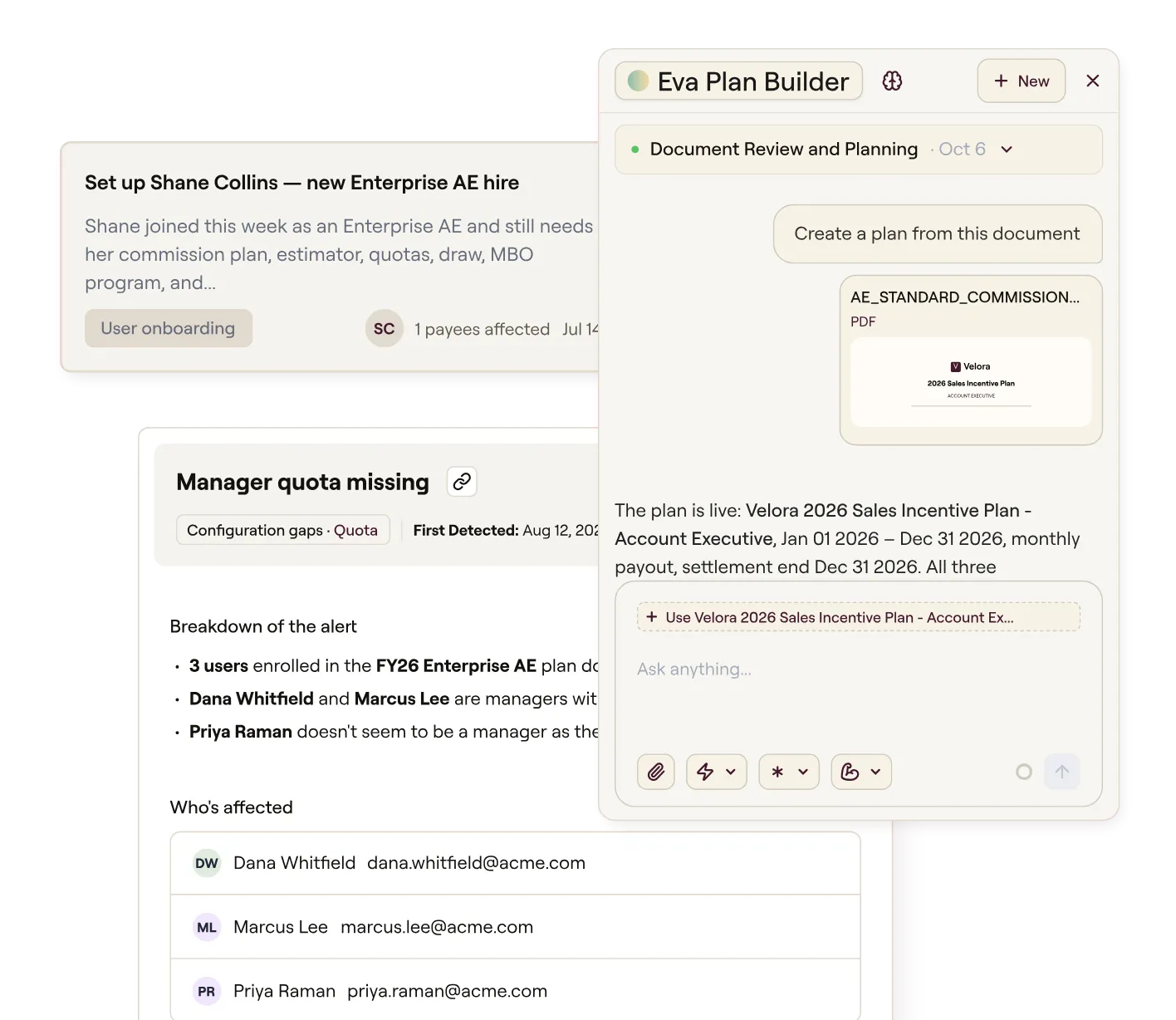
Your comp admin describes the change to Eva, Everstage's AI teammate. Eva drafts the plan logic and the data work, and tests it on the real engine before it goes live.
CRO
It’s already live? Then who do I chase?
Month 4
A rep disputes a March payout. Nobody can say which plan version or which deals produced the number.
Your AE
"My March number is wrong. I have screenshots."
Full history on every record. Reps click any line on their statement to see how it was calculated.
AE
Oh. Okay. I’ll go close something.
Month 6
Finance wants approvals and an audit trail before anything reaches payroll.
Your finance partner
"I can’t sign off on payroll until I know who changed what."
Approval workflows before payout. Every change is logged with who, when, and before and after.
Finance partner
I have no follow-up questions. That’s a first.
Month 9
The engineer who built it is back on the product roadmap. RevOps inherits code nobody on the team can read.
Your eng lead
"Can RevOps own the commission repo now? I’m on the roadmap."
Your team owns the plans. We own the platform.
Eng lead
Great. Please remove me from #comp-ops.
Month 12
New fiscal year. Every plan changes at once.
Your CFO
"What will next year’s plans cost us?"
Model next year's plans on last year's real data before you launch them.
CFO
Put that in the board deck.
You're busy. Spend the week designing the revenue system instead of firefighting it.
We asked 195 North American revenue leaders where their time goes. Commission work tops the list of manual chores, and a homegrown tool adds one more: keeping it running.
52.6%
name comp disputes as a manual time sink, the most of any task.
48.1%
still verify commission calculations and payouts by hand.
40%
vs 15.3%
Teams that show reps their commission at close are far more likely to spend most of their time on strategic work.
Source: Everstage, T+0: The Commission Visibility Report (Revenue Execution 2026), with Emporia Research. 195 senior revenue leaders in North America, Jul 14 to Aug 5 2026. Self-reported.

Eva, Everstage's AI teammate
A homegrown tool waits for a rep to find the bug. Eva finds it first.
Set the intent once, like "flag payout anomalies before the run closes." Eva checks every run and pings you in Slack, Teams, email or on your phone.
- No quota assigned
- Unlocked statements
- Unrecovered negative earnings
- Plan gaps
- Bad data
"The fastest way to lose a comp team's trust is to give them a number that changes when they ask twice."

Vivek
CTO, Everstage
Three ways to run commissions
Vibe-coded build
Spreadsheet-style comp platforms
1. Time to first payout
Days to weeks
Often a quarter, frequently through a partner
A few weeks, implemented by our in-house Implementation Architects
2. Plan changes
A ticket to engineering
Admin edits across linked sheets
Describe it to Eva; tested on the real engine first
3. Catching errors before payday
Whatever your tests cover
You ask, the AI answers
Watchers check every run and alert you
4. Rep disputes
Someone reads the code
Statement plus a support ticket
Rep clicks the line item and sees the calculation
5. Audit trail and approvals
Build it yourself
Yes
Yes, with full history on every record
6. Security
Your own review
Typically SOC 2
SOC 2 Type II, SOC 1, ISO 27001, ISO 42001, GDPR, CCPA
7. AI access from Claude or ChatGPT
A raw database connection
Varies
Eva via MCP, same permissions and same math
8. Who maintains it
The engineer who built it
The vendor, plus your admin
Us
Forward this to whoever said "We'll just build it"
1
Who owns this system after the person who builds it moves on?
2
When a rep disputes a payout from 2 quarters ago, how will you show which plan version and which deals produced it?
3
How many times will your plans change this year, and who makes each change?
4
What will Finance need to see before signing off on payroll?
5
If you're public or heading to an IPO, how does this hold up in an audit?
6
Who gets paged when the run fails the night before payroll?
Sometimes building is the right call.
If every line on the left is you, a script will do. We'll help you scope it on a call: the data model, the plan logic, and the checks worth adding. Come back when a line on the right comes true.
A script will do
You'll outgrow it
One plan, no tiers or splits
Tiers, splits, accelerators or clawbacks
Fewer than 15 reps
15+ reps, and hiring
No plan changes this year
Plans change mid-year
Finance doesn't need an audit trail
Finance signs off before payroll
Your builder is staying put
Your builder has a roadmap to get back to
The Build Trap
Five stages every homegrown comp tool goes through. A formula that puts a dollar amount on the maintenance cost nobody budgeted for. And the full Perplexity story: they built it, ran it for weeks, and bought anyway.

"Everstage is the commissions source of truth that RevOps can actually control. We were able to scale sales compensation from 80 to 350 payees."

Brian Le
Sales Compensation Partner, Notion
Bring your spec. Leave with a plan that survives payday.
Send what your team built or plans to build. In 30 minutes we mark what tends to show up after go-live. You keep the list, even if you build.


Questions RevOps teams ask us
Can't we just build our commission tool with Claude or Cursor?
You can, and the payout math will likely work in a week. The cost shows up later: mid-year plan changes, clawbacks on paid deals, disputes about past quarters, and the audit trail Finance asks for before payroll.
When does building commission software in-house make sense?
When all five are true: one plan with no tiers or splits, fewer than 15 reps, no plan changes this year, no audit trail needed by Finance, and a builder who isn't going anywhere.
We already built ours. When should we switch?
Bring your spec. In 30 minutes we mark what tends to show up after go-live. You keep the list, even if you keep building.
Can our engineers still work with commission data if we buy?
Yes. Engineers reach Eva from Claude or ChatGPT through MCP, with the same permissions and the same math as the platform.
Does Everstage's AI calculate payouts with an LLM?
No. Eva writes SQL against the rules that produce the official payout. The model never does the math.