TL;DR
Everstage's model is self-serve for day-to-day operations and support-assisted for complex configuration work, by design. Admins handle run management, reporting, dashboards, user access, and standard plan operations directly. Complex commission plan logic, structural plan changes, and custom analytics get in-house support involvement — included for every customer, with no tiers and no add-on fees. Reactive tickets follow severity-based SLAs (1 to 6 business hours), the in-house team monitors 24/5, and business-hour coverage runs 8 AM to 5 PM in each customer's local timezone. The wait the reviews describe is governed by the SLA, not by an open queue.
What the reviews say, and what they leave out
We heard you. This is a complaint we took seriously.
Here's the feedback in customers' own words:
- "Certain changes still require direct intervention from Everstage's support team."
- "Reliance on support for certain changes creates bottlenecks during critical closure periods."
- "Complex changes in comp rules or reports may require support involvement."
Each one reads the support model as a gap. None of them describes the model Everstage actually sells. Support involvement isn't an accidental dependency: it's the value bundle every customer gets included, with no tier upgrade and no professional-services line item. The competitive question isn't whether complex changes need expert involvement — every ICM platform requires that. The question is who pays for it, how fast the response is, and what gets done day-to-day without ever opening a ticket.
What Everstage's support model covers
The model has three layers. The first two come included for every customer. The third governs how fast the first two run.
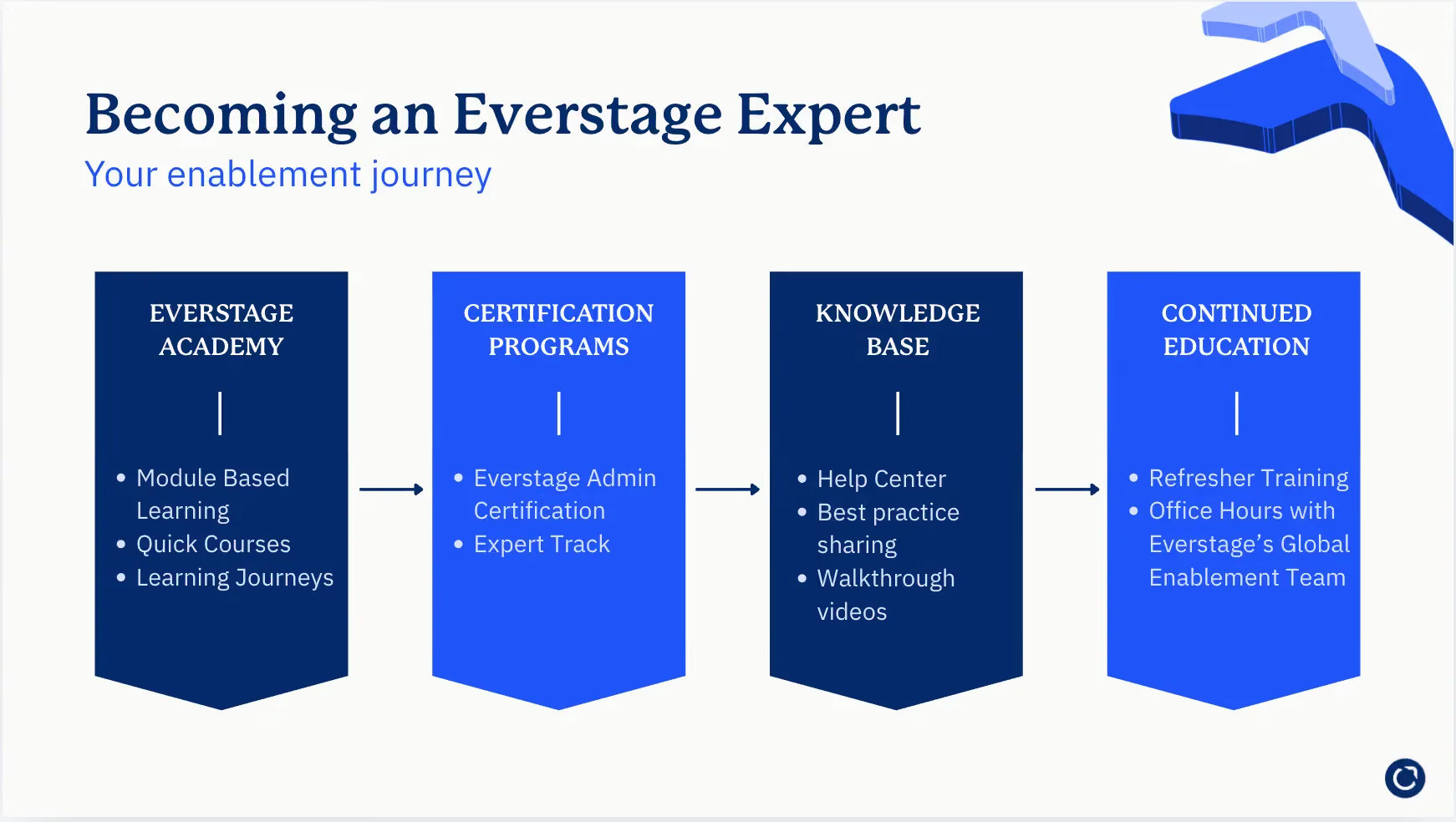
Self-serve admin layer. Day-to-day operations sit with the customer's admins: run scheduling and execution, statement review, exception handling, user provisioning and access, dashboard navigation, and standard reporting. Admins don't open a ticket to run a commission cycle or pull a report.
Proactive support layer (included). Commission plan configuration and updates, dashboard and reporting customization, compensation strategy guidance, data and integration support, and onboarding continuity. The in-house team builds, modifies, and tests plans alongside the customer's team — mid-cycle adjustments, fiscal-year rollouts, SPIFFs, and bespoke dashboard requests. This is the work other ICM platforms charge a professional services fee for.
Reactive support layer. Bug resolution, incident management, integration and data-flow troubleshooting, with severity-based response times in the 1-to-6 business-hour range, escalation paths that run from support rep to CTO, and a 99.9% uptime guarantee.
The structure: in-house team (not outsourced), 24/5 monitoring of tickets, business-hour availability 8 AM to 5 PM in the customer's local timezone, equal premium support for every customer regardless of contract size.
How the model builds toward customer self-sufficiency
The involvement model isn’t static. Three things Everstage does structurally to reduce how often customers need a ticket over time:
- Customers work directly with the Everstage team to get multi-tiered plan logic and approvals right the first time. Getting the configuration accurate at setup reduces the volume of correction requests in steady state.
- Features are enabled selectively based on what each customer’s team actually uses. Keeping the interface scoped to relevant functionality reduces noise and support requests that come from configuration confusion.
- Customers have a direct channel to feed back into the product roadmap. When an admin workflow is consistently triggering support requests, that pattern surfaces as an input for what gets built into the self-serve layer next.
The pricing model removes the most common support-bottleneck pattern. In many ICM deployments, the reason support involvement creates bottlenecks is that the customer is on a tier that doesn't include the support level they actually need, or the proactive work sits behind a professional services engagement. Everstage's structure removes both gates: the same support model applies to every customer, and proactive plan/dashboard work is included.
Why complex comp rule changes go through the proactive support layer
"Complex changes in comp rules may require support involvement" reads as a limitation. The product reality is that the in-house team handles this work as a service — not as a paid gate, but as the default. A senior comp ops person reviewing a new accelerator structure before it goes live is the kind of involvement most customers describe as the reason they bought Everstage, not the reason they're frustrated with it.

The honest trade-off: customers who specifically want every plan change to be admin-self-serve, with no expert review layer, are evaluating a different model than the one Everstage runs. For customers who want the expert review included, the proactive layer is the answer.
What active customers report in practice
Customers running commissions on Everstage describe the support relationship differently from the review summaries. The pattern is closer to "extension of our team" than "vendor we open tickets with." Two examples from Everstage's customer collateral:


What’s already available on Everstage
Several workflows that previously required a support request are now fully self-serve from the admin UI:
- Auto Locking Payouts. Admins define rules and schedules to automatically lock payouts for selected payees. Manual locking used to mean relying on admins to remember schedules and act at the right time. This removes that dependency entirely.
- HRIS Auto-Sync. HRIS updates are automatically approved and imported. Records with no data differences are silently cleared without cluttering the queue. Admins stay in control without being stuck in a manual review loop for every HR change.
- Approval Workflow Improvements — Fallback Options. When an approver leaves the organization or a hierarchy-based approver doesn't exist in the system, the workflow now automatically reassigns to a valid alternate or skips the stage. Approval requests keep moving without admin firefighting or support tickets.
- AI-Assisted User Onboarding. Admins define natural-language assignment rules, run them, and eligible users are onboarded to commission plans in one go — including handling internal transitions. What previously required navigating across multiple modules and hands-on implementation time is now a single operation.
- Bulk Datasheet Adjustments. Admins import a file to update, ignore, or split multiple datasheet records at once. Pre-filled templates reduce setup effort. What previously required manual scripts or backend intervention is fully self-serve from the UI.
On the roadmap
- Contracts Revamp. Provider-agnostic contract management with native e-sign capability. AI populates placeholder values directly from existing data sources — admins define what a field should hold in natural language, and the system handles the rest. Removes the current dependency on DocuSign and the manual drag-and-drop placeholder setup.
- AI-Assisted User Onboarding — Extended Modules. The current module automates commission plan assignments. Upcoming expansion covers Crystal, quotas, and draws. New rep activation and internal transitions become fully self-serve across modules, not just commission plans.
- MBO Phase 2 — Bulk Operations. Managers handle MBO reviews in bulk — submitting multiple records or performing bulk overrides without opening each individually. End-of-cycle crunches that currently generate high support volume become a matter of a few clicks.
- In-product communication — giving admins the ability to create banners and tooltips natively within Everstage for targeted, self-serve payee communication.
FAQs
What changes can Everstage admins make without contacting support?
Day-to-day platform operations: running commission cycles, reviewing statements, handling exceptions, configuring standard reports and dashboards, managing user access and permissions, and standard plan operations. Recent platform additions have expanded this further. Auto Locking Payouts, HRIS Auto-Sync, Approval Workflow fallbacks, AI-Assisted User Onboarding, and Bulk Datasheet Adjustments are all fully admin self-serve today. Complex plan logic changes, custom dashboards beyond standard configuration, and integration adjustments route through the in-house support layer that comes included.
What's Everstage's support response time?
Reactive tickets follow severity-based SLAs in the 1 to 6 business-hour range. Tickets are monitored 24/5 with business-hour coverage from 8 AM to 5 PM in each customer's local timezone. Escalation paths run from support rep to CTO. The system-level uptime guarantee is 99.9%.
Does Everstage charge extra for proactive support or premium tiers?
No. Every customer gets the same support model: in-house team, severity-based reactive SLAs, and proactive support for plan configuration, dashboard customization, comp strategy guidance, and integration work. No tiers, no add-on fees.
How does Everstage handle support during commission close periods?
The same in-house team, the same severity-based SLAs, and the same proactive support model. Customers route the most time-sensitive close-period requests through the in-app support widget or support portal where severity tagging triggers the fastest response, and lean on the proactive layer to batch plan changes ahead of close-week pressure.
Why do complex comp rule changes go through support?
Because complex comp logic changes are where a single misconfigured rule produces incorrect payouts at scale, and Everstage's model bundles expert involvement for that work rather than asking admins to absorb the risk. For customers who want every plan change to be admin-self-serve with no expert review layer, that's a different model than the one Everstage runs.
Is Everstage's support team in-house or outsourced?
In-house. The reactive and proactive support work is handled by Everstage's own team, with escalation paths that run inside the company up to the CTO. Onboarding continuity means the same team carries customer context forward from implementation onward, so customers don't re-explain their environment ticket-to-ticket.
How does Everstage's support model compare to other ICM platforms?
Most ICM platforms structure support in tiers (with the level of access tied to contract size) and bill plan configuration work as professional services. Everstage's model is the inverse: equal premium support for every customer, with proactive plan and dashboard work included rather than billed as an engagement.
What does Everstage's CSAT score look like?
98% positive in 2025. CSAT is measured across the in-house support team's ticket resolution and proactive engagement work.
Is Everstage expanding what admins can do without a ticket?
Yes. Auto Locking Payouts, HRIS Auto-Sync, Approval Workflow fallbacks, AI-Assisted User Onboarding, and Bulk Datasheet Adjustments all moved into the admin self-serve layer in the last product cycle. On the roadmap: Contracts Revamp (provider-agnostic e-sign with AI-assisted placeholder population), extended AI-Assisted Onboarding covering quotas, draws, and Crystal, In-product communication and MBO Phase 2 bulk operations. The direction is consistent — more configuration scenarios handled directly by admins, without a ticket.