
TL;DR
- RevOps already built the system: the comp plan, the CPQ guardrails, the dashboards. None of it reaches the rep at the moment it matters.
- A rep's only real feedback on a pricing call is their commission, and it lands weeks after the quote already went out.
- Quoting errors go uncaught until after the deal has already closed.
- Stop tightening approval rules, the weakest lever available, and put the commission number on the quote itself before the rep hits send.
- Help reps start with a quote built to win, so discounting isn't their first lever.
It's 11 pm on the last day of the quarter. A rep is staring at a quote, one toggle away from 25% off. The CPQ will let it through. The rep knows it might help close the deal. They don't see what that discount does to their commission. That number won't show up until weeks later, long after the quote is already sent.
In the moment that matters, the rep is making the pricing decision blind.
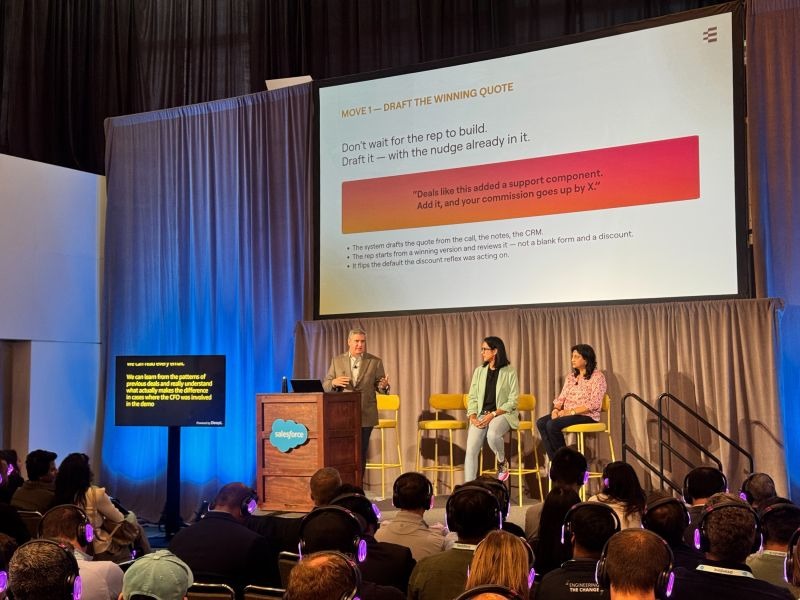
Jose Aleman, VP, Revenue Architect at Everstage, spent 20 minutes at Dreamforce '26 unpacking where the gap comes from, why tighter approval rules can't close it, and what RevOps should try instead. Elizabeth Martinez, Director of Sales Operations, and Ann Kannampilly, Senior Manager of Compensation at Unity, showed what that gap costs a comp team in practice.
Why guardrails don't land
That 11 pm decision exposes a bigger problem: the systems designed to guide the rep aren't giving them the right feedback when they need it.
Three systems meet at the quote. CPQ decides what can be sold and at what price. Comp and ICM decide what the rep gets paid for selling it. And the rep's decision, in the seconds before they hit send, is where those two systems either agree or don't.
The rep's only real feedback on that decision is their commission, and it's calculated after the deal closes, then paid out weeks later through ICM. Margin goes straight to Finance, and the rep never sees it at all.
Jose called this the two-sided lag: RevOps can see the signal, a discount pattern, a margin hit, but has to request it from the analytics team before acting on it. Sales sees the consequence only after the window to change anything has already closed. Same lag, two different owners, and neither one is accountable for closing it.
And the economics make that lag expensive. McKinsey research has found that a 1% improvement in price realization can lift operating profit by 8–9%. When reps reach for discounting without the right signals, small pricing decisions can have an outsized impact on profitability.
The instinct is to respond with a tighter guardrail: lower the discount threshold, add an approval step.
Donella Meadows, who spent a career studying where to intervene in complex systems, ranked that move dead last, #12 out of 12. In her words, tightening parameters is "arranging the deck chairs on the Titanic." Six rungs up her list sits something cheaper and far more effective: restoring the flow of information. Who sees what, and when.
That's the argument in one line: RevOps keeps deploying guardrails, #12, when the higher-leverage move is restoring a missing feedback loop, #6. Put the meter on the quote.
So what does putting the meter on the quote actually look like? Jose broke it into three moves.
Three moves that close the loop
✅ Draft the winning quote, with the commission on it
Stop running ICM and CPQ as two separate systems. Once they're integrated, the gap between the deal closing and the rep seeing their commission disappears; they see it live, right inside the quote they're building. Push it further, and the system doesn't wait for the rep to start at all. It drafts the quote itself, pulled from the call notes and the CRM, with the nudge already built in: "Deals like this added a support component. Add it, and your commission goes up by X." The rep isn't filling out a blank form anymore. They're reviewing a quote that's already built to win.
✅ Guidance, not just guardrails
A guardrail only caps the worst case. Guidance improves the whole decision. Jose walked through a real example on stage: a rep wants to open at 25% off. A guardrail would cap that at 20%. Guidance does more. It shows the rep how the last 11 deals in that segment actually closed, gets them to 10% instead, and teaches them something they'll use on the next deal. The guardrail saved 5 points. The guidance saved 15.
✅ Make the signals proactive
A quote sits in approval for 6 days. A segment's discounts keep drifting up. A renewal gets priced under the floor. None of that should wait for someone to go dig up a report; it should land on the manager's desk on its own, before it turns into a pattern.
Someone has to own the landing
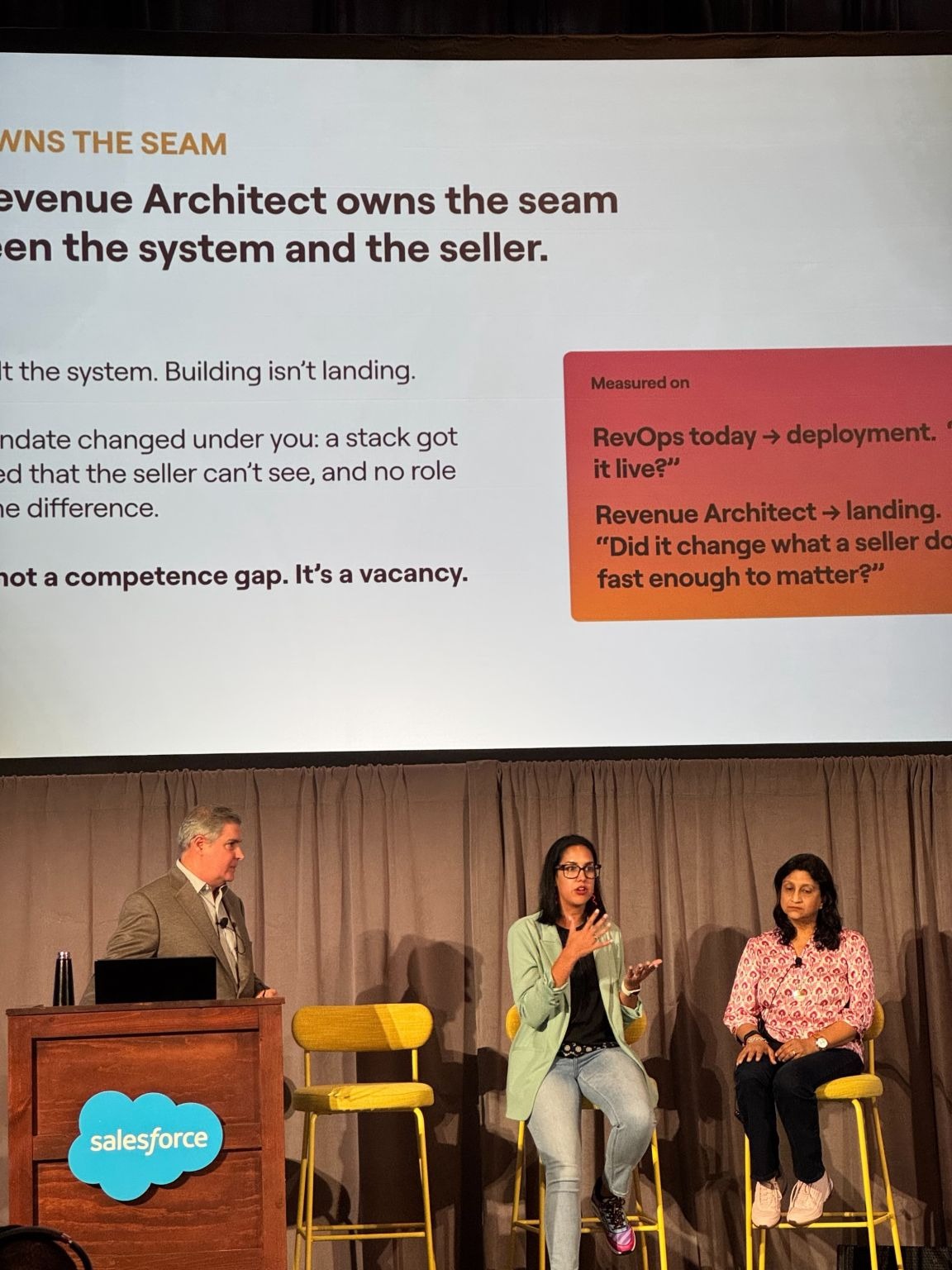
RevOps already built the comp plan, the CPQ rules, the dashboards. None of that is the same as landing. Jose puts one person on the hook for closing that gap: the Revenue Architect, judged on whether a change actually reached the seller in time to matter, not on whether the system is technically live.
What the room saw: three scenarios from Unity
Elizabeth Martinez walked through three moments where this gap actually shows up inside a deal cycle.
- Quote-to-comp alignment. A rep building a quote needs to know, in real time, what it does to their commission. Today that means looping in both Comp and CPQ, and sometimes getting two different answers from two different specialists. That's confusion and delay built into the one moment a rep needs clarity most. Embed a comp view directly inside the quoting tool, and that back-and-forth disappears. It also means policy exceptions get flagged at the moment of quoting, not discovered after the deal is already signed.
- Compensation committee prep. Before a comp committee meets, Sales flags deals or cancellations at a high level, and Comp runs the analysis to bring real numbers into the room. Often, after all that work, the actual financial impact turns out to be small. Sometimes the question that triggered an expensive, time-consuming call is worth about $100. Show leaders the financial impact upfront, and committee time gets reserved for the decisions that actually need a room full of people.
- Data hygiene at the source. Quoting errors still get caught the same way they always have: a deal closes, a rep sees a commission number they didn't expect, and only then does anyone trace it back to a mistake in the quote. It never touches the customer. It does touch internal reporting and revenue accounting. If comp visibility existed at the point of quoting, reps could flag the discrepancy themselves before the deal closes, catching setup errors early and surfacing exactly where enablement is falling short.
Solid bytes from the room
A few lines worth screenshotting, straight from the session materials:
"This isn't a discipline problem. It's a landing problem."
"A guardrail is deployment. It was never measured on whether it lands."
"The guardrail saved five points. The guidance saved fifteen."
"The role becomes real because the tool makes landing measurable."
"Go put the meter on the quote."
What to do tomorrow
Before your next comp planning cycle, pull your last 20 discounted deals and run them through three questions:
- Where does the rep actually see the consequence of that discount, and how many weeks late does it arrive?
- Where is the comp plan rewarding a behavior the pricing model punishes, or the other way around?
- Where did you deploy a guardrail, a threshold, a cap, an approval step, when what the deal actually needed was a visible signal?
That's the audit. It won't take a quarter. It takes an afternoon and access to your own deal data.
Put the meter on the quote
Everstage is a revenue execution platform that puts Incentives and CPQ on one system, so every quote is compensation-aware by default. Enterprise revenue teams use it to close the gap between what the comp plan promises and what the rep actually sees at the moment of the deal: an AI layer, Eva, reads deal history and helps draft the quote instead of just filling out the form, and the whole thing is instrumented, so you can see whether a change showed up on the next quote or got lost somewhere before it.
If your CPQ and your incentives are still two separate systems talking past each other, book a demo and see what a compensation-aware quote looks like inside your own stack.