
.avif)
TL;DR
- Improving sales performance in 2026 means building one operating system. It connects goals and incentives with coaching and real-time data visibility.
- Set clear goals and track quota progress in real time. Design incentive plans that reward the right sales behaviors.
- Measure baseline performance before you change strategy. Track quota attainment and win rate first.
- Use automation to clear manual sales and commission workflows so reps and managers focus on revenue-generating work.
- Give reps transparent visibility into commissions and attainment to keep motivation high and reduce payout disputes.
- Improving sales performance is a cross-functional effort. It spans RevOps and finance as well as sales compensation and leadership, beyond frontline managers
Sales performance improves when every rep knows what to prioritize. Reps also need to see how success is measured and how their work turns into earnings.
When a sales team consistently hits its targets, revenue grows and the business becomes more sustainable. Reaching that level stays hard, and many reps miss their goals despite strong effort.
Sales Insights Lab Sales reports show that only 24.3% of salespeople exceeded their quota last year.
Improving sales performance in 2026 reaches beyond sales leadership. It pulls in RevOps, finance, sales compensation, and frontline managers. These teams work from the same performance data and payout logic. When goals, commissions, and coaching align with real-time visibility, reps know what to prioritize. Leaders can then connect sales activity to revenue outcomes.
Below, you will find the strategies that improve sales performance and the factors behind it.
What is Sales Performance?
Sales performance refers to how well a sales team or individual salesperson achieves their sales targets and objectives. It measures effectiveness in generating revenue and acquiring new business.
Sales performance management combines strategy, process, and technology to monitor and improve team effectiveness. You evaluate sales performance through quantitative factors like revenue, conversion rate, and quota attainment. Qualitative measures like rep competency and customer satisfaction matter too.
What Good Sales Performance Looks Like
Good sales performance stays consistent and measurable over time. It means hitting targets quarter after quarter.
It rewards the behaviors and systems that produce sustainable wins, beyond closing single deals.
From a practical standpoint, good sales performance blends output metrics like revenue and conversion rate with quality indicators like customer satisfaction and retention. Hitting a revenue target means little if your churn rate spikes or if deals require steep discounts to close.
High-performing teams share several traits:
- Consistently meeting or exceeding KPIs.
- Maintaining conversion rates above industry benchmarks.
- Demonstrating strong customer loyalty and repeat purchases.
- Adapting quickly to market and customer changes.
Sales Results vs. Sales Performance: What Should You Actually Improve?
Sales results are lagging indicators such as revenue and closed deals. Sales performance covers the leading indicators that produce those outcomes. Examples include pipeline hygiene and forecast accuracy. Activity quality and conversion rates also count.
This distinction matters. A team can hit a revenue target through heavy discounting. Weak signals still appear, such as declining win rates and rising churn. Improving performance means improving the behaviors and systems that produce results, beyond reporting the results themselves.
Compares lagging result metrics with the leading performance indicators that drive them.
How to Measure Sales Performance
Before you can improve sales performance, you need to measure it. The right metrics show where reps lose momentum and which behaviors drive revenue. They also reveal whether your incentive plans work.
Choose metrics based on team maturity and sales motion. Early-stage teams focus on activity and pipeline coverage. Mature teams emphasize win rate and forecast accuracy. The table below maps core metrics to what they measure and why they matter.
Maps eight core sales metrics to what they measure, their improvement lever, and review frequency.
Why sales performance is a cross-functional revenue problem
Sales performance belongs to more than sales managers. RevOps owns the process and data, while finance owns commission governance. Sales compensation teams design incentive plans, and sales leaders own coaching and execution. When these functions work in silos, performance suffers. Reps chase the wrong deals, and payouts become harder to trust. Leaders also lose sight of what moves revenue.
For RevOps Track where reps lose momentum across pipeline stages and connect activity data with quota attainment.
For Finance Ensure commission plans reward profitable revenue, not just closed revenue.
For Sales Leaders Give reps real-time visibility into goals, earnings, and next-best actions.
Key Drivers of Sales Team Performance
Before changing your sales strategy, identify the factors that drive performance. They include product quality and pricing, plus rep capability and incentive design. For commission-based teams, compensation design can matter as much as sales activity.
1. Product Quality
No sales strategy, however strong, can overcome a product that fails its promise. Poor product quality drives lost sales, and it damages your reputation and future pipeline.
Also, 87% of customers say peer reviews strongly shape their purchasing decisions. No matter how good your salespeople are, product quality is paramount. Even the best sales practices fall short when product quality lags.
Sales reps hear customer complaints and feature requests first. Build a direct feedback channel to the product team.
2. Pricing Strategy
Pricing is one of the most sensitive touchpoints in a sales conversation. Around 58% of customers want to talk about pricing on the first sales call.
Get it wrong, and you lose customers or leave revenue on the table. Research by Insivia suggests that even a 1% increase in pricing can lead to an average 11% boost in profits.
While sales teams may not own pricing strategy, pricing directly affects sales performance. Sales professionals should ask stakeholders whether pricing can flex, or whether larger deals qualify for volume discounts.
3. Sales Rep Skills and Capability
W. Clement Stone said: "Sales are contingent upon the attitude of the salesman, not the attitude of the prospect."
Even the best product and pricing strategies can fail if salespeople lack the ability to connect with customers and understand their needs. Hiring reps who lack industry knowledge creates bottlenecks and slows the sales process.
Reps should understand the industry and customer emotions to address pain points. Sales leaders develop soft skills alongside hard skills.
A successful sales team is made up of skilled, adaptable reps who understand buyer pain points and can guide customers toward the right solution.
4. Market Conditions
Market trends like economic shifts and competitive dynamics affect sales performance sharply. When the market is favorable, sales teams experience shorter sales cycles and higher demand.
During downturns, buyer hesitation rises and closing deals gets harder.
Sales teams should track economic conditions and industry trends to adjust their approach. During difficult times, reframe sales tactics and focus on cost-effective solutions.
For instance, during a recession a manufacturing equipment supplier might highlight cost savings and long-term ROI. Flexible payment terms can make the investment more appealing.
5. Team Motivation
Motivation drives a salesperson to push through tough rejections and keep seeking new leads. Motivated salespeople engage more prospects and close more deals.
Low motivation leads to disengagement and higher turnover. When employees feel motivated, their work performance improves by 20%.
Team motivation hinges on how clearly reps understand their goals and incentives. Salespeople need to know why their work matters and how it contributes to company success.
6. Incentive plan design
Incentive plans shape sales behavior. If plans reward only closed revenue, reps may prioritize short-term wins over profitable or strategic deals. If plans are too complex, reps struggle to see how to maximize earnings. High-performing teams design plans that stay simple and tie directly to business goals.
7. Performance and commission visibility
Reps perform better when they can see where they stand against quota and how their current pipeline affects earnings. Delayed or unclear commission visibility can reduce motivation and create payout disputes.
7 Actionable Strategies to Improve Sales Performance
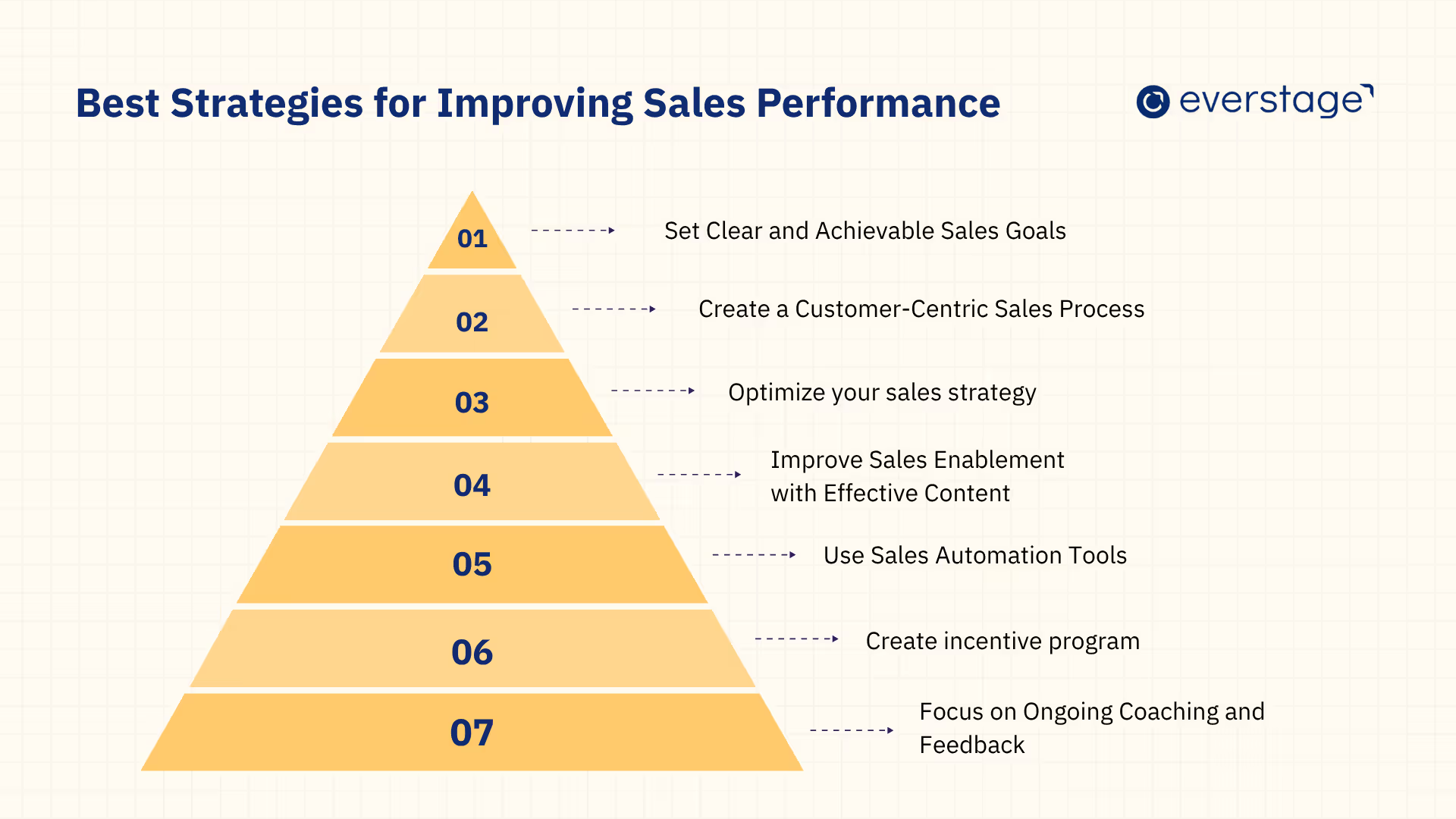
The most effective sales performance strategies go beyond motivation alone. They connect sales goals and incentive plans with real-time visibility and coaching. When reps see what to do and what they can earn, performance gets easier to manage. Clear tracking also makes it easier to scale.
1. Set Clear and Achievable Sales Goals
Clear, measurable goals drive better sales performance. Sales goals keep teams focused and aligned with the business's objectives.
These goals keep your team motivated and provide a benchmark for progress. When goals are vague, tracking success or finding areas for improvement gets difficult.
Goal setting increases job satisfaction, with employees being 6.7 times more likely to feel proud of their organization.
To set effective goals, sales managers should align targets with both short-term and long-term objectives. Break down large goals into smaller milestones that the team can celebrate along the way.
Where this matters: When sales goals connect to real-time incentive tracking, reps see performance before payout cycles. They see attainment and expected commissions as the quarter progresses.
2. Create a Customer-Centric Sales Process
A customer-centric sales process builds trust and increases conversions. A tailored approach that solves customer pain points, instead of pushing product features, builds stronger relationships.
According to Salesforce, 84% of business buyers expect sales reps to act as trusted advisors. Customer-centric selling positions the rep as a trusted advisor who builds long-term relationships and identifies challenges.
When salespeople focus on solving customers' problems, customers feel more valued and are more likely to return for future purchases.
Instead of entering a sales conversation with a question like "How can I convince the customers to buy my product?", sales reps should ask questions like:
- What knowledge should I share with the customers to find their right solution?
- How can my solution improve customers' lives?
- How do I improve customer interactions at all touchpoints?
Marketing and sales teams should work together to keep the customer experience seamless across touchpoints.
3. Optimize your Sales Strategy
Sales strategy needs regular evaluation so leaders can spot bottlenecks. Frequent reviews help teams adapt to market changes and lift quota attainment. Optimizing begins with analyzing your existing sales process. Evaluate where bottlenecks exist and where opportunities are being missed. Use CRM sales data to spot trends and identify gaps.
Pipeline analysis reviews each stage to find where prospects drop off, then adjusts tactics. An agile sales strategy also helps teams adapt fast to market changes.
For instance, in a saturated market, narrowing the focus to niche segments can improve conversion rates and reduce wasted effort. Sales organizations should run regular performance reviews and refine strategies.
4. Improve Lead Qualification and Pipeline Quality
Poor-fit opportunities waste rep time and inflate forecasts. Improving lead qualification is one of the fastest ways to lift conversion rates and rep productivity.
Start with a clear ideal customer profile, then apply a consistent qualification framework and lead scoring so reps focus on the right deals. Define pipeline stage criteria and inspect pipeline regularly to keep forecasts honest.
Use this checklist to qualify opportunities:
- Fit: Does the prospect match your ideal customer profile?
- Urgency: Is there a compelling event or timeline?
- Budget: Is funding confirmed or likely?
- Stakeholder access: Can you reach the decision-makers?
- Pain severity: Is the problem worth solving now?
- Disqualification triggers: No authority, no budget, or no defined need.
5. Improve Sales Enablement with Effective Content
Sales enablement equips your team with the resources they need to succeed. Effective content like product demos and ROI calculators plays a critical role.
In fact, 76% of leaders attribute improvements in sales performance to their investments in sales enablement. Content helps reps engage prospects with relevant, timely information. It helps them address pain points and move prospects down the funnel.
With the right content on hand, reps can speak directly to each prospect's concerns. It also shortens the sales cycle.
Well-designed sales content can also help manage objections and make it easier for reps to demonstrate the value of a product.
6. Automate manual sales and compensation workflows
Sales automation reaches well beyond emails and follow-up reminders. Tools like automated email sequences and CRM integrations build workflows that improve the process. For performance-focused teams, automation should also cut manual commission calculations and approval delays. According to McKinsey, about one-third of all sales tasks can be automated.
The same research suggests that early adoption of sales automation can increase revenue by up to ten percent. That efficiency frees salespeople to focus on relationship-building and complex deals.
Automated email sequences keep leads followed up while reps skip sending each message by hand. Lead scoring prioritizes prospects by likelihood to convert, so teams focus on the highest-potential ones. Automating commission workflows helps sales, RevOps, and finance teams reconcile less and improve performance more.
Sales automation tools reduce administrative burden and keep outreach consistent. Consistent outreach builds trust with prospects and keeps cycles on track.
Where this matters: When commission calculations and approvals are automated, reps trust their earnings data. Managers can then coach on the actions that lift attainment.
7. Audit Your Sales Technology Stack
A bloated or underused tech stack hurts performance as much as a missing one. Auditing your tools shows whether to consolidate them or replace them.
Common sales technology problems paired with practical fixes.
8. Align Incentives and Recognition Programs
Sales leaders should reward the behaviors that drive sustainable revenue, beyond one-time wins. A well-designed sales incentive program shows reps which deals to prioritize. It also clarifies how success is measured and how actions turn into earnings.
Typically, a 50:50 or 60:40 split works best, where base salary provides financial stability and commissions serve as performance incentives. That balance pushes reps toward higher goals while keeping financial security.
Use these incentive program design principles:
- Keep plans simple enough for reps to understand.
- Reward strategic behaviors such as renewals and profitable deals.
- Give reps real-time visibility into quota progress and expected commissions.
- Automate commission calculations to reduce manual errors.
- Review plan performance regularly with sales, RevOps, and finance.
- Reduce payout disputes by making plan logic transparent.
Set clear, achievable targets that motivate the sales team. These targets should be data-backed and based on historical performance to keep them challenging and attainable.
A sales compensation platform like Everstage turns incentive plans into an operating system for performance. Everstage automates commission calculations and gives reps real-time visibility into earnings. It also enables multi-stage approvals for sales and finance teams. The result is less manual work and reps focused on revenue.
Turn incentives into a sales performance lever
See how Everstage helps revenue teams automate commissions, improve payout visibility, and align rep behavior with revenue goals. Book a Demo
9. Focus on Ongoing Training and Sales Coaching
Every salesperson, irrespective of their position, needs comprehensive coaching to understand the company culture. Coaching also prepares them for critical situations and sharpens decision-making.
Only 53% of sales leaders utilize coaching solutions. Your coaching programs should start at onboarding.
Sales coaching mentors salespeople to identify their strengths for improvement and guides them through complex sales scenarios. Coaching helps reps build soft skills like communication and negotiation.
Regular coaching sessions like role-plays and pipeline reviews let reps practice and apply feedback in real time. These sessions let managers give constructive feedback and celebrate wins.
Create an Action Plan to Improve Sales Performance
Strategies become useful when packaged into an executable plan. A 30-60-90 day action plan moves you from advice to results with clear owners and timelines.
A 30-60-90 day plan with owners, KPIs, and expected outcomes for each phase.
Why Sales Performance Improvement Fails
Most improvement efforts stall for predictable reasons. Knowing the failure points helps you avoid them before they cost a quarter.
- Unclear goals: Reps lack direction. Fix by setting measurable, time-bound targets.
- Too many metrics: Focus dilutes. Track a focused set of leading and lagging indicators.
- Weak manager coaching: Feedback stays inconsistent. Establish a regular coaching cadence.
- Poor CRM hygiene: Bad data hides reality. Enforce pipeline inspection and data standards.
- Misaligned incentives: Plans reward the wrong behaviors. Align compensation with business goals.
- Lack of cross-functional ownership: Silos break execution. Assign shared accountability across RevOps, finance, and sales.
- Inconsistent follow-through: Initiatives fade. Monitor dashboards and review progress regularly.
- Short-term revenue focus: Discounting and churn erode value. Reward profitable, sustainable revenue.
Start Improving Sales Performance with a Repeatable System
Improving sales performance requires more than activity tracking. Teams need clear goals and accurate data, plus coaching and incentive plans that motivate the right behaviors. When reps understand their targets and how performance turns into earnings, results get easier to manage and scale.
The most effective teams treat performance improvement as a repeatable system across RevOps, finance, and sales leadership, beyond one-off tactics.
Want to turn sales commissions into a stronger revenue lever? See how Everstage automates commissions and aligns sales behavior with business goals. Book a Demo.
Questions worth asking
The things most people want to know before they commit.
What is the difference between sales results and sales performance?
Sales results are lagging outcomes like revenue and closed deals. Sales performance includes the leading indicators that produce those outcomes, like pipeline hygiene and forecast accuracy. A team can hit revenue targets through discounting while still showing weak performance signals, which is why you should improve both.
What should a sales performance improvement plan include?
A sales performance improvement plan should include clear goals and baseline metrics. Add root-cause analysis, assigned owners, timelines, and a review schedule. A 30-60-90 day structure helps teams audit performance, fix bottlenecks, and scale wins.
What sales tools can help improve performance?
CRM software like Salesforce and HubSpot keeps pipeline data clean. Sales compensation platforms like Everstage automate commissions, and analytics tools like Tableau surface trends. Sales compensation software automates commission calculations and gives reps real-time visibility into earnings. It also connects incentive design to performance outcomes.
How do sales incentives affect sales performance?
Sales incentives influence which deals reps prioritize and how they manage pipeline. They also shape whether reps chase short-term wins or long-term revenue quality. Well-designed incentive plans align rep behavior with business goals.
Can AI help increase sales?
Yes, AI can help increase sales and improve sales performance by automating lead scoring, analyzing sales trends, and providing personalized recommendations. AI tools can also forecast sales outcomes and suggest next steps, enabling sales teams to be more strategic.
What role does sales leadership play in improving performance?
Effective sales leadership is key to driving sales performance. Leaders provide direction, set clear expectations, offer coaching, and establish a positive team culture. Strong leadership ensures alignment with company goals and helps motivate the team to meet targets.