
.avif)
TL;DR
- Sales performance automation tracks and improves sales results. It also automates repetitive work such as CRM updates and reporting.
- For commission-driven teams, it ties quota attainment to incentive earnings and payout outcomes. RevOps and Finance then work from one source of truth.
- Use AI and analytics to forecast sales and surface high-value opportunities. The same data reduces payout errors and commission disputes.
- A clear rollout roadmap drives adoption and ROI. It moves from audit and KPI definition to piloting and optimization.
- The strongest platforms support flexible compensation plans and accurate payouts. They also include approval workflows and audit-ready reporting.
Sales teams lose productivity when performance data, quotas, and incentives sit in separate systems. Incentive earnings are often managed in spreadsheets and disconnected workflows, making commission tracking and quota visibility harder for RevOps and Finance. This fragmentation slows execution and increases the risk of errors and missed outcomes.
The cost goes beyond lost selling time. Payout cycles slow down, and manual reconciliation grows. Rep trust drops, and questions pile up for Sales Ops at the end of each commission period.
According to Salesforce, sales reps spend less than 30% of their working hours selling. For commission-driven teams, that lost time compounds across every payout cycle and quota review. Each dispute also lands on Sales Ops and Finance.
Sales performance automation streamlines and automates repetitive processes. It scores and prioritizes leads and generates real-time dashboards, helping teams make faster, data-driven decisions. Commission-driven teams see the most value when it connects sales activity directly to quota attainment and incentive payouts.
This guide explains what sales performance automation is and how it differs from general sales automation. It also covers which capabilities matter most and how to choose the right tools.
What is Sales Performance Automation?
Sales performance automation uses software to track and improve sales results in real time. It connects data from CRM systems and commission plans into one view. Leaders see what works, and reps track their own progress. Finance manages accurate payouts with less manual effort.
Automation handles lead scoring and real-time dashboards. This gives sales leaders an up-to-the-minute view of team performance.
It shifts teams from reactive management to proactive management. Reactive teams scramble to fix issues after they appear. Proactive teams use automation to flag risks before they hit revenue.
Why Sales Performance Automation Matters for RevOps and Finance Teams
RevOps and Finance teams gain the most operational relief from automation. It removes the manual work of reconciling attainment and payout approvals across disconnected systems.
- RevOps teams get cleaner performance data and fewer manual workflows.
- Finance teams reduce payout errors and approval delays.
- Sales leaders gain real-time visibility into quota progress and incentive impact.
- Sales reps understand exactly how performance translates into earnings.
Sales Automation vs. Sales Performance Automation
Sales automation and sales performance automation are related, but they solve different problems.
Caption: How everyday sales automation differs from sales performance automation.
Commission-driven teams gain the most value when every stakeholder sees how sales outcomes become earnings.
Sales Performance Automation vs CRM vs Sales Force Automation
Search results show recurring confusion about whether sales performance automation is just a CRM. These categories overlap, but each solves a distinct problem. The table below shows how they differ across purpose and outcomes.
Purpose and outcomes across four sales technology categories.
How Sales Performance Automation Works
Sales performance automation follows a repeatable operating workflow that moves from raw data to optimized outcomes. Understanding this flow helps teams see exactly where automation removes manual effort.
- Data capture: The system pulls data from CRM and payroll into a single performance record.
- Performance rule configuration: Teams define quotas and commission rules without code.
- Trigger-based alerts: The system flags events like a quota milestone or a stalled deal.
- Automated workflows: Approvals and payout calculations run automatically.
- Dashboard updates: Real-time dashboards refresh attainment and earnings visibility.
- Coaching recommendations: Performance gaps trigger tailored coaching and enablement actions.
- Continuous optimization: Historical data informs better plans and forecasts over time.
Key Components of Sales Performance Automation
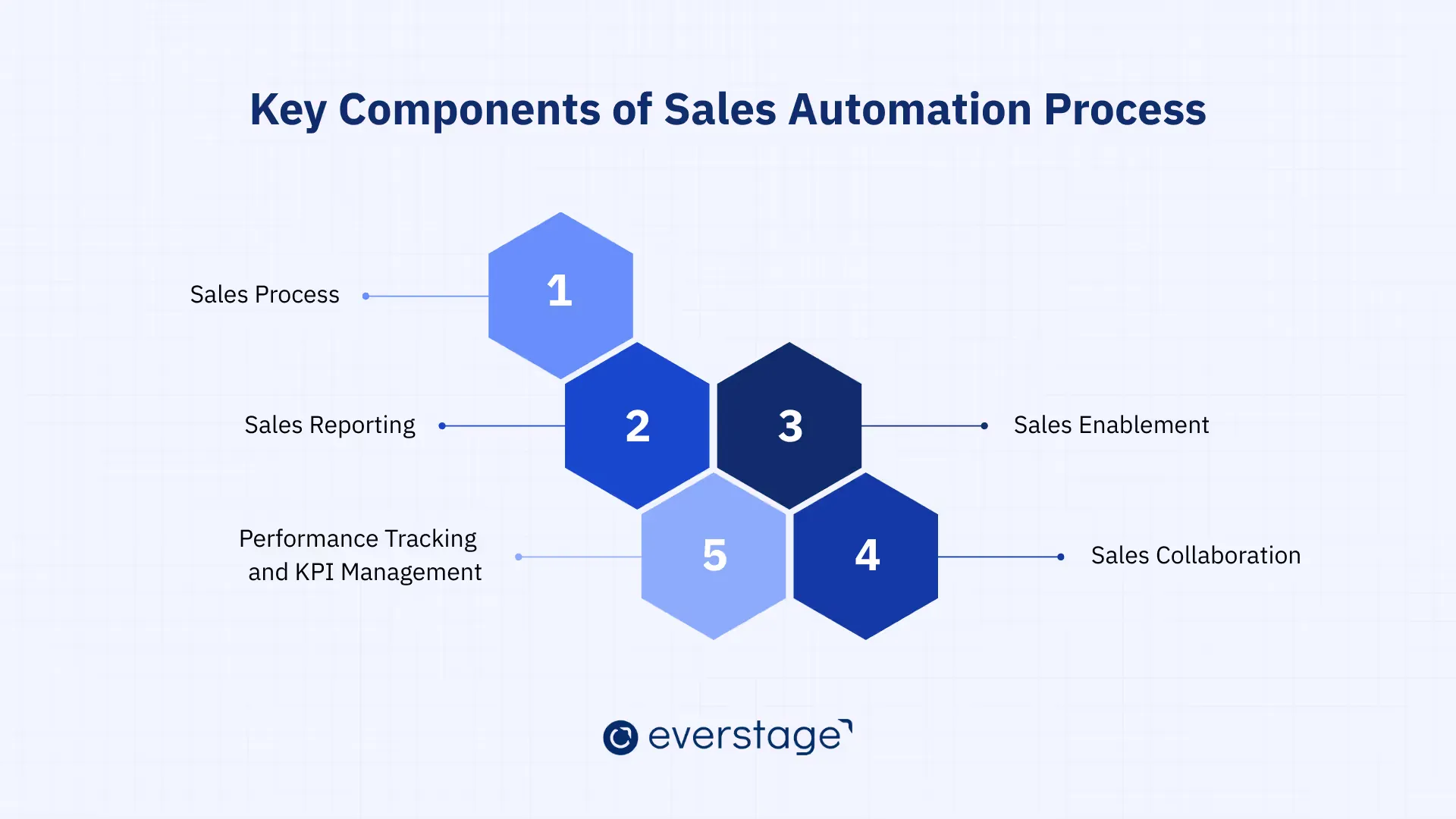
Sales performance automation combines analytics and integrations to help revenue teams act on data faster. The strongest systems also connect performance outcomes to incentives and payouts.
Sales Process Automation
Sales process automation forms the backbone of performance initiatives because it removes the bottlenecks that slow deal cycles. In a typical week, tasks like updating CRM records and logging meeting notes consume several hours per rep.
Automation platforms let sales organizations handle complex workflows and automate repeatable processes. Sales teams then set up performance-related automation workflows.
For example, a leader can trigger an alert when a rep's deal closure falls below 70% of target by mid-quarter. A commission rule that hits its condition can trigger a payout approval workflow. RevOps can also configure quota progress alerts and route exceptions to Finance for review.
When a sales call is logged in the CRM, an automated workflow can:
- Record meeting details in the correct opportunity record.
- Trigger a tailored follow-up email with relevant content.
- Schedule the next meeting based on the rep's and client's availability.
- Update the sales pipeline stage automatically.
- Flag commission-impacting changes for payout approval.
This speeds up the time between touchpoints. It also reduces human error and commission disputes downstream.
Sales Reporting and Analytics
Sales reporting and analytics automation turns raw performance data into clear intelligence. Manual reporting forces teams to export data from several systems and rebuild charts by hand.
Automated reporting tools connect directly to CRMs and financial systems to pull data in real time. This creates a single, unified dashboard that tracks performance metrics. The table below shows common metrics automated reporting surfaces for RevOps and Finance teams.
Common sales metrics that automated reporting surfaces for revenue teams.
With real-time visibility, managers can identify underperforming areas early and adjust sales strategy before the end of a quarter. According to McKinsey, 53% of sales teams say data-driven insights help them achieve better sales outcomes.
Automated analytics let salespeople dig into their efforts and see what works. For Finance and RevOps, the same data reduces manual reporting and payout reconciliation.
Sales Enablement
Sales enablement automation gives every rep instant access to the right content and training. Manual setups scatter sales content across folders and outdated email threads.
It supports performance through content recommendations and role-based onboarding. Training triggers and playbooks reach reps at the right moment. When a lead reaches a set pipeline stage, the system recommends the most relevant resources. New hires get onboarding tracks tied to their role and ramp stage.
In fact, G2 research shows that organizations are 80% more likely to increase their win rates with a unified enablement platform.
Sales Collaboration
Sales collaboration automation streamlines communication and alignment across departments that impact the sales cycle. Poor alignment leaves leads with inconsistent messaging and missed handoffs.
When collaboration tools connect to sales automation systems, updates from one team reach all relevant stakeholders instantly. For example, when a customer success manager spots an upsell, a Slack and Salesforce integration alerts the assigned rep with account history.
This connection reduces silos and speeds up response times. The whole customer-facing team stays aligned. For leadership, the benefit is better cross-functional visibility and a unified approach to revenue growth.
Sales Compensation and Incentive Automation
Incentive automation forms the core of sales performance automation for commission-based teams. It connects quota attainment and commission rules to approvals and payout calculations. Reps and leaders see how performance becomes earnings.
- Automated commission calculations
- Real-time earnings visibility
- Quota and attainment tracking
- Approval workflows for payout governance
- Audit trails for Finance and RevOps
Performance Tracking and KPI Management
Performance tracking sits at the heart of sales performance automation. Teams configure KPIs in automation to spot areas of improvement. Reps monitor their own attainment and earnings.
Automation tools replace static spreadsheets with live dashboards. They show quota attainment and deal health in real time.
Managers set KPI alerts when a rep falls below a threshold or beats a milestone. They route payout approvals to Finance once commission rules are met. This visibility supports proactive decisions and keeps reps aligned with organizational goals.
For example, when a rep reaches 80% of quota early in the quarter, the system can trigger a recognition workflow or suggest stretch goals. When performance metrics dip below target, coaching workflows launch automatically to address skill gaps.
How Sales Performance Automation Empowers Sales Teams
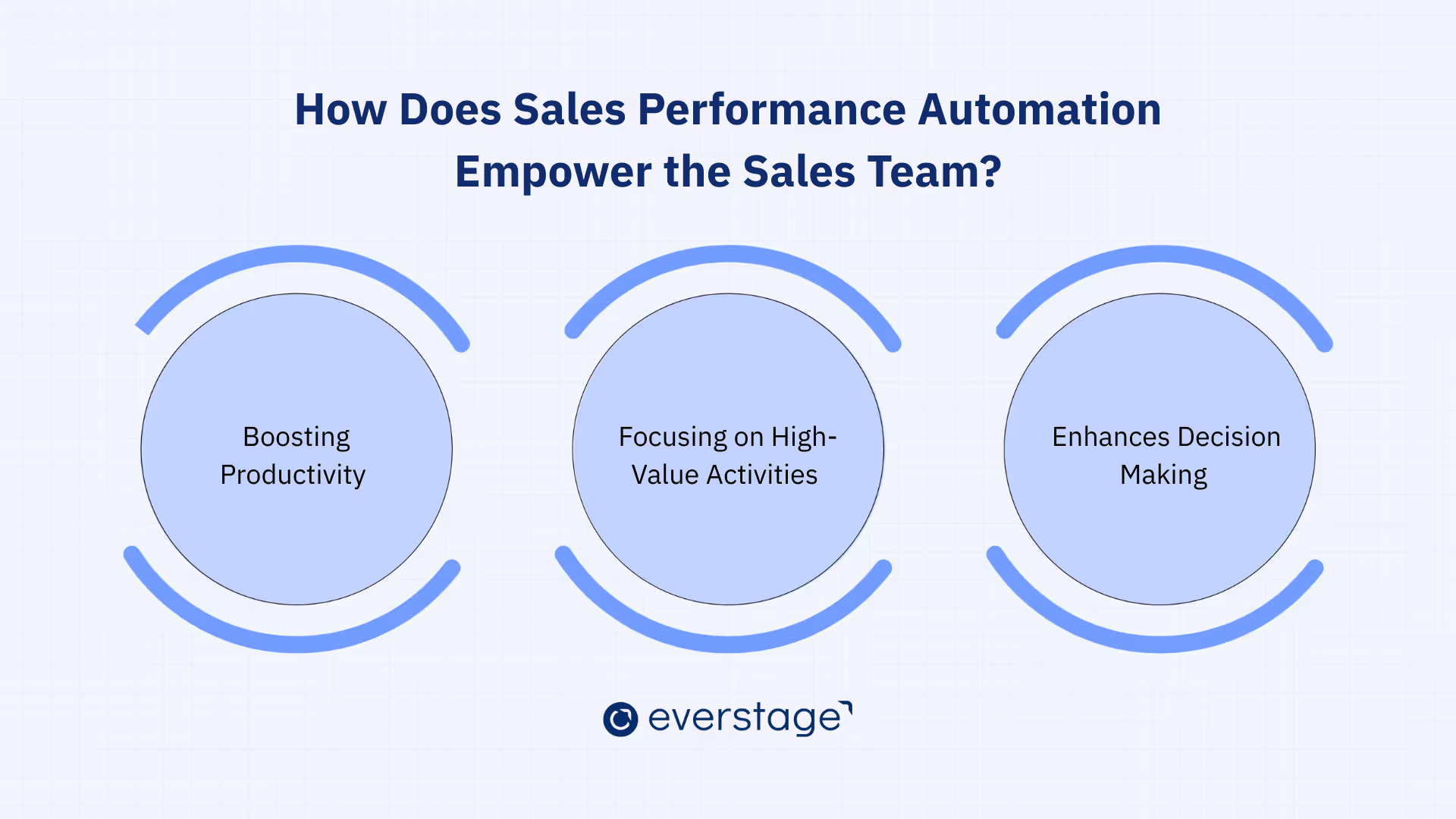
Sales teams use a stack of automated technologies to fuel growth and improve performance. Here are some ways automation empowers sales teams:
Increases Selling Time and Reduces Administrative Work
Automation recovers selling time by cutting low-value administrative work. Reps lose selling capacity to tasks like logging calls and updating CRM records.
These tasks support pipeline visibility, but they cut directly into selling time. Sales performance automation solves this by building productivity tools into the sales workflow.
When meeting scheduling is automated, prospects see real-time availability and confirm appointments instantly. Automated reminders keep every meeting on track, and CRM integrations log calls and notes for the rep.
Research shows that sales representatives spend 22% less time on administrative work when automation is in place. This frees up time for prospecting and active deal management.
Prioritizes High-Value Opportunities
Automation surfaces the highest-value opportunities so reps focus their day. With weak signals, teams chase unqualified leads as hard as strong ones.
AI-driven lead scoring and intent data surface high-value opportunities automatically. For instance, a prospect visits the pricing page several times and opens marketing emails. The engine raises the lead score and alerts the assigned rep.
These alerts arrive in real time and let the sales team engage when conversion probability is highest. This prioritization sends the most attention to the best opportunities while automated cadences nurture less qualified leads.
Reps start each day knowing which accounts to focus on and which actions move them forward. Targeted effort means fewer wasted calls and faster cycle times.
Improves Forecasting Accuracy and Sales Decisions
Accurate forecasting is one of the most challenging aspects of sales leadership. Traditional forecasting leans on subjective rep judgment, which produces inconsistent projections.
Automation replaces guesswork with real-time, data-driven insights. Forecasting tools analyze historical win rates and pipeline health to predict outcomes. They flag deals at risk of slipping and suggest next steps.
For example, when a deal's close date slips or buyer engagement stalls, the system recalculates the forecast and flags the risk.
Accurate, data-backed forecasts also build credibility among leadership and customers, supporting more strategic decisions.
Sales Performance Automation Examples You Can Implement
Concrete examples show sales performance automation in action. Each one pairs a trigger with an automated action and a business outcome.
- Automated lead scoring: When a prospect shows buying intent, the system scores and routes the lead, improving conversion focus.
- Quota progress alerts: When a rep crosses a milestone, an alert fires and keeps reps and managers aligned.
- Commission visibility updates: When a deal closes, the rep sees real-time earnings, which reduces payout anxiety.
- Pipeline risk alerts: When a deal stalls, the system flags it and enables timely intervention.
- Meeting follow-up automation: When a call is logged, a follow-up email and next meeting get scheduled, which speeds up cycles.
- Performance dashboard refreshes: When data changes, dashboards update automatically and remove manual reporting.
- Coaching triggers: When metrics dip, a coaching workflow launches and closes skill gaps faster.
- Forecast recalculation: When a close date shifts, the forecast updates and improves accuracy.
- Renewal or upsell alerts: When account signals appear, reps get notified, which protects revenue.
- Incentive payout notifications: When approvals clear, payout status updates and reduces disputes.
How to Implement Sales Performance Automation
This rollout framework gives RevOps and Sales Ops a practical, step-by-step path. Most teams move fastest by starting with high-volume, rules-based processes before layering in complex AI-driven workflows.
- Audit manual sales workflows: Map where reps and Finance lose the most time.
- Define performance KPIs: Set the quota and commission metrics that matter.
- Identify automation opportunities: Prioritize by time savings and revenue impact.
- Clean and connect data sources: Standardize fields, then connect CRM and payroll systems.
- Select tool categories: Match tools to the part of the performance process you need to improve.
- Pilot with one team: Validate workflows and outcomes before scaling.
- Train users: Drive adoption with role-based onboarding.
- Measure adoption and ROI: Track selling time recovered and payout accuracy.
- Optimize workflows over time: Refine plans and triggers using historical data.
Common Challenges of Sales Performance Automation
Automation delivers strong returns, but teams should plan for common implementation risks. Addressing these early improves adoption and ROI.
- Poor CRM hygiene: Bad data leads to incorrect alerts and payouts. Mitigation: audit and standardize data before launch.
- Disconnected systems: Siloed tools break workflows. Mitigation: prioritize native integrations and APIs.
- Over-automation: Automating complex judgment calls can backfire. Mitigation: keep humans in the loop for nuanced decisions.
- Rep resistance: Low adoption undermines value. Mitigation: involve reps early and show earnings visibility benefits.
- Unclear ownership: Stalled rollouts usually miss an internal champion. Mitigation: assign a RevOps or Sales Ops owner.
- Privacy and security risks: Sensitive comp data needs protection. Mitigation: use role-based access and audit trails.
- High setup effort: Complex plans take time. Mitigation: pilot with one team and expand.
- Difficulty measuring ROI: Value can be hard to quantify. Mitigation: baseline metrics before and after implementation.
What to Look for in Sales Performance Automation Tools
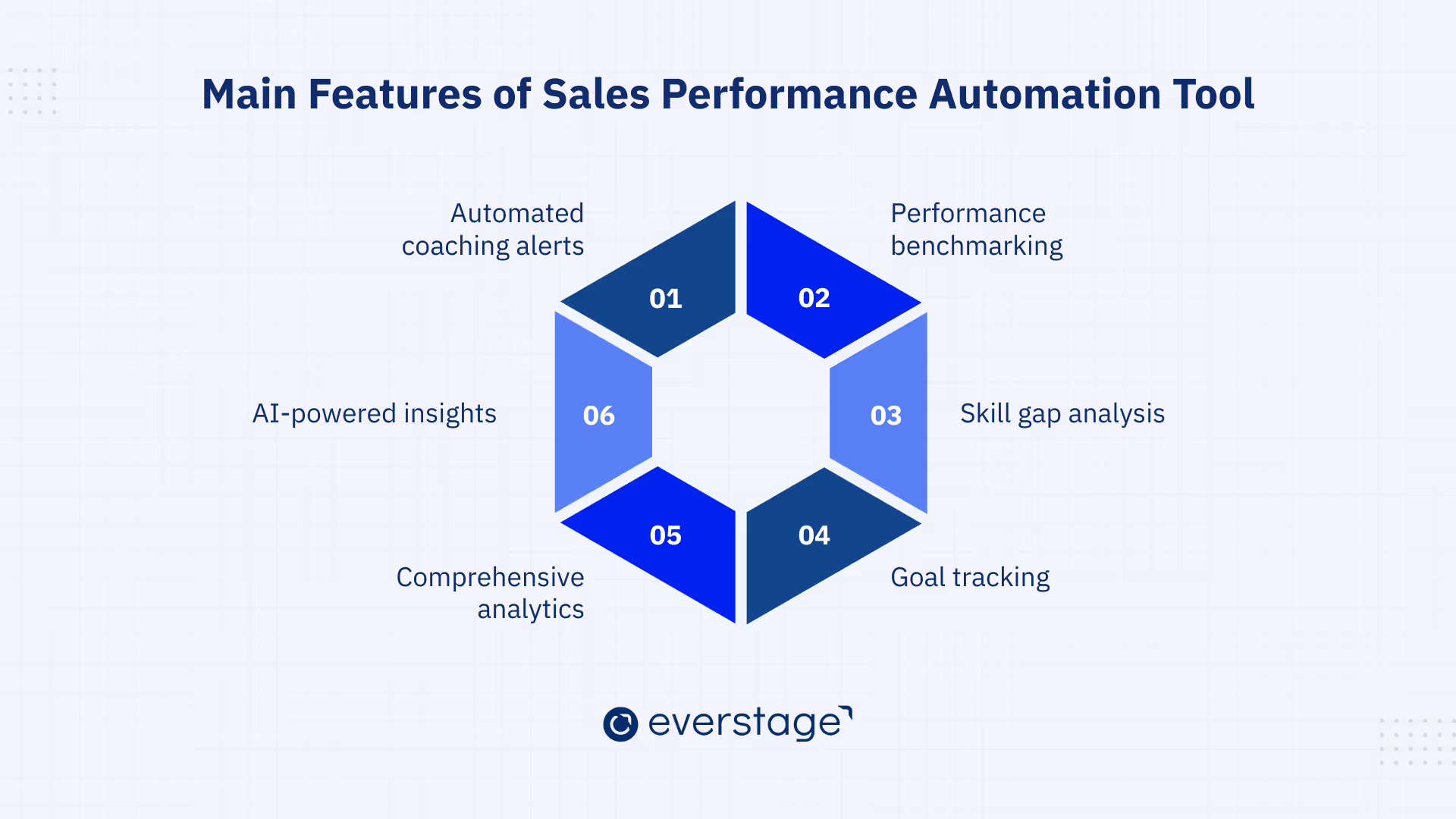
A sales performance automation tool should track quota progress and earnings in one place. Commission-driven organizations also need flexible compensation plans and accurate payouts. Approval workflows and audit-ready reporting round out the list.
Here's what to look for when choosing a sales performance automation tool:
Commission Plan Flexibility
The platform should handle complex compensation plans and accelerators. It should also support clawbacks and custom payout rules without heavy IT support.
Payout Accuracy and Auditability
Finance and RevOps teams need clear audit trails and calculation transparency. These reduce payout errors and disputes.
Rep-Facing Earnings Visibility
Sales reps should see quota progress and estimated commissions in real time. This shows them how performance affects earnings.
Automated Coaching Alerts
Automated coaching alerts flag performance issues the moment they appear. The system uses data to give reps immediate, personalized feedback from specific performance triggers.
For example, when a rep's conversion rate dips or deal velocity slows, the system sends real-time notifications to the rep and their manager. Corrective action happens immediately instead of waiting for the next quarterly review.
Over time, this builds a culture of continuous improvement where small adjustments lead to big gains.
Performance Benchmarking
Benchmarking gives sales teams context by measuring progress against clear standards. Standards can include industry averages or your own historical data.
With the right automation tool, you can spot top performers and see what they do differently. Underperforming reps get guided toward clear, measurable targets. This transparency drives healthy competition and keeps goals both ambitious and achievable.
Skill Gap Analysis
Skill gap analysis explains why a rep misses quota when effort stays high. A rep may miss quota because of specific skill gaps like objection handling or negotiation.
Data exposes these hidden weaknesses and turns anecdotal feedback into evidence. Once identified, managers can tailor training programs or pair reps with mentors.
This precision speeds up development. It also boosts confidence and engagement across the team.
Goal Tracking
Sales is a target-driven profession, and clear goal visibility is critical for motivation and accountability. Modern automation tools display progress toward individual and team KPIs in real time. Reps see how their daily activities contribute to quarterly quotas, and managers spot who is ahead or behind.
Beyond tracking, many platforms add gamification features and leaderboards to keep morale high. This creates a sense of ownership and urgency that keeps sales teams aligned and focused on results.
Comprehensive Analytics and Reporting
Real-time dashboards let leaders track individual and team KPIs. These range from pipeline management to deal health and activity volume.
Drill-down capabilities let managers move from a high-level view to the details driving results. Historical trend analysis reveals performance patterns that help set realistic targets and refine strategies.
Automated reports and alerts surface potential issues, such as stalled deals or sudden drops in prospecting activity, the moment they happen.
AI-powered Insights
Advanced systems use AI to analyze historical win/loss data and find patterns that predict deal closes. They recommend precise next steps, like the best time to follow up or the decision-maker to engage.
Automated performance systems also use AI insights to recommend coaching programs and predict individual performance.
These platforms flag at-risk deals before they slip away and forecast revenue with predictive analytics. AI can also identify accounts likely to churn, offering tailored retention strategies to preserve valuable relationships.
Benefits of Automated Sales Performance Tracking
Automated tracking connects activity and quota attainment to incentive earnings in one place. Reps gain clarity, and managers get faster coaching signals.
Transparent Incentive Earnings
When salespeople see their performance instantly, they understand how work becomes income. Seeing in real time how a closed deal affects their payout helps maintain motivation through the sales cycle.
Transparency reduces speculation and builds trust in the compensation structure. A WorldatWork survey found that 85% of employees place greater trust in their employer when pay processes are transparent.
Real-Time Quota Visibility
Sales reps see how every closed deal affects quota attainment and earnings. Managers spot performance gaps before the quarter ends.
With automated performance tracking, leaders act on data faster, which can result in:
- Faster coaching signals that arrive before a formal performance review.
- Tighter alignment of sales and Finance through automatic data sync.
- Quick monitoring of attainment over time, with recommendations on coaching and enablement.
Reduced Commission Disputes
When performance and payout data sit in one place, reps see how commissions were calculated on their own. Clear attainment data and calculation logic reduce disputes and build trust in the process.
Automated performance tracking also lets organizations:
- Use live data to identify individual and team strengths and weaknesses.
- Set tailored goals and customize coaching plans based on attainment and needs.
- Compare different coaching approaches and choose the most impactful methods.
Types of Sales Performance Automation Tools and How to Compare Them
Sales performance automation covers CRM workflows and incentive tracking. The right tool depends on which part of the performance process you need to improve. The table below maps tool categories to their ideal use cases.
Sales performance automation tool categories matched to buyers and use cases.
Best Sales Performance Automation Tools by Use Case
Three platforms cover the main sales performance automation use cases. The table compares each by strength and limitation.
Three platforms compared by use case and limitation.
1. Everstage: Best for Sales Compensation and Incentive Automation
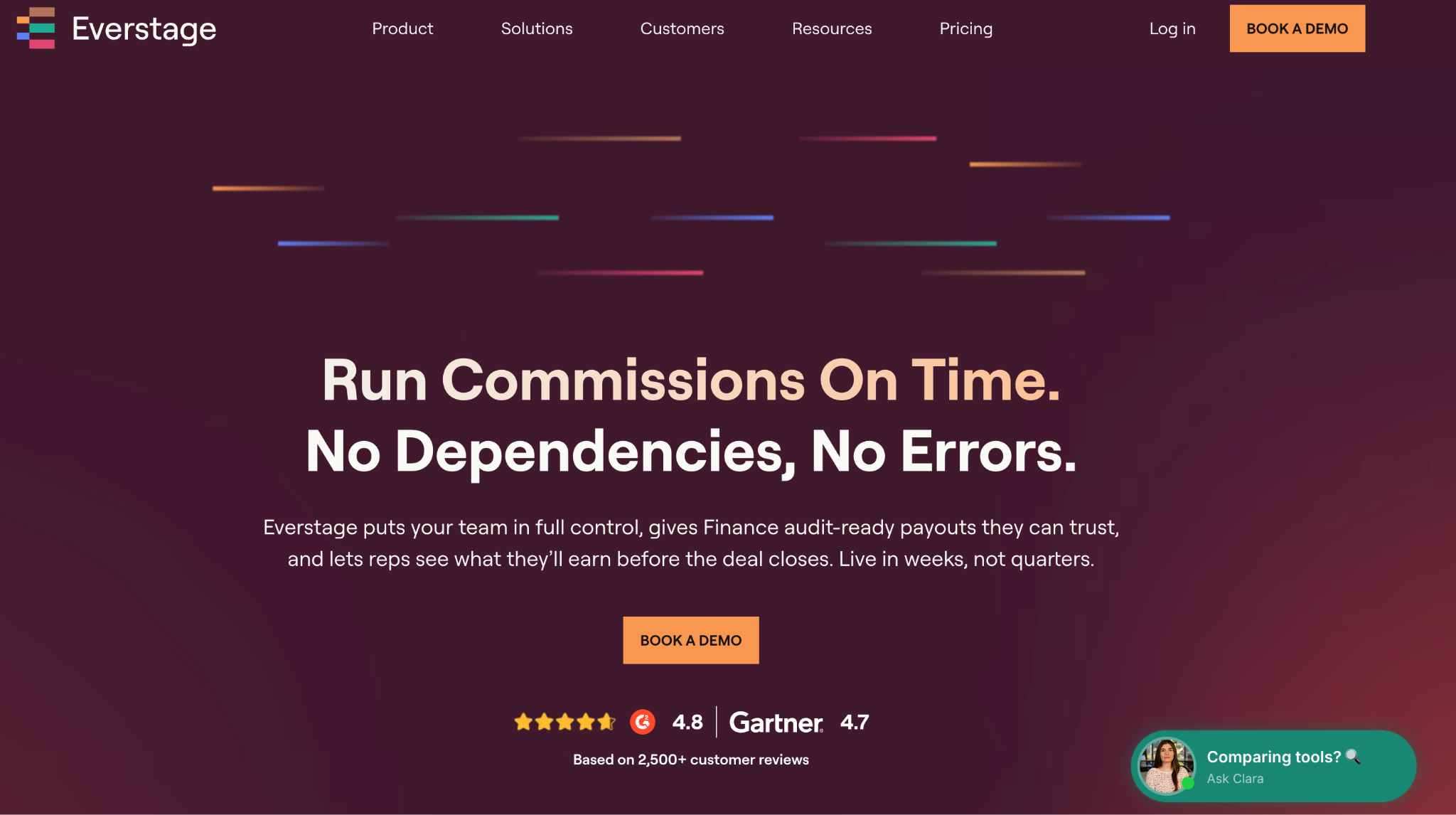
Everstage is a sales compensation automation platform for teams that need accurate commission calculations. It delivers real-time earnings visibility and flexible plan management without spreadsheets or heavy IT support. Built for operations and finance leaders, it gives real-time visibility into commission performance and payout accuracy.
Everstage also offers custom workflows with multi-stage approvals to build trust in the commission process. It uses triggers and pre-defined rules to create automated workflows and send alerts when data changes. Everstage works alongside your CRM and automates the compensation layer.
Key features:
- Automated commission calculation with real-time accuracy.
- Transparent dashboards for reps and managers.
- Quota attainment tracking and incentive performance analysis.
- Flexible plan configuration to align with shifting business goals.
2. HubSpot: Best for Sales Workflow Automation

HubSpot offers an all-in-one platform that integrates CRM and marketing tools into one revenue operations environment. Its sales module streamlines lead management and deal tracking with analytics for performance measurement.
The automation engine builds workflows that run from lead nurturing to post-sale follow-ups. Integrations with hundreds of apps let HubSpot scale from small businesses to enterprises while staying easy to use. It is less specialized for complex commission plans.
Key Features:
- Built-in CRM with email tracking and meeting scheduling.
- Automated lead nurturing and deal stage progression.
- Customizable sales pipelines and reporting dashboards.
- Integration with marketing and service hubs for unified operations.
3. Salesforce: Best for CRM-Based Sales Performance Tracking
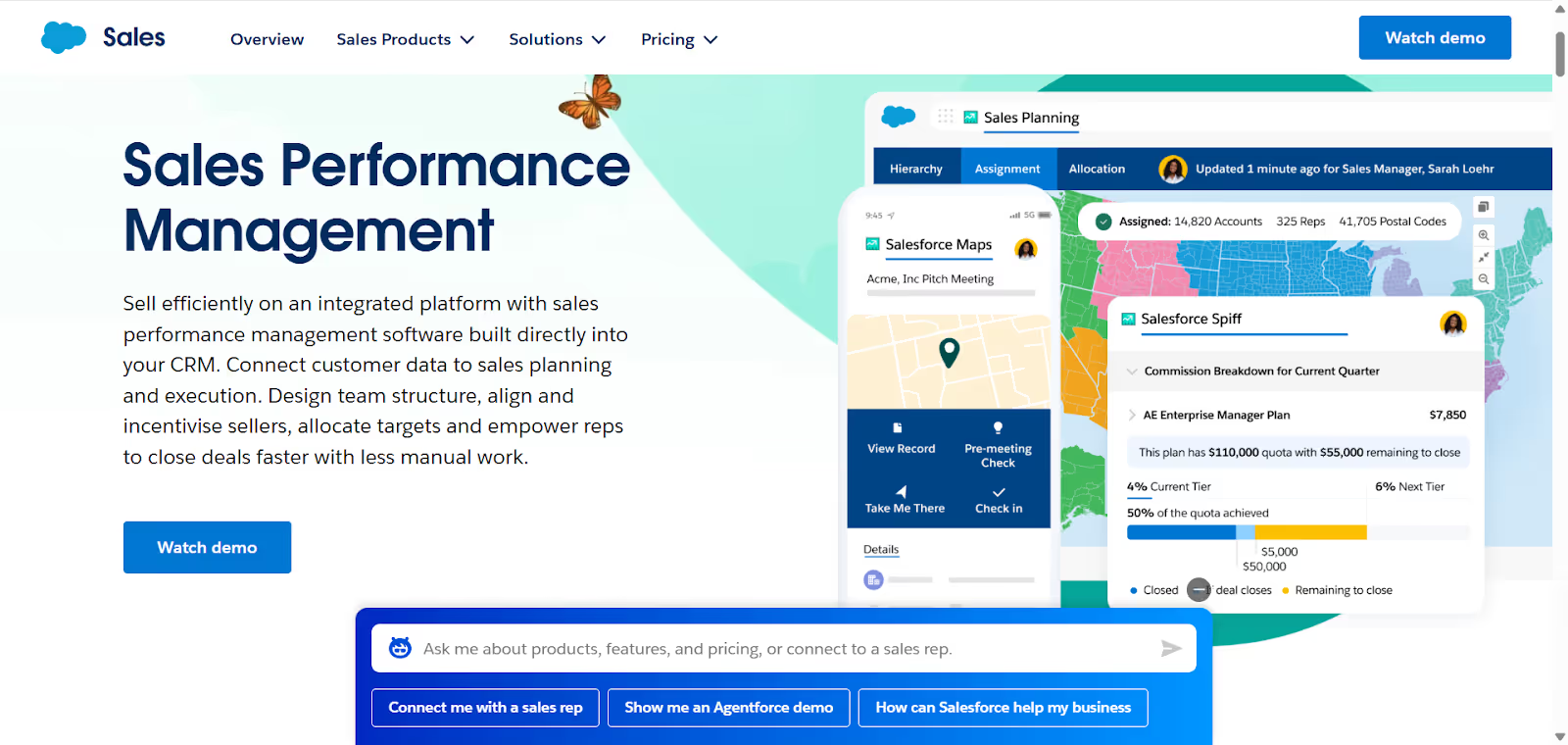
Salesforce is one of the most powerful and customizable sales performance automation platforms on the market. Salesforce Einstein adds AI-powered insights that help teams prioritize leads and spot at-risk deals. Deep customization of workflows and reports makes it suitable for complex enterprise sales. The AppExchange marketplace adds thousands of third-party apps to extend functionality. It often requires admin or implementation support.
Key Features:
- Industry-leading CRM with advanced customization options.
- AI-driven lead scoring and forecasting.
- Extensive integration ecosystem via AppExchange.
- Real-time performance dashboards and pipeline tracking.
Building a Connected System for Performance, Incentives, and Revenue
Sales performance automation delivers the most value when it connects performance to incentives and revenue. For commission-driven teams, that means real-time earnings visibility for reps and accurate quota data for leaders. Finance gets a faster, more reliable way to manage payouts.
If you are considering sales performance automation, start by identifying where your team spends the most time on manual work. Then look for tools that integrate with your systems and offer the analytics and AI your team needs.
If your team still manages commissions and approvals across spreadsheets, Everstage can automate the process and turn incentives into a revenue lever.
Questions worth asking
The things most people want to know before they commit.
What is the difference between sales automation and sales performance automation?
Sales automation handles repetitive activities like emails and CRM updates. Sales performance automation measures and improves sales outcomes like quota attainment and payout accuracy. For commission-driven teams, sales performance automation connects performance data directly to earnings.
What is the 80 20 rule for sales performance automation?
The 80/20 rule suggests automating the repetitive 80% of workflows like data entry and payout calculations. Human judgment handles the complex 20%, including negotiation and exception handling. This balance maximizes efficiency while keeping the human element that closes deals.
How does AI improve sales performance automation?
AI analyzes historical win/loss data to predict deal outcomes and flag at-risk deals. It also forecasts revenue. It surfaces coaching opportunities and identifies accounts likely to churn. The result turns raw data into proactive guidance.
Which metrics should teams track after implementing sales performance automation?
Track selling time recovered and quota attainment. Monitor forecast accuracy and pipeline velocity. Add payout accuracy and rep adoption for the financial view. These metrics show both efficiency gains and the financial impact of automation.
Can sales performance automation help with lead management?
Yes, sales performance automation tools include automated lead scoring and prioritization, which lets reps focus on the most promising prospects. Automated lead management systems save time and increase conversion rates by organizing leads based on behavior and engagement.
What sales tasks should not be fully automated?
Relationship building and complex negotiations should keep humans in the loop. The same applies to sensitive customer conversations and exception handling. Automation works best for rules-based, repetitive tasks. Decisions that need empathy and judgment stay with people.