

.avif)
TL;DR
Visual CPQ simplifies complex product configuration and quoting by using interactive visuals, real-time pricing, and guided rules to improve speed and accuracy across the sales cycle.
- Replace static, text-based CPQ with visual, customer-friendly configuration experiences
- Reduce pricing errors and rework with real-time validation and automated calculations
- Help sales teams close deals faster by improving clarity, confidence, and buyer engagement
- Scale complex, customizable offerings without slowing down quoting or approvals
Introduction
Your sales rep is on a video call with a manufacturing client who needs a custom equipment configuration. The client wants to see exactly what they're buying: a specific conveyor system with custom dimensions, particular safety features, and specialized automation controls.
Your rep opens a spreadsheet. Then another. They're toggling between PDFs, trying to explain how the final product will look, what each component does, and why the price keeps changing as requirements shift. Twenty minutes in, the client is confused. The rep is flustered. And the quote still isn't ready.
This scenario plays out thousands of times every day in B2B sales. Traditional CPQ systems help with pricing logic and product rules, but they fail at something fundamental: showing customers what they're actually buying.
That's the gap visual CPQ fills. It transforms the configure-price-quote process from a text-heavy, error-prone workflow into an interactive experience where customers see their product taking shape in real time. Every configuration change updates both the visual representation and the price instantly.
In complex sales environments like manufacturing, automotive, furniture, and industrial equipment, visual CPQ has moved from nice-to-have to competitive necessity. Buyers expect to see what they're purchasing. They want to experiment with configurations. They need confidence that what they're ordering matches what they'll receive.
This guide walks you through what visual CPQ actually is, how it works, why it's becoming essential for B2B sales teams, and how to evaluate whether your organization needs it. Whether you're selling customizable products, managing complex configurations, or simply trying to speed up your sales cycle, understanding visual CPQ gives you a strategic advantage.
Let's start with the fundamentals.
What is Visual CPQ?
Visual CPQ (Configure, Price, Quote) is a sales technology that combines traditional CPQ logic with interactive, visual product configuration. Instead of relying on text-based forms, dropdowns, or rule tables, Visual CPQ lets sales reps and buyers see the product take shape as they configure it, often through 2D or 3D visuals.
At its core, Visual CPQ helps sales teams build accurate, compliant quotes for complex products. But it does this in a way that’s far more intuitive than legacy CPQ tools.
With Visual CPQ, every configuration choice: size, color, components, features, or add-ons, is reflected instantly in a visual model. As selections change, pricing updates in real time, ensuring that what the buyer sees is always aligned with what they’ll be quoted. This removes guesswork from the sales process and significantly reduces configuration and pricing errors.
The global market for Configure Price Quote Software was valued at US $3 billion in 2024 and is projected to reach US $7.3 billion by 2030, growing at a CAGR of 16.2% from 2024 to 2030.
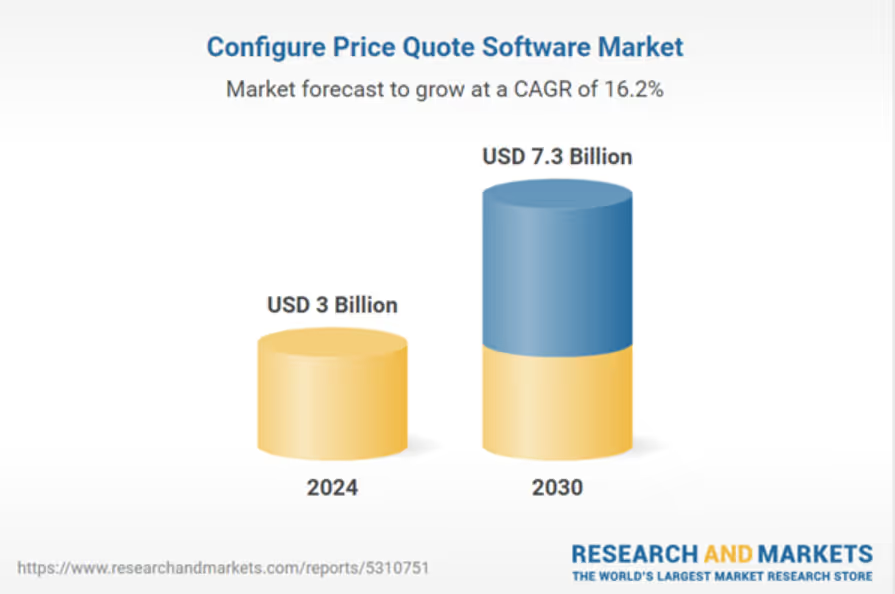
Traditional CPQ systems are rules-driven but largely invisible. They expect reps to understand how different options interact behind the scenes. Visual CPQ makes those rules visible. It guides users step by step, prevents invalid combinations, and clearly shows what’s possible and what isn’t.
This is especially valuable for businesses selling:
- Highly configurable products
- Modular or custom-built solutions
- Products with complex pricing logic
- Solutions that require buyer collaboration during configuration
Visual CPQ turns configuration from a back-office task into a front-stage sales experience. It bridges the gap between technical accuracy and buyer understanding, making it easier for sales teams to sell complex products without slowing down the deal.
Tools like Everstage CPQ combine visual configuration capabilities with intelligent pricing engines, helping sales teams configure products accurately while giving customers the interactive experience they expect.
Why Visual CPQ is the Future of Sales Configuration
Sales configuration has changed, but buyer expectations have changed even faster.
Today’s buyers want clarity before they commit. They expect to understand what they’re buying, how it works, and how pricing changes based on their choices, without waiting days for revised quotes or explanations. Traditional CPQ tools, while powerful, weren’t designed for this level of interaction. They prioritize internal accuracy over buyer experience.
Visual CPQ flips that model.
Instead of treating configuration as a back-office process, Visual CPQ brings it directly into the sales conversation. Buyers and sales reps can explore options together, see the impact of each decision instantly, and move forward with confidence. This shift is why Visual CPQ is quickly becoming the standard for modern sales configuration.
1. Buyer expectations are now visual and interactive
B2B buyers increasingly behave like B2C consumers. They’re used to configuring products visually, whether it’s customizing a car, a workspace, or software features. Static forms and long spec sheets feel outdated in comparison.
Visual CPQ meets buyers where they are by offering intuitive, interactive configuration experiences. When customers can see exactly what they’re getting, uncertainty drops, trust increases, and decisions happen faster.
2. Sales complexity keeps increasing
Product catalogs are expanding. Pricing models now include usage-based tiers, bundles, regional pricing, and custom discounts. Managing this complexity through manual steps or text-heavy CPQ tools slows sales teams down and increases the risk of errors.
Visual CPQ handles this complexity behind the scenes while keeping the experience simple on the surface. Configuration rules, pricing logic, and approvals still exist, but they’re embedded into a guided, visual flow that prevents mistakes before they happen.
3. Speed and accuracy are no longer trade-offs
In a traditional sales configuration, teams often have to choose between speed and accuracy. Move fast, and errors creep in. Be thorough, and deals stall.
Visual CPQ removes this trade-off. Real-time validation ensures only valid configurations are created, while instant pricing updates eliminate back-and-forth revisions. Sales teams can move faster without sacrificing compliance or margin control.
4. Sales teams need tools that support live selling
Modern sales conversations happen live: on calls, demos, or shared screens. Visual CPQ fits naturally into these moments. Instead of explaining options verbally or sending follow-up documents, reps can configure products in real time alongside the buyer.
This makes sales conversations more collaborative and engaging, helping buyers feel involved rather than sold to.
How Visual CPQ Enhances Product Configuration and Quote Accuracy
One of the biggest challenges in selling configurable products isn’t closing; it’s getting the configuration and pricing right the first time. Even small errors in options, dependencies, or discounts can delay deals, trigger re-approvals, or erode margins. Visual CPQ directly addresses this problem by combining guided configuration with real-time validation.
Guided configuration prevents invalid combinations
Visual CPQ embeds business rules directly into the configuration experience. As users select product options, the system automatically allows or restricts choices based on compatibility, availability, and policy rules.
Instead of discovering errors after a quote is generated, invalid combinations are prevented upfront. This means:
- Fewer back-and-forth revisions
- Less reliance on sales ops or engineering teams
- Reduced the risk of promising products that can’t be delivered
Sales reps don’t need deep technical knowledge to sell complex products. The system guides them through valid paths while ensuring every configuration remains compliant.
Real-time visuals eliminate ambiguity
Text-based configurations leave too much room for interpretation. Buyers may misread specs, misunderstand options, or assume features are included when they aren’t.
Visual CPQ removes this ambiguity by showing exactly what the configured product looks like at every step. As components are added or removed, the visual representation updates instantly. This shared understanding reduces miscommunication and helps buyers feel confident about what they’re approving.
Real-time pricing ensures accurate quotes
Pricing errors are one of the most common causes of delayed deals. Manual calculations, outdated price lists, or misapplied discounts can all lead to incorrect quotes.
With Visual CPQ, pricing logic is tied directly to configuration choices. As options change, prices update automatically in real time, factoring in bundles, volume tiers, regional pricing, and discount rules. This ensures that:
- Quotes reflect the latest pricing policies
- Margins are protected
- Approval workflows are triggered only when necessary
Sales teams can generate accurate, audit-ready quotes without slowing down the sales cycle.
Fewer handoffs mean faster deal cycles
Traditional configuration often requires multiple handoffs, sales to sales ops, sales ops to finance, and finance back to sales. Each step introduces delays and opportunities for error.
Visual CPQ reduces these dependencies by consolidating configuration, pricing, and validation into a single flow. When quotes are accurate from the start, approvals move faster and deals close sooner.
Key Features of a Visual CPQ Tool
.avif)
A Visual CPQ tool goes beyond basic configuration and pricing logic. Its real value lies in how it combines accuracy, automation, and visual clarity into a single sales workflow.
While capabilities may vary by platform, high-performing Visual CPQ solutions typically share a core set of features designed to simplify complex selling.
1. 3D Product Configuration
3D product configuration is the foundation of Visual CPQ. It allows sales reps and buyers to visually assemble products by selecting components, dimensions, colors, and add-ons, all within a realistic, interactive model.
As configurations change, the 3D visual updates instantly. This helps buyers understand exactly what they’re getting and eliminates the guesswork that often comes with spec-heavy products. For sales teams, it reduces dependency on technical documentation and ensures that every configuration aligns with predefined rules.
This feature is especially valuable in industries like manufacturing, equipment sales, and modular software, where product complexity can otherwise slow deals down.
2. Interactive Visual Quoting
Interactive visual quoting connects the configuration directly to the quote. As users adjust product options, the quote updates in real time, showing line items, pricing breakdowns, and totals alongside the visual model.
This makes the quoting process more transparent for buyers and more efficient for reps. Instead of generating multiple quote versions or following up with revisions, sales teams can finalize pricing during live conversations.
By turning quotes into an interactive experience rather than a static document, Visual CPQ keeps momentum high and reduces deal friction.
3. Real-Time Pricing Adjustments
Real-time pricing is what ensures speed doesn’t come at the cost of accuracy. Visual CPQ tools automatically apply pricing logic as configurations change, factoring in bundles, volume tiers, regional pricing, contract terms, and discount thresholds.
This eliminates manual calculations and reduces pricing errors that often trigger approval delays. Sales reps can confidently present accurate pricing on the spot, while finance teams maintain control over margins and discounting rules behind the scenes.
4. Customizable Design Features
Customization is central to Visual CPQ. Buyers can tailor products to their specific needs, while the system ensures every customization remains viable and compliant.
These design features allow sales teams to offer flexibility without increasing risk. Reps can sell personalized solutions at scale, and buyers feel more ownership over the final product, both of which contribute to higher deal confidence and conversion rates.
Everstage CPQ delivers these core features in an integrated platform designed for modern sales teams. Visual configuration tools combine with intelligent automation, flexible pricing engines, and seamless system integrations to streamline the entire configure-price-quote process.
Understanding these features provides a foundation for evaluating visual CPQ solutions. The specific implementation details vary across platforms, but these capabilities represent the baseline for effective visual configuration and quoting.
Benefits of Using a Visual CPQ Tool
.avif)
Visual CPQ doesn’t just improve how products are configured; it changes how deals move through the pipeline. By combining accuracy, speed, and visual clarity, it removes many of the friction points that slow down complex sales.
Here are the core benefits sales teams see after adopting a Visual CPQ software:
1. Reduced Sales Cycle Time
Long sales cycles are often driven by configuration errors, pricing revisions, and approval delays. Visual CPQ tackles all three at once.
By guiding reps through valid configurations and applying pricing rules automatically, quotes can be built and finalized in a single conversation. Fewer revisions mean fewer follow-ups, fewer internal handoffs, and faster approvals. Deals move forward while buyer intent is still high.
For sales teams selling complex or customized products, this can shave days, or even weeks, off the quote-to-close process.
2. Improved Quote Accuracy
Quote errors are expensive. They lead to rework, delayed onboarding, margin leakage, and damaged buyer trust.
Visual CPQ improves accuracy by validating configurations in real time and tying pricing directly to approved rules. Every quote reflects the latest product options, pricing logic, and discount policies, without relying on manual checks.
The result is fewer disputes, cleaner handoffs to finance and operations, and a more predictable revenue process.
3. Better Customer Experience
Buyers are more confident when they understand what they’re purchasing. Visual CPQ turns configuration into a collaborative experience, allowing customers to see options, explore alternatives, and understand pricing implications instantly.
This transparency builds trust. Instead of feeling overwhelmed by specs or confused by line items, buyers feel involved in shaping the solution. That confidence often translates into faster decisions and fewer last-minute objections.
4. Enhanced Collaboration Across Teams
Visual CPQ creates a shared source of truth for sales, sales ops, finance, and product teams. Configuration rules, pricing logic, and approval workflows are defined once and enforced automatically.
This reduces reliance on ad-hoc checks and manual reviews. Sales teams gain autonomy, while finance and operations maintain control. Everyone works from the same system, which improves alignment and reduces friction as the business scales.
Visual CPQ vs Traditional CPQ: Key Differences
While both Visual CPQ and traditional CPQ aim to solve the same core problem, accurate configuration, pricing, and quoting, the way they support sales teams is fundamentally different.
Understanding these differences helps clarify why many organizations are moving beyond legacy CPQ tools.
1. User experience: visual vs text-driven
Traditional CPQ tools are built around forms, dropdowns, and rule tables. They work well from a systems perspective, but require sales reps to interpret configurations mentally. Buyers rarely interact with them directly.
Visual CPQ, on the other hand, is experience-led. Configuration happens through interactive visuals where users can see the product evolve as options change. This makes the process intuitive for reps and far easier for buyers to understand during live sales conversations.
2. Configuration accuracy: reactive vs proactive
In traditional CPQ, errors are often discovered after a configuration is submitted, during pricing review, approval, or even fulfillment. Fixing those mistakes introduces delays and rework.
Visual CPQ prevents errors upfront. Invalid combinations are blocked in real time, and configuration rules are enforced visually. Instead of correcting mistakes later, the system ensures only valid configurations are created from the start.
3. Sales speed: multi-step vs real-time
Traditional CPQ workflows typically involve multiple steps:
- Configure
- Generate quote
- Validate pricing
- Request approvals
- Revise and resend
Visual CPQ compresses this into a single flow. Configuration, pricing, and validation happen together, often during the same call or demo. This allows sales teams to move faster without sacrificing compliance.
4. Buyer involvement: internal tool vs shared experience
Traditional CPQ is designed primarily for internal use. Buyers only see the final output, a PDF or static quote.
Visual CPQ invites buyers into the process. They can explore options, understand trade-offs, and participate in shaping the solution. This shared experience increases engagement, builds trust, and reduces last-minute objections.
5. Scalability: complexity hidden vs complexity managed
As product catalogs and pricing rules grow, traditional CPQ tools become harder to use effectively. Reps need more training, and reliance on sales ops increases.
Visual CPQ scales more naturally. Complexity is handled behind the scenes, while the front-end experience remains simple and guided. This makes it easier to onboard new reps, expand product offerings, and support growth without slowing sales down.
How Visual CPQ Helps Sales Teams Close Deals Faster
Speed matters in sales, but speed without clarity often backfires. Visual CPQ accelerates deal velocity by removing friction at every stage of the sales conversation, from discovery to final approval.
Instead of relying on follow-ups, revisions, and internal dependencies, sales teams can move deals forward with confidence in real time.
1. Live configuration keeps momentum high
One of the biggest reasons deals stall is the loss of momentum. When buyers have to wait for updated quotes or clarifications, enthusiasm fades, and priorities shift.
Visual CPQ allows sales reps to configure products live, during demos, calls, or screen shares. Buyers can explore options, ask questions, and see answers immediately. Decisions that once took days of back-and-forth can now happen in a single conversation.
This immediacy keeps deals moving while buyer intent is still strong.
2. Fewer revisions mean fewer delays
Every quote revision adds friction. It introduces delays, creates confusion, and increases the chances of pricing disputes or approval bottlenecks.
Because Visual CPQ validates configurations and pricing upfront, quotes are far more likely to be correct the first time. That reduces:
- Rejected quotes
- Re-approvals
- Manual fixes from sales ops or finance
With fewer corrections needed, deals progress smoothly from proposal to signature.
3. Clear visuals reduce buyer hesitation
Buyer hesitation often comes from uncertainty about what’s included, how the product will work, or whether the solution fits their needs.
Visual CPQ removes this uncertainty by making the product tangible. Buyers can see exactly what they’re getting and how each option affects the final solution and price. This clarity reduces objections late in the sales cycle and helps buyers commit with confidence.
4. Sales reps spend less time explaining and more time selling
Traditional selling often requires reps to explain complex configurations verbally or through dense documentation. Visual CPQ shifts that burden to the system.
Instead of explaining every option, reps can show it. This makes conversations more efficient, more engaging, and easier to tailor to buyer needs. Reps spend less time troubleshooting and more time guiding decisions, which directly impacts close rates.
Top Industries That Benefit From Visual CPQ
Visual CPQ is especially powerful in industries where products are complex, customizable, or difficult to explain through static specs alone. When buyers need clarity before committing, and sales teams need accuracy at scale, visual configuration becomes a competitive advantage.
Below are the industries seeing the highest impact from adopting Visual CPQ.
1. Manufacturing and Industrial Equipment
Manufacturers often sell products with hundreds or thousands of possible configurations. Size, materials, components, compliance requirements, and regional constraints all affect what can be sold and how it’s priced.
Visual CPQ allows sales teams to configure machinery, equipment, or assemblies visually while enforcing engineering and production rules behind the scenes. Buyers can see exactly what they’re ordering, while manufacturers reduce costly errors that would otherwise surface during production or fulfillment.
This is especially valuable for made-to-order and engineer-to-order models where accuracy is critical.
2. SaaS and Technology Providers
SaaS pricing has grown increasingly complex. Bundles, feature tiers, usage-based pricing, add-ons, and contract terms all influence the final quote.
Visual CPQ helps sales teams present these options clearly. Buyers can see how different features, user counts, or usage levels impact pricing in real time. This transparency reduces confusion, speeds up approvals, and helps buyers choose plans that actually fit their needs.
For SaaS companies selling multi-product or enterprise plans, Visual CPQ brings structure and clarity to otherwise confusing pricing conversations.
3. Furniture, Fixtures, and Modular Products
Furniture and modular product sales rely heavily on visualization. Buyers need to understand dimensions, layouts, finishes, and compatibility before committing.
Visual CPQ enables customers and sales reps to design configurations visually, adjusting components, layouts, and finishes while ensuring everything remains compatible. This reduces returns, rework, and buyer dissatisfaction caused by mismatched expectations.
The result is a smoother buying experience and greater confidence in high-consideration purchases.
4. Automotive and Mobility Solutions
Automotive and mobility solutions, especially in B2B and fleet sales, require precise configuration across models, features, compliance options, and pricing structures.
Visual CPQ allows buyers to explore configurations visually while sales teams ensure every selection meets regulatory, operational, and pricing constraints. This is particularly useful for fleet customization, specialty vehicles, and aftermarket solutions.
5. Telecom and Managed Services
Telecom and managed service offerings often bundle hardware, software, service levels, and contract terms. Explaining these combinations through spreadsheets or static proposals is time-consuming and error-prone.
Visual CPQ helps sales teams present bundled solutions clearly, showing how service levels, coverage, and pricing change as options are selected. This makes it easier for buyers to compare packages and commit faster.
What to Look for in a CPQ Visualization Tool
Not all Visual CPQ tools deliver the same value. While many platforms claim to offer visual configuration, the real differentiator lies in how well they balance usability, accuracy, and scalability. Choosing the right CPQ visualization tool is critical, especially if you’re selling complex, customizable products.
Here are the key factors to evaluate before investing in a Visual CPQ solution.
1. Strong configuration and pricing engine
Visuals alone aren’t enough. Behind every effective Visual CPQ tool is a robust rules and pricing engine that governs what can be sold and how it’s priced.
Look for a platform that supports:
- Complex configuration rules and dependencies
- Dynamic pricing models (tiered, bundled, usage-based)
- Discount controls and margin protection
- Automated approvals based on thresholds
The visual layer should simplify selling, not override the logic that protects accuracy and profitability.
2. Intuitive, rep-friendly user experience
If a CPQ tool requires extensive training, adoption will suffer. The best Visual CPQ solutions are designed for sales reps first, intuitive, guided, and easy to use during live conversations.
Sales teams should be able to:
- Configure products without deep technical knowledge
- Generate quotes quickly without switching tools
- Confidently present options during calls or demos
A clean, guided interface reduces reliance on sales ops and shortens ramp time for new reps.
3. Real-time visualization capabilities
True Visual CPQ updates visuals instantly as configurations change. This real-time feedback is essential for buyer clarity and rep confidence.
Evaluate whether the tool supports:
- Real-time 2D or 3D visualization
- Smooth performance during live demos
- Accurate representation of final products
The closer the visual matches the real product, the fewer surprises there will be post-sale.
4. Seamless integrations with your sales stack
Visual CPQ should fit naturally into your existing workflows. Look for integrations with:
- CRM systems for opportunity and account data
- ERP or billing systems for fulfillment and invoicing
- Contract management and e-signature tools
Strong integrations reduce manual data entry, prevent errors, and ensure a smooth quote-to-cash flow.
5. Scalability and flexibility
As your product catalog, pricing models, and sales teams grow, your CPQ tool should scale with you. The right platform makes it easy to:
- Add new products and configurations
- Update pricing rules without heavy technical effort
- Support multiple regions, currencies, and languages
A scalable Visual CPQ solution supports growth without forcing constant rework or customization.
Challenges and Limitations of Visual CPQ
While Visual CPQ delivers significant benefits, it’s not a plug-and-play solution. Like any sales technology, its impact depends on how well it’s implemented and aligned with your business processes.
Understanding the common challenges upfront helps teams set realistic expectations and avoid adoption pitfalls.
1. Initial setup and implementation effort
Visual CPQ tools require a strong foundation of product data, configuration rules, and pricing logic. For organizations with fragmented catalogs or undocumented pricing policies, this setup phase can take time.
Configuration rules must be clearly defined, validated, and tested before rollout. While this upfront effort pays off long term, teams should plan for an initial investment of time and cross-functional collaboration, especially between sales, product, and finance.
2. Dependence on clean product and pricing data
Visual CPQ is only as accurate as the data behind it. If product options, pricing tiers, or discount rules are outdated or inconsistent, errors can still surface, just faster and at scale.
Organizations must maintain disciplined data governance. This includes regular updates to product catalogs, pricing models, and approval thresholds. Without this rigor, even the most advanced Visual CPQ tool can introduce confusion instead of clarity.
3. Change management and adoption hurdles
Switching from traditional quoting methods to Visual CPQ changes how sales teams sell. Some reps may resist new workflows, especially if they’re comfortable with spreadsheets or legacy CPQ tools.
Successful adoption requires:
- Clear communication of benefits
- Practical, role-based training
- Early wins that demonstrate value
Without buy-in from frontline reps, Visual CPQ risks becoming an underused feature rather than a core selling tool.
4. Not ideal for every sales model
Visual CPQ delivers the most value in complex, configurable sales environments. For businesses selling simple, fixed-price products with minimal variation, the visual layer may offer limited incremental benefit.
In these cases, a lightweight CPQ or pricing tool may be sufficient. Visual CPQ shines when complexity exists, when clarity, validation, and visualization materially improve the buying experience.
Conclusion: Should Your Business Use Visual CPQ?
If your sales team sells complex, configurable products and still relies on static quotes, spreadsheets, or text-heavy CPQ tools, Visual CPQ is no longer a “nice to have.” It’s a strategic upgrade.
Visual CPQ helps sales teams simplify complexity without sacrificing accuracy. By combining guided configuration, real-time pricing, and interactive visuals, it removes friction from the quote-to-cash process and replaces uncertainty with clarity, for both reps and buyers.
That said, Visual CPQ delivers the most value when complexity exists. If your products involve multiple options, dependencies, pricing models, or buyer stakeholders, visual configuration can dramatically improve speed, confidence, and close rates. For simpler sales models, the added visual layer may offer limited returns.
The real question isn’t whether Visual CPQ looks impressive; it’s whether your current sales process creates delays, errors, or confusion that cost you deals. If quotes take too long, revisions are common, or buyers struggle to understand what they’re buying, Visual CPQ directly addresses those pain points.
As buyer expectations continue to shift toward transparency and interactivity, sales teams that invest in visual, intuitive selling experiences will have a clear advantage. Visual CPQ isn’t just about configuring products better; it’s about helping buyers decide faster and helping sales teams win more consistently.
If you’re ready to move beyond static quotes and manual workarounds, Everstage CPQ helps sales teams bring visual configuration, automated pricing, and accuracy into every deal, without adding friction.
Book a demo to see how Everstage CPQ helps your team configure faster, quote accurately, and close complex deals with confidence.
Questions worth asking
The things most people want to know before they commit.
What is Visual CPQ in simple terms?
Visual CPQ is a sales tool that lets reps and buyers configure products visually while automatically applying pricing and validation rules. Instead of filling out text-based forms, users can see the product change in real time and generate accurate quotes instantly. This makes selling complex, customizable products faster and easier.
How is Visual CPQ different from traditional CPQ?
Traditional CPQ relies on text fields, dropdowns, and backend rules that buyers never see. Visual CPQ adds an interactive visual layer on top of those rules, allowing users to see configurations, understand options clearly, and view real-time pricing. The result is fewer errors, faster quotes, and better buyer engagement.
Who should use Visual CPQ?
Visual CPQ is ideal for sales teams selling complex or configurable products, such as manufacturers, SaaS companies with modular pricing, telecom providers, and businesses offering custom solutions. It’s especially valuable when multiple options, dependencies, or pricing models make traditional quoting slow or error-prone.
Does Visual CPQ replace sales ops or approval workflows?
No. Visual CPQ reduces dependency on sales ops for routine configuration and pricing, but it doesn’t eliminate governance. Approval workflows, discount thresholds, and pricing controls still exist, just automated and enforced in real time. This gives sales teams more autonomy while maintaining control for finance and leadership.
Is Visual CPQ difficult to implement?
Implementation requires upfront work, including defining product rules, pricing logic, and data structures. However, once set up, Visual CPQ significantly reduces manual effort and rework. With the right platform and cross-functional alignment, most teams see long-term efficiency gains that outweigh the initial setup effort.
How does Everstage CPQ support Visual CPQ use cases?
Everstage CPQ combines guided visual configuration with real-time pricing, automated approvals, and seamless integrations across the sales stack. It’s built to help sales teams configure faster, accurately quote generation, and close complex deals without manual back-and-forth.