

.avif)
TL;DR
CPQ for telecom helps streamline pricing, quoting, and service configurations, improving sales efficiency and customer satisfaction.
- Automates product configuration, reducing manual work and errors
- Speeds up quote generation, shortening the sales cycle
- Ensures accurate pricing across varying models and customer needs
- Enhances the overall customer experience with tailored, quick quotes
This guide serves telecom revenue teams managing complex B2B quoting workflows. It speaks to sales operations, pricing, deal desk, finance, and RevOps leaders responsible for quote accuracy, approval speed, and margin protection.
Is your sales team spending too much time manually configuring complex bundles, calculating pricing, and producing error-prone quotes? Telecom revenue teams face this challenge daily. Delays create margin leakage, billing disputes, and approval bottlenecks, frustrating both reps and buyers while slowing the sales process and increasing mistakes.
CPQ (Configure, Price, Quote) software solves this. CPQ telecom solutions automate the work of configuring services, pricing them accurately, and producing quotes in real time.
The CPQ for telecom market is projected to grow at a CAGR of 13.2% from 2025 to 2033, reaching USD 6.74 billion by 2033.
Telecom businesses that adopt CPQ streamline operations, reduce human error, and shorten the sales cycle. CPQ also surfaces upselling opportunities by suggesting additional services based on customer data. That creates a more personalized experience that lifts sales.
This article shows how CPQ helps telecom providers simplify sales processes, reduce errors, and close deals faster.
What Is CPQ for Telecom and How Does It Work?
CPQ for telecom is software that helps sales teams configure service bundles, apply accurate pricing rules, and produce customer-ready quotes. Telecom CPQ must account for more than a generic quoting tool. It checks service availability, network compatibility, regional fees, contract terms, and usage-based pricing.
Telecom businesses face complex product configurations and pricing models that drive errors and slow sales cycles.
Telecom sales teams also handle operational demands like network infrastructure compatibility. That means confirming a proposed service works with the customer's current access technology, coverage, or device requirements. Service provisioning adds another layer of complexity.
Telecom CPQ differs from standard CPQ in scope. It must verify service availability, network coverage, usage-based pricing, regulatory fees, installation requirements, and provisioning feasibility before a quote reaches the customer.
CPQ software integrates with CRM systems, product catalogs, and provisioning workflows to keep pricing and configuration aligned. That integration cuts manual effort and improves sales efficiency. Telecom teams that implement CPQ see faster quoting, sharper pricing accuracy, and a quicker sales process.
Maps common telecom sales problems to the CPQ capability that solves each and the resulting outcome.
Why Telecom Providers Need CPQ to Manage Complex Sales
Telecom sales carry heavy complexity through diverse service offerings, intricate pricing models, and shifting customer requirements. CPQ (Configure Price Quote) software brings the automation and accuracy that streamline these processes. The result improves sales efficiency and customer satisfaction.
1. Common Telecom Sales and Quoting Challenges CPQ Solves
Telecom companies face several challenges that CPQ software addresses directly:
- Complex Product Configurations: Telecom businesses provide highly customized service bundles that are difficult to configure accurately and efficiently by hand.
- Pricing Complexity: Telecom pricing models combine regional pricing, service tiers, volume discounts, and promotional offers.
- Frequent Errors in Quotes: Manual processes produce pricing errors, incorrect configurations, and missed discounts. These mistakes cause delays and customer dissatisfaction.
- Slow Sales Cycle: Manually configuring the product catalog, calculating prices, and building quotes slows the sales cycle.
2. How CPQ Improves Telecom Sales and Pricing
CPQ streamlines the telecom sales process in three ways:
- Streamlining Pricing Models: CPQ applies pricing rules and discounts automatically. Every quote stays accurate and consistent without manual calculations.
- Speeding Up Quote Generation: CPQ automates the configuration and pricing of service bundles. Sales teams produce accurate quotes in a fraction of the time and shorten the sales cycle.
- Reducing Errors: Automated quoting minimizes human error in pricing and configurations. Each quote stays accurate and consistent across the sales team.
CPQ automates product configuration, pricing, and quote generation. That accuracy speeds up the sales process at the same time.
Compares manual quoting, generic CPQ, and telecom CPQ across seven capabilities relevant to telecom sales.
How CPQ Works Across Configure, Price, Quote, and Order Handoff
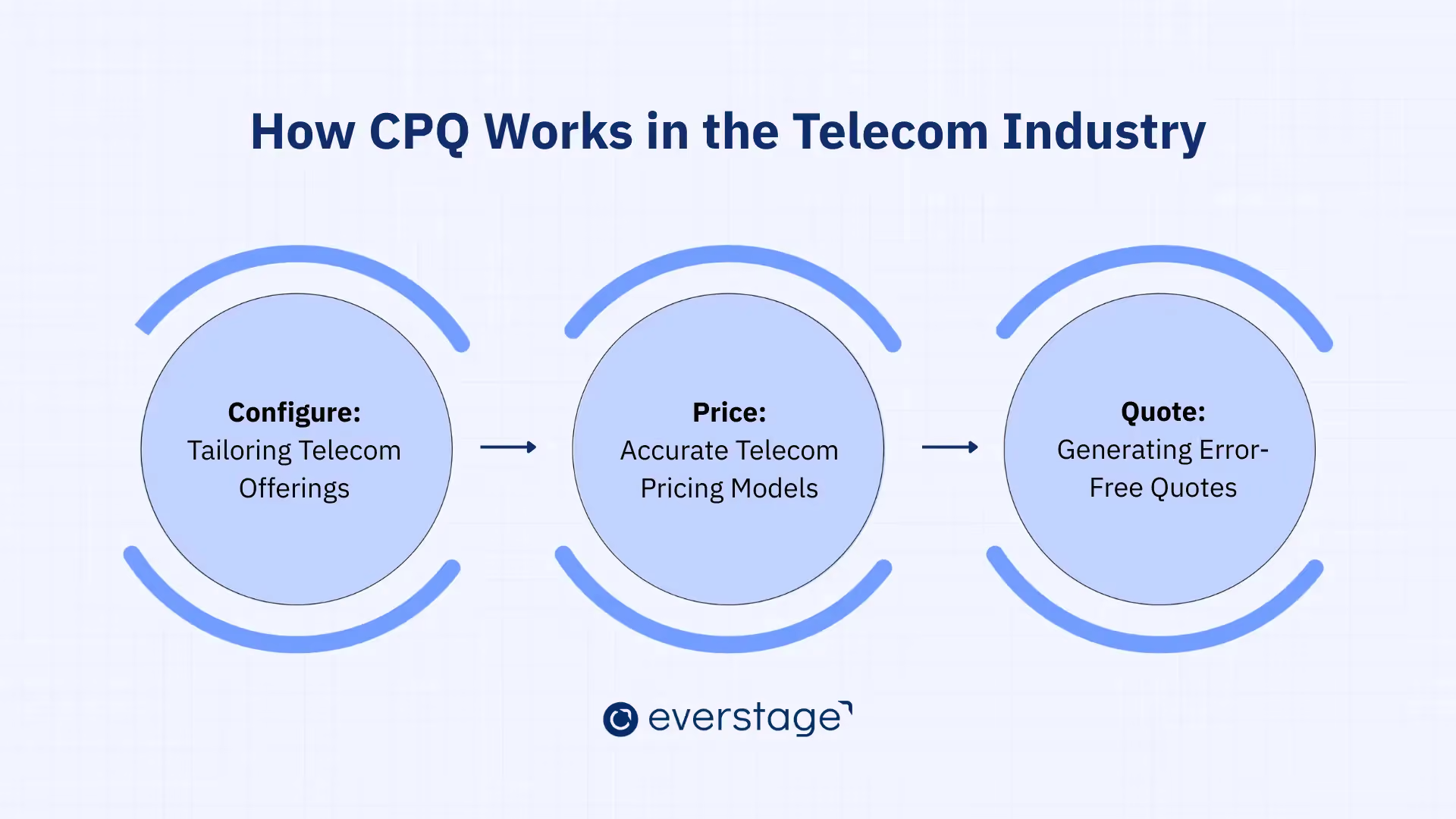
CPQ (Configure, Price, Quote) software changes how telecom companies run their sales processes. Telecom providers deliver customized, accurate quotes quickly, improve operational efficiency, and create a better customer experience.
Here is how CPQ works across the four stages of the telecom sales process.
1. Configure: Tailoring Telecom Offerings
Telecom companies offer a wide range of products and services that each customer needs configured differently. A mobile plan, internet service, or bundled package all require setup. CPQ streamlines configuration by automating and simplifying the build of personalized offerings.
CPQ enables telecom providers to:
- Create Custom Bundles: Telecom providers configure tailored service bundles around customer requirements. A business customer might need a high-speed internet plan, custom cloud storage, and a VoIP solution. CPQ assembles these services into a bundle that fits the customer's needs and the company's offerings.
- Automate Service Compatibility: CPQ checks for compatibility issues across service offerings automatically. If a customer requests a mobile plan that requires specific network coverage or data speed, CPQ confirms the selected services match what is available in the customer's region.
2. Price: Accurate Telecom Pricing Models
Telecom pricing carries deep complexity through different service rates, multiple discount tiers, and region-specific tax structures. Telecom pricing also includes industry-specific cost drivers that many general CPQ implementations miss unless modeled explicitly:
- Interconnection fees (charges tied to connecting calls or traffic between networks and partners)
- Spectrum licensing costs (cost structures that influence pricing for wireless services, especially enterprise-grade plans and coverage commitments)
- Regulatory surcharges and compliance fees (mandatory charges that vary by region, service type, and customer segment)
- Usage-based and overage pricing (data, roaming, international calling, peak usage tiers)
- Contract-specific pricing rules (enterprise SLAs, negotiated rate cards, multi-site rollouts, termination clauses)
CPQ automates the pricing process so discounts, taxes, special offers, and regional pricing variations apply accurately on every quote.
Lists the pricing inputs a telecom CPQ engine applies, with a telecom example for each.
CPQ helps telecom providers to:
- Automate Pricing Calculations: CPQ integrates pricing models so telecom providers calculate the exact cost for a bundle automatically. The engine factors in service tiers, volume discounts, and promotions.
- Manage Dynamic Pricing Models: Telecom pricing changes with market conditions, new customer contracts, and regulatory updates. CPQ lets telecom companies update pricing across the system at once, so every sales quote reflects current prices.
- Protect Margins With Guardrails: CPQ validates margin impact during quoting by factoring in discounts, contract terms, usage models, and network costs. It then routes low-margin deals through approval thresholds to prevent over-discounting.
For example, Everstage's CPQ lets teams update pricing models for market shifts and customer-specific agreements. Pricing stays accurate and competitive without manual intervention on every change.
3. Quote: Generating Error-Free Quotes
Accurate, timely quotes drive the telecom sales process. Manual quote generation eats time and invites errors like incorrect pricing, misapplied discounts, and mismatched service configurations.
CPQ automates the full quoting process so each quote stays accurate and consistent. The advantages include:
- Real-Time Quote Generation: Once configuration and pricing are set, CPQ produces an accurate quote instantly. Sales reps spend less time preparing proposals, and customers receive quotes without delay.
- Consistency Across Sales Teams: Every sales rep follows the same pricing and product rules. Quotes stay aligned with company policies, which reduces discrepancies and customer disputes.
- Error Reduction: CPQ automates the quoting process and cuts human error sharply. Sales teams skip manual pricing math and capture details like taxes and special discounts every time.
Accurate, consistent quotes save time and build customer trust through clear, reliable pricing.
4. Order Handoff: Turning Approved Quotes Into Fulfillable Orders
A quote holds value only when it can be fulfilled cleanly. Telecom deals often break down at this stage. CPQ reduces order fallout by passing validated configurations, pricing, and contract terms directly to order management and provisioning systems.
- Validated Order Capture: CPQ confirms the order matches the approved quote. That eliminates quote-order mismatches that delay provisioning.
- Provisioning Readiness: Service eligibility and compatibility checks confirm the configured services can be delivered in the customer's region.
- Billing Alignment: Quoted prices, approved discounts, and contract terms flow into billing. That reduces invoice discrepancies after the deal closes.
How CPQ Connects With Telecom Order Management and Quote-to-Cash
Telecom CPQ cannot operate alone. To handle end-to-end sales complexity, it connects product configuration, pricing, quote generation, and order capture. It also links order validation, provisioning, billing, and contract changes into one quote-to-cash flow.
Disconnected systems create predictable failure points. Telecom teams hit quote-order mismatches, order fallout, billing discrepancies, and duplicate data entry. Handoffs between sales and operations break down. A connected CPQ-to-cash workflow closes these gaps.
A typical telecom quote-to-cash workflow looks like this:
- Customer requirements capture
- Service eligibility and availability check
- Bundle and service configuration
- Pricing and discount rules applied
- Margin validation
- Approval routing
- Quote generation
- Contract acceptance
- Order handoff
- Provisioning
- Billing
CPQ connected to order management and billing gives telecom revenue teams a single source of truth. Sales and operations share the same visibility.
Telecom CPQ Architecture: Product Catalog, Offer Management, and Quote Management
Every telecom CPQ implementation rests on system components buyers should understand before comparing platforms or writing requirements. Each component prevents errors in complex bundles and enterprise deals.
Product Catalog
A centralized catalog defines every service, bundle, dependency, and retired SKU. Reps quote current, compatible offerings instead of outdated services.
Offer and Rules Management
Commercial rules govern which services can be bundled and where they are available. They enforce eligibility across regions and customer segments.
Pricing Engine
The pricing engine applies recurring, one-time, usage-based, and contract-specific charges. It layers in taxes, surcharges, discounts, and margin thresholds.
Quote Management
Quote management handles versioning, cloning, and consistency. Every quote reflects approved pricing and configuration logic.
Approval Workflows
Multi-stage approvals route non-standard discounts, margin exceptions, and custom terms to the right stakeholders automatically.
Publishing and Version Control
Publishing workflows control when catalog and pricing changes go live. All quotes reflect the latest approved rules.
Managing MACD Workflows With CPQ for Telecom
Telecom buyers need CPQ that handles lifecycle changes, not first-time quotes alone. Move, add, change, and disconnect (MACD) workflows sit at the center of telecom, especially for enterprise customers with ongoing service changes.
- Move: Relocate services across sites while preserving pricing and contract continuity.
- Add: Add bandwidth, locations, or services to an existing enterprise account without rebuilding the quote.
- Change: Upgrade, downgrade, or renew services and adjust contract terms while keeping billing accurate.
- Disconnect: Cancel legacy services or terminate contracts cleanly, with termination clauses and billing handled correctly.
For example, adding bandwidth to a multi-site location or changing contract terms mid-cycle requires CPQ to validate eligibility. It then reprices accurately and keeps billing aligned across the account.
Business Benefits of CPQ for Telecom Providers
CPQ (Configure, Price, Quote) software delivers measurable benefits to telecom businesses. It automates complex processes, improves sales efficiency, and raises customer satisfaction.
As telecom services grow more complex, CPQ helps revenue teams update pricing rules faster and package services consistently. It also prevents quote-to-invoice mismatches that delay revenue recognition.
1. Increased Sales Velocity
CPQ accelerates the sales cycle by automating time-consuming tasks like configuring products, calculating prices, and producing quotes. Telecom sales teams respond faster to customer requests and close deals sooner.
- Quick Quote Generation: CPQ automates quote creation and removes manual pricing adjustments and configuration work. Sales teams deliver accurate quotes in real time.
- Faster Decision-Making: Real-time pricing and personalized service bundles let telecom providers present clear, quick offers. Customers decide faster and sales cycles shorten.
For example, Everstage's CPQ reduces the time telecom companies spend producing quotes by automating pricing and configuration. The full sales process speeds up.
2. Faster Time-to-Market
Launching new services quickly matters in telecom, and CPQ supports that pace. CPQ automates product configuration and pricing so telecom businesses bring new offerings to market with minimal delay.
- Pre-Configured Bundles: Telecom providers build pre-configured service bundles in CPQ. They deploy these bundles quickly when new products launch, which speeds market entry.
- Seamless Pricing Updates: When pricing models change or new promotions launch, CPQ updates all relevant quotes automatically. Telecom companies stay responsive and aligned with current market conditions.
Quick product launches and pricing updates help telecom providers stay ahead of competitors and meet customer demand.
3. Improved Accuracy and Reduced Errors
CPQ improves pricing accuracy, which matters in telecom where manual errors create serious problems. CPQ automates quoting and pricing so every quote stays accurate and consistent.
- Consistency Across Quotes: Every sales rep follows the same pricing rules and product configurations. Quotes stay aligned with company standards, which reduces discrepancies across the sales team.
- Error-Free Quotes: CPQ automates pricing, tax calculations, and discount application. It removes human error so customers receive reliable, accurate quotes every time.
Fewer errors help telecom companies build customer trust, avoid disputes, and improve operational efficiency.
4. Better Margin Protection
CPQ enforces discount thresholds, approval workflows, and pricing rules. Sales teams move quickly while protecting deal profitability.
5. Fewer Billing Disputes
CPQ keeps quoted prices, approved discounts, and billing data aligned. That reduces invoice discrepancies after the deal closes.
How Telecom Teams Use CPQ Across the Revenue Lifecycle
For Sales Teams
Sales reps produce accurate quotes faster, cut back-and-forth with pricing teams, and respond to customers before competitors do.
For Pricing and Deal Desk Teams
Pricing and deal desk teams standardize discounting, enforce approval rules, and protect margins across complex enterprise deals.
For Finance Teams
Finance teams reduce billing discrepancies by keeping quoted prices, approved discounts, and final invoices aligned.
For RevOps Teams
RevOps teams build cleaner quote-to-cash workflows by connecting CRM, CPQ, billing, product catalog, and reporting systems.
When Should a Telecom Business Implement CPQ?
Several signs point to CPQ readiness, especially slow quote generation, frequent pricing errors, and complex product configurations that strain manual processes.
These signs show where CPQ delivers the most value.
1. Signs Your Telecom Business is Ready for CPQ
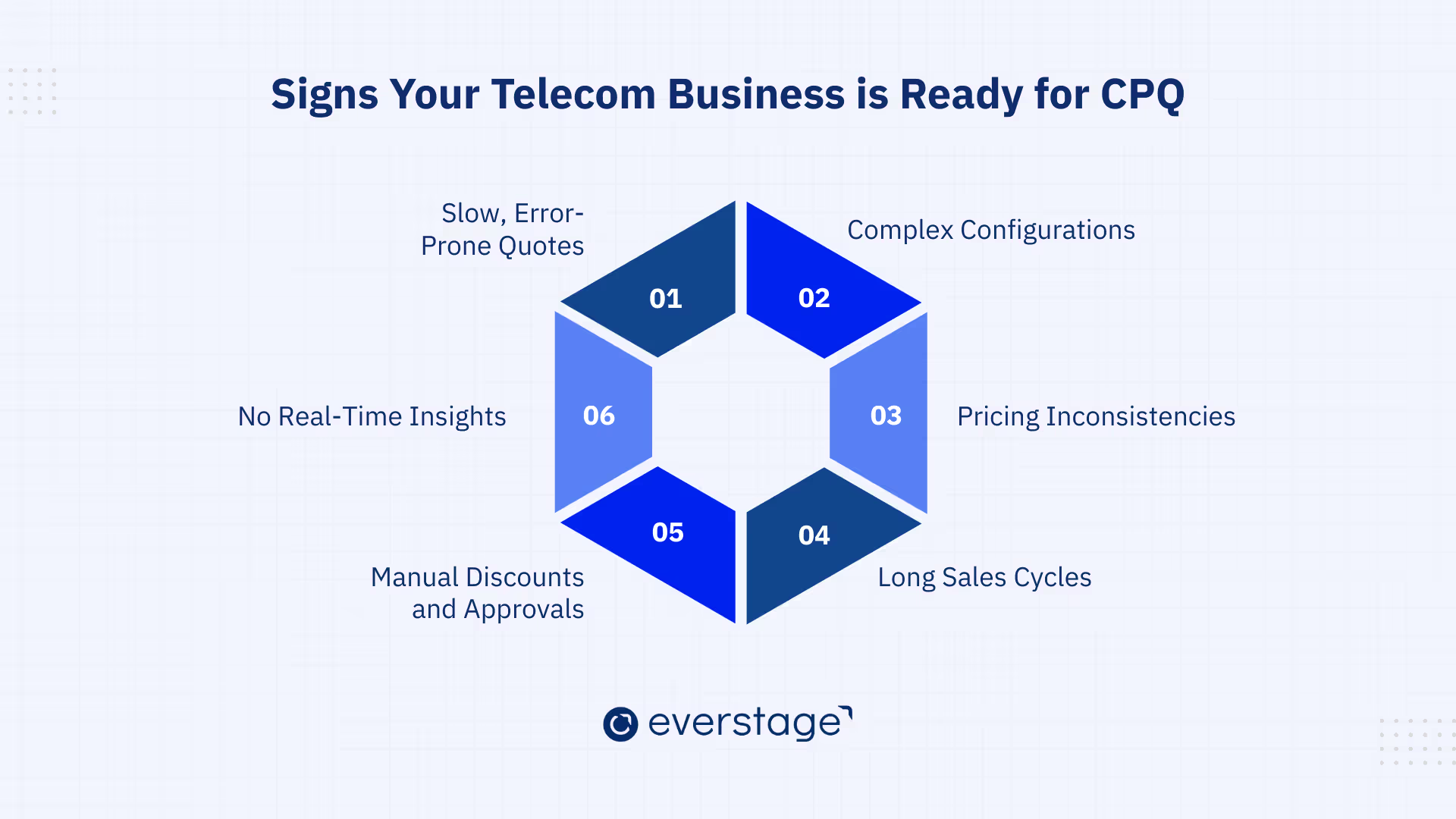
- Slow and Error-Prone Quote Generation: Sales teams spend too long producing quotes by hand, which causes delays and pricing or configuration errors.
- Complex Product Configurations: Highly customized bundles become cumbersome and mistake-prone when managed manually.
- Frequent Pricing Inconsistencies: Quoted prices and final bills regularly diverge, which causes revenue loss and customer dissatisfaction.
- Long Sales Cycles and Delays in Closing Deals: Sales reps struggle to respond quickly, which slows the sales cycle and loses opportunities.
- Manual Discounting and Approval Workflows: Disjointed discounting and approval processes require manual intervention, which creates delays and inconsistent pricing.
- Lack of Real-Time Reporting and Insights: Sales managers lack visibility into quote performance, forecasts, and bottlenecks, which hides inefficiencies and missed optimization.
CPQ Readiness Checklist for Telecom Teams
- Your reps use spreadsheets to calculate pricing or discounts
- Quote approvals take more than one business day
- Customers frequently question pricing or invoices
- Your product catalog changes faster than reps can keep up
- You sell bundles with regional availability or usage-based pricing
2. Must-Have Features in Telecom CPQ Software
If your telecom business shows these signs, choosing the right platform matters. Use the checklist below to evaluate features against telecom-specific needs.
Lists telecom CPQ features with the reason each matters, a telecom example, and a priority level.
Everstage CPQ helps you streamline these processes and put automation to work for your organization.
How to Implement CPQ in Telecom: Best Practices and Rollout Steps
A CPQ implementation boosts efficiency and streamlines telecom operations. To reach that result, align your teams, integrate CPQ with existing systems, and follow a structured rollout.
1. Align Sales and Pricing Teams
Effective CPQ depends on close work between sales and pricing teams. These teams define the pricing models, discount structures, and product configurations that CPQ automates. Without alignment, miscommunication creates inconsistencies and errors in quotes and customer interactions.
- Clear Pricing Models: Sales teams need to understand the pricing structures. Pricing teams need to confirm these structures appear accurately in the CPQ system. That clarity keeps pricing consistent.
- Standardized Processes: Both teams should follow one approach for applying discounts, building bundles, and setting prices. Standardized processes let CPQ produce reliable, accurate quotes every time.
- Collaborative Configuration: Sales and pricing teams configure services together so customer needs match the company's pricing guidelines. That cooperation produces tailored, competitive offers.
2. Integrate CPQ With CRM, Billing, ERP, Provisioning, and Order Management
Integration with CRM, billing, and ERP systems determines how much value CPQ delivers. Integration moves data across departments cleanly, which eliminates manual entry, reduces errors, and improves efficiency.
- CRM Integration: CPQ linked to CRM systems gives sales teams real-time customer data. Quotes stay personalized and reflect the customer's history and preferences.
- Billing Integration: CPQ linked to billing keeps pricing and configurations consistent from the quote through the final invoice. That reduces billing discrepancies and prevents customer disputes.
- ERP Integration: CPQ connected to ERP systems synchronizes product availability, manages inventory, and streamlines order management and fulfillment. The configured services stay ready for deployment.
For example, Everstage CPQ integrates with CRM platforms like Salesforce. Sales reps access customer data inside the quoting workflow. That eliminates redundant data entry, speeds quote generation, and keeps pricing, customer context, and approval rules consistent from opportunity to quote.
3. Clean Up Your Product Catalog First
Before you implement CPQ, standardize product names, bundle rules, dependencies, and retired SKUs. Reps then quote current, compatible services.
4. Define Approval Rules Before Launch
Map approval thresholds for discounts, custom terms, margin exceptions, and non-standard bundles before the system goes live.
5. Pilot CPQ With a Focused Sales Segment
Start with one team, region, or product line before you scale across the telecom sales organization.
6. Track Quote-to-Cash Metrics
Measure quote turnaround time, approval cycle time, discount leakage, quote accuracy, win rate, and billing dispute rates.
How Everstage CPQ Helps Telecom Teams Quote Faster and More Accurately
Everstage CPQ helps revenue teams simplify complex quoting workflows. It centralizes product configuration, pricing rules, discount approvals, and CRM-connected quoting in one experience.
- CRM-connected quoting: Keep customer, opportunity, and quote data aligned inside the sales workflow.
- Rule-based pricing and approvals: Standardize discounts, taxes, surcharges, and approval paths to reduce pricing errors.
- Faster quote turnaround: Help reps produce accurate, customer-ready quotes without manual spreadsheet work.
- Revenue governance: Give sales, pricing, and finance teams better control over margins, approvals, and quote consistency.
Book a CPQ demo to see how Everstage CPQ supports complex telecom quoting workflows.
Questions worth asking
The things most people want to know before they commit.
How is telecom CPQ different from standard CPQ software?
Telecom CPQ differs from standard CPQ in scope. It must account for service availability, network compatibility, usage-based pricing, regulatory surcharges, installation requirements, contract terms, and provisioning feasibility before a quote reaches the customer. It also supports bundled offers and a clean order handoff to provisioning and billing systems. Generic CPQ tools rarely model these requirements out of the box.
Why should telecom service providers implement CPQ solutions?
Telecom service providers should implement CPQ to overcome pricing complexity, slow quote generation, and frequent manual errors. CPQ software automates product configuration, applies accurate pricing models, and produces error-free quotes. The result is faster sales cycles, sharper accuracy, and higher customer satisfaction.
What systems should telecom CPQ integrate with?
Telecom CPQ should integrate with CRM, billing, ERP, product catalog, provisioning, contract lifecycle management, and order management systems. These integrations keep customer, quote, pricing, and order data aligned across the quote-to-cash flow. They eliminate duplicate data entry and reduce quote-to-bill mismatches.
How does CPQ improve pricing accuracy in the telecom industry?
CPQ improves pricing accuracy by automating the application of complex pricing rules, including discounts, taxes, and special offers. It keeps every quote consistent and reduces the human errors that manual pricing produces. Telecom providers generate accurate quotes that reflect current pricing and product information.
When should a telecom provider replace manual quoting with CPQ?
A telecom provider should replace manual quoting with CPQ when reps rely on spreadsheets for pricing, approvals take more than a day, or customers frequently question pricing and invoices. The same applies when the product catalog changes faster than reps can track, or when bundles include regional availability and usage-based pricing. These signals show manual processes create delays, errors, and margin leakage.
What are the best CPQ tools for telecom companies?
The best CPQ tool for a telecom company depends on product complexity, CRM environment, pricing governance, approval workflows, and integration needs. Many teams evaluate tools such as Salesforce CPQ, Conga/Apttus, and Everstage. Everstage fits teams that want a modern, CRM-connected CPQ workflow built to reduce manual quoting effort, improve pricing consistency, and accelerate sales cycles.