

.avif)
TL;DR
CPQ for high tech simplifies complex configurations, pricing, and quoting processes, helping sales teams drive efficiency, accuracy, and scalability.
- Automate quoting and pricing for faster, error-free sales cycles
- Align sales, engineering, and finance teams for seamless collaboration
- Scale operations across regions without compromising accuracy
- Choose the right CPQ platform to reduce pricing errors and boost productivity
Introduction
Quoting in high tech is harder than it should be. Your sales reps are building quotes for products that have hundreds of configuration options, compatibility rules, and pricing variables. They're bundling hardware with software licenses, subscriptions, and services.
They're managing discounts that require approvals and ensuring configurations that won't break during fulfillment. Most of them are doing this in spreadsheets.
The results are predictable. Quotes take days instead of hours. Configuration errors slip through. Pricing mistakes eat into margins. Approval chains stall deals. And when competitors can quote faster, you lose deals not because your product is weaker, but because your process is slower.
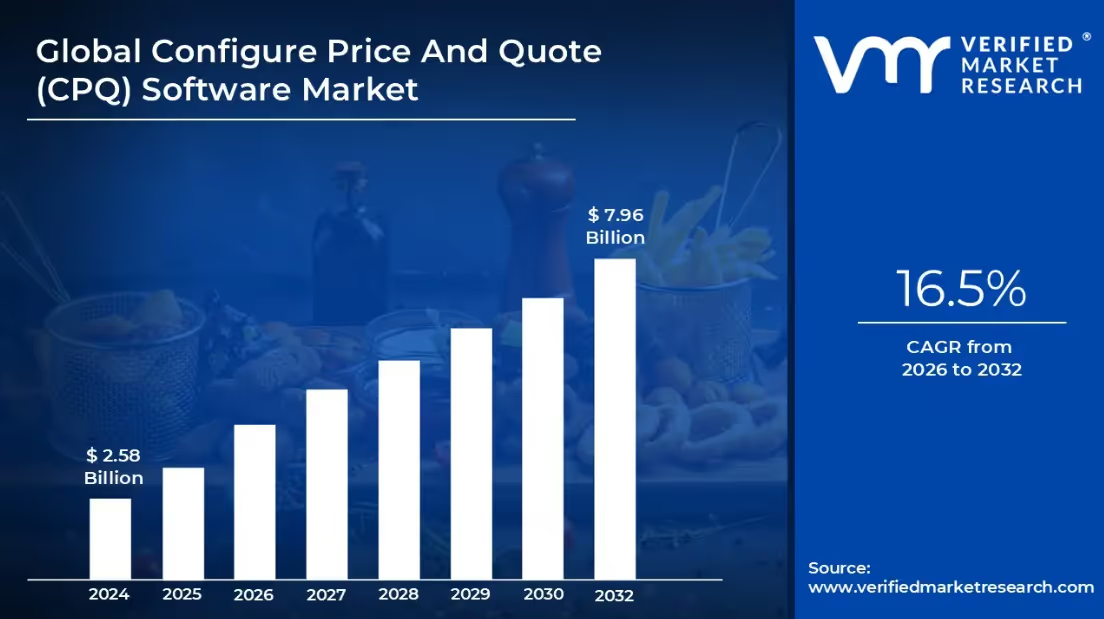
CPQ changes that equation completely. The CPQ software market is growing at 16.5% annually and is projected to hit $7.96 billion by 2032. Configure, Price, Quote (CPQ) platforms automate the mechanics of complex sales by enforcing product rules, applying accurate pricing, and generating professional quotes quickly.
For high-tech companies selling enterprise software, networking equipment, semiconductors, telecom infrastructure, or SaaS platforms, CPQ eliminates the manual work that slows down revenue.
But CPQ only delivers value if it's built for the way high-tech companies actually sell. The right platform handles product complexity without requiring constant IT support. It scales across regions and channels. And it integrates with your existing systems instead of creating new silos.
This guide explains what makes high-tech quoting uniquely challenging, how CPQ addresses those challenges, which features matter most, and how to choose a platform that fits your business needs. So let’s dive in.
Challenges That CPQ Solves for High-Tech Companies
High-tech companies face a unique set of sales challenges that can complicate the quoting process, from managing complex product configurations to ensuring accurate pricing across global markets. Fortunately, Configure, Price, Quote (CPQ) technology is uniquely positioned to address these issues by providing structure, automation, and consistency to the sales process.
1. Managing Highly Configurable and Customizable Products
In the high-tech industry, products are often highly customizable, involving multiple configurations of hardware, software, and services. This complexity leads to a high risk of errors in product combinations, compatibility, and exclusions. CPQ platforms help by enforcing configuration rules that ensure only valid product combinations are quoted.
By automating this process, CPQ minimizes reliance on engineers and product experts for every quote, speeding up the sales cycle and reducing configuration errors.
2. Reducing Pricing Errors and Margin Leakage
Pricing in high-tech sales can be complex, with dynamic pricing models such as volume discounts, contract-based pricing, and regional variations. Manual pricing processes often lead to errors, inconsistent discounting, and margin leakage, especially when pricing information is decentralized. CPQ platforms centralize pricing logic and enforce margin protection automatically, ensuring consistent pricing across regions and teams.
This helps protect margins while maintaining competitive pricing, critical in industries where every discount or pricing error can significantly affect the bottom line.
3. Eliminating Manual Quoting and Spreadsheet Dependency
Many high-tech sales teams still rely on spreadsheets, emails, and offline tools to create quotes, leading to inefficiencies such as time wasted on rekeying data, version control issues, and a high risk of errors.
CPQ eliminates these manual processes by automating quoting, which not only saves time but also ensures the accuracy of the quote every time. This transition to automation improves productivity and accelerates the sales process, enabling sales teams to respond to customers faster and more accurately.
4. Aligning Sales, Engineering, and Finance Teams
In high-tech sales, cross-functional collaboration is essential. Misalignments between sales, engineering, and finance teams often result in delays and mistakes in the quoting process. CPQ integrates these functions into a single, centralized platform, offering shared visibility into product configurations, pricing, and deal details.
This reduces the need for back-and-forth communication between departments and improves the accuracy and speed of quote generation. By providing a single source of truth, CPQ ensures that everyone is on the same page, helping to streamline processes and avoid miscommunications.
5. Scaling Sales Operations Across Regions and Channels
For high-tech companies with global sales teams, scaling operations while maintaining pricing consistency across regions and channels can be a daunting task. CPQ solutions are designed to handle multi-currency, multi-region pricing, and tax rules, allowing businesses to manage complex global sales operations seamlessly.
Furthermore, CPQ systems can be configured to support both direct sales and partner sales channels, ensuring that all sales teams, regardless of location or sales model, can work with consistent, up-to-date information.
By addressing these key challenges, CPQ technology enables high-tech companies to streamline their sales operations, reduce errors, and accelerate the sales process. As the complexity of products and sales processes continues to grow, CPQ becomes increasingly essential in ensuring efficiency and scalability in high-tech sales environments.
Why Does High Tech Need CPQ?
Manual quoting doesn't scale when you're selling configurable hardware, software subscriptions, and services together. High-tech companies need CPQ because spreadsheets, email chains, and tribal knowledge create bottlenecks that slow down deals and increase errors.
1. Automating Quoting and Pricing for Complex Products
High-tech pricing involves dozens of variables. Volume discounts stack with contract rates. Regional pricing adjusts for currency and local taxes. Promotional offers apply to specific product lines. Partner rebates change quarterly. Subscription renewals price differently than new purchases.
Reps can't track all of this manually. They open spreadsheets, cross-reference pricing documents, calculate discounts by hand, and hope they got it right. By the time they finish, the pricing might already be outdated.
CPQ centralizes all pricing logic in one system. The software knows which discount tiers apply to which customers. It adjusts for regional requirements automatically. It accounts for contract terms negotiated months ago.
When a customer requests pricing for servers, networking equipment, software licenses, and support services, the system calculates everything instantly.
2. Streamlining Sales Workflows and Approvals
Approval bottlenecks kill momentum. A rep configures a custom solution, sends it to engineering for validation, waits for finance to approve the discount, and then waits for legal to review contract terms. Three days later, the quote goes out, and the customer has moved on.
CPQ routes approvals based on pre-defined logic. Standard deals that fall within discount guidelines and margin thresholds get approved automatically. Edge cases get escalated immediately to the right person with full context. The approver sees configuration, pricing, margin impact, and customer history in one place. They approve or reject with a single click.
3. Ensuring Consistent and Accurate Product Configurations
High-tech products have dependencies that aren't obvious. A certain chipset only works with specific power supplies. Some software features require minimum memory thresholds. Hardware sold in Europe needs different compliance certifications than hardware sold in North America.
Reps can't remember all of this, especially newer team members or partners. They configure something that looks reasonable, the customer signs off, and then fulfillment discovers the configuration won't work. Now you're rebuilding the order, explaining the mistake, and delaying delivery.
CPQ prevents this entirely. The system knows which components work together. If a rep selects a processor requiring a specific cooling system, the software only shows compatible options. Incompatible parts don't appear. Invalid configurations can't be created.
This consistency extends across every sales channel. A direct rep in California, a partner in Germany, and a customer using your self-service portal all see the same configuration options and pricing. No discrepancies. No confusion. No fulfillment delays.
Must-Have CPQ Features for High-Tech Companies
High-tech sales environments demand CPQ capabilities that go beyond basic quoting. Products are highly configurable, pricing is dynamic, and sales teams must operate across regions, channels, and business models.
The following features are foundational for supporting this complexity at scale.
1. Advanced Product Configuration and Rules Engine
High-tech products aren't simple. A single server configuration might involve choosing from hundreds of processors, memory modules, storage drives, and power supplies. Each choice creates dependencies. Some components require others. Some combinations are incompatible.
A strong CPQ platform needs a rules engine that handles this complexity without performance issues. The system should support hierarchical product structures where base models can be customized with compatible add-ons. It should enforce hard constraints that prevent invalid configurations and offer soft guidance that suggests optimal combinations.
The configurator also needs to handle bundling logic. High-tech companies sell hardware, software licenses, implementation services, and support contracts together. The CPQ system should let reps configure all elements in a single quote while applying the right pricing logic to each component.
2. Guided Selling and Intelligent Recommendations
Not every rep is a product expert. Newer team members and channel partners need help navigating complex catalogs without making mistakes.
Guided selling walks reps through structured questions that map customer requirements to valid configurations. If a customer needs high-availability networking equipment, the system asks about uptime requirements and traffic volume, then recommends appropriate hardware.
Intelligent recommendations suggest bundles, upgrades, and complementary products. If a customer is buying storage hardware, the system might recommend backup software that similar customers purchased. The key is balancing automation with flexibility, so guided selling helps inexperienced reps without slowing down veterans.
3. Real-Time Pricing, Discounting, and Margin Controls
Pricing in high-tech changes constantly. Component costs fluctuate. Promotional campaigns launch and expire. Contract terms get negotiated. The CPQ system needs to handle all of this in real time.
Real-time pricing pulls current rates from your pricing database automatically. If component costs increased overnight, new quotes reflect that immediately. Discount controls let finance set margin thresholds that trigger approval workflows. The system calculates margin at the line-item and quote level in real time, showing reps exactly how discounts impact profitability.
4. Approval Workflows, Auditability, and Compliance
Automated approval workflows route quotes based on criteria like deal size, discount percentage, or product mix. For example, a quote under $50,000 with standard pricing gets approved instantly. A quote over $500,000 with custom discounts requires sign-off from sales management and finance.
Audit trails matter for compliance. Every configuration change, pricing adjustment, and quote version should be logged with timestamps and user attribution. If a customer questions pricing months later, you can pull the exact quote and see who approved it.
5. Enterprise Integrations and Scalability
CPQ needs to connect with your CRM for customer data, your ERP for product information, your billing system for invoicing, and your contract management platform for terms. Native integrations work better than custom-built connections, syncing data bidirectionally without creating duplicates.
Scalability means the system performs well as your product catalog and user base expand. The platform needs to handle enterprise-scale complexity without slowdowns.
Once the core requirements are clear, the focus shifts to evaluating solutions that can deliver these capabilities in practice. The following section reviews leading CPQ platforms for high-tech companies and how they compare across key criteria.
Top CPQ Platforms for High Tech
.avif)
Choosing the right CPQ platform depends on your product complexity, sales motion, and integration requirements. Some platforms excel at handling highly configurable hardware. Others are built for subscription-based software sales. The best choice aligns with how your team actually sells.
1. Everstage CPQ and Quoting Automation
Everstage CPQ is designed for complex, scalable sales environments where speed and accuracy matter equally. The platform handles intricate product configurations with a powerful rules engine that prevents invalid combinations while maintaining fast quote generation times.
The system integrates directly with CRM and ERP platforms, ensuring pricing stays current, and customer data flows seamlessly across systems. Real-time approval workflows keep deals moving without sacrificing control. Finance sets the guardrails, and the system enforces them automatically.
Everstage works well for high-tech companies scaling revenue operations across multiple regions and channels. The platform supports multi-currency pricing, regional tax rules, and channel-specific discount structures without requiring separate instances for each market.
2. SAP CPQ
SAP CPQ targets global enterprises with complex manufacturing and distribution requirements. The platform handles multi-currency pricing, regional compliance rules, and deep ERP integration for companies with heavy back-office dependencies.
SAP works best for large high-tech manufacturers selling configurable hardware at scale. The system manages bill-of-materials complexity and connects configuration decisions directly to production planning. If your business relies heavily on SAP's broader enterprise stack, the CPQ integration provides continuity across quote-to-cash processes.
3. Oracle CPQ Cloud
Oracle CPQ is enterprise-grade software designed for large deal sizes and complex approval chains. The platform integrates tightly with Oracle's ecosystem, making it a natural fit for companies already using Oracle CRM and ERP systems.
High-tech companies with long sales cycles, multi-stakeholder deals, and heavy customization requirements often choose Oracle CPQ. The platform handles technical product specifications and supports sophisticated pricing models, though implementation timelines tend to be longer than newer cloud-native alternatives.
2. DealHub CPQ
DealHub CPQ is built for modern sales organizations that need flexibility in deal structuring. The platform handles complex discounting, multi-party approvals, and subscription-based pricing models effectively.
It's well-suited for SaaS companies and businesses selling hybrid hardware-software solutions. The guided selling features help reps navigate product catalogs while the CPQ engine handles pricing calculations in the background.
Mid-market and enterprise tech companies use DealHub when they need to scale revenue operations without adding operational overhead.
5. Apttus (Conga) CPQ
Apttus, now part of Conga, combines CPQ with contract lifecycle management. The platform excels when legal involvement is heavy, and contract terms require detailed management.
Large high-tech organizations use CPQ when they need tight integration between quoting and contract generation. The platform handles complex pricing but shines in scenarios where contract negotiation, clause management, and legal approval workflows are critical to closing deals.
Comparison Table of Leading CPQ Platforms
Choose based on your product complexity, existing tech stack, and how quickly you need to see results. Platforms with simpler implementations, like Everstage, deliver faster time-to-value. Enterprise platforms like SAP and Oracle provide deeper integration but require longer deployment cycles.
Key Benefits of CPQ for High-Tech Sales
.avif)
Implementing CPQ (Configure, Price, Quote) technology provides high-tech companies with powerful tools to overcome common sales challenges. By addressing the complexity of products, pricing errors, long sales cycles, and siloed operations, CPQ directly drives sales performance, efficiency, accuracy, and revenue growth.
Below, we explore how CPQ can connect these challenges to measurable outcomes that ultimately improve business performance.
1. Complexity of Configurable Products and Solutions
High-tech companies often sell highly configurable products, such as hardware bundles, software solutions, or integrated services. Without automation, managing these complex configurations manually can overwhelm sales teams, resulting in mistakes and delays.
How CPQ Helps:
- Simplifies configuration logic: CPQ automates complex product configurations, ensuring that sales reps can easily navigate through numerous product options and configurations without having to rely on engineering teams for every deal.
- Reduces dependency on engineering for every deal: Sales reps can create valid configurations without needing constant approval from technical experts, speeding up the sales process and freeing up resources.
- Enables reps to sell complex solutions confidently: With the CPQ system guiding them, sales reps can quickly generate accurate quotes for sophisticated solutions, boosting their confidence and ability to close deals faster.
Outcome: This leads to faster deal cycles and fewer configuration errors, helping companies close more deals and reducing bottlenecks caused by technical reviews.
2. Inaccurate Pricing and Manual Errors
Pricing errors in high-tech sales can be costly. Spreadsheets and manual quote generation processes are prone to mistakes that can undermine profitability and damage customer relationships.
How CPQ Helps:
- Eliminates spreadsheet-driven mistakes: CPQ automates the pricing process, reducing human error that often arises from outdated or inaccurate pricing models in spreadsheets.
- Protects margins automatically: CPQ ensures that pricing is always aligned with margin controls, offering real-time visibility into deal profitability and ensuring that no deals are sold at a loss.
- Ensures consistent pricing across regions and teams: By centralizing pricing logic, CPQ ensures that all sales teams, regardless of their region, quote customers using the same pricing models and discount structures.
Outcome: These benefits protect margins, reduce revenue leakage, and ensure that pricing is consistent, which not only safeguards profitability but also builds customer trust by maintaining fair and transparent pricing.
3. Long Sales Cycles and Slow Quote Turnaround
The sales cycle in high-tech industries can be long, and slow quote turnaround times can delay deals, especially in competitive markets where speed is critical.
How CPQ Helps:
- Reduces quote creation time from days to minutes: CPQ automates the process of generating quotes, reducing the time it takes to create and approve proposals from days to just minutes.
- Faster quotes = higher win rates: Speed is essential in closing deals. A faster quote turnaround can increase win rates, as sales teams can respond to customers more quickly and maintain momentum in the negotiation process.
- Especially critical for competitive high-tech deals: In high-tech markets where margins are tight and competition is fierce, being able to provide a timely and accurate quote can make the difference between winning or losing a deal.
Outcome: By shortening quote turnaround times, CPQ directly impacts deal velocity, enabling sales teams to close more deals in less time, thereby increasing overall sales productivity and revenue.
4. Silos Between Sales, Engineering, and Finance
In many high-tech companies, sales teams, engineering, and finance work in silos, leading to miscommunication, delays, and friction during the sales process. These challenges can result in last-minute escalations and inefficiencies.
How CPQ Helps:
- Centralized pricing and configuration logic: CPQ centralizes all product configuration rules and pricing models in one system, creating a single source of truth for sales, engineering, and finance teams to work from.
- Shared visibility across teams: CPQ provides real-time visibility into deal details, allowing all departments involved in the sales process to access the most up-to-date information on product configurations, pricing, and customer requests.
- Fewer last-minute deal escalations: By ensuring that all teams are aligned and have access to consistent data, CPQ reduces the need for last-minute escalations, speeding up decision-making and minimizing errors.
Outcome: This improved alignment between departments enhances the efficiency of the sales process, reducing internal friction and ensuring smoother, faster deal closures. It also fosters better collaboration across teams, leading to a more streamlined and productive sales operation.
These benefits come to life most clearly when we look at real high-tech CPQ use cases. By transforming complex workflows into streamlined, automated processes, CPQ allows high-tech sales teams to focus on what they do best: selling.
The outcomes, faster deals, fewer errors, and better collaboration, directly translate to revenue growth and a stronger competitive position in the marketplace.
CPQ Use Cases in High-Tech Sales
High-tech sales teams deal with a mix of products, pricing models, and selling motions that rarely fit into a simple quoting flow.
Below are practical CPQ use cases that show how CPQ tools support real-world high-tech selling scenarios and why it becomes essential as complexity grows.
1. Hardware + Software Bundles
Many high-tech companies sell physical products alongside licenses, firmware, support, maintenance contracts, and professional services. Each component often has dependencies, compatibility rules, and pricing implications.
CPQ enables sales teams to configure complete solutions by enforcing bundle logic automatically. Reps can select hardware models, attach the correct software licenses, add required services, and ensure compatibility without relying on engineering or manual checks.
Pricing updates in real time as bundles change, reducing errors and rework after the quote is shared with the customer.
2. Subscription and Recurring Revenue Models
High-tech revenue is increasingly driven by subscriptions, renewals, and usage-based components layered on top of traditional product sales.
CPQ supports recurring pricing structures by handling contract terms, billing frequencies, renewals, and upgrades within the same quote. Sales teams can combine one-time hardware charges with monthly or annual subscriptions while maintaining visibility into total contract value and long-term revenue.
This prevents fragmented quoting across tools and ensures consistency from initial sale through renewal.
3. Global Enterprise Deals with Localization
Enterprise technology deals often span regions, currencies, tax rules, and compliance requirements. Managing this manually introduces risk and slows down deal cycles.
CPQ applies region-specific pricing, currency conversions, and localized terms automatically based on the customer and deal context. Approval workflows adapt to regional policies, ensuring governance without delaying quotes. This allows global sales teams to move faster while maintaining consistency and compliance across markets.
4. Channel and Partner Quoting
High-tech companies frequently sell through resellers, distributors, and partners who need accurate quotes without full internal system access.
CPQ enables controlled partner quoting by exposing approved products, pricing, and discount thresholds. Partners can generate compliant quotes while the company retains visibility and control over margins and deal structure. This reduces back-and-forth, speeds partner-led deals, and protects revenue across indirect channels.
5. Custom Enterprise Contracts
Large high-tech deals often require customer-specific pricing, nonstandard terms, and legal or finance involvement.
CPQ manages these exceptions through configurable approval workflows and contract-aware pricing. Custom terms are captured within the quoting process, tracked for auditability, and reused where appropriate. This creates a repeatable process for complex enterprise deals without turning every quote into a manual project.
Not all CPQ platforms handle these use cases equally, which makes choosing the right solution critical.
How to Choose the Right CPQ Platform for High Tech
Selecting a CPQ platform for high-tech sales is less about feature checklists and more about how well the solution fits the complexity of your products, pricing models, and sales operations.
The right CPQ should simplify selling today while supporting how your business will scale tomorrow.
1. Integration with Existing Systems and Data Sources
High-tech sales rarely operate in isolation. Quotes depend on accurate customer data, product availability, pricing rules, and billing structures that live across multiple systems.
A strong CPQ platform integrates natively with CRM, ERP, billing, and finance systems to create a single, reliable flow of data. Clean integration ensures that product configurations, pricing updates, and customer preferences stay consistent from quote to order to revenue recognition. Avoiding duplicate systems reduces reconciliation work, minimizes errors, and prevents sales teams from working with outdated information.
2. Support for Complex Configuration Rules
High-tech products often include technical dependencies, exclusions, and mandatory add-ons that make configuration challenging at scale.
The right CPQ should include a robust rule engine that enforces dependency logic and compatibility constraints during the quoting process. Bundling rules should guide reps toward valid solutions while preventing combinations that cannot be delivered or supported. This ensures accuracy without requiring deep product expertise from every seller.
3. Real-Time Pricing and Version Control
Pricing complexity increases with global operations, negotiated contracts, and frequent product updates.
An effective CPQ applies real-time pricing logic based on region, customer, volume, and contract terms. It should also maintain clear version control for quotes, allowing teams to track changes, approvals, and overrides over time. This level of auditability is critical for finance teams and helps maintain pricing discipline without slowing down deals.
4. Ease of Use and Configurator Flexibility
Even the most powerful CPQ fails if sales teams avoid using it.
Ease of use drives adoption. A flexible configurator should support different roles and selling motions, from inside sales to enterprise account executives. Intuitive workflows reduce training time and help reps create accurate quotes quickly, while customizable interfaces ensure the system adapts to how teams actually sell rather than forcing rigid processes.
5. Scalability and Multi-Region Support
High-tech companies evolve rapidly, expanding product lines, entering new markets, and experimenting with new pricing models.
The right CPQ platform supports multi-currency transactions, localization, and regional compliance requirements out of the box. It should scale with growth without requiring re-implementation as complexity increases. This ensures CPQ remains an enabler of expansion rather than a constraint.
One platform that addresses these high-tech requirements end-to-end is Everstage CPQ.
How Everstage CPQ Addresses High-Tech Sales Complexity
High-tech sales teams need more than a generic CPQ. They need a platform that is purpose-built to handle product complexity, dynamic pricing, and cross-functional workflows without slowing down sales. Everstage CPQ addresses these challenges by aligning core CPQ capabilities directly to the realities of high-tech selling.
1. Managing Configuration Complexity
High-tech products often involve intricate dependencies between hardware, software, subscriptions, and services. As product portfolios expand, relying on manual expertise or tribal knowledge becomes unsustainable.
Everstage CPQ centralizes configuration logic into a scalable rules framework that enforces compatibility, exclusions, and required components during the quoting process.
Sales teams are guided toward valid, deliverable solutions while maintaining flexibility to tailor offerings for different customer needs. This reduces configuration errors and minimizes last-minute involvement from engineering teams.
2. Ensuring Pricing Accuracy and Margin Control
Pricing in high-tech environments is rarely static. Volume tiers, regional pricing, customer-specific agreements, and bundled discounts all add layers of complexity.
Everstage CPQ applies real-time pricing logic directly within the quote, ensuring accuracy across regions and deal types.
Built-in guardrails help protect margins by enforcing discount thresholds and approval rules, giving sales teams confidence to move quickly without compromising profitability. Finance teams benefit from consistent pricing application and clear visibility into deal economics.
3. Automating Workflows Across Teams
Complex deals often stall due to manual handoffs between sales, finance, legal, and operations.
Everstage CPQ streamlines workflow automation by routing approvals based on deal attributes such as price, margin, or configuration complexity.
Every stakeholder works from the same source of truth, reducing back-and-forth communication and accelerating quote turnaround times. This predictable process keeps deals moving while maintaining governance.
4. Supporting Global Scalability
As high-tech companies expand into new markets, quoting processes must adapt to currencies, compliance requirements, and regional policies.
Everstage CPQ is designed to scale globally, supporting multi-currency pricing, localization, and region-specific rules without requiring reimplementation. This allows organizations to grow their sales footprint while maintaining consistency and control across geographies.
5. Enabling Cross-Team Alignment and Insight
Beyond quoting, Everstage CPQ acts as a unifying layer across sales, finance, and operations.
Shared visibility into configurations, pricing decisions, and approvals improves alignment and accountability. Analytics and reporting provide insight into deal performance, pricing trends, and bottlenecks, enabling leaders to optimize processes based on real data rather than assumptions.
The platform delivers enterprise-grade capability without introducing unnecessary complexity for end users. With the right CPQ in place, high-tech companies can fundamentally transform how they sell.
Conclusion
High-tech sales environments are defined by complexity. From configurable products and hybrid pricing models to global operations and multi-channel selling, traditional quoting processes struggle to keep pace.
CPQ has become critical because it brings structure, accuracy, and governance to a sales motion that is no longer simple or linear.
More than a quoting tool, CPQ acts as a growth enabler for high-tech companies. It allows sales teams to move faster without sacrificing accuracy, protects margins through consistent pricing and approvals, and creates a scalable foundation that supports new products, markets, and revenue models. As complexity increases, CPQ ensures speed and control can coexist.
When evaluating CPQ solutions, high-tech leaders should look beyond feature lists and market hype. The right product is the one that matches the real-world complexity of your products, pricing, and sales operations, both today and as the business evolves.
If you are looking to simplify complex sales while enabling sustainable growth, Everstage CPQ provides the accuracy, speed, and scalability high-tech teams need. Book a demo to see how Everstage CPQ can transform the way you sell.
Questions worth asking
The things most people want to know before they commit.
What makes CPQ especially important for high-tech companies?
High-tech companies sell complex combinations of hardware, software, subscriptions, and services, often with strict compatibility and pricing rules. Manual quoting breaks down quickly as product catalogs grow and pricing models evolve. CPQ provides structure, automation, and governance that make complex selling repeatable and scalable.
Can CPQ handle both one-time and recurring revenue models together?
Yes, modern CPQ platforms are designed to support hybrid revenue models. They can combine upfront hardware or license fees with recurring subscriptions, renewals, and usage-based components in a single quote. This ensures accurate total contract value and consistent pricing across the entire customer lifecycle.
How does CPQ reduce sales cycle length in high-tech deals?
CPQ eliminates manual configuration checks, spreadsheet pricing, and ad hoc approvals that slow down deals. Automated rules, real-time pricing, and predefined approval workflows allow reps to generate accurate quotes faster. This reduces back-and-forth between teams and helps sales respond quickly in competitive situations.
Is CPQ only useful for large enterprise high-tech companies?
CPQ is valuable for both scaling mid-market and enterprise high-tech companies. As soon as product complexity, discounting rules, or multi-region selling increase, manual processes become risky. CPQ Implementation earlier helps growing companies avoid costly process rework later.
How does CPQ support global and multi-region sales teams?
CPQ applies region-specific pricing, currencies, taxes, and approval rules automatically based on deal context. This ensures consistency and compliance while allowing global teams to operate independently. Centralized control combined with local flexibility is key for international high-tech sales.
What systems should CPQ integrate with in a high-tech tech stack?
CPQ should integrate tightly with CRM, ERP [Enterprise resource planning], billing, and finance systems to maintain a clean flow of data from quote to cash. Strong integrations prevent duplicate data entry and pricing mismatches. This alignment improves forecasting accuracy and reduces operational friction across teams.