

.avif)
TL;DR
HVAC CPQ improves customer experience for manufacturers by simplifying complex buying journeys, reducing errors, delays, and uncertainty in high-value, engineer-to-order deals.
- Eliminate configuration and pricing errors that erode buyer trust
- Accelerate long sales cycles with faster, more accurate quotes
- Improve collaboration across sales, engineering, and operations
- Build buyer confidence in complex HVAC purchasing decisions
Selling HVAC systems today is more complex than ever. Buyers no longer care only about product features or price. They also care about how easy, clear, and reliable the buying process feels.
Most HVAC deals involve several teams: sales, engineering, procurement, and operations. These purchases often take months and require custom configurations. When quotes are slow, pricing changes unexpectedly, or errors appear late, buyers lose confidence. Even small mistakes can delay approvals or force teams to restart conversations.
Many of these challenges come from manual quoting and disconnected tools. Sales teams struggle with complex configurations spread across CRM records, while engineering teams spend time fixing avoidable errors. As a result, the customer experience breaks down long before an order is placed.
This is where Configure-Price-Quote (CPQ) plays a key role. CPQ helps streamline complex buying journeys by guiding configurations, standardizing pricing, and reducing errors early.
In this blog, we’ll look at why HVAC customer experience often breaks down and how CPQ helps fix these issues across complex sales cycles.
Why HVAC Manufacturers Struggle to Deliver a Consistent Customer Experience
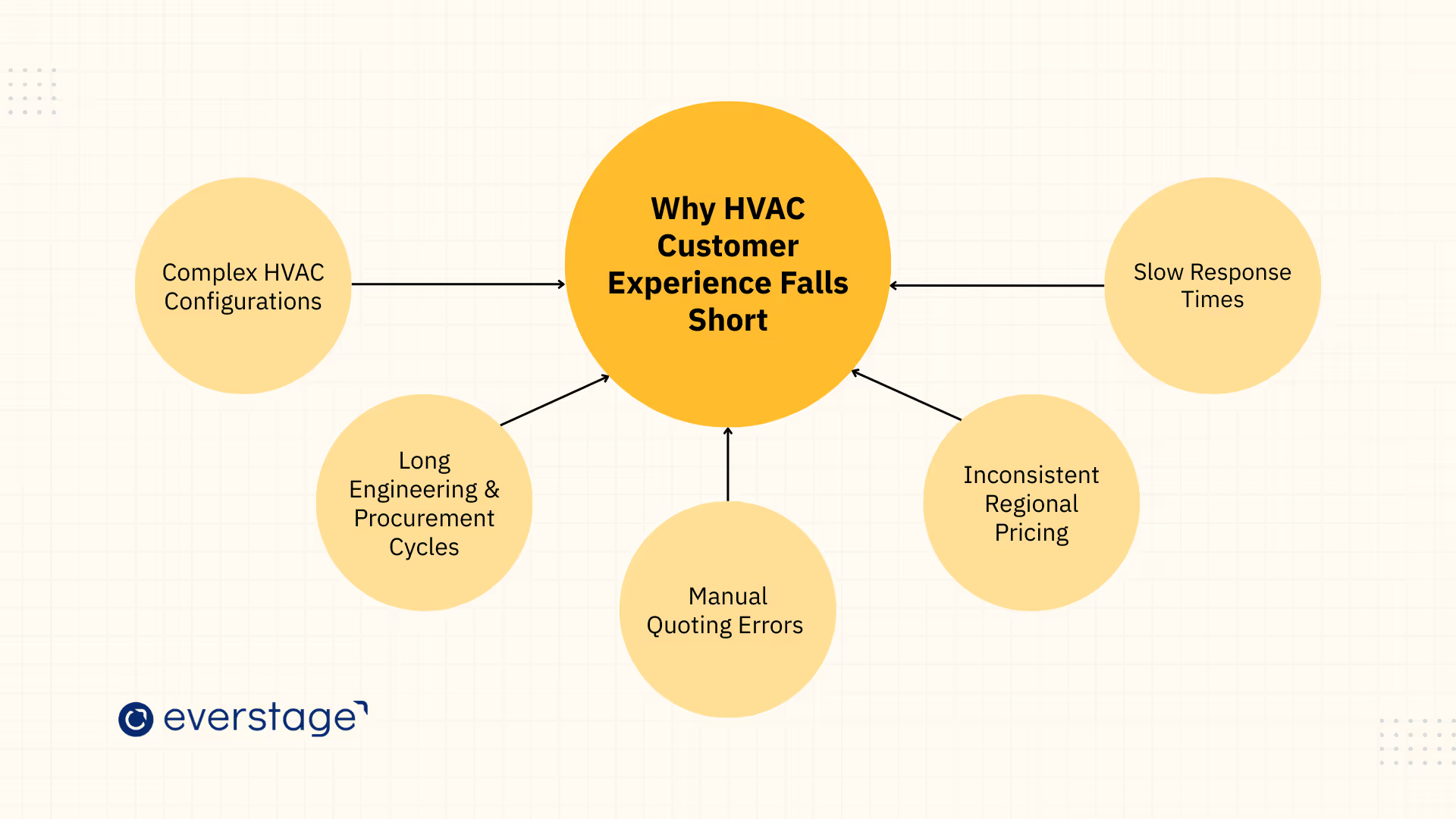
HVAC manufacturers often want to deliver a smooth, reliable buying experience. But in reality, several structural challenges make consistency difficult. Product complexity, large deal sizes, and heavy cross-team involvement create friction for buyers, especially as customer expectations for clarity and responsiveness continue to rise.
These issues don’t just slow deals; they increase buyer risk and decision uncertainty. Let’s break down the most common reasons this happens.
1. Complex Engineer-to-Order HVAC System Configurations
Many HVAC systems are built using an engineer-to-order model. Each deal may involve custom sizing, capacity calculations, compliance requirements, considerations like load calculations, ductwork sizing, energy efficiency ratings, and detailed product configurations.
This level of customization makes selling harder. Sales reps must translate customer needs into technical configurations, often without real-time validation. As options increase, decisions slow down, and confusion grows for both buyers and sellers.
The risk is high. A single misconfigured component can affect bills of materials, leading to system failure, compliance issues, or expensive rework. For customers, this creates fear of making the wrong choice. For manufacturers, it leads to delays, revisions, and margin loss.
2. Long Buying Cycles Involving Engineering, Procurement, and Operations
HVAC purchases rarely involve one decision-maker. Engineering teams, including MEP engineers or energy consultants, focus on feasibility, procurement looks at cost and contracts, facility managers evaluate long-term performance considerations, and operations care about installation and maintenance.
Each group has different priorities. This creates frequent handoffs, reviews, and approvals. Every handoff adds time, and every delay increases the chance of momentum loss.
When buyers wait weeks for updates or revised quotes, confidence drops, and it becomes harder to close deals. They may question whether the manufacturer can deliver reliably, even if the product itself is strong.
3. Manual Quoting Errors That Increase Buyer Risk and Rework
Many HVAC quotes are still built using spreadsheets, emails, and manual calculations throughout the quoting process. These processes are error-prone.
Common issues include incorrect pricing, missing components, outdated discounts, or invalid configurations. Often, these errors surface late, during approvals or after engineering review.
Late-stage corrections damage trust. Buyers feel exposed to risk, especially in high-value deals where mistakes can have long-term consequences. Accuracy isn’t optional in HVAC; it’s essential.
4. Inconsistent Pricing and Configurations Across Regions and Channels
Pricing often varies by region, distributor, or sales channel. Without a centralized system, two customers can receive different quotes for similar systems.
This inconsistency creates confusion. Buyers may compare quotes internally or across vendors and question fairness or transparency.
Over time, this hurts brand credibility. Inconsistent experiences make manufacturers seem unreliable, even when issues are operational, not intentional.
5. Slow Response Times That Weaken Buyer Confidence and Trust
Today’s buyers expect faster answers, even in complex sales. Long wait times signal uncertainty or inefficiency.
When quotes take weeks instead of days, buyers may explore alternatives. Faster competitors gain an edge, even if their products are similar. Slow turnaround doesn’t just delay revenue; it weakens trust and lowers conversion rates.
Together, these challenges make it hard for HVAC manufacturers to deliver a consistent, low-risk buying experience. This is where CPQ begins to change the equation by addressing these issues at their source.
How CPQ Improves the HVAC Customer Experience
%20(1).avif)
In HVAC manufacturing, customer experience breaks down not because teams lack effort, but because complexity creates uncertainty.
CPQ improves the experience by acting as a coordination and clarity layer across sales, engineering, and operations. Its real impact isn’t internal speed; it’s the confidence it gives buyers as they move through long, high-risk purchasing decisions.
Rather than optimizing isolated steps, CPQ improves outcomes buyers actually care about: fewer surprises, clearer options, and predictable approvals.
1. Faster, More Accurate Quotes Across the HVAC Buying Journey
In HVAC sales, speed and accuracy cannot be separated. Fast quotes with errors increase risk, while accurate quotes deliver late stall decisions.
CPQ reduces manual effort while preserving precision by applying validated configuration and pricing logic early in the process. This allows sales teams to respond quickly without waiting for repeated engineering checks for every variation.
For buyers, this matters because early-stage quotes shape trust. When initial quotes are both fast and reliable, customers feel confident moving forward instead of holding back for fear of revisions. Fewer early mistakes also mean fewer disruptive changes later, when approvals are harder, and the stakes are higher.
2. Guided Configuration That Reduces Technical and Commercial Uncertainty
HVAC buyers are often asked to choose between options they don’t fully understand, such as tonnage selection, refrigerant compatibility, SEER rating configurations, capacity ranges, compliance constraints, add-ons, or system dependencies.
CPQ introduces guided configuration using predefined configuration rules that limit choices to what is technically feasible and commercially viable. Instead of presenting every possible option, it helps buyers see what works together and what doesn’t through a clearer visualization of viable options.
This prevents incompatible or non-viable configurations from reaching later stages, where fixes are expensive, and confidence is already fragile. By translating engineering complexity into clear, structured choices, CPQ reduces hesitation and helps buyers move forward with clarity instead of guesswork.
3. Consistent Pricing and Fewer Revisions for Smoother Approvals
Inconsistent pricing strategies are a major source of friction in HVAC deals, especially when quotes pass through procurement, finance, and regional stakeholders.
CPQ applies centralized pricing rules so that discounts, margins, and regional variations are aligned from the start. This consistency reduces the need for re-quoting during internal and customer-side approvals.
When pricing remains stable across reviews, approvals move faster. Buyers spend less time questioning discrepancies and more time evaluating value. The result is smoother internal alignment and fewer delays caused by avoidable pricing disputes.
4. Better Collaboration Between Sales, Engineering, and Operations Teams
Customer experience often suffers when internal teams work from different assumptions. Sales may promise one thing, engineering may revise it, and operations may inherit unclear requirements.
A CPQ system creates a shared source of truth across functions. Sales teams can better align proposals with load requirements and system constraints, engineering teams can validate equipment selections earlier, engineering sees what was sold, and operations gain early visibility into system requirements.
This reduces manual handoffs and clarification cycles that typically slow deals and introduce errors. When teams are aligned internally, customers experience fewer surprises externally, making the buying journey feel controlled and dependable.
5. Improved Buyer Confidence in High-Value, Long-Lifecycle HVAC Decisions
HVAC systems are long-term investments. Buyers worry not just about today’s decision, but about performance, compliance, and future cross-sell implications.
CPQ improves confidence by delivering consistent answers throughout the journey. When configurations remain stable, pricing holds up under review, and revisions are minimal, buyers feel safer committing to large, long-lifecycle purchases.
In HVAC manufacturing, confidence is the true measure of customer experience. CPQ strengthens that confidence by reducing uncertainty at every decision point.
6. Better Customer Satisfaction and Loyalty
Customer satisfaction in HVAC is built on reliability, not delight. Buyers value predictability, clarity, and follow-through.
CPQ helps ensure a consistent experience from quote to approval to handoff. Fewer errors, smoother approvals, and clearer expectations lead to fewer post-sale issues and less friction during delivery.
Over time, this reliability builds trust. Customers return not just because the system performs well, but because the buying experience felt controlled and dependable—making repeat business more likely.
While CPQ can significantly improve the HVAC buying experience, manufacturers still need to consider how it fits within their broader operating environment and existing workflows.
Key Considerations When Adopting CPQ in HVAC Manufacturing
Adopting CPQ in HVAC manufacturing is less about technology and more about fit. Because HVAC sales sit at the intersection of engineering precision, commercial negotiation, and operational execution, CPQ must support existing ways of working, not force teams to work around it.
The goal is to reduce friction across the buying journey without introducing new internal bottlenecks. Below are the most important strategic considerations manufacturers should evaluate before moving forward.
1. Alignment with Existing Sales, Engineering, and Order Workflows
HVAC manufacturers rarely operate with clean, linear workflows. Quotes move back and forth between sales, engineering, and operations, often in parallel rather than in sequence.
Any CPQ approach must align with these realities. It should integrate smoothly with HVAC design software, load calculation tools, or building information modeling environments where relevant. If it disrupts engineering validation processes or requires fulfillment teams to reinterpret what was sold, it risks creating more downstream issues than it solves.
The most important question to ask is whether CPQ can support continuity from quote to order. Configurations approved during quoting should flow cleanly into engineering review, order execution, and downstream ERP processes without rework.
When CPQ mirrors how teams already collaborate, it strengthens consistency instead of forcing change for change’s sake.
2. Ease of Adoption for Sales Teams and Technical Stakeholders
In HVAC manufacturing, adoption isn’t limited to sales. Engineers, pricing teams, and operations all interact with quoting outputs in some form.
Usability plays a critical role here. If CPQ is too simplified, technical teams won’t trust it. If it’s too complex, sales teams won’t use it consistently. The balance lies in allowing depth where needed while keeping the experience user-friendly for day-to-day users.
Successful adoption depends on whether CPQ encourages cross-functional participation while maintaining consistent use of customer data across teams. When sales trusts the outputs, engineering trusts the constraints, and operations trusts the handoff, CPQ becomes part of the workflow, not an extra step layered on top.
3. Scalability Across Products, Regions, and Business Growth
HVAC portfolios evolve constantly. New product variants, regulatory changes, regional pricing models, and channel partnerships add complexity over time.
CPQ must be able to scale alongside this growth without becoming brittle. That means supporting expanding product catalogs without increasing confusion, managing regional and channel-specific rules without fragmenting the experience, and adapting as the business enters new markets.
Scalability isn’t just about volume; it’s about maintaining consistency as complexity grows. A CPQ approach that works only for today’s product mix or market footprint can quickly become a constraint rather than an enabler.
Conclusion
Delivering a consistent customer experience in HVAC manufacturing is difficult by nature.
Systems are complex, deals are high value, and decisions involve multiple teams with different priorities. When quoting, configuration, and pricing rely on manual processes or disconnected workflows, even capable teams struggle to give buyers clarity. The result is hesitation, delays, and increased buyer risk, long before a final decision is made.
CPQ solutions help address these challenges at their source. By bringing structure to complex configurations, applying consistent pricing logic, and aligning sales, engineering, and operations around a shared view, CPQ reduces friction across the buying journey. Buyers encounter fewer surprises, fewer revisions, and clearer answers at every stage.
More importantly, CPQ software shifts the experience from uncertainty to confidence. When HVAC buyers can trust that what they see early will hold through approval and delivery, decision-making becomes easier and faster. Clarity replaces guesswork. Consistency replaces rework.
As HVAC manufacturers continue to balance technical depth with buying simplicity, CPQ will remain an important conceptual layer for reducing decision risk. The broader thinking behind platforms such as Everstage CPQ reflects this shift toward clearer, more aligned experiences that support confident decisions, even in the most complex sales environments.
Questions worth asking
The things most people want to know before they commit.
Why is customer experience especially challenging in HVAC manufacturing?
HVAC sales involve engineer-to-order systems, long buying cycles, and multiple decision-makers. When configuration, pricing, and approvals are fragmented across teams, buyers face uncertainty, delays, and rework, making it difficult to deliver a consistent and low-risk buying experience.
How does CPQ improve customer experience without oversimplifying HVAC products?
CPQ manages complexity rather than removing it. It guides buyers toward technically valid and commercially viable options, ensuring configurations are feasible while shielding buyers from unnecessary technical detail that can slow decisions or introduce confusion.
Does CPQ only benefit sales teams, or other teams as well?
CPQ impacts sales, engineering, operations, and finance. It reduces invalid configurations for engineers, improves clarity for fulfillment teams, and minimizes pricing disputes, creating better internal alignment that directly improves the external customer experience.
How does CPQ reduce buyer risk in high-value HVAC deals?
CPQ reduces buyer risk by ensuring early quotes are accurate, consistent, and stable through approvals. Fewer late-stage changes mean buyers can make confident decisions without worrying about compliance issues, cost surprises, or system feasibility concerns.
Can CPQ help manage regional or channel-based complexity in HVAC sales?
Yes. CPQ applies centralized configuration and pricing logic while accommodating regional rules and channel differences, reducing confusion caused by conflicting quotes and helping buyers experience consistent terms regardless of how or where they engage.
Is CPQ still relevant as HVAC products and regulations continue to evolve?
CPQ supports evolving product portfolios and regulatory requirements by maintaining consistent decision rules. This helps manufacturers manage increasing complexity over time without compromising clarity, accuracy, or the customer experience.