Sales compensation is the second-largest cost line in most B2B companies. But most teams treat it like payroll processing, and only a few treat it like the revenue lever it actually is. The gap between those two groups shows up on G2.
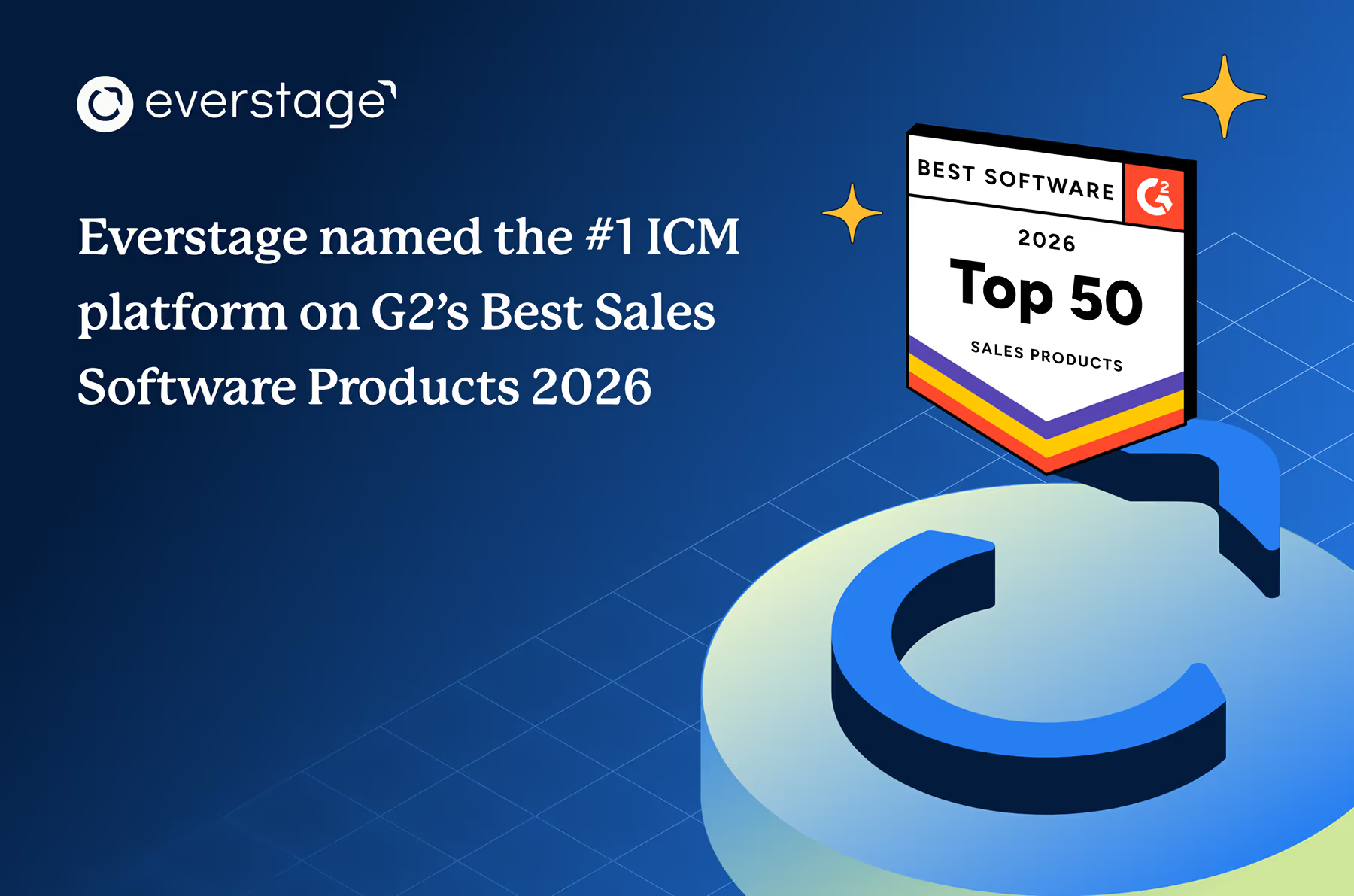
Everstage is the #1 incentive compensation management platform on G2's 2026 Best Sales Software Products, sitting at #19 overall, one of the youngest companies on the entire list, and the only ICM platform in the top 20.
That's not the interesting part.
The interesting part is what put us there: not marketing spend, not brand legacy, not sheer review volume. Customer satisfaction, at scale, from the people who run comp cycles every day and finally stopped hating it.
Our thesis while building Everstage was simple. The ICM category had been solving the wrong problem for a decade. Most platforms were built to automate commission calculations. That's table stakes. The real problem is whether your comp design is actually driving the revenue behavior your business needs — and nobody was building for that.
Here's how Everstage's founder frames the problem:
.avif)
The setup most B2B companies have normalized
Ops leaders are sitting on a broken setup, and they know it. A single person owns the spreadsheet. Finance is chasing down reconciliation every close cycle. Reps are running shadow accounting because they don't trust their statements, and leadership is asking Ops to be strategic, while they spend as much as 3 days every month calculating commissions, defending payouts, and fielding questions from Finance.
None of this is new. What's new is that 1,900+ teams across company sizes and industries have now gone on record saying the old way wasn't good enough, and something better exists.
That record lives on G2. And it made Everstage #1 in its category.
But what a G2 ranking actually tells you and what most buyers miss when they read it is worth slowing down on.
The difference between bought at scale and loved at scale
G2 metric most buyers get wrong
Most G2 evaluations start with the same instinct: sort by most reviewed, filter by rating, and read the top three. It's a reasonable starting point. But the review count tells you how many people bought something. It doesn't tell you whether the people using it are still glad they did a year later.
That's a different signal. And it's the one that matters when the platform in question is something your RevOps team, your Finance team, and your reps are all expected to open, trust, and act on every single day.
Everstage has a 4.8 average across 1,900+ reviews. That rating didn't come from a review campaign. It came from RevOps leaders, Finance teams, and sales managers who ran a full comp cycle, dealt with support on a random Tuesday, onboarded new reps, and then decided to say something about it.
What they said is more useful than the number itself. On the rep side:
"Gone are the days of guesswork; now, I can instantly see how my payouts are calculated, deal by deal, and track my progress against quota. This clarity has been a game-changer for motivation and trust, eliminating doubts and empowering us to understand and maximize our earnings.
— G2 Verified Review
On the operations side:
"Everstage has significantly benefited us at Whatfix by eliminating shadow accounting, fostering trust and motivation among the sales team through clear visibility into earnings and performance, and freeing up valuable time for both sales reps to focus on selling and for finance/operations to move away from tedious calculations and into more strategic activities like plan design and forecasting."
— G2 Verified Review
Those aren't responses to a survey prompt. They're what people write when a product changed how their day actually works. Review volume tells you a product has been bought at scale. Reviews like these tell you it has been trusted at scale. When you're evaluating something your entire revenue org has to live in, those are not the same thing.
The more telling data point: Everstage grew 10x in two years, and customer satisfaction scores went up, not down. Scaling usually breaks the things customers notice most: response times, onboarding quality, and the sense that someone actually knows your account. That didn't happen here.
The data make a compelling case. So why do so many teams still sit on the decision?
The cost of switching is real. So is the cost of staying
Whether you're running comp on a legacy tool that's been good enough for three years, or a spreadsheet that one person on your team has somehow kept alive through two reorgs and a headcount cut, the moment you start evaluating something new, a second voice kicks in. Not the one that's frustrated with the current setup. The other one. The one that says: I know this is broken, but at least I know how it's broken. A migration is six months of my life I don't have.
That voice is reasonable.
Switching ICM platforms involves stakeholder alignment, data migration, comp plan rebuilds, rep communication, and a Finance sign-off that will ask you to justify every line of the business case. We're not going to tell you it's painless.
What we are going to do is answer the objections directly.
Still have objections we haven't covered? Talk to us, we've heard them all.
Here's what the switch actually looked like for teams that made it. For those who moved off spreadsheets:
"Everstage has completely removed the need for spreadsheets, which used to be such a hassle in my previous organization. I no longer have to worry about manual errors or spending time double-checking numbers. Now, I can see my exact incentive amount for the month right on the platform — it's accurate, transparent, and saves me a lot of time."
— G2 Verified Review
For those who moved off a legacy platform:
The migration has a cost. So does every month you don't. Overpayments that surface three months late, reconciliation cycles that burn 20+ hours per analyst, reps who've stopped trusting their statements and started keeping their own count, none of that shows up on a switching cost estimate. It shows up on your comp accuracy, your team's time, and eventually your rep retention. The question isn't whether switching is painless. It's whether staying is actually cheaper.
There's a second decision inside the ICM decision
The platform you're on now determines what you can build in two years.
Most ICM evaluations are framed as a tool swap. Current platform out, better platform in. But there's a second decision most buyers don't see until it's too late: whether the platform you choose can serve as actual revenue infrastructure, or whether it's just a faster version of the thing you're replacing.
The ICM category is moving toward AI-native architecture. Comp design, territory structure, and quota setting are starting to be treated as interconnected systems, not three separate spreadsheets owned by three separate people. The platforms that will handle that future aren't the ones built to automate calculations. They're the ones built to expose comp data cleanly, connect it to revenue outcomes, and let RevOps act on it in real time.
If your current setup can't do that, if the data is locked in a legacy tool, siloed from your CRM, or dependent on a manual export to become useful, you're not just behind today. You're making a future-state decision right now, whether you mean to or not.
The question isn't whether to modernize comp infrastructure. It's whether you do it before the AI-readiness gap becomes a competitive one.
Incentives should drive revenue growth, not just track it. If comp is 10% of your revenue budget, why is it the last thing your CRO redesigns when pipeline stalls?
The teams that moved first are already on record. Here's what their decision looks like from the outside.
What the G2 ranking actually reflects
B2B software lists have different weights. Some are analyst-driven. Some are media-driven. G2's Best Software list is buyer-driven. The ranking formula weights satisfaction scores and market presence, both of which require actual users making actual decisions to say something worked.
Everstage didn't land at #19 by outspending incumbents on marketing. The companies it's ranked above have been in the market for a decade or more and have built substantial brand recognition. The ranking is a function of what happened when buyers who went through implementation, ran live comp cycles, and dealt with support on a Tuesday morning decided to tell someone about it.
They did. 1,900+ times.
If you're evaluating ICM platforms
The questions that matter aren't "does it calculate commissions" and "what's the price." They're: will my reps trust it? Will Finance stop chasing me? Will I get my weekend back?