

.avif)
TL;DR
Increase sales productivity by optimizing processes, leveraging technology, and aligning team performance with business outcomes to drive higher revenue and efficiency.
- Streamline workflows and adopt automation to free reps for high-value selling activities
- Use data-driven insights to prioritize leads and track key performance metrics
- Align incentives, KPIs, and coaching programs to focus on results that matter
- Foster a culture of accountability, transparency, and continuous skill development
Sales productivity grows when every hour, every account, and every incentive points toward the revenue outcomes your business wants. It rewards focus over busywork.
According to the Salesforce State of Sales Report, sales reps spend only 36% of their time selling. Administrative tasks, unproductive meetings, and low-quality leads consume the rest.
Customer acquisition costs keep climbing, and sales cycles keep stretching. That makes sales productivity a priority for revenue leaders. The real challenge is maximizing the time reps spend on activities that move revenue. Compensation visibility helps here too. When reps see how performance affects earnings, motivation rises and disputes drop.
This article lays out the strategies and tactics that help your team reach its full potential.
You will find concrete steps that span streamlined processes and modern technology. You will also learn the common barriers that hold sales teams back and how to clear them.
Why Sales Productivity Looks Different for Revenue, Finance, and Sales Comp Leaders
CROs view productivity as higher quota attainment without adding headcount. RevOps focuses on removing process friction and giving reps visibility into pipeline-moving actions. Finance and Sales Compensation teams design incentive plans that reward profitable growth while keeping commission costs predictable and disputes low.
- For Sales: Better visibility into earnings, targets, and priorities.
- For RevOps: Cleaner performance tracking, quota alignment, and scalable workflows.
- For Finance: Predictable commission costs, payout governance, and fewer disputes.
- For HR and Payroll: More accurate payout operations and smoother compensation cycles.
- For Sales Compensation: Simpler plan management, better auditability, and stronger rep trust.
What Is Sales Productivity?
Sales productivity measures how efficiently your team turns effort into results. It compares output, like revenue or closed deals, against input, like selling time and costs.
Sales Productivity = Sales Output ÷ Sales Input
- Sales Output covers the tangible results of your sales efforts, including revenue and new pipeline opportunities.
- Sales Input refers to the resources behind those results. It includes selling time and the costs tied to selling, such as tools and training.
High output from low input signals strong productivity. High input with low output points to inefficiencies you can fix.
To measure sales productivity, track these key metrics:
Five core sales productivity metrics, their formulas, and the levers that improve each one.
Consider two reps who work the same hours. One focuses on high-quality leads and closes five $10,000 deals. The other chases weaker leads and closes two $7,000 deals. The first rep posts higher productivity because better prioritization produced more revenue.
Increasing sales productivity takes more than cleaner workflows or better time management. Reps perform better when they know which deals matter and how their actions affect quota and earnings. That makes incentive alignment one of the most underused levers for revenue efficiency.
For deeper measurement guidance, see our guide on sales productivity metrics.
How to Calculate Sales Productivity
Sales productivity equals sales output divided by sales input. Output covers revenue, closed deals, or pipeline generated. Input covers selling time, headcount, and the costs behind those results. Here are three practical calculations.
- Revenue per rep: Total revenue ÷ number of reps. If five reps generate $2.5M, revenue per rep is $500,000.
- Productive selling time ratio: Selling hours ÷ total work hours. If a rep sells 14 hours out of a 40-hour week, the ratio is 35%.
- Pipeline generated per selling hour: Pipeline value ÷ selling hours. A rep who creates $200,000 across 50 selling hours produces $4,000 per selling hour.
Calculate productivity on the same cadence as your sales cycle, usually monthly or quarterly. The most common mistake measures activity, like calls or emails, while ignoring revenue impact. Anchor productivity to outcomes instead of effort.
The Missing Link in Sales Productivity: Incentive Alignment
Most productivity programs center on time management, CRM hygiene, or coaching. Those matter. They still fail to explain why reps prioritize certain deals, accounts, or behaviors. Incentives explain that.
When reps see how their actions affect earnings, quota progress, and team goals, productivity becomes measurable and motivational. Compensation design, payout transparency, and performance visibility all turn into revenue levers here.
The Key Pillars That Drive Sales Productivity
The most productive sales teams build systems instead of chasing activity volume. Those systems remove friction, clarify priorities, and reward profitable behavior. High-performing teams tend to align around five drivers that lift efficiency and results.
1. Process Efficiency
A smooth sales process forms the backbone of productivity. High-performing teams run streamlined workflows and clear, repeatable playbooks that cut friction at every stage. From lead generation to close, each step should keep reps on high-value work.
Standardized scripts for initial calls, a set approach to objections, and a consistent follow-up system save time. They also lift conversion rates by reducing back-and-forth.
2. People Enablement
Sales productivity comes down to the people behind the effort. Ongoing coaching, skill development, and knowledge-sharing keep your team sharp.
Top-performing teams invest in regular training sessions and role-playing exercises with constructive feedback. Reps who feel supported by continuous development stay motivated to succeed.
3. Performance Alignment
Sales productivity depends on the right outcomes, not just activity. Many teams reward metrics like calls made or emails sent, which rarely translate into revenue.
Align incentives, compensation, and KPIs with meaningful outcomes such as closed deals and customer retention. Tools like Everstage make outcome-focused compensation plans easier to design and manage. Reps get real-time commission visibility, and RevOps can model plan changes before rollout, so teams reward the results that matter most.
4. Technology Enablement
Technology drives sales productivity through CRM systems, automation software, and AI analytics. These tools automate manual work and surface insights that free reps to sell.
Automating data entry, meeting scheduling, or follow-up emails gives reps more time with prospects. For compensation-led productivity, technology should also connect CRM activity, quota progress, and commission data. Then reps and leaders can see how performance becomes earnings and revenue impact.
AI tools prioritize leads and suggest next steps, helping teams decide faster.
5. Cultural Accountability
The best teams celebrate success together, share feedback freely, and own their outcomes. When reps see their performance data in real time and join regular check-ins, they stay focused and keep improving.
Everstage supports this culture with a unified platform for performance metrics, sales targets, and incentive progress in real time. Full transparency into goals and achievements gives reps a deeper sense of ownership and motivation.
Once these drivers are clear, you can pinpoint where sales teams fall short and why productivity stalls despite good intentions.
What Most Sales Productivity Programs Miss
Many productivity initiatives chase more calls, more emails, or more dashboards. When compensation rewards the wrong behaviors, teams get busier while staying flat on results. The missing layer is incentive alignment, which connects daily work to the outcomes the business needs most.
Spreadsheet-based commission processes quietly reduce productivity. They delay payouts and erode rep trust. Finance and RevOps also lose hours to manual reconciliation. Automated compensation workflows help teams adapt plans faster and keep reps focused on revenue-driving work.
The Compensation-Led Productivity Framework
Sales productivity improves when four systems work together:
- Clear goals: Reps know which outcomes matter.
- Aligned incentives: Compensation rewards the right behaviors.
- Real-time visibility: Reps see progress and earnings impact before payout day.
- Automated operations: Finance and RevOps cut manual work, disputes, and payout delays.
Common Sales Productivity Challenges and Barriers
Sales teams face challenges that keep them from their full potential. These barriers slow productivity and drag down performance. Here are the main obstacles that hold sales teams back.
1. Time Wasted on Manual Tasks, Reporting, and Admin
Administrative tasks eat a large share of a rep's day. CRM updates, report generation, and email replies pile up fast.
That admin load cuts into prospecting and closing time. Automating these repetitive tasks with CRM tools or sales automation software frees reps for high-impact work like prospecting and closing.
2. Poor Lead Qualification and Chasing Low-Quality Prospects
Weak lead qualification sends reps after unqualified prospects. The result is longer sales cycles and lower conversion rates.
Lead qualification frameworks like BANT (Budget, Authority, Need, Timing) or MEDDIC (Metrics, Economic Buyer, Decision Criteria, Decision Process, Identify Pain, Champion) help teams prioritize better.
These frameworks let reps confirm whether a lead has budget, authority, and need. They also clarify how the lead fits the decision process, so reps focus on the prospects most likely to convert.
3. Misaligned Sales & Marketing Processes
Misalignment breaks handoffs, weakens messaging, and lets opportunities slip through the cracks.
Aligning sales and marketing around shared KPIs, lead qualification criteria, and regular communication helps both teams pass leads with the right context. That improves efficiency and raises close rates.
According to HubSpot's 2024 Sales Trends Report, companies with aligned sales and marketing teams are 103% more likely to beat their goals this year.
4. Misaligned Incentives: Rewarding Activity, Not Outcomes
Many teams reward activity metrics like calls made or emails sent instead of closed deals or revenue growth. Aligning incentives with deal value and customer retention pushes reps toward actions that drive business results.
Tying compensation to results makes reps prioritize the work with the greatest impact on the bottom line. Platforms like Everstage make this alignment straightforward by helping you design data-driven, outcome-focused compensation plans.
Are your incentives driving the right sales behavior? See how Everstage helps revenue teams align compensation plans with revenue outcomes, automate payouts, and give reps real-time visibility into earnings. Book a demo
5. Lack of Coaching and Continuous Learning
Continuous learning keeps reps competitive. Reps struggle to improve their performance when coaching and skill development are missing.
Regular coaching sessions, role-playing, and microlearning tools give reps the skills to adapt to changing markets and handle objections. A culture of continuous development keeps reps motivated and sharpens their technique to close more deals.
6. Remote and Hybrid Challenges: Distractions and Weak Accountability
Remote and hybrid models introduce distractions that lower accountability and productivity. Reps can lose focus when the office structure disappears.
Clear expectations, regular check-ins, and collaboration tools like Slack, Zoom, or project management platforms keep remote teams connected and accountable.
These barriers are clear and manageable. Process improvements, tighter alignment, and ongoing learning help sales teams reach their full potential and produce better results.
How Leaders Can Remove Rep-Level Productivity Friction
Rep productivity climbs when leaders cut admin drag, clarify priorities, and show sellers the incentives and targets that matter most. Less friction and more high-value work let reps achieve more with less effort.
Here are concrete strategies to lift sales productivity.
1. Time Spent Selling vs. Admin Work
Reps lose too much time to administrative tasks. Data entry, reporting, and scheduling consume hours each week. Automate these tasks with CRM tools like auto-logging and email templates to cut manual input and reclaim selling time.
Freeing reps from non-revenue tasks gives them more time with prospects and more deals closed.
2. Use Automation to Reduce Manual Data Entry
CRM auto-logging, email templates, and automated scheduling handle repetitive work and free reps for strategic tasks. These tools save time and reduce human error.
According to HubSpot's 2024 Sales Trends Report, 81% of sales professionals say AI helps them spend less time on manual tasks, while 78% report it makes them more efficient.
3. Encourage "Focus Blocks": Batching Calls and Emails
Multitasking lowers efficiency. Batching similar tasks into focus blocks keeps reps organized and productive. Reps should schedule set times for one activity at a time.
Set 30-minute blocks for calls to a specific lead segment, and dedicate separate blocks to email outreach. Batching similar tasks cuts distractions and speeds completion, producing better outcomes with less effort.
4. Lead Prioritization & Qualification Frameworks
Sales productivity jumps when reps focus on the best leads. Lead qualification frameworks keep reps away from low-quality prospects. Popular frameworks include:
- BANT: Budget, Authority, Need, Timing confirms the lead is ready to buy.
- MEDDIC: Metrics, Economic Buyer, Decision Criteria, Decision Process, Identify Pain, Champion suits complex, enterprise-level sales.
- CHAMP: Challenges, Authority, Money, Prioritization centers on customer needs before moving forward.
AI lead scoring also prioritizes high-intent leads automatically, so reps focus on the strongest opportunities. Working qualified leads helps reps close more deals in less time.
5. Coaching, Training & Continuous Skill Development
Even top reps need regular coaching and skill development to stay sharp. They struggle to adapt to new techniques or market shifts when learning stops.
Sales leaders should prioritize ongoing development to keep teams performing. Role-playing, microlearning tools, and peer-driven learning keep reps engaged and improving. Consistent feedback and training help reps refine skills, handle challenges, and stay motivated.
6. Mistakes to Avoid
As you push for productivity, watch for these common mistakes:
- Too much admin work: Reps can still drown in non-revenue tasks even with automation. Make sure automation tools get full use.
- Prioritizing quantity over quality: High-volume outreach wastes time. Put lead quality ahead of sheer volume.
- Over-scripting calls: Strict scripts make calls sound robotic. Allow flexibility for authentic, personalized conversations.
Improving rep productivity rewards smarter work. Avoiding these mistakes keeps reps on meaningful sales activities and drives better results.
Next, let's look at how to lift productivity across the whole team so your organization operates efficiently.
How to Improve Sales Team Productivity
Improving team productivity means building a streamlined workflow that keeps reps on what matters most: closing deals and generating revenue.
Process optimization, cross-team alignment, and smart territory management let sales leaders build a high-performance environment. Below are concrete strategies to lift your team's efficiency and results.
1. Process Optimization & Sales Playbooks
A well-defined sales process is essential for productivity. Sales playbooks standardize how your team works, reduce variability, and produce consistent results.
- Standardize Key Elements of Sales Playbooks: Consistent messaging keeps every rep on a unified pitch. Clear, standardized responses to objections help reps overcome resistance quickly.
- Reduce Variability Between Reps: A shared process and shared materials cut inconsistency. A standardized playbook ramps new reps faster and keeps experienced reps on the practices that convert.
2. Sales & Marketing Alignment
Misalignment between sales and marketing is a major productivity roadblock. When both teams agree on the same priorities, sales focuses on the right leads and messaging.
- Define Shared KPIs: Align sales and marketing around common goals such as MQLs (Marketing Qualified Leads), SQLs (Sales Qualified Leads), and opportunities.
- Weekly Syncs Between Sales and Marketing: Regular communication keeps both teams aligned on lead quality and strategy. These syncs surface lead feedback, challenges, and wins.
- Ensure a Feedback Loop on Lead Quality: Sales should give marketing steady feedback on lead quality. That feedback helps marketing sharpen targeting and messaging over time.
3. Smarter Territory & Pipeline Management
Strong territory and pipeline management keeps reps on the most promising opportunities. Optimized territories and balanced workloads raise productivity and reduce burnout.
- Assign Territories Based on Opportunity Density: Look at opportunity density instead of geography alone. Reps in high-potential segments focus on high-value opportunities and improve their chances.
- Use Data to Balance Workloads: Sales managers should distribute leads and opportunities fairly. Data-driven insights balance workloads by lead quality, market potential, and rep performance.
- Regular Pipeline Reviews: Frequent pipeline reviews surface bottlenecks and keep deals moving. They help managers spot issues early and adjust strategy.
- Tools for Forecasting and Pipeline Management: Forecasting tools provide real-time data so managers can predict revenue and optimize the pipeline. They make sure every lead gets attention and reps stay on the right deals.
4. Team-Level Mistakes To Avoid
Even strong strategies can stumble on mistakes that reduce productivity. Spotting and fixing these traps keeps the team high-performing.
- Overcomplicating Processes: Too many tools or dense playbooks overwhelm reps. Simplify processes so reps reach the resources they need quickly. Easier work means more productive reps.
- Ignoring Feedback Loops: Sales and marketing need constant, open communication. When feedback stays siloed, teams repeat mistakes and waste resources. Build a culture of feedback and keep both teams aligned on what works.
- Neglecting to Update Playbooks: Markets, buyer behavior, and customer needs change over time. Outdated playbooks lower conversion rates and waste effort. Update playbooks regularly to reflect current trends.
Lifting team productivity takes streamlined processes, aligned sales and marketing, and reps equipped with the right tools. These strategies help your team close more deals, grow revenue, and build long-term growth.
Before the tactics, it helps to see why increasing sales productivity is a leadership priority, not only a rep-level goal.
Sales Productivity Benchmarks: What Good Performance Looks Like
Benchmarks help you diagnose current performance before you apply improvement tactics. Treat the ranges below as directional guidance. Actual targets shift with industry, deal size, sales motion, and market maturity.
Directional sales productivity benchmarks and what each range signals about team health.
For deeper data, see our sales productivity statistics and sales productivity report.
Sales Productivity Workflow Audit Checklist
This checklist pinpoints the blockers reducing rep efficiency before you build an improvement plan.
Common workflow blockers, their productivity impact, owners, and next actions.
Why Sales Productivity Matters for Leadership
Sales productivity is a leadership priority, not only a rep-level goal, and it can lift the entire organization. When leaders improve productivity across teams, systems, and culture, the impact reaches far beyond quota.
Here is why boosting sales productivity matters for leadership and how it drives long-term success.
1. Higher ROI per Rep
Improving productivity rarely requires more headcount. A modest gain can produce meaningful additional revenue. Leaders who streamline processes, remove inefficiencies, and equip reps with the right tools raise revenue per rep without growing the team.
2. Shorter Ramp Times for New Reps
Faster ramp means new hires contribute to pipeline sooner. When leadership invests in streamlined coaching, clear processes, and effective training, new reps ramp much faster. They hit targets and drive revenue earlier.
3. More Predictable Forecasting
Optimized productivity gives leaders sharper insight into pipeline health, which makes forecasting more predictable. Consistent, measurable productivity makes revenue easier to forecast and supports data-driven decisions.
4. Lower Attrition and Improved Retention
Productive reps feel more confident and motivated, which lowers attrition and lifts retention. Weak support and inefficient processes lead to burnout, disengagement, and higher turnover.
5. Scalable Growth
A high-performing sales team drives results today and sets up scalable growth for the future. Optimized productivity lets teams handle rising demand without constantly hiring reps or raising budgets.
With the leadership case clear, let's look at how leadership shapes the systems, incentives, and culture that drive long-term productivity.
Leadership Strategies to Boost Productivity
Sustained sales productivity asks leadership to do more than run daily operations. Leaders create the right environment, align team goals, and build systems that help reps perform at their best.
Here are the leadership strategies that lift team productivity.
1. Incentives & Compensation Design
Compensation is one of the strongest levers leaders have for productivity. A well-structured incentive program motivates reps to align their effort with company goals and rewards the behaviors that drive success.
Compensation plans should stay simple enough for reps to understand and flexible enough for leaders to adjust. Finance should be able to forecast them. When reps cannot see how performance affects earnings, motivation drops and disputes rise. Platforms like Everstage automate commission plan management so RevOps and Finance can model changes before rollout.
- Revenue vs. margin-based incentives: Reward profitable growth instead of bookings volume alone.
- Accelerators and decelerators: Motivate overperformance while discouraging low-quality deals.
- SPIFF governance: Use short-term incentives while keeping plans clear.
- Clawbacks and payout rules: Make adjustments clear to reduce disputes.
- Plan modeling: Test incentive changes before rollout so Finance and RevOps can forecast impact.
- Align Compensation with Business Outcomes:
Tie compensation to key goals like revenue growth, customer retention, and deal quality. Instead of rewarding volume alone, push reps to close high-value deals and build lasting customer relationships that generate sustainable revenue.
- Use SPIFFs for Short-Term Motivation
SPIFFs (Sales Performance Incentive Funds) are short-term bonuses that encourage specific behaviors or goals. They drive immediate actions, like closing a set number of deals in a week or promoting a new product, and deliver a quick productivity boost.
- Avoid Incentives That Encourage Discounting
Stay cautious with plans that reward heavy discounting. When reps win deals through deep discounts, the bottom line and product value both suffer. Keep incentives focused on profitable deals and long-term customer success.
Ready to align incentives with revenue outcomes?See how Everstage automates commission workflows and gives reps real-time visibility into earnings. Book a demo
2. Building a Productivity Culture: Recognition, Accountability, and Transparency
A productivity culture makes reps feel supported, valued, and accountable. Recognition, clear goals, and open communication shape that culture.
- Celebrate Wins Publicly: Public recognition motivates strongly. Use leaderboards, Slack shoutouts, or team-wide emails to highlight top performers. This boosts morale and sets a positive example that encourages others to push for similar wins.
- Encourage Accountability: Reps work harder when they own their performance. Set clear, measurable goals and give reps visibility into their progress. Regular performance updates keep reps focused on their targets.
- Foster Psychological Safety: Reps must feel safe to raise challenges and ask for help. Psychological safety encourages open communication and problem-solving, which speeds collaboration and resolution.
3. Setting the Right KPIs and Feedback Loops
Strong productivity needs the right performance metrics and consistent feedback. Clear KPIs and steady feedback keep reps aligned with business goals and improving.
- Focus on Key KPIs like quota attainment, sales velocity, and pipeline coverage to keep reps on target.
- Regular 1:1 Meetings: Hold weekly or bi-weekly one-on-ones to review performance. Use them to discuss KPIs, offer coaching, and give constructive feedback. These meetings keep reps on track and surface obstacles early.
- Create Feedback Loops: Build a continuous feedback cycle between managers and reps. Real-time feedback helps managers guide reps and course-correct quickly. This iterative process keeps reps improving and aligned with team goals.
4. Leadership Mistakes to Avoid
Even well-intentioned leaders fall into traps that hurt productivity. Spotting and avoiding these mistakes protects long-term success.
- Misaligned Incentives: One of the biggest leadership mistakes rewards activity volume, like calls made or emails sent, over deal quality or revenue. Reps who chase activity targets focus on quantity, which wastes effort on low-value deals.
- Poor Onboarding and Coaching: Weak onboarding and coaching delay ramp time. New reps need structured support to get up to speed. Without it, they fall short of expectations.
- Setting Too Many KPIs: KPIs track progress, but too many overwhelm reps. A focused, impactful set tells reps exactly what to prioritize. Competing metrics create confusion and pull attention from the goals that matter.
Leadership plays a central role in boosting sales productivity.
Aligning compensation with business outcomes, building a culture of recognition and accountability, setting clear KPIs, and giving consistent feedback all help teams perform at their best. Now let's look at the technologies that lift your team's efficiency.
Best Sales Productivity Tools and Technologies
The right tools automate routine work, streamline workflows, and surface insights so teams work smarter. CRM systems, sales engagement platforms, compensation software, and AI analytics together raise productivity. Here is how each contributes:
What each sales tool category improves and the gap it leaves open.
1. CRM & Automation Tools
Customer Relationship Management (CRM) systems form the backbone of sales productivity. They centralize leads, track interactions, and automate repetitive tasks. That saves time and keeps reps on what matters: engaging prospects and closing deals.
- Salesforce & HubSpot: These platforms centralize customer data, track interactions, and automate data entry. They reduce manual updates and give reps a full view of leads and customers.
- Auto-Scheduling, Call Logging, and Email Templates: CRM automation tools like auto-scheduling, call logging, and email templates remove time-consuming tasks. They arrange meetings and streamline prospect communication, saving reps hours every week.
2. Sales Engagement Platforms
Sales engagement platforms streamline outreach and keep communication with prospects consistent. They automate follow-ups and support multichannel engagement, keeping reps organized and productive.
- Create Sales Cadences: These platforms build sales cadences, sequences of personalized emails, calls, and follow-ups that engage leads at key moments. Automated reminders keep reps on top of every opportunity.
- Multichannel Outreach & Consistent Follow-Ups: These platforms keep reps engaging prospects across email, phone, and social without losing track of interactions. Automated reminders reduce manual touches and improve lead nurturing.
3. Sales Compensation and Incentive Management
Compensation software connects performance, incentives, and payouts. It automates commission calculations and gives reps real-time visibility into earnings, which cuts admin work and builds trust. CRM and engagement tools improve activity management, but they leave incentive misalignment unsolved. That gap is what compensation software closes.
4. AI & Analytics for Forecasting and Prioritization
AI-powered tools improve the sales process with data-driven insights that help teams prioritize leads and forecast accurately. Machine learning analyzes data to predict the best opportunities, so reps focus where it counts.
- Predictive Lead Scoring: AI tools analyze lead behavior and engagement to score conversion likelihood. This scoring keeps reps on high-potential leads and reduces wasted time.
- Conversation Intelligence: Some platforms capture and analyze sales calls, scoring conversation quality and objection handling. These tools give reps feedback that sharpens their approach and lifts conversion rates.
- Forecasting Tools: Many tools give real-time pipeline visibility so leaders track deal progress and predict revenue accurately. They support informed decisions and timely strategy adjustments.
- AI Copilots for Sales Reps: New AI tools draft follow-up emails, suggest objection responses, and analyze live calls. These copilots automate routine work and free reps to build relationships and close deals.
With the right technology stack, leaders raise revenue per rep, reduce sales cycle waste, and protect compensation ROI without adding headcount.
Next, let's look at a 30-60-90 day plan that uses automation, data insights, and process optimization to maximize results.
30-60-90 Day Plan to Boost Sales Productivity
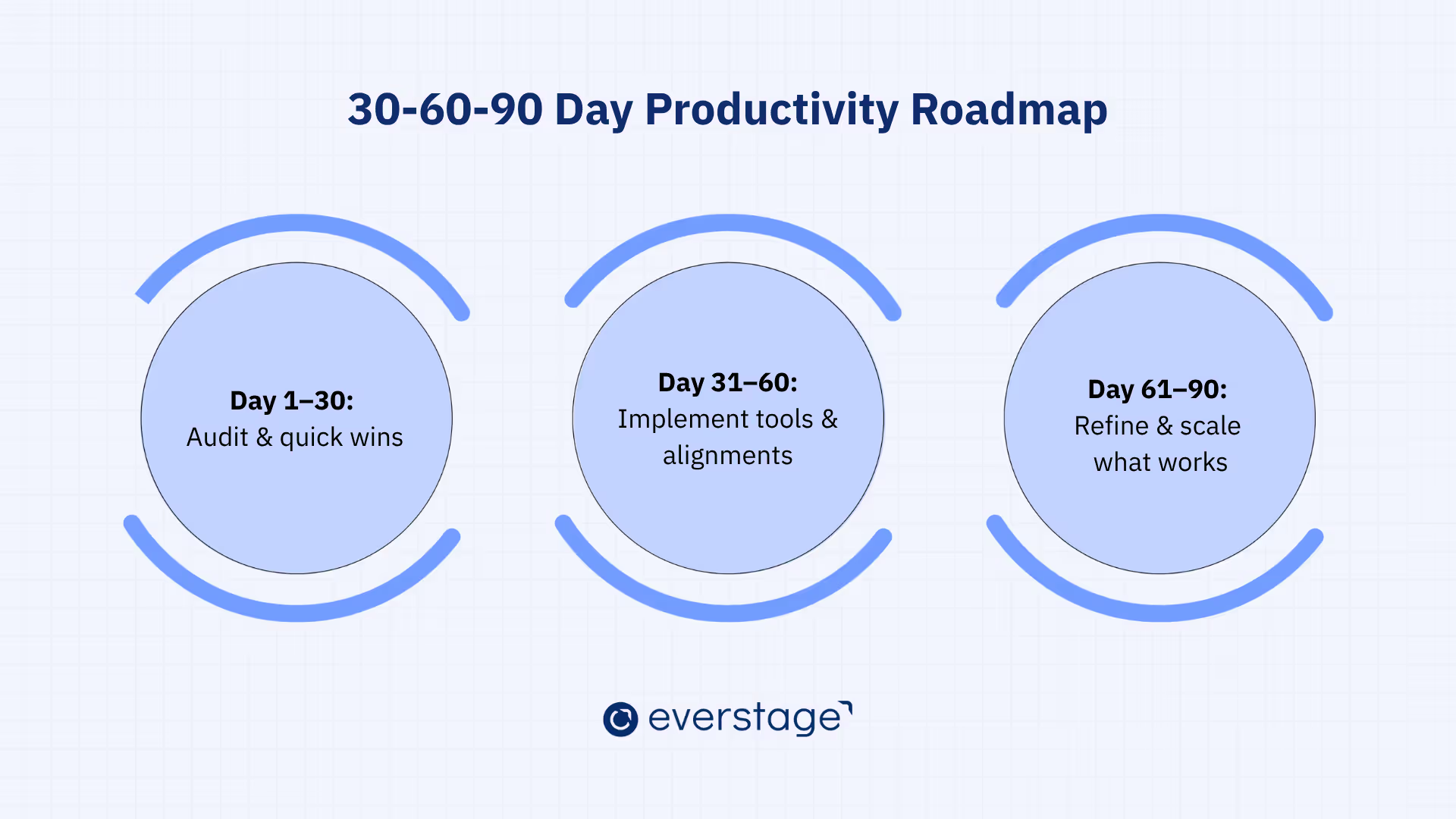
A structured 30-60-90 day plan improves sales productivity in stages. Three clear phases let you implement changes gradually for lasting impact.
Caption: A 90-day plan showing focus, actions, owners, and success metrics for each phase.
This approach lets you measure progress, spot improvements, and refine strategies over time. Here is the plan in detail.
First 30 Days: Audit Selling Time, Review KPIs, Identify Quick Wins
The first 30 days establish where your team stands and surface areas for immediate improvement.
- Audit Selling Time: Measure how much time reps spend on core selling versus non-selling tasks like admin work, data entry, and reporting. Use CRM tools or time-tracking software to map time and find where automation helps.
- Review Current KPIs: Examine the KPIs you use to measure performance. Do they match business goals? Do they focus on outcomes like quota attainment, conversion rates, and sales velocity? Adjust or refine them so they drive the right behaviors.
- Identify Quick Wins: Find small changes that produce immediate results, such as automating basic tasks, sharpening lead qualification, or refining meeting scheduling. Quick wins build momentum and show your team that change pays off fast.
By day 30, you understand how time is spent, which KPIs need refinement, and which quick improvements lift productivity right away.
Next 30 Days (31–60): Implement Automation, Align Sales & Marketing, Introduce New Playbooks
Phase two installs systems that raise efficiency and aligns teams for better collaboration.
- Implement Automation: Add tools that reduce repetitive tasks like call logging, email follow-ups, and meeting scheduling. CRM tools like Salesforce and HubSpot automate data entry and tracking.
- Align Sales & Marketing: Sales and marketing should work as one revenue team. Set regular meetings to discuss lead quality, campaign feedback, and shared goals. Establish shared KPIs so everyone agrees on priorities.
- Introduce New Sales Playbooks: Standardize the sales process with new playbooks. They should cover best practices for lead qualification and objection handling. A clear, repeatable process lets reps execute consistently and improve results.
By day 60, you have automation in place, sales and marketing aligned, and a standardized playbook for the team.
Next 30 Days (61–90): Evaluate Compensation Alignment, Introduce Coaching Programs, Refine Pipeline Reviews
The final phase optimizes existing structures and adds ongoing support for sustained growth.
- Evaluate Compensation Alignment: Review the compensation plan against goals like revenue growth, deal quality, and customer retention. Incentive structures should reward reps for profitable deals and lasting relationships, not volume-based targets alone.
- Introduce Coaching Programs: Roll out structured coaching for continuous development. Offer weekly role-playing, deal reviews, and peer coaching to sharpen rep skills. Regular coaching keeps reps improving and motivated to hit targets.
- Refine Pipeline Reviews: Run regular pipeline reviews to assess deal health and keep opportunities moving. Use forecasting tools for real-time pipeline visibility. Frequent reviews help leaders catch bottlenecks and keep deals progressing.
By day 90, your team has an aligned compensation structure, a strong coaching program, and a refined pipeline process. Auditing, automating, aligning teams, and adding support together build a more efficient, high-performing team.
This phased approach supports data-driven decisions and continuous improvement. With this roadmap in place, your team is ready to lift productivity, grow sales, and build long-term growth.
Need a clearer view of incentive impact? See how Everstage helps teams automate commission workflows and align compensation plans with revenue goals. Book a demo
How Everstage Helps Turn Sales Compensation Into a Productivity Lever
Everstage helps revenue teams automate commission workflows, align incentive plans with business outcomes, and give reps real-time visibility into quota and earnings. Teams can use compensation data to guide behavior throughout the sales cycle instead of waiting for payout cycles or manual spreadsheets.
- Automate commission calculations and reduce manual admin
- Give reps transparent visibility into earnings and targets
- Align incentives with revenue, margin, retention, or strategic goals
- Help Finance and RevOps monitor compensation performance and payout impact
Sustain Sales Productivity Gains Over Time
Sustained sales productivity rewards smarter work over longer hours. Efficiency stays central in a competitive market.
Optimized processes, the right technology, and a supportive, high-performance culture help your team reach its full potential without burnout.
Processes drive productivity first. Clear, repeatable workflows create consistency and reduce friction, so the team spends more time selling and less on admin.
Technology builds on that foundation. It automates routine tasks, surfaces data insights, and helps the team prioritize high-quality leads for better decisions. A culture of recognition, accountability, and continuous learning keeps reps motivated, engaged, and performing.
When process, technology, and culture work together, your sales team meets its goals and consistently exceeds them.
Looking to improve sales productivity through smarter incentive alignment? Everstage helps revenue teams automate commission workflows, give reps real-time visibility into earnings, and align compensation plans with the outcomes that drive profitable growth.
Book a demo to see how Everstage turns sales commissions into a stronger revenue lever.
Questions worth asking
The things most people want to know before they commit.
How does AI help increase sales productivity?
AI increases productivity by automating manual tasks and surfacing data-driven insights. It powers predictive lead scoring, analyzes sales calls for coaching, forecasts revenue, drafts follow-up emails, and suggests next-best actions. By handling routine work and prioritizing high-intent leads, AI frees reps to build relationships and close deals.
How does incentive compensation impact sales productivity?
Incentive compensation shapes which deals, accounts, and behaviors reps prioritize. When plans reward profitable revenue, retention, margin, or strategic products, reps focus on work that improves business outcomes. Real-time commission visibility also shows reps how daily actions affect quota progress and earnings, which sustains motivation.
How can sales teams improve productivity without increasing burnout?
Balance territories fairly, reduce low-value admin, protect focus time, and recognize wins regularly. Sustainable productivity comes from removing friction instead of piling on activity targets. Monitor workload, quota pressure, and morale so you can adjust before reps disengage.
What tools can help improve sales team performance?
CRM platforms, sales automation software, analytics tools, and sales compensation software all improve performance. CRMs manage customer relationships, automation tools simplify repetitive tasks, and analytics measure productivity. Sales compensation software adds incentive alignment and real-time earnings visibility, helping reps focus on the behaviors that drive revenue.
How can I optimize sales processes to improve efficiency?
Optimizing sales processes means identifying bottlenecks, automating repetitive tasks, and aligning sales strategies with business goals. CRM systems, analytics software, and lead generation platforms improve workflow efficiency. Regular analysis of sales data and team performance keeps the process improving.
How can I measure sales productivity improvements?
Measure improvements by tracking metrics like quota attainment, revenue per rep, conversion rates, deal size, sales cycle length, payout disputes, and compensation ROI. Analytics tools and CRMs capture data that reflects how well teams perform. These insights help you adjust strategies for continuous improvement.