

.avif)
TL;DR
Improve Sales Plan by focusing on clarity, data-driven goals, and alignment across teams to build a scalable, efficient system.
- Audit your current sales process to identify gaps between planning and execution.
- Redefine SMART goals and refine your Ideal Customer Profile to target high-fit leads.
- Streamline the sales cycle and align it with the buyer’s journey to boost velocity.
- Equip teams with the right tools, training, and performance metrics for continuous improvement.

Introduction
You don't lose deals because your team isn't working hard. You lose them because your sales plan is stuck in yesterday.
Think about it: buyers today don't follow a straight line from cold call to contract. They research on their own, consult peers, compare options, and only then decide if they want to talk to you. If your sales plan is still built around checking activity boxes like calls, emails, and demos, you're setting your team up for frustration.
The truth is, activity metrics might make you feel productive, but they don't guarantee revenue. And if you've noticed your team hitting every KPI yet still missing quota, that's not a performance issue; it's a planning issue.
This guide is about rewriting that playbook. You'll learn how to shift from "busy selling" to "smart selling," with actionable strategies, proven frameworks, and practical steps that actually align with the way people buy today.
How to Improve a Sales Plan (and Why It Matters)
Improving your sales plan isn't just about setting better targets or writing a more detailed document. It's about building a sales improvement plan that aligns your strategy, tools, people, and new customer expectations into one seamless system. When done right, this becomes your action plan to improve sales performance, from pipeline quality to win rates to revenue predictability.
So why does this matter?
Because a good sales plan helps you sell. A great one helps you scale.
If your team doesn't have clarity on who they're selling to, what messaging works, how to track success, or where the bottlenecks are, it's not a sales execution issue. It's a planning issue. And that's what we're here to fix.
Benefits of Improving Your Sales Plan
When you build a modern, data-driven performance improvement plan for sales, the payoff is measurable and fast. Let's look at a few key benefits, backed by real-world examples and frameworks.
- Predictable revenue growth
One of the biggest advantages of a strong sales plan is forecast accuracy. Salesforce reports that companies with formalized sales plans and CRM integration are 33% more likely to accurately predict quarterly revenue outcomes. This kind of clarity helps you prioritize high-performing channels and double down on what's working.
- Stronger team alignment and accountability
Your sales team isn't just a group of individual performers. They're part of a system. Pipedrive's team structure model emphasizes that when roles, goals, and tools are aligned through a central plan, sales reps perform better, and managers coach better. This shared alignment also reduces internal friction and siloed thinking.
- Faster adaptability in changing markets
Markets change fast. New competitors, shifting buyer behavior, or economic downturns can disrupt even strong pipelines. A flexible, regularly updated sales plan helps you adapt quickly, reallocating resources and adjusting messaging so you stay competitive in dynamic conditions.
If you're rethinking how your compensation strategy fits into a stronger sales plan, this resource breaks down practical ways to align comp with performance goals.
Core Elements of an Effective Sales Plan
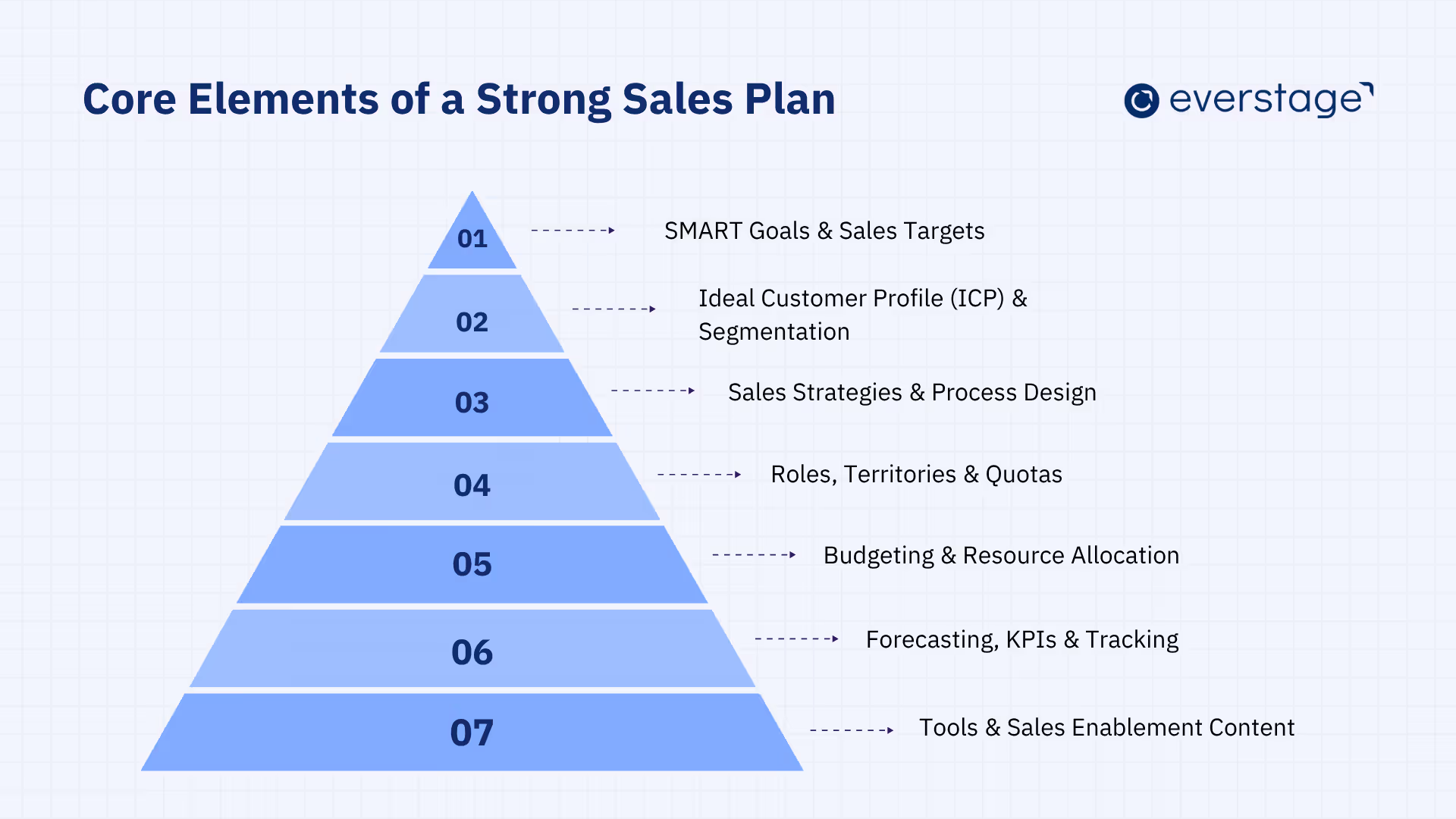
Improving a sales plan starts with knowing what a good one should actually include. Let's walk through the foundational elements your plan needs and what best-in-class companies are doing right.
1. SMART Goals & Sales Targets
Every business plan to improve sales begins with clear goals. But those goals need to be SMART: Specific, Measurable, Achievable, Relevant, and Time-bound. Setting SMART goals ensures your team isn't chasing vague metrics like "increase pipeline" or "boost conversions." Instead, you might set a target like: "Close $1.2M in net-new revenue from mid-market SaaS clients in Q4."
2. Ideal Customer Profile (ICP) & Segmentation
You can't improve sales performance if your sales reps are selling to the wrong people. Defining and refining your ICP is one of the most impactful steps you can take. A good ICP isn't just a title or industry. It's a profile built on firmographic data (company size, industry, location), tech stack, behavioral traits (like product usage or engagement level), and buying triggers.
3. Sales Strategies & Process Design
A great sales plan doesn't just define what you're selling; it sharpens how you sell it. Your sales process should act as a structured journey that mirrors how your buyers actually make decisions. From initial outreach and lead nurturing to closing the deal and ensuring a seamless post-sale handoff, each stage must be clearly mapped with the right strategy, tools, and ownership. When you align your sales process with the buyer journey, you reduce friction, improve handoffs across teams, and create a repeatable path to revenue.
4. Roles, Territories & Quotas
If your reps are stepping on each other's toes, or if certain regions are underserved, your territory and role alignment may be off. Every improved sales plan should clearly define who owns what, geographically, vertically, or by account size.
When you're formalizing roles and quotas, having clear commission agreements in place helps prevent disputes and keeps everyone aligned.
5. Budgeting & Resource Allocation
Even the best sales technique will fall short without the right resources behind it. Your plan should allocate budget across tools, training, marketing support, and headcount. Prioritizing enablement and infrastructure investments ensures your team has what it needs to reach the target audience and scale sustainably.
6. Forecasting, KPIs & Tracking
Forecasting isn't just about predicting revenue targets; it's about creating visibility. Your sales plan should define clear KPIs for each stage of the funnel, including conversion rates, average deal size, pipeline coverage, and velocity. With these metrics in place, you can track the team's performance in real time and adjust tactics proactively.
One real-world example is Chargebee, a leading SaaS billing platform. Their sales team initially relied on spreadsheets for commission tracking, which made forecasting and performance visibility a constant struggle. By implementing Everstage, they not only eliminated errors but also gained real-time insights into quota attainment and pipeline health. The result? Greater accuracy in forecasting, stronger alignment between sales and finance, and a sales plan that scaled with their growth.
Since accurate forecasting often ties directly to revenue recognition, understanding ASC 606 can help finance and sales teams stay aligned on compliance.
7. Tools & Sales Enablement Content
Your tech stack and content library are the backbone of sales execution. A solid plan includes the right CRM system, sales automation tools, playbooks, pitch decks, and customer-facing assets. Equipping your sales team members with the sales tools and content they need and ensuring they know how to use them drives consistency and confidence in every interaction.
Common Gaps in Sales Plans (and How They Hurt Performance)
Even when teams put time, marketing efforts, and sales efforts into building a sales plan, many still struggle to hit their targets. That's usually not because the team isn't working hard enough, it's because the plan itself has critical blind spots.. Let's unpack the most common issues that weaken your action plan.
1. Unrealistic or Vague Targets
Setting stretch business goals can be motivating, but setting unrealistic or undefined goals backfires. When sales targets are disconnected from market conditions or historical performance, they don't inspire your team; they stress them out.
A Forrester report on sales productivity revealed that over 40% of B2B reps feel their quotas are unattainable. Without SMART structures or sales data-driven forecasting, salespeople either burn out trying to hit moving targets or disengage completely.
2. Weak ICP or Misaligned Targeting
When your reps spend time chasing the wrong accounts, everyone loses. A weak or outdated Ideal Customer Profile (ICP) causes wasted effort, bloated sales pipelines, and longer sales cycles.
Gartner's research shows that companies that continuously refine their ICP based on win/loss customer data are 2.5x more likely to see improvements in conversion rates. Misalignment between your targeting strategy and your potential customer needs means you're running fast, but in the wrong direction.
3. Inefficient Sales Cycle
A sales cycle with too many steps, unclear handoffs, or redundant approvals slows everything down. When deals get stuck in limbo, revenue recognition gets delayed, and forecasting becomes a guessing game.
More importantly, buyers lose interest when your process doesn't match their pace or priorities.
4. Lack of Sales Enablement
You can't expect sales representatives to perform without the right tools, content, and sales training. Even the most talented reps can't succeed without the right support. If your team lacks playbooks, objection-handling guides, case studies, or product training, performance will plateau.
Enablement isn't optional. It's what turns average teams into consistent performers by giving them tools to sell smarter and faster.
5. Poor Tracking & Feedback Loops
Without visibility into what's working and what's not, your sales plan becomes static. Teams repeat the same mistakes, sales managers can't coach effectively, and strategy becomes reactive instead of proactive.
Strong tracking and feedback loops ensure you can course-correct quickly, optimize performance, and scale what works.
Step-by-Step Framework to Improve Your Sales Plan
.avif)
Improving your sales plan isn't about a complete overhaul, it's about making intentional, data-backed upgrades that compound over time. In this section, we'll walk through a clear, step-by-step framework to help you move from reactive execution to repeatable, high-performance selling.
1. Audit Your Existing Plan
Before making changes, understand what's working and what's not. Review your current sales goals, Ideal Customer Profile (ICP), sales stages, team structure, and KPIs. Look for misalignment between strategy and execution, and identify where reps are facing friction.
Do this now:
- Pull performance data from your CRM for the last two quarters
- Interview 2–3 reps about challenges they face in the current process
- Review your ICP document and check if it reflects your best existing customers
2. Redefine SMART Goals
Replace vague goals like "grow revenue" with SMART ones: Specific, Measurable, Achievable, Relevant, and Time-bound. Tie each goal to a clear KPI so your team knows what sales success looks like and how to track it.
Do this now:
- Rewrite 1 revenue goal and 1 activity goal as SMART goals
- Set KPIs for each goal (e.g. average deal size, meetings booked)
- Share these with your team and gather feedback on feasibility
3. Revalidate ICP & Market Segmentation
Market conditions shift — your ICP should too. Use CRM data and past deal wins/losses to re-segment your market and refine who your team should focus on. This helps you prioritize high-fit leads and avoid wasting time on poor matches.
Do this now:
- Analyze your top 20% of closed-won deals for common traits
- Remove outdated firmographic or behavioral criteria from your ICP
- Group leads in your CRM based on new segmentation logic
4. Optimize Sales Cycle & Buyer Journey
A long or clunky sales cycle slows down growth. Map each step of your new sales process to the buyer's journey and identify where deals get stuck. Streamlining this flow improves velocity and increases your chances of closing.
Do this now:
- Visualize your current sales funnel from lead to close
- Identify 1–2 stages where deals most often stall
- Set target timeframes for each stage to reduce cycle length:
- Qualification: ~30 days for mid-market deals, shorter (10–15 days) for SMBs.
- Proposal/Negotiation: ~45 days for complex B2B or enterprise cycles.
- Closing: Aim to finalize within 15–20 days post-proposal.
5. Equip Teams with Tools & Training
Your reps can't sell effectively without the right support. Refresh your sales enablement content, update CRM workflows, and offer ongoing training to help your marketing team sell with confidence and consistency.
Do this now:
- Audit your sales deck, demo scripts, and objection-handling docs
- Schedule a short training session on a key sales skill
- Ask reps which tools or content they feel are outdated or missing
6. Realign Territories, Roles & Quotas
Uneven workloads and unclear responsibilities lead to missed targets. Reassign territories to match market potential, define clear roles, and set realistic quotas based on data and rep capacity.
Do this now:
- Review lead distribution to ensure balanced territory coverage
- Clarify role boundaries between SDRs, AEs, and CS teams
- Adjust quotas based on territory size or historical performance
7. Add KPIs, Forecasting & Review Mechanisms
Improving your sales plan isn't a one-time task. Add KPIs for each stage, implement sales forecasting tools, and schedule quarterly reviews to stay agile and data-driven. This creates a feedback loop that helps you optimize continuously.
Do this now:
- Set monthly review dates for your sales KPIs and pipeline health
- Choose 3 metrics to monitor weekly (e.g. win rate, pipeline velocity)
- Use forecasting tools or dashboards to improve visibility
Sales Plan Templates & Frameworks You Can Use
Building a sales plan from scratch or even revisiting one mid-year can feel overwhelming. But once you've audited your current approach, realigned goals, and identified gaps, what you need next is structure. A usable template helps you put all those moving pieces together into one cohesive plan.
Below is a flexible, editable template you can use to create or refine your own action plan for sales improvement.
Sales Plan Template
1. Executive Summary
Briefly outline the purpose of the plan, the timeframe it covers (e.g., Q4 2025), and the top-level outcomes you're aiming to achieve. Example: "Increase net-new revenue by 20% through better mid-market targeting and faster cycle times."
2. Sales Goals & KPIs
Define 3–5 SMART goals and attach measurable KPIs.
Example:
- Goal: Grow mid-market ARR by $500K
- KPI: 25 new qualified opportunities per month
- KPI: 3X pipeline coverage ratio for monthly quota
3. Ideal Customer Profile (ICP) & Segmentation
Clearly define your ICP with firmographic, technographic, and behavioral characteristics.
Example:
- Industry: SaaS
- Size: 100–500 employees
- Tech Stack: Uses Slack, HubSpot, Stripe
- Behavior: Engaged with 2+ marketing touchpoints in past 30 days
4. Sales Process Overview
Map out the key stages of your sales cycle and the owner of each stage.
Example:
- Lead > MQL > SQL > Opportunity > Closed-Won
- SDRs own lead → SQL
- AEs own SQL → Closed-Won
5. Team Roles, Territories & Quotas
List sales roles, regional or vertical territories, and how quotas are assigned.
Example:
- 3 AEs covering North, South, and West
- Quota: $300K/quarter per AE
- 1 Overlay SE for all territories
6. Tools & Enablement Assets
List the tech stack and the key enablement content available to support the sales team.
Example:
- CRM: Salesforce
- Engagement: Apollo
- Enablement: Confluence wiki with objection-handling playbooks, pitch decks, and pricing calculators
7. Forecasting & Review Rhythm
Outline how and when performance will be reviewed.
Example:
- Weekly pipeline review with AEs
- Monthly forecast accuracy analysis
- Quarterly retro to update plan based on performance trends
This framework is flexible. You can expand, adapt, or compress it depending on your sales maturity, team size, and growth stage. What matters most is not how pretty the plan looks, but how aligned it is with your goals and how easy it is for your team to follow.
If you've never created a full sales plan before, start with the seven sections above. You don't need fancy software. A shared Google Doc, Notion page, or CRM-linked dashboard works just fine, as long as everyone's aligned and using it consistently.
Conclusion
If you've made it this far, you already know that improving a sales plan isn't about rewriting documents; it's about rethinking decisions.
You don't need a complete reset to see results. Often, it takes one smart change like redefining your goals, tightening your ICP, streamlining your sales cycle to unlock momentum across the board. But waiting until the next quarter, the next review, or the next big hire only delays what's possible now.
If you want your revenue engine to perform with predictability and precision, your sales plan can't be guesswork. It has to be intentional. Data-backed. Aligned from the top down.
That's exactly what we help with at Everstage. From identifying bottlenecks in your pipeline to aligning sales compensation with performance goals, our platform gives RevOps and sales leaders the visibility and control to drive better outcomes, without the friction.
Ready to turn your plan into performance? Book a demo with Everstage and let's build your best sales year yet.
Questions worth asking
The things most people want to know before they commit.
How often should a sales plan be updated?
While most companies revisit their sales plan annually, high-performing teams adjust quarterly. Updating your plan every 90 days ensures it stays relevant to shifting market conditions, buyer behavior, and internal performance trends.
What’s the difference between a sales strategy and a sales plan?
A sales strategy defines the approach, like who you sell to, how you position, and how you compete. A sales plan translates that strategy into execution with specific goals, team roles, processes, and tools to bring the strategy to life.
Should marketing and customer success be involved in the sales planning process?
Yes. Involving cross-functional teams ensures your sales plan aligns with upstream lead quality (marketing) and downstream retention or upsell opportunities (customer success). It also helps surface blind spots early on.
How do I know if my current sales plan is hurting performance?
Some subtle signs include inconsistent win rates, reps skipping CRM updates, frequent internal misalignment on goals, and overreliance on a few high performers. These issues often point back to planning, not just execution.
What’s the best way to get executive buy-in for sales plan changes?
Tie proposed improvements to measurable business outcomes like revenue impact, forecast accuracy, or rep productivity. Use data from previous quarters to build your case, and consider piloting the changes with a single team before scaling.
How can I ensure my team actually follows the sales plan?
Build accountability into the workflow. That means integrating the plan into CRM fields, dashboards, weekly reviews, and 1:1 coaching sessions. If the plan lives only in a slide deck, it’s unlikely to drive daily action.