

.avif)
TL;DR
- B2B sales planning links revenue goals to data and incentives. It builds structure and accountability across the entire revenue organization.
- Core components include account segmentation, quota setting, capacity planning, forecasting, and incentive alignment.
- A data-driven sales plan turns strategic objectives into clear actions. KPIs and regular performance reviews guide it across Sales, RevOps, and Finance.
- The strongest processes connect quota and territory decisions to sales compensation. Reps learn what to prioritize, and leaders forecast revenue and payout impact.
- Modern sales planning stays adaptive. Predictive analytics and automation refine forecasts, territories, and incentives in real time.
Many quarters start strong, with high team energy. By mid-quarter, pipeline reviews turn messy and forecasts slip. Without a solid B2B sales plan, strong teams react to numbers instead of driving them.
B2B sales planning fixes that gap. It builds a framework that ties strategy, forecasting, and execution into one system. Done right, it gives Sales, RevOps, and Finance clarity on where to focus and how to allocate capacity. It also shows how to prioritize territories and connect incentives to revenue goals.
At Everstage, we treat sales planning as more than an annual spreadsheet exercise. It is the operating layer that connects revenue strategy with territories, quotas, capacity, and incentives. That connection moves teams from planning to execution with confidence.
This guide shows how to build and execute a data-driven B2B sales plan tied to measurable outcomes. You will learn what sales planning means and how it differs from a sales plan. You will also build a process that adapts as markets change.
What Is B2B Sales Planning?
B2B sales planning aligns your revenue goals, target markets, and sales operations to build a predictable and scalable growth engine. It connects high-level strategy, such as which markets to prioritize or how much revenue to target, with the daily actions of your sales team. In short, it turns strategy into sales reality.
For RevOps, Sales Ops, Finance, and revenue leaders, a strong B2B sales plan creates three major advantages:
- Productivity: Your reps know exactly where to spend their time and which accounts offer the highest potential.
- Alignment: Marketing, finance, and sales move toward the same growth goals, using shared data and forecasts.
- Adaptability: You can adjust quotas, territories, and forecasts as markets shift, while keeping momentum.
Why B2B Sales Planning Matters for Revenue Growth
Beyond clarity, structured planning produces measurable business outcomes that RevOps, Finance, and sales leaders connect directly to revenue impact:
- Predictable revenue: Tying quotas and pipeline targets to capacity makes forecasts more reliable.
- Higher quota attainment: Fair, data-backed quotas keep more reps in range and reduce churn.
- Better resource allocation: Capacity and territory models direct headcount where opportunity is highest.
- Cross-functional alignment: Shared data keeps Sales, RevOps, Finance, and Marketing working toward the same numbers.
- Improved forecasting accuracy: Connected planning reduces over-forecasting and surprises at quarter end.
- Stronger sales performance: Clear targets and aligned incentives keep reps focused on the right deals.
B2B Sales Planning Components: 5 Elements Every Plan Needs
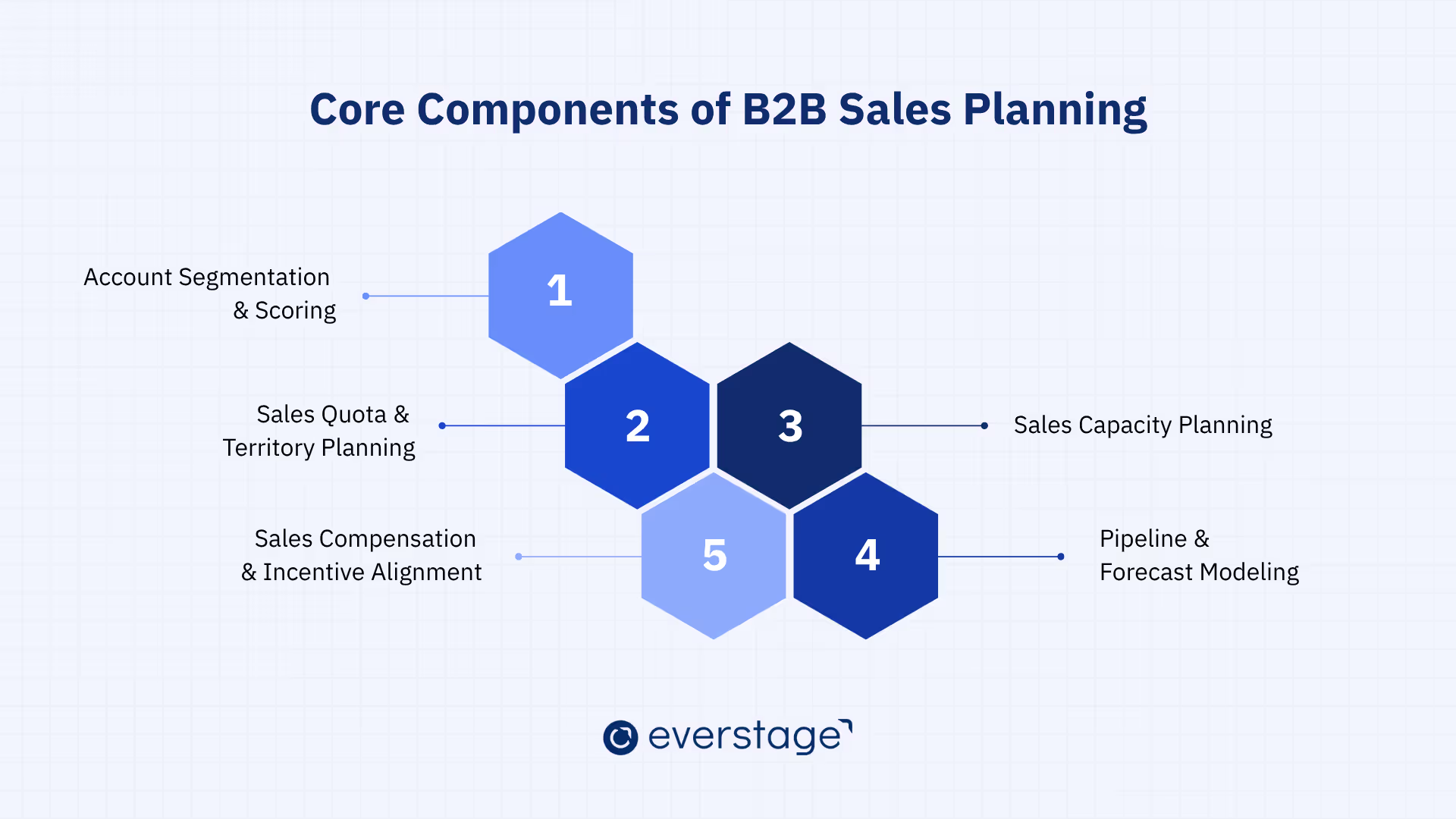
These five pillars form the architecture behind your revenue engine. Each one defines who to sell to, what to aim for, and how success gets measured.
1. Account Segmentation & Scoring
Account segmentation tells you which companies deserve your team's time. It groups companies by size and revenue potential. You then focus on high-value opportunities instead of chasing every lead.
Once you segment, add a layer of scoring. By analyzing firmographic and behavioral data, you rank accounts by buying intent and fit. That moves guesswork into data-backed precision. The best sales teams define their Ideal Customer Profile (ICP), who fits your solution, and Ideal Account Profile (IAP), who is ready to buy.
2. Sales Quota & Territory Planning
Once you know who to sell to, decide who covers what. Quota and territory planning give every rep a fair shot at success while maximizing market coverage.
The best teams use data-backed models. These models weigh historical performance against current rep capacity and account potential. Territories can split by geography, such as North America versus EMEA. Other teams split by vertical or company size. Everstage Planning helps teams design balanced, transparent territories and quota models that reflect both market potential and rep bandwidth.
RevOps takeaway: A strong process connects CRM data, territory models, and incentive plans in one operating rhythm. Teams then make changes inside one system instead of disconnected spreadsheets. For Finance, this keeps quota cost and payout impact visible during annual planning.
Planning quotas and territories in spreadsheets? See how Everstage Planning helps revenue teams create balanced territories and fair quotas with transparent workflows. Explore Everstage Planning
3. Sales Capacity Planning
Your sales team's productivity depends on one key variable: capacity. Sales capacity planning shows how much selling power you need to hit your revenue targets.
The math is straightforward: Capacity = (Number of reps × Average productivity per rep)
The real insight goes deeper. Ramp-up time and attrition each shift the number. McKinsey's global B2B Pulse study shows that capacity planning must stay flexible. Top-performing B2B companies keep investing in hybrid sales models and advanced sales technologies to stay agile in uncertain economic conditions.
Nearly 70% of market-share winners increased sales team investments year over year. Only 36% of laggards did the same. Winners treat uncertainty as a chance to strengthen their commercial engine. Connected planning lets RevOps and Finance model rep capacity, ramp time, and quota assumptions together. Headcount plans then reflect realistic attainment.
4. Pipeline & Forecast Modeling
Even the best plans fail without a strong forecasting process. Pipeline modeling is where projections meet reality. It predicts revenue from deal stages, conversion rates, and sales velocity.
A weighted pipeline model assigns probabilities to deals at each stage (like 25% for demos, 75% for proposals). This helps you create realistic revenue forecasts and spot bottlenecks early.
McKinsey's research also found that B2B winners orchestrate sales channels across the full funnel. They use predictive technology to connect marketing and sales data, prioritize leads, and automate forecasting. This orchestration reduces lost insights across long B2B cycles and improves accuracy in deal-stage forecasting.
5. Sales Compensation & Incentive Alignment
Incentive alignment completes sales planning. How you compensate reps shapes their behavior. It drives what they prioritize and whether they stay.
A well-designed compensation plan links performance to rewards. McKinsey found that hybrid and omnichannel teams outperform traditional ones when incentives align across every channel.
Sellers who manage digital, remote, and in-person engagements need balanced compensation. That balance rewards results across every channel and prevents overemphasis on one-off deals.
Here is where planning and performance meet. If quotas are unrealistic or incentives reward the wrong motions, even a well-designed sales plan fails in execution. For sales compensation leaders and Finance, the goal is a framework that balances fairness, transparency, and motivation. It rewards individual effort and team outcomes. Everstage connects incentive design with sales planning. Teams create transparent plans, reduce payout confusion, and keep reps focused on revenue-driving work.
Connect your sales plan to incentive execution
Everstage helps teams align quotas, territories, and compensation plans so reps know exactly what to do and how they'll be rewarded. Book a Demo
B2B Sales Planning vs. B2B Sales Plan: Key Differences
Many teams use the terms sales planning and sales plan interchangeably. They mean two different things. Understanding the difference separates strategic sales organizations from reactive ones.
How B2B sales planning compares with a B2B sales plan across purpose, owners, and outputs.
Connecting the planning process to the plan itself activates your B2B strategy. The planning phase sets direction, such as where to play and how to win. The sales plan turns that direction into measurable actions your team runs daily.
B2B Sales Planning Frameworks to Choose From
No single structure fits every B2B sales plan. The right model reflects your deal complexity and sales motion. Use this comparison to pick the framework that fits.
Five B2B sales planning frameworks with best-fit scenarios, inputs, KPIs, and risks.
B2B Sales Plan Template: What to Include
Copy this template as a skimmable structure. Each row defines a plan section, its owner, and how often to review it.
A section-by-section B2B sales plan template with owners, data sources, and review frequency.
B2B Sales Planning Checklist for 2026
- Confirm revenue targets and growth assumptions
- Segment accounts by ICP, potential, and coverage model
- Model capacity by role, ramp time, and productivity
- Design territories using opportunity and performance data
- Set quotas that reflect market potential and rep capacity
- Align incentives to strategic priorities
- Review monthly and adjust quarterly
Want to turn this checklist into a working plan? Use this framework to align quotas, territories, capacity, and incentives before the next planning cycle. Talk to Everstage
A quarterly sales planning cadence showing monthly review focus and owners.
How to Create a B2B Sales Plan Step by Step
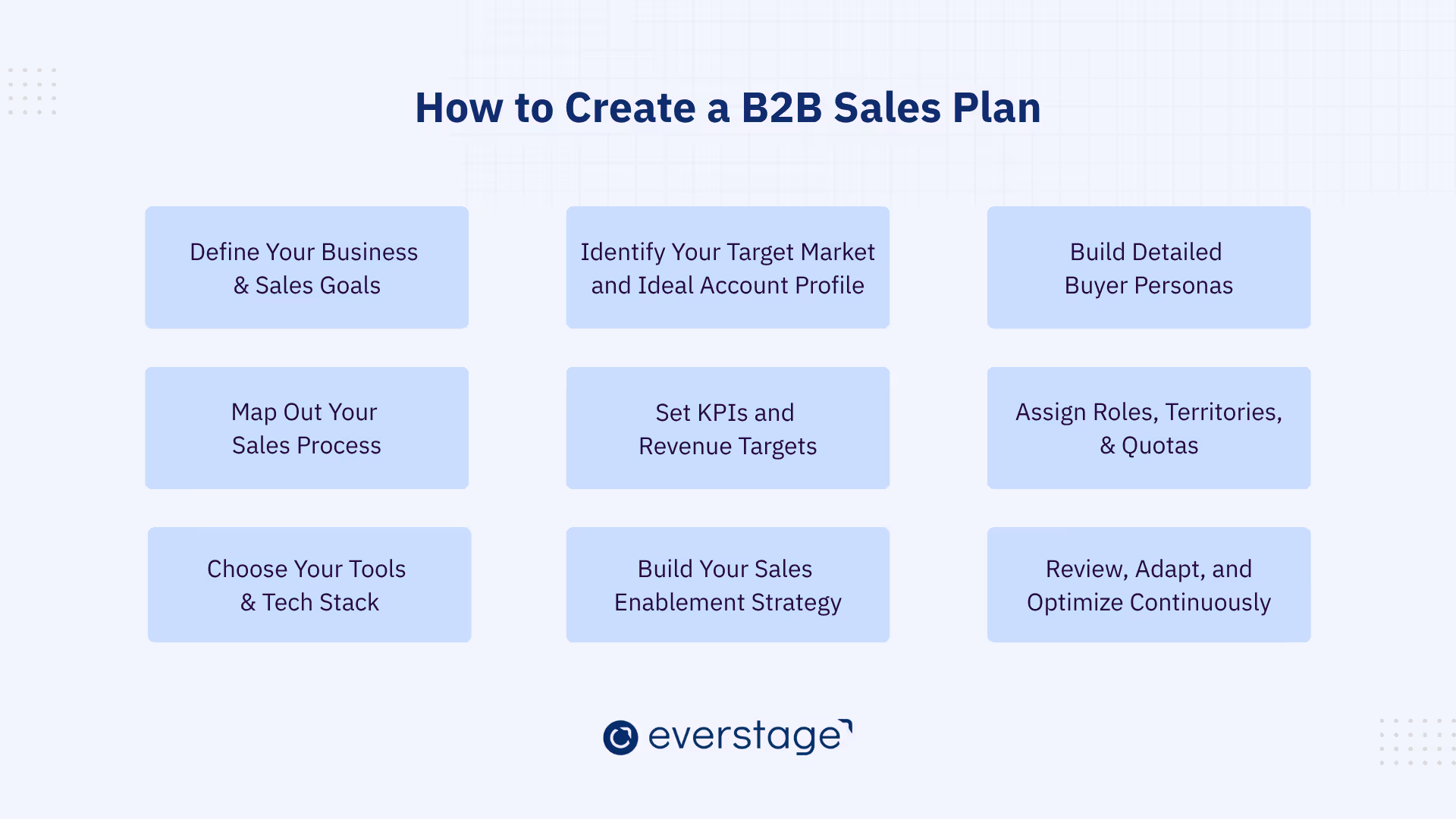
Building a B2B sales plan means turning ambition into a structured operating model. Here is how to create one step by step.
Step 1 – Define Your Business & Sales Goals
Every B2B sales plan starts with clear goals. Define the reason behind your targets, such as growing recurring revenue or entering new markets. McKinsey reports that best-in-class B2B sellers achieve up to 20% higher revenue gains by aligning goals and redefining go-to-market through hybrid sales models.
Take Action:
- Audit your existing goals: Are they measurable and tied to business outcomes, or just activity-based? Rewrite them using SMART criteria.
- Align with leadership: Confirm that your sales goals support company-wide objectives like growth and market share.
- Set tiered targets: Define company, team, and individual goals so everyone knows how their contribution drives the larger outcome.
Output: A revenue goal hierarchy that connects company targets to team quotas and individual rep expectations.
Step 2 – Identify Your Target Market and Ideal Account Profile (IAP)
Once your goals are clear, identify who you should sell to. Build an Ideal Account Profile (IAP) to target companies most likely to convert and stay loyal. Use firmographic and intent data to focus on high-fit accounts and build a more predictable pipeline.
Take Action:
- Define selection criteria: List 5–7 characteristics (industry, employee count, tech stack, budget) that describe your best customers.
- Leverage data tools: Use platforms like ZoomInfo or Apollo to validate account fit using real-time data and intent insights.
- Segment your accounts: Create Tier 1, Tier 2, and Tier 3 categories to prioritize effort and personalize outreach accordingly.
Output: A scored, tiered target account list mapped to your ICP and IAP.
Step 3 – Build Detailed Buyer Personas
Once you know your target accounts, identify who makes the decisions. Create a B2B buyer persona that captures each stakeholder's goals, pain points, and success metrics. Stakeholders include procurement, finance, and end users. Understanding their priorities turns generic pitches into problem-solving conversations.
Take Action:
- Interview real customers: Talk to your top clients to learn what influenced their buying decision and what objections they raised.
- Map the decision chain: Identify primary decision-makers, budget owners, and influencers for each account type.
- Create persona snapshots: Document each persona's goals, channels, and KPIs to guide personalized messaging.
Output: A set of persona snapshots covering each key stakeholder in the buying group.
Step 4 – Map Out Your Sales Process
Your B2B sales process bridges strategy and execution. It turns leads into customers. Define clear stages to keep the team aligned and coach reps effectively. The flow runs: Lead generation → MQL → SQL → demo → proposal → negotiation → closed-won.
Treat the process as a planning map, not just a pipeline. For each stage, define the planning inputs you need:
- Prospecting: Owner, target account list, activity volume, expected conversion to MQL.
- Qualification (MQL → SQL): Qualification criteria, stage duration, fit and intent scoring.
- Discovery: Stakeholder mapping, required enablement, pain-point validation.
- Solution presentation / demo: Conversion rate, forecast probability, content needed.
- Proposal & negotiation: Pricing rules, approval owners, win-rate benchmark.
- Closing & post-sale handoff: Forecast probability, contract steps, CS handoff owner.
Take Action:
- Document every stage: Write down what qualifies a lead to move from one stage to the next. Clarity eliminates confusion.
- Map tools to stages: Align CRM, email automation, and proposal software to each stage for smoother handoffs and tracking.
- Review regularly: Audit your pipeline monthly to spot bottlenecks and refine your process based on sales performance data.
Output: A stage-by-stage sales process map with conversion rates, owners, and forecast probabilities.
Step 5 – Set KPIs and Revenue Targets
After mapping your process, define how to measure success. Set clear KPIs and revenue targets so every rep knows what good looks like. Track metrics like conversion rate, deal size, and sales cycle length to drive accountability and forecast with confidence.
Planning goals matched to KPIs and recommended review frequency.
Take Action:
- Pick 4–6 measurable KPIs: Focus on metrics that truly influence revenue outcomes, not vanity numbers.
- Set realistic targets: Use past performance and market trends to create stretch goals that keep your team motivated instead of burned out.
- Track and share progress: Use dashboards or weekly reviews so every rep sees how their numbers impact company goals.
Output: A KPI dashboard with targets and review cadence shared across Sales, RevOps, and Finance.
Step 6 – Assign Roles, Territories, and Quotas
With targets set, assign ownership clearly. Define roles, territories, and quotas to ensure accountability and prevent overlap. Each rep should know their accounts and goals. A well-structured territory plan balances opportunity with capacity, making success a planned outcome.
Take Action:
- Clarify ownership: Define which salespeople or teams handle specific geographies or deal sizes.
- Use performance data: Assign quotas using past attainment rates, average deal sizes, and regional demand patterns.
- Visualize your map: Build a simple territory dashboard or chart to track coverage, overlap, and quota progress in real time.
Output: A territory and quota model that balances opportunity, capacity, and historical performance.
Step 7 – Choose Your Tools & Tech Stack
Your sales plan is only as effective as the systems behind it. The right sales tech stack helps you track leads, automate repetitive tasks, and surface what works. Integrating your CRM with marketing automation and analytics keeps data flowing and improves forecast accuracy.
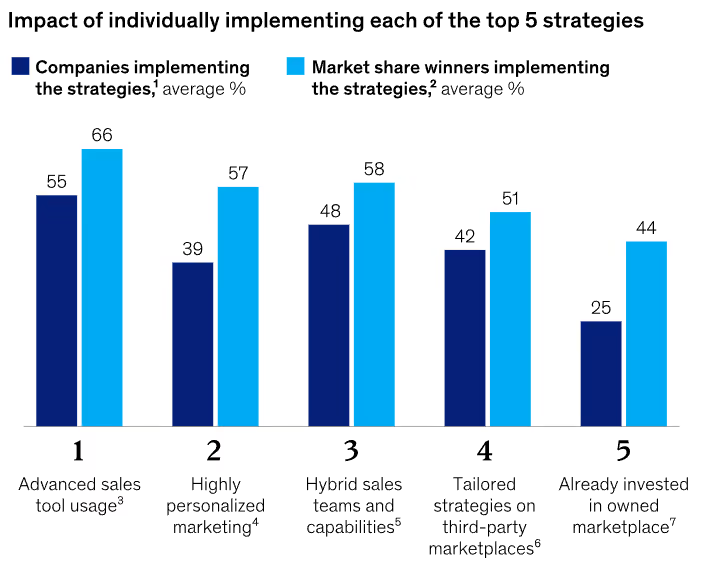
Build your planning tech stack by function. Evaluate each tool on integration, data quality, and ease of adoption:
- CRM: The system of record for accounts, pipeline, and activity.
- Forecasting: Predictive and weighted pipeline modeling.
- Territory planning: Balanced coverage and account assignment.
- Compensation planning: Quota-to-incentive alignment and payout modeling.
- Sales engagement: Outreach sequencing and activity tracking.
- Enablement: Centralized content, playbooks, and training.
- Analytics: BI dashboards tying metrics back to revenue.
- Data enrichment: Firmographic, technographic, and intent data.
Take Action:
- Audit your current stack: Identify tools that overlap or create data silos.
- Prioritize integration: Choose platforms that sync easily across sales, marketing, and customer success.
- Invest in enablement: Train your team on how to use each tool effectively to get full ROI from your stack.
Output: A connected, function-based tech stack with clear ownership and integration mapping.
Step 8 – Build Your Sales Enablement Strategy
A sales plan works only if your team can execute it. Sales enablement gives reps the tools, training, and content to sell effectively. Beyond onboarding, it gives continuous support through playbooks and product updates. That support drives confident, faster-closing conversations.
Strong enablement is content-led and role-based. Map content to each buyer-journey stage and set a coaching cadence. Track which assets actually move deals forward.
Take Action:
- Create a content hub: Centralize sales decks, case studies, and one-pagers so reps can access them instantly.
- Train continuously: Schedule monthly learning sessions focused on product updates, objection handling, and storytelling.
- Track usage and impact: Use your CRM to measure which enablement assets actually help deals progress.
Output: A buyer-stage content map and coaching cadence tied to enablement asset performance.
Step 9 – Establish Review & Feedback Loops
A B2B sales plan should improve over time instead of sitting idle. Regular reviews and feedback loops help you spot wins and fix gaps. Run pipeline check-ins and quarterly retros to adapt from data. Your strategy stays sharp and aligned with real results.
Take Action:
- Schedule consistent reviews: Hold monthly pipeline and quarterly strategy meetings to track progress and identify gaps.
- Create open feedback channels: Encourage reps and managers to share what is blocking deals or improving win rates.
- Use dashboards for visibility: Track metrics in real time so insights drive faster, evidence-based decisions.
Output: A recurring review rhythm with documented adjustments to quotas, territories, and messaging.
B2B Sales Plan Example in Action
Here is a simplified example for a B2B SaaS team that shows the planning logic end to end.
Scenario: A mid-market SaaS company targets $12M in new ARR for 2026, with an average deal size of $30K and a 25% win rate.
- Revenue goal: $12M new ARR → 400 closed-won deals needed.
- Pipeline requirement: At a 25% win rate, the team needs ~1,600 qualified opportunities and roughly 4x pipeline coverage ($48M in pipeline).
- Capacity: If each ramped AE closes ~$1M ARR annually, the team needs ~12 fully ramped reps, plus buffer for ramp time and attrition.
- Territories: Split coverage across North America (60%), EMEA (25%), and APAC (15%) based on opportunity density.
- Quotas: Assign $1.1M quota per ramped AE (overassignment to ~110%) to protect against shortfalls.
- Activities & KPIs: Track pipeline coverage weekly, quota attainment and cycle length monthly, forecast accuracy quarterly.
- Review cadence: Monthly pipeline reviews, quarterly retros to rebalance territories and quotas.
A sample action plan across roles keeps execution tight:
- Sales leaders: Quarterly review of attainment, capacity, and territory balance.
- Sales managers: Monthly coaching on pipeline health and conversion.
- RevOps: Weekly monitoring of pipeline coverage and CRM data quality.
- Reps: Weekly pipeline updates, prioritizing high-fit accounts and logging activities.
Common B2B Sales Planning Mistakes and How to Fix Them
Even strong teams stumble on the same planning traps. Here are the most common ones and how to fix each.
Common B2B sales planning mistakes, warning signs, and recommended fixes.
Why Spreadsheet-Based Sales Planning Breaks Down
Spreadsheets work when teams are small. As territories, quotas, and payout rules multiply, manual planning creates version-control issues and delayed approvals. Trust in the final numbers drops.
Connected planning lets revenue teams model quota, territory, and incentive changes in one workflow before they reach the field. RevOps and Finance get fewer reconciliation cycles and more confidence in the plan.
Customer proof: See how revenue teams use Everstage to improve planning transparency, incentive execution, and sales performance workflows.
Explore Everstage customer stories.
B2B Sales Planning Best Practices for 2026
Blend strategy fundamentals with forward-looking methods to keep your B2B sales plan relevant and high-performing.
1. Persona & Strategy Alignment with Marketing (ABM/ABS)
Sales and marketing alignment is the foundation of effective B2B planning. Integrate Account-Based Marketing (ABM) to target high-value accounts with coordinated messaging. Adopt Account-Based Selling (ABS) for hyper-segmented personalization. When both teams share audience insights, campaigns get sharper and deal sizes grow.
2. Data-Driven Strategy & Metrics Tracking
Leverage real-time data to spot trends, like how early demos accelerate closes or which segments deliver higher ACV. Track metrics such as conversion rate, deal velocity, and revenue by segment. Use dashboards to translate analytics into decisions that guide reps daily.
3. Omnichannel & Digital Enablement
Meet buyers where they are. Combine omnichannel outreach across email, social, and phone with AI personalization. You scale engagement while keeping a human touch. Enable digital tools and e-commerce portals to streamline low-touch transactions and reduce friction in the buying process.
4. Continuous Coaching & Sales Enablement
Equip your reps for success beyond onboarding. Build an enablement program that includes ongoing training, real-time feedback, and current sales assets. Regular coaching sessions and micro-learning improve confidence and win rates.
5. Adaptive Planning & Agile Review Loops
Keep your sales plan flexible. Set quarterly and monthly review cycles to evaluate what works. Use the insights to adjust quotas, messaging, and territory assignments. Agile feedback loops keep your team responsive to market signals and customer behavior.
How to Align Your Sales Plan With the Buyer Journey
Your internal sales process should mirror how buyers actually make decisions. Map your plan, content, and enablement to each buyer-journey stage:
- Problem awareness: Educational content and outbound that surfaces pain.
- Evaluation: Comparison content, ROI proof, and tailored demos.
- Stakeholder consensus: Multi-threaded outreach for procurement, finance, and end users.
- Negotiation: Pricing guardrails, approval workflows, and value reinforcement.
- Post-sale expansion: Onboarding, renewal, and upsell motions.
For long B2B cycles with multiple decision-makers, plan for digital-first engagement and longer nurture so forecasts reflect realistic timelines.
How to Evaluate and Improve Your B2B Sales Plan
A plan improves only when you audit it consistently. Evaluate performance using pipeline coverage, quota attainment, and win rate. Layer in forecast accuracy, CRM hygiene, and customer feedback.
Use this review checklist:
- Forecast accuracy vs. actuals
- Quota attainment by rep and segment
- Pipeline coverage ratio
- Territory balance and coverage gaps
- Rep capacity and ramp progress
- CRM data quality and hygiene
- Enablement asset usage
- Compensation alignment with strategy
The Future of B2B Sales Planning: AI, Automation, and Predictive Analytics
B2B sales planning is becoming adaptive and AI-driven. Automation and predictive analytics now enable real-time forecasting and smarter resource allocation. Modern strategies shift continuously with market changes and buyer intent, instead of sitting in static quarterly plans.
The future of sales planning is connected planning. Today many teams update quotas, territories, and incentives in separate tools. Revenue teams will increasingly use integrated systems across CRM, HRIS, and compensation workflows. These systems model the impact of every change before it reaches the field.
1. AI-Driven Forecasting and Real-Time Adjustments
Artificial intelligence is quickly becoming the foundation of modern sales planning. McKinsey reports that companies investing in AI see 3% to 15% revenue uplift and a 10% to 20% sales ROI uplift.
AI tools now process CRM data and market signals to adjust quotas, territories, and forecasts continuously. This shift reduces human bias and helps teams respond faster to demand changes.
2. Automated Territory Mapping and Resource Optimization
Manual territory design is giving way to intelligent mapping systems that analyze revenue potential, account density, and rep productivity in real time.
With automation, you can ensure fair distribution of opportunities and avoid over- or under-resourcing in specific markets, improving both morale and results. For RevOps and Finance teams, the real advantage is less manual reconciliation between territory models, quota assumptions, and incentive plans.
3. Predictive Analytics for Rep Performance
Predictive models can now evaluate factors like deal velocity, engagement rates, and product mix to forecast individual rep performance. Bain & Company notes that early adopters of predictive analytics in sales see up to 30% higher win rates and better rep retention.
These insights enable proactive coaching and smarter incentive design. They turn planning from a backward-looking exercise into a forward-focused advantage.
Build a Living Sales Operating System for Better Results
The best B2B sales plans are living operating systems, not static documents. They keep revenue goals, territories, and incentives aligned as conditions change.
Strategy alone falls short. Execution drives growth. Everstage helps revenue teams move from spreadsheet-based planning to connected execution. With Everstage Planning and Incentives, teams design fair territories, set transparent quotas, and give reps clarity on how to win.
Ready to turn sales planning into predictable revenue? Book a demo with Everstage.
Questions worth asking
The things most people want to know before they commit.
How is B2B sales planning different from B2C sales planning?
B2B sales planning involves longer buying cycles, multiple decision-makers, and relationship-driven strategies. In contrast, B2C focuses on high-volume, emotion-led purchases. B2B plans prioritize account segmentation, quotas, and territory alignment to maximize long-term value rather than short-term conversions.
How should B2B sales planning account for long sales cycles and multiple decision-makers?
Build your plan around the buyer journey, not just internal stages. Map content and outreach to problem awareness, evaluation, stakeholder consensus, negotiation, and post-sale expansion. Plan for multi-threaded engagement across procurement, finance, and end users. Set forecast probabilities that reflect realistic timelines so forecasts stay accurate for long, multi-stakeholder deals.
How often should a B2B sales plan be reviewed or updated?
Review your plan quarterly, with monthly pipeline check-ins. Markets shift quickly, and product cycles and competitor actions change with them. Regular reviews keep your strategy agile and grounded in reality.
How do you measure whether a B2B sales plan is working?
Measure plan performance using pipeline coverage, quota attainment, win rate, sales cycle length, and forecast accuracy. Layer in CRM data quality, closed-lost analysis, and customer feedback. If attainment is consistent, forecasts are accurate, and territories stay balanced, the plan is working. If not, those metrics tell you exactly where to adjust.
What is the difference between a B2B sales business plan and a B2B sales action plan?
A B2B sales business plan covers market opportunity, revenue model, go-to-market assumptions, resources, and financial projections. A B2B sales action plan is tactical, defining short-term execution tasks, owners, deadlines, and KPIs. The business plan sets direction; the action plan turns it into day-to-day execution.
Can small B2B businesses benefit from structured sales planning?
Absolutely. A clear plan helps small teams focus on high-value accounts and allocate resources wisely. Even a lean version with quarterly targets and defined responsibilities reduces chaos and boosts revenue consistency.