
.avif)
TL;DR
- A sales performance review helps RevOps and sales leaders evaluate reps. It draws on quota attainment and pipeline data, plus deal quality and compensation records.
- The strongest reviews are data-backed and frequent. They tie to clear coaching actions instead of annual-only formalities.
- Use CRM and compensation data to find the real drivers of performance gaps. Common causes include territory design and quota allocation.
- Connect review insights to coaching plans and quota planning. These decisions improve future revenue execution.
- Follow up monthly or bi-weekly so performance issues are addressed before quarter-end compounds them.
- Track metrics like quota attainment and revenue growth. Conversion rate and deal size matter too. Add retention and activity data for the full picture.
Every quarter close raises the same question for sales leaders. Did reps miss targets because of skill gaps or pipeline quality? Territory coverage and quota design can also play a role.
A sales performance review answers that question with data. It gives managers a structured way to evaluate quota attainment and sales activity. Reviews also cover deal quality and development needs while aligning teams with business goals.
Many sales teams face rising pressure to perform. According to the RepVue Cloud Sales Index Q4 2024 report, average quota attainment was around 40%-44%.
Low quota attainment often signals more than a rep-performance problem. It can point to issues with territory design or quota allocation. Compensation plans and pipeline coverage also shape the result. That is why high-performing revenue operations teams review sales performance using both activity data and incentive data.
The fix is a structured sales performance review. It helps leaders evaluate quota attainment and sales activity with data instead of guesswork. Reviews also surface deal quality and development needs.
This guide walks you through the step-by-step process of running effective sales performance reviews. You will learn why reviews matter and how to evaluate performance accurately. You will also build development plans that help your team grow.
What Is a Sales Performance Review?
A sales performance review is a structured evaluation of how effectively a rep or team performs against defined revenue goals. It considers quota attainment and pipeline contribution. The review also weighs deal quality and skill development.
A general employee review covers broad responsibilities like communication and project delivery. A sales performance review connects directly to revenue outcomes and incentive plans.
It assesses factors like quota attainment and deal conversion rates. The review also weighs skills like negotiation and product knowledge. Sales-specific KPIs give the review targeted feedback. Reps use it to refine techniques and strengthen client interactions.
In a modern revenue organization, the review connects quota progress and payout visibility. It links incentive-plan performance with manager coaching. Teams then spot what drives or blocks revenue and turn that insight into improvements.
How Often Should Sales Performance Reviews Happen?
A sales performance review works on more than an annual cadence. Formal reviews happen quarterly or annually, supported by monthly or bi-weekly check-ins that track progress in real time.
For quota-carrying teams, quarterly reviews work best. They align performance and incentive conversations before issues compound. Use the cadence table below to choose the right format for your management goals.
Review formats, cadences, and the teams best suited to each.
Why Sales Performance Reviews Matter
Effective sales performance reviews do more than track metrics. They align your team's efforts with company goals. They also motivate improvement and consistent development.
Here's why sales performance reviews matter:
1. Clarifies Expectations and Benchmarks for Success
A sales performance review provides a structured framework for defining success and aligns individual goals with organizational objectives.
When salespeople receive structured feedback on past performance, they gain insight into where they excel and where they need improvement. That understanding helps them adjust focus and align efforts with company objectives.
According to McKinsey, companies that focus on employee performance are 4.2 times more likely to perform better than others. They also report an average 30% higher revenue growth and a 5-point lower attrition rate.
2. Boosts Engagement and Retention
Salespeople thrive on recognition. Performance reviews give managers a chance to acknowledge achievements. Recognition during reviews creates a positive work environment and leads to higher morale and stronger retention.
Sales performance reviews also provide a space for coaching and guidance. That lets managers work with employees on specific areas for development.
A mix of recognition and coaching enhances employee engagement.
3. Drives Continuous Improvement in Technique
Frequent performance reviews serve as a critical tool for identifying gaps in a salesperson's skills and techniques. These reviews help managers pinpoint areas for improvement, like refining sales techniques or improving product knowledge.
Just as an athlete adjusts their technique after each performance, salespeople benefit from frequent reviews that highlight areas for improvement. Constructive feedback lets salespeople take immediate action and fine-tune their approach.
Sales teams can also run a brainstorming session and hone their skills based on the evaluation. That helps them adapt to shifting customer needs and reach their goals.
4. Turns Feedback into Actionable Growth Opportunities
Only 16% of employees report that their last conversation with a manager was extremely meaningful. A sales performance review closes that gap.
The most effective reviews turn feedback into actionable growth opportunities. Instead of pointing out what went wrong, reviews provide a roadmap for improvement.
The process also encourages employees to own their development and builds accountability. For example, instead of general feedback like "improve client engagement," managers can suggest concrete actions, such as "schedule follow-up meetings after each demo" or "personalize email outreach based on client data."
That level of specificity shows salespeople exactly which actions improve performance. When feedback is actionable, employees can track progress and make improvements more easily.
5. Connects Performance, Quotas, and Incentives
Sales performance reviews work best when they connect rep activity to quota attainment and incentive outcomes. It helps leaders see whether issues come from rep behavior or pipeline quality. Territory coverage and plan design can also be the cause. It also gives reps more transparency into how their actions affect both earnings and revenue outcomes.
How to Conduct a Sales Performance Review Step by Step
Conducting a sales performance review involves more than looking at numbers. It involves several steps, from defining sales goals to collecting data. Later steps include coaching and monitoring progress.
This section covers how to evaluate sales performance, step by step:
1. Define Sales Goals & KPIs
The first step in a successful sales performance review is to define clear, measurable goals. Without these, the review becomes subjective and fails to provide tangible direction. Sales goals should align with company objectives so every team member works toward the same targets.
Key metrics to define:
- Quota attainment: Did the salesperson meet or exceed their target sales goals?
- Revenue growth: How much revenue did they generate over the review period?
- Conversion rate: What percentage of leads turned into actual sales?
- Customer acquisition cost (CAC): How much did it cost to acquire each new customer?
- Sales cycle length: How quickly are they closing deals?
Once the KPIs are set, communicate them clearly so they stay achievable and aligned to the broader company strategy. For example, if a sales rep needs to close 20 deals within a quarter, the target should be measurable and within their capability.
2. Gather Data & Feedback
Data gathering is a critical part of the sales performance evaluation process. Pull data from your CRM and commission platform. Add sales engagement tools and customer systems. Review performance data alongside incentive data. Capture quota attainment and commission earned. Track payout accuracy and pipeline contribution. Check accelerators triggered and any quota-crediting disputes.
Certain CRM data points carry more weight in reviews. These include sales velocity and win rate. Average deal size and deal loss reasons also help.
These numbers are essential for measuring success against business objectives.
Feedback from peers and customers adds depth to the review. A rep self-assessment deepens it further. Peer feedback shows how well the salesperson collaborates with the team or handles internal challenges.
Combining self-assessment with peer and customer insights sharpens the evaluation and surfaces areas to improve.
Pre-review data checklist:
- CRM data: pipeline value, win rate, deal stages, and loss reasons
- Quota and attainment data against variable compensation targets
- Commission and payout data, including accelerators and disputes
- Activity data: calls, emails, and meetings
- Peer feedback and customer feedback
- Rep self-assessment
- A prepared agenda and follow-up plan
3. Prepare a Sales Performance Review Template
A well-structured evaluation document is essential for consistency and clarity. It gives a clear view of how the evaluation runs and which areas need focus.
An evaluation document consists of the following key steps:
- Start with sales metrics like quota attainment and revenue generated. Add conversion rates and sales cycle length. These figures form the foundation of the review.
- Next, assess skills like product knowledge and communication. These soft skills drive long-term success and reveal gaps that raw numbers miss.
- Use feedback from peers and clients to gain insight into interpersonal dynamics and overall effectiveness.
- Finally, set SMART development goals (Specific, Measurable, Achievable, Relevant, Time-bound). Outline action steps through training or mentorship.
4. Conduct the Review Meeting
The review meeting is where you deliver feedback and discuss growth opportunities. You also create development plans together. The key to a successful meeting is an open, two-way conversation. A positive, constructive approach helps the salesperson feel supported instead of criticized.
Follow these best practices to conduct a review meeting:
- Start with positives: Acknowledge achievements and strengths. Recognizing wins, like exceeding quota or improving client relationships, sets a positive tone.
- Review quantitative data: Discuss the KPIs and where the rep succeeded or fell short. Focus on sales quotas and conversion rates.
- Share qualitative feedback: Offer insights from peers and clients. Touch on communication and team collaboration.
- Encourage feedback: Allow the salesperson to share their perspective on their performance. What challenges did they face? What could have gone better?
5. Create an Action Plan and Schedule Follow-Ups
After the review meeting, move beyond simply discussing performance. A sales performance review should improve the next sales cycle, beyond summarizing the previous one. Use the findings to adjust quota allocation and territory coverage. Refine compensation plans and coaching priorities.
Start by addressing process inefficiencies, such as streamlining lead qualification or automating repetitive tasks to reduce sales cycle length. Reevaluate your target audience so you focus on the right customer segments. Adjusting your Ideal Customer Profile (ICP) can improve lead quality and conversion.
Data from Gartner also notes that almost 90% of sellers feel burned out at work. Hence it is essential to keep every salesperson's workload balanced.
Revenue and sales operations teams face a bigger challenge than a quarterly evaluation. They must keep quota and payout data accurate all period. Platforms like Everstage help teams centralize performance data and automate quota assignment. They model incentive plans and give managers real-time visibility into whether reps and territories are on track.
Sales Performance Review Strategies That Drive Better Outcomes
The best sales performance reviews do more than summarize past activity. They help revenue teams identify what to fix before the next performance period begins.
1. Use real-time quota and pipeline data
Identify attainment risk before quarter-end. Review quota progress and pipeline coverage throughout the period. Track deal quality and forecast changes so managers intervene earlier.
2. Separate rep performance from territory or quota-design issues
If multiple reps miss the same target, the issue may sit in territory coverage or quota allocation instead of individual effort. Use reviews to isolate the real cause before assigning blame.
3. Connect review outcomes to coaching plans
Translate findings into specific coaching goals and activity targets. Reps then know exactly what to improve next.
4. Review incentive effectiveness, not just rep activity
If reps prioritize the wrong deals or behaviors, the issue may sit in the incentive plan. Use reviews to check whether commission structures encourage the revenue outcomes the business needs.
5. Use consistent scorecards across teams
Standardized templates and scorecards reduce bias. They make it easier to calibrate performance fairly across managers and territories.
6. Follow up monthly instead of waiting for annual reviews
Schedule monthly or bi-weekly check-ins so issues are addressed before they compound. Continuous feedback keeps reps on track and reduces quarter-end surprises.
Sales Performance Review Template: What to Include
A reusable template keeps reviews consistent and captures every important detail. Use the structure below as a copy-ready framework for each rep.
Sections to capture in a reusable sales performance review template.
Sales Performance Review Examples by Evaluation Area
Concrete examples make feedback easier to deliver and easier to act on. Pair a positive observation with an improvement note and a measurable action for each area.
- Quota attainment: Positive, "You hit 118% of quota this quarter." Improvement, "Two large deals slipped; tighten close plans." Action, "Build a mutual close plan for every deal over $25K."
- Customer relationship-building: Positive, "Clients consistently mention your responsiveness." Improvement, "Expand relationships beyond your single champion." Action, "Map and engage three stakeholders per account."
- Pipeline management: Positive, "Your pipeline coverage is healthy at 3.5x." Improvement, "Several deals are stalling in late stages." Action, "Review aging opportunities weekly and define next steps."
- Product knowledge: Positive, "You handle technical questions confidently." Improvement, "Strengthen competitive positioning." Action, "Complete competitive battlecard training this month."
- Time management: Positive, "You maintain consistent activity levels." Improvement, "Too much time on low-value prospects." Action, "Prioritize accounts that fit the ICP scoring model."
- Sales presentation skills: Positive, "Your demos clearly tie features to value." Improvement, "Tailor presentations more to each buyer." Action, "Customize at least two slides per discovery insight."
- Collaboration: Positive, "You share wins and learnings with the team." Improvement, "Loop in solutions engineering earlier." Action, "Engage SE support before the technical evaluation stage."
- Objection handling: Positive, "You stay composed under pricing pressure." Improvement, "Reframe value before discounting." Action, "Practice value-based objection responses in role-play."
Sales Performance Review Questions to Ask Reps
The right questions turn a review into a two-way conversation. Use these prompts to encourage self-reflection and surface blockers managers might miss.
- Self-assessment: What are you most proud of this period? Where did you fall short of your own expectations?
- Wins and challenges: Which deals went well and why? What blocked the others?
- Pipeline quality: How confident are you in your current pipeline? Where are the biggest risks?
- Lost deals: What patterns do you see in deals you lost? What would you do differently?
- Customer conversations: What are customers telling you about our product, pricing, or competitors?
- Skill gaps: Which skills would most improve your results? Where do you want to grow?
- Coaching needs: What support do you need from me to hit your next target?
- Process blockers: What slows you down that needs my help to fix?
- Future goals: What do you want to achieve next quarter and over the next year?
What Key Sales Performance Metrics Should I Evaluate?
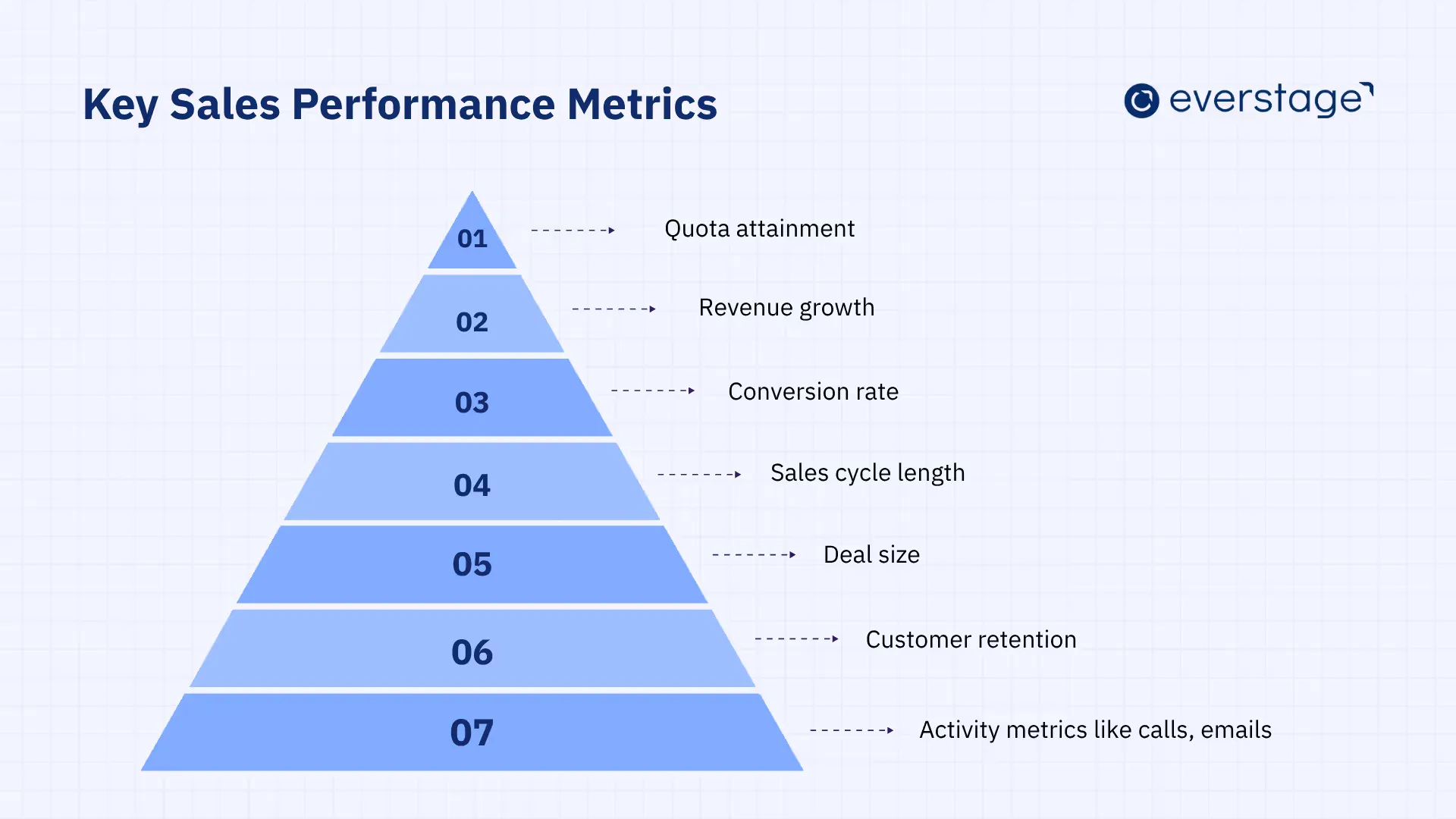
A thorough sales performance review weighs several metrics together for a complete assessment.
Below are the most important metrics to evaluate, with clear explanations and examples to guide your assessments.
Core sales metrics with formulas and the coaching or compensation actions they inform.
1. Quota Attainment
Quota attainment is one of the most direct ways to measure a salesperson's success. It refers to how much of their sales target (quota) they met or exceeded within a given period.
Formula: Quota Attainment (%) = (Actual Sales / Sales Quota) × 100 So if a salesperson's target for the month is $50,000 and they bring in $60,000, their quota attainment is 120%.
What to look for: If quota attainment stays low across a team, the issue likely extends beyond individual performance. It may point to unrealistic quotas or poor territory coverage. Thin pipeline and misaligned incentives also factor in.
2. Revenue Growth
Revenue growth measures the increase in revenue an individual or team generates over a specific period. This metric shows the broader impact of the salesperson's efforts on company finances.
Formula: Revenue Growth (%) = [(Current Period Revenue - Previous Period Revenue) / Previous Period Revenue] × 100
If a salesperson generated $100,000 in Q1 and $120,000 in Q2, the revenue growth for Q2 would be: Revenue Growth (%) = [(120,000 - 100,000) / 100,000] × 100 = 20%
What to look for: Evaluate growth against quota and territory potential within market context.
3. Conversion Rate
The conversion rate measures how effectively a rep turns leads into paying customers. It reflects the salesperson's ability to qualify prospects and close deals.
Formula: Conversion Rate (%) = (Deals Closed / Leads Generated) × 100
A high conversion rate signals strong skills like lead qualification and negotiation. A low conversion rate might point to inefficiencies in the sales process or weak lead qualification.
What to look for: Low conversion may indicate lead-quality or messaging issues. Sales-process gaps and coaching needs can also play a part.
4. Sales Cycle Length
The sales cycle length measures the average time a lead takes to move from initial contact to a closed deal. This metric helps identify bottlenecks in the sales process.
Formula: Sales Cycle Length = Total Time for Deals Closed / Number of Deals Closed
If a salesperson closes 10 deals over 120 total days, the average sales cycle length would be 12 days.
What to look for: Check that incentive plans reward deal quality alongside speed.
5. Deal Size
Deal size refers to the average value of the sales a rep makes. Larger deals typically show the ability to close higher-value contracts or upsell existing clients.
Formula: Average Deal Size = Total Sales Revenue / Number of Deals Closed
Tracking deal size shows the types of deals a salesperson closes. Larger deals may reflect success selling premium products. Smaller deals could signal a need for coaching on upselling or targeting higher-value prospects.
Compensation lens: If reps consistently prioritize smaller deals, review whether the incentive plan rewards deal volume over strategic revenue quality.
6. Customer Retention Rate
Customer retention measures how well salespeople maintain relationships with existing clients. This matters for building long-term partnerships and ensuring steady revenue.
Formula: Customer Retention Rate (%) = [(Number of Customers at End of Period - New Customers Acquired) / Number of Customers at Start of Period] × 100
A high retention rate indicates strong relationship-building and customer satisfaction, which keeps a loyal customer base intact. Low retention may point to weak customer service or a need to improve the product.
7. Activity Metrics (Calls, Emails, Meetings)
Tracking calls and meetings shows a rep's activity and engagement with prospects. These metrics signal effort, even though effort alone rarely guarantees results.
A rep who makes 200 calls and books 30 meetings shows clear activity. But what if conversions stay low?
Fewer, well-targeted interactions that generate quality opportunities demonstrate efficiency on the sales team.
Effective reviews balance quantity with quality. They pair activity data with outcome metrics like conversion rates and revenue. This recognizes salespeople for working smart and driving results, beyond raw effort.
Also Read: What is Sales Quota Attainment?
Key Performance Areas to Review Beyond Sales Metrics
Quantitative metrics show what closed. Qualitative performance areas explain whether results are repeatable. A balanced review evaluates both the outcomes and the behaviors that drive them.
- Communication and discovery skills: How well does the rep surface needs and articulate value?
- Negotiation and objection handling: Can the rep protect margin and reframe value under pressure?
- Product knowledge: Does the rep handle technical and competitive questions confidently?
- CRM hygiene: Is pipeline data accurate and current?
- Time management: Is the rep prioritizing high-value, ICP-fit accounts?
- Collaboration: Does the rep engage solutions engineering, marketing, and CS effectively?
- Customer relationships: Are relationships broad and durable across multiple stakeholders?
- Ownership of development: Does the rep proactively seek feedback and improve?
Common Sales Performance Review Mistakes to Avoid
Reviews create value when feedback turns into measurable improvement. Avoid these common mistakes that weaken the process.
1. Reviewing only revenue, not pipeline quality
Revenue tells you what closed. Pipeline quality tells you whether performance is repeatable. Review deal source and stage progression alongside closed-won revenue. Track conversion rates and pipeline coverage too.
2. Ignoring quota fairness and territory context
If you evaluate attainment without considering territory coverage and quota design, you risk blaming reps for structural problems. Always review performance in context.
3. Waiting until year-end to give feedback
Surprising reps with criticism months after the fact erodes trust. Use monthly or bi-weekly check-ins so feedback stays timely and actionable.
4. Relying on subjective feedback without data
Vague feedback like "be more proactive" is hard to act on. Ground every observation in CRM and outcome data.
5. Separating performance reviews from compensation outcomes
Quota attainment and deal quality often influence commissions and bonuses. If performance and payout data live in separate systems, reviews can become subjective or disputed. Connecting reviews to sales compensation data keeps them objective.
6. Failing to document action plans
Without documented goals and follow-up dates, reviews become one-off conversations that lack accountability. Always capture next steps and revisit them.
Building a Repeatable System for Performance and Accountability
Sales performance reviews are most valuable when they go beyond a routine manager-rep conversation. They show leaders what drives quota attainment and where reps need coaching. They also reveal whether territories and incentive plans support the right behaviors.
Combining quantitative metrics with qualitative feedback and compensation insights turns reviews into a repeatable system for improving performance.
As a leader, you ensure the review process empowers your team and builds accountability.
Want to connect sales performance reviews with quota and commission data? Book a demo to see how Everstage helps teams track attainment and improve payout visibility.
Questions worth asking
The things most people want to know before they commit.
What is the connection between sales performance reviews and compensation?
Sales performance reviews and compensation connect closely. Quota attainment and revenue contribution often determine commissions and bonuses. When performance data and commission calculations live in separate systems, reviews can become subjective or disputed. A sales performance management platform connects performance metrics and incentive payouts in one transparent workflow.
What is the role of sales managers in a performance review?
Sales managers assess individual performance, provide constructive feedback, and help set actionable development goals. They guide the team, align personal objectives with company goals, and offer support like training to improve overall sales effectiveness.
How often should sales performance reviews be conducted?
Formal sales performance reviews happen quarterly or annually, with monthly or bi-weekly check-ins to track progress in real time. For quota-carrying teams, quarterly reviews work best. They align performance and incentive conversations before issues compound.
What is the difference between a quarterly and annual sales performance review?
A quarterly review focuses on near-term performance and pipeline health. Managers can course-correct quickly on incentive alignment. An annual review takes a broader view of overall performance and career development. Most high-performing teams use quarterly reviews supported by monthly check-ins, reserving annual reviews for strategic planning.
How do you handle underperformance in a sales performance review?
Start by identifying the root cause. It could be a skill gap or a quota-design issue. Then create a structured improvement plan with coaching goals and activity targets. Add enablement resources and measurable timelines, supported by frequent check-ins.
Should sales performance reviews include soft skills?
Yes. Soft skills like communication and customer relationship management matter. Measure them through feedback from peers and clients, plus self-assessments.