

.avif)
TL;DR
- Incentive pay is variable compensation tied to individual or company performance, separate from fixed base pay.
- Common sales incentive structures include commissions and accelerators, plus SPIFFs and profit-sharing.
- Effective plans need clear eligibility and measurable metrics, plus transparent payout rules and reliable calculations.
- Incentive pay works best when outcomes are measurable and reps can influence the results.
- Manual incentive management can create payout delays and disputes that erode rep trust.
What is Incentive Pay?
Incentive pay is a performance-based compensation system that motivates employees by linking rewards directly to their achievements. In sales compensation, it appears as commissions and accelerators tied to revenue behaviors like closing deals or expanding accounts.
Incentive programs that combine financial rewards with recognition drive significant employee engagement and productivity.
For example, Blueberry Pediatrics saw an 89% participation rate in employee programs after adopting an incentive platform. Peer-to-peer recognition increased acknowledgment by 30 times.
Incentive pay stays variable and ties to specific goals or milestones, separate from fixed salary. This pays reps for the behaviors the business wants to scale, like closing strategic deals or expanding key accounts.
Incentive pay takes several forms, including commissions and profit-sharing plans. Businesses tailor the structure to different roles and industries.
Why Incentive Pay Matters for Sales Compensation Teams
Incentive pay links plan design to payout accuracy and rep motivation. A well-designed system helps reps know what to do and helps managers coach the right behaviors. Finance teams forecast variable compensation with more confidence.
- Sales Ops can align incentives with quota and territory strategy.
- Finance can control variable compensation spend and improve payout accuracy.
- Revenue leaders can use incentives to guide behavior toward strategic goals.
- Reps can track earnings transparently and trust their payouts.
Incentive Pay vs Base Pay vs Bonus Pay
A compensation plan combines base pay and incentive pay, alongside bonus pay and merit pay. Each serves a distinct purpose inside the organization.
The table below breaks down the differences and their impact on rep motivation.
Compares base pay, incentive pay, bonus pay, and merit pay across definition, predictability, and purpose.
Each compensation type plays a vital role in a balanced strategy. Knowing when to apply each one helps businesses drive performance and keep employees satisfied.
Base pay offers stability and a consistent salary. Incentive pay motivates employees to exceed expectations and contributes to business growth. Bonus pay stays discretionary or performance-based. Merit pay is a permanent salary increase tied to performance reviews.
Incentive Pay: Casual vs Structured Programs
Incentive pay runs informal and one-off, or formal and tied to defined performance plans. Knowing the difference helps teams pick the right approach.
Compares casual and structured incentive programs by definition, use case, and risk level.
When Does Incentive Pay Work Best?
Incentive pay performs unevenly across situations. It delivers the strongest ROI when outcomes are measurable and reps influence the results directly.
Use this checklist to decide whether incentive pay is appropriate:
- Outcomes are measurable and tracked reliably.
- Employees can influence the results being rewarded.
- Targets are realistic and achievable.
- Tracking and reporting are transparent.
- Managers communicate the plan clearly.
- Payout value is meaningful enough to motivate.
- Budget is approved and compliance is reviewed.
Incentive pay loses impact in highly collaborative work where individual attribution stays unclear. It also weakens when success depends on factors outside the employee's control.
Why Do Companies Use Incentive Pay?

Incentive pay works as an operating system for behavior, beyond a simple reward mechanism. The right plan pushes reps toward strategic products and improves forecast discipline. It also speeds pipeline conversion and reduces compensation disputes.
The sections below show how incentive pay improves quota attainment and gives Finance teams more control over variable compensation spend.
1. Increases Employee Motivation and Output
The Incentive Research Foundation's Report found that incentive pay programs designed to encourage "thinking smarter" lift performance by 26%.
For example, a commission-based incentive encourages a sales team to close more deals or upsell existing clients, since extra effort means higher pay.
This builds a performance-driven culture that lifts productivity. Incentive pay pushes reps to work smarter and use their time well.
2. Improves Retention and Engagement
Reps who feel their contributions are valued and directly rewarded are more likely to stay with the company long-term. A well-designed incentive pay plan can enhance job satisfaction by adding recognition and reward.
For example, account executives who earn meaningful accelerators for exceeding quota stay motivated all year instead of coasting after hitting target. Profit-sharing can foster a sense of ownership and alignment with the company's success.
This approach retains employees with financial incentives and the emotional reward of contributing to something larger. They contribute to company growth and benefit directly from it.
3. Aligns Employee Behavior with Business Strategy
One of the main reasons companies implement incentive pay is to align employee behavior with company objectives. A report by Harvard Business Review shows how incentive pay creates this alignment by tying compensation directly to specific business outcomes.
This keeps employee effort focused on strategic goals like increasing revenue or improving customer satisfaction.
For example, if a company wants to increase expansion revenue, it can reward account executives or customer success managers for upsells and renewals. If the goal is to improve margin, incentives can tie to discount discipline or profitable deal structures.
4. Helps Attract Top Talent
Incentive pay becomes a key differentiator when recruiting high-performing candidates who feel confident in their abilities and motivated to earn more based on results.
A report by HRMorning found that 58% of organizations pay premiums for in-demand skills. The most popular methods apply a premium to base pay (50%) or a one-time bonus (26%), with periodic bonuses at 19%.
Performance-based rewards like stock options and performance bonuses attract candidates who feel driven and aligned with company growth.
5. Offers Flexibility in Managing Compensation Budgets
A study by McKinsey & Company found that a one-off $50 million investment in incentives can generate $1 billion in recurring value above business-as-usual performance. That shows the financial impact incentive pay can have.
Incentive pay models reward employees while keeping fixed costs low. Performance-based rewards tie compensation to results instead of mere presence at work.
For Finance and RevOps teams, variable compensation also creates budget flexibility. When revenue teams outperform, higher payouts tie to higher revenue. When performance slows, variable spend adjusts while fixed salaries stay intact.
If your team is rethinking incentive design to drive revenue outcomes, use this guide to connect compensation strategy with rep behavior and top-line growth.
How Does Incentive Pay Work?
Every effective incentive pay plan runs on a clear system. Employees know what the company expects and how rewards get structured.
The system must stay clear and fair so employees remain motivated and aligned with company objectives.
Here's how effective incentive pay systems work:
Key Components of an Incentive Pay Plan
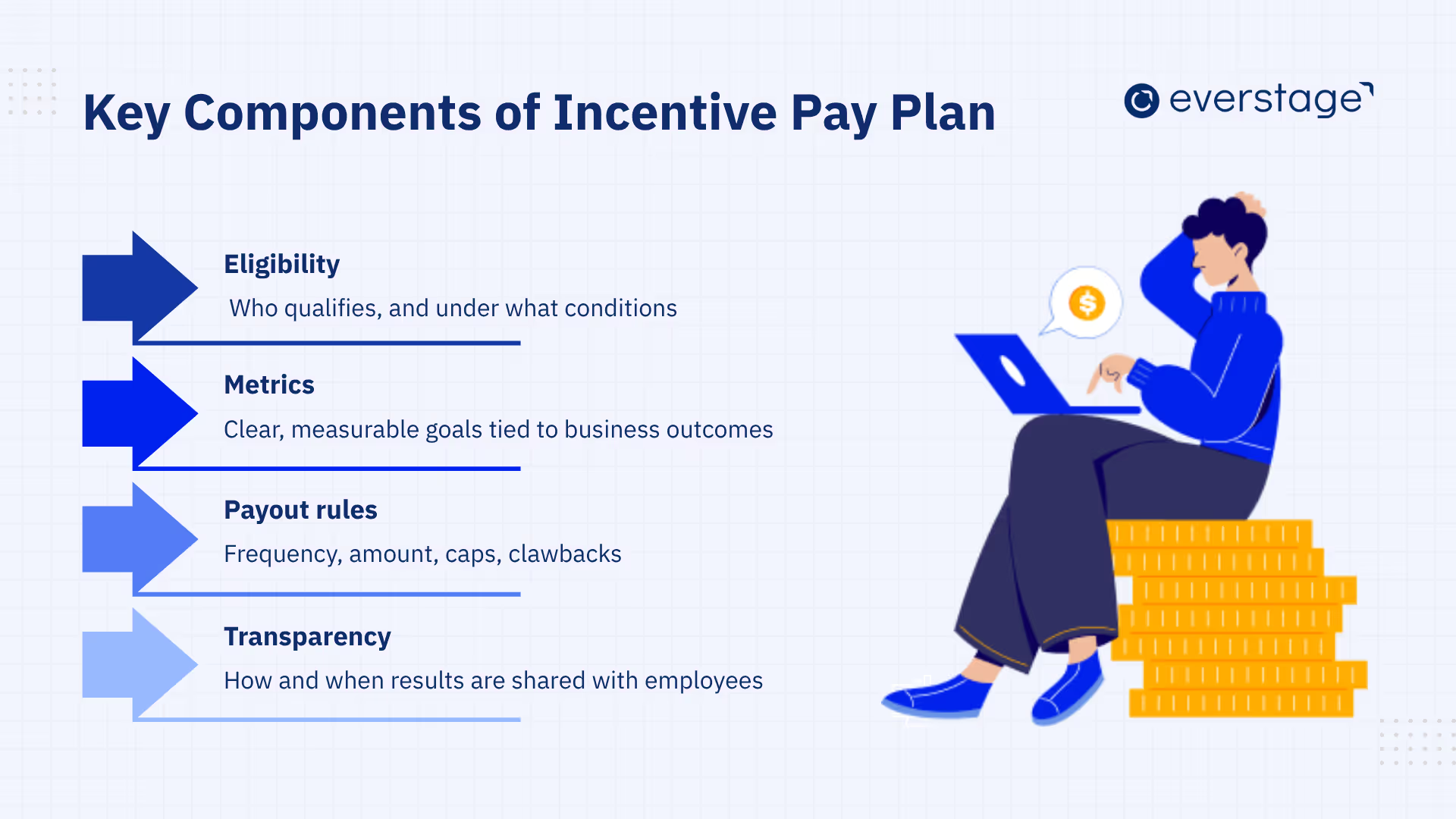
Eligibility: Who qualifies, and under what conditions
The first component is eligibility criteria, which set who qualifies for incentive pay and under what conditions. Eligibility usually rests on job function and tenure.
Example:
A company might specify that only sales reps who exceed 80% of their annual sales target qualify for an annual bonus. This keeps incentives aligned with the most critical business goal, meeting sales targets.
Metrics: Clear, measurable goals tied to business outcomes
The core of any incentive pay system is the performance metric. These metrics must stay clearly defined and tied to business outcomes. When setting these goals, companies make them measurable and aligned with strategic objectives.
Example:
A marketing team might be incentivized on lead generation numbers. A clear, measurable goal might be that each employee earns an incentive for generating X number of qualified leads per month. This pushes the team to align its efforts with the company's goal of growing the sales pipeline.
Payout rules: Frequency, amount, caps, clawbacks
Payouts run monthly or quarterly, with some annual cycles. Companies can set caps to limit total payout and prevent excessive payouts when goals get exceeded repeatedly.
Clawbacks let the company recover funds when performance was later found inaccurate or short-lived.
Example:
A company might set a quarterly performance bonus for its sales team, with caps based on individual performance. The highest achiever might receive a maximum of $5,000. If the sales target for the quarter is exceeded by 20%, the cap can increase to $6,000.
Transparency: How and when results are shared with employees
Transparent communication about how decisions get made builds trust and reduces confusion. Employees feel empowered and confident that their efforts will be fairly evaluated.
Example:
A company might send monthly reports showing progress toward sales targets and the rewards each rep can earn. Clearer communication makes employees more motivated to meet goals.
If payout disputes or unclear earnings visibility slow your team down, this guide shows how transparent plans improve trust and performance.
Pay Levels: Short-Term vs Long-Term Incentives
Incentive pay plans reward both short-term and long-term performance. The two types serve different purposes and work together to drive immediate results and long-term loyalty.
Short-term Incentives: Monthly or quarterly bonuses, sales commissions, SPIFFs
Short-term incentives reward periodic performance, like meeting quarterly sales targets or completing key tasks. These incentives are generally monetary, like bonuses or commissions, and they motivate employees toward specific, short-term goals.
Short-term incentives maintain high performance in day-to-day operations and keep employees focused on delivering results now.
Example:
A sales commission structure may reward reps with monthly payouts based on the number of deals they close, which directly impacts monthly company revenue. Other short-term incentives include quarterly bonuses based on meeting set revenue or production goals.
Long-term: Stock grants, deferred bonuses, profit sharing
Long-term incentives reward sustained performance through stock options and deferred bonuses. These incentives drive employee retention, since they tie to the long-term growth and success of the company.
Employees who hold stock options or receive deferred bonuses may be more inclined to stay with the company for several years to maximize their long-term incentives.
Example:
A technology startup may offer employees stock options that vest over five years. This aligns employee interests with the company's long-term success and serves as a retention tool. Employees stay to benefit fully from the options.
Why it matters
Both short-term and long-term incentives play crucial roles in an incentive pay system. Short-term incentives drive immediate behavior, keeping employees focused on current business objectives.
Long-term incentives build employee loyalty, aligning their interests with the company's future success and reducing turnover.
Balancing both types keeps employees motivated toward immediate and long-term objectives.
Incentive Pay Calculation Formula and Methods
Incentive pay is calculated by tying a financial reward to measurable performance outcomes. While the structure varies by company or role, most models follow a consistent logic: reward employees proportionally to what they achieve.
Understanding how incentive pay is calculated helps both employers and employees grasp the true potential of performance-based compensation.
In sales environments, calculations grow complex because payouts depend on quota attainment, accelerators, and ramp periods. Clawbacks and product-specific rates add more layers. This is why many growing teams move from spreadsheet tracking to automated incentive compensation platforms.
Core Formula for Incentive Pay Calculation
Incentive pay runs on simple, measurable performance metrics that determine how much employees earn based on their contributions. The fundamental calculation formula is:
Incentive Pay = Performance Metric × Incentive Rate
This formula adapts to many business models and roles. In sales compensation, the performance metric is often quota attainment or closed revenue. The incentive rate is the percentage tied to meeting or exceeding those metrics.
For example, a salesperson may receive a 10% commission for sales, while a project manager may earn a fixed bonus for completing a project ahead of schedule.
The three methods below show how businesses calculate incentive pay:
1. Flat-Rate Incentive
A flat-rate incentive pays a fixed reward once an employee hits a specific goal or milestone. The model stays predictable and simple to implement. Employees know what they receive when they meet the objective.
Example: Imagine a project manager tasked with delivering a product launch. If the product launches before the deadline, they may receive a $1,000 bonus. The payout stays fixed regardless of the accomplishment's scale, as long as the goal is met.
Best for: This model suits milestone-based incentives. It works well in project-driven roles where the reward acknowledges completing a key task instead of scaling with performance.
2. Percentage-Based Incentive
A percentage-based incentive suits roles where work ties directly to revenue. Employees receive a percentage of the value they generate, usually sales or project revenue. The more they sell, the more they earn.
Example: A salesperson earns a 10% commission on all sales made. If they close a deal worth $40,000, their incentive pay would be:
Incentive Pay = $40,000 × 0.10 = $4,000
Best for: This works best for sales-driven roles like real estate agents and business development executives.
3. Tiered or Threshold-Based Incentive
A tiered or threshold-based incentive adds an extra layer of motivation by applying different payout rates based on performance bands or thresholds. As employees surpass benchmarks, they earn a higher percentage or larger rewards, which encourages them to keep exceeding expectations.
Example: A salesperson receives:
- 5% commission on the first $10,000 in sales
- 7% commission on the next $10,000 in sales
- 10% commission on any sales exceeding $20,000
If the salesperson generates $30,000 in sales for the month, their incentive pay would be:
- 5% of the first $10,000 = $500
- 7% of the next $10,000 = $700
- 10% of the remaining $10,000 = $1,000
Total incentive pay = $500 + $700 + $1,000 = $2,200
Best for: This structure works best in sales teams where pushing beyond a base target is essential to increasing revenue. It also helps in competitive industries such as real estate or B2B sales, where overachievement earns recognition and reward.
Types of Incentive Pay with Examples
Companies vary in their objectives, and the compensation model should adapt to the type of role.
The most common types of incentive pay below suit specific business environments and roles.
Commission-Based Incentives
Commission-based incentives are widely used in sales-driven roles, where compensation ties directly to the rep's ability to generate revenue.
Reps receive a percentage of the sales they generate. The more a rep sells, the more they earn, which pushes them to exceed targets.
Example: A sales representative earns 10% commission on every sale, with an additional reward if they surpass $50K in monthly revenue.
Structures:
- Flat-rate: A fixed percentage of every sale made, regardless of the amount.
- Tiered: Commissions increase as sales thresholds are met (e.g., 5% for the first $10K, 7% for the next $10K, etc.).
- Threshold-based: Reps earn higher commissions once they exceed a specific sales figure.
Pros:
- Highly motivating for revenue-driving roles: The structure directly rewards high performers and encourages reps to exceed targets.
- Scalable rewards: The more reps sell, the more they earn, which drives higher sales and revenue for the company.
Use Cases:
- Sales teams in retail and real estate, where individual sales tie directly to compensation.
Performance Bonuses
Performance bonus programs are among the simplest forms of incentive pay. These bonuses tie to specific milestones or achievements within a set period.
Cash bonuses appeal to employees because they offer an immediate, tangible reward for meeting short-term objectives, which motivates strong performance.
Examples:
- Year-end bonuses awarded to employees for exceeding annual targets.
- Milestone rewards for completing key projects ahead of schedule.
Pros:
- Simple to administer: Cash bonuses are easy to calculate and implement, making them a practical choice for businesses of all sizes.
- Immediate impact: Employees recognize the reward for their contributions right away, which boosts morale and motivation quickly.
Use Cases:
- Corporate roles where meeting specific quarterly or annual goals is essential.
- Leadership and management positions, where meeting high-level business objectives is critical.
- Product teams that need to meet specific milestones or deliverables.
SPIFFs
SPIFFs are short-term incentives that drive specific sales behaviors, like selling a strategic product or accelerating pipeline movement. They work best when the goal stays clear and reps can track progress in real time.
Stock Options and Profit Sharing
Stock options and profit-sharing are long-term incentive pay models that tie employees' rewards to the overall success of the company. Stock options grant employees the right to buy company shares at a predetermined price, which they can sell later at a market price if the company's stock value increases.
Profit-sharing gives employees a percentage of the company's profits, typically distributed annually.
Examples:
- Stock options allow employees to purchase shares at a lower price and benefit from the company's long-term growth.
- Profit sharing involves giving employees a portion of the company's profits, aligning their interests with the company's financial success.
Pros:
- Ties employees to the company's long-term success: These options create a sense of ownership and loyalty, as employees directly benefit from the company's performance.
- Great for startups or companies focused on retention: Stock options and profit-sharing help retain key talent, especially in high-growth or startup environments.
Use Cases:
- Startups or growth-focused companies aiming to retain top talent by offering long-term rewards linked to the company's success.
- High-growth industries where long-term planning and employee retention are key to scaling operations.
Recognition-Based Rewards
Recognition-based rewards are non-cash incentives for behaviors that align with company values or culture. These rewards include public recognition and Employee of the Month awards.
Although non-monetary, these rewards can have a significant impact on employee motivation and morale when properly aligned with company culture.
Examples:
- Employee of the Month awards for exceptional performance.
- Peer recognition programs where employees nominate colleagues for outstanding contributions.
- Manager-nominated awards for exceeding specific performance goals.
Pros:
- High perceived value when culturally aligned: When employees feel valued, they feel more motivated to perform well. Public recognition can boost morale and job satisfaction.
- Encourages cultural alignment: This model reinforces company values and encourages employees to act in ways that support those values.
Use Cases:
- Cultural or values-based companies where behaviors such as collaboration, customer service, or innovation are prioritized.
- Small businesses or teams where non-cash rewards can be highly personalized and impactful.
Non-monetary Incentives
Non-monetary incentives sit outside direct financial compensation but still deliver substantial value to employees. They encourage engagement and morale while keeping payroll costs steady.
These rewards include extra paid time off (PTO) and learning budgets.
Examples:
- Extra PTO for employees who exceed performance targets.
- Wellness retreats as a reward for meeting quarterly goals.
- Learning budgets for professional development or training.
Pros:
- Helps foster engagement and morale without straining company budgets.
- Useful in mission-driven or budget-conscious environments where monetary rewards may be hard to offer.
Use Cases:
- Mission-driven companies where employees feel motivated by values and personal development more than monetary rewards.
- Smaller businesses or nonprofits where cash flow limitations make monetary incentives difficult but employee engagement is still a priority.
Incentive Pay Examples by Role and Program Type
Different roles call for different incentive structures. The table maps roles to incentive types and payout cadences.
Designing an Effective Incentive Pay System
A well-structured incentive pay system aligns employee behavior with company objectives while building a performance-driven culture.
A plan that works starts with clear outcomes and a fair, sustainable reward system.
Here's how to design one that works:
How to Build and Implement an Incentive Pay Program
Creating a custom incentive program involves several strategic steps that tailor the plan to the company's goals and the roles of its employees.
Here's how you can build a plan that motivates reps and aligns with organizational needs:
Step 1: Define business objectives: What behavior are you trying to drive?
Before designing any incentive program, the first step is to define the business objectives the program should achieve. Ask yourself: What behaviors or outcomes do we want to encourage?
For example, if your company's priority is increasing sales, you may want a plan that rewards sales teams for closing deals or meeting sales targets.
Alternatively, if your goal is to improve customer satisfaction, the plan could reward customer service teams for hitting satisfaction targets or maintaining positive customer reviews.
Step 2: Segment roles: Differentiate incentives by job function
Roles should be incentivized in different ways. Different job functions contribute differently to overall success, so it helps to differentiate incentives by role.
Sales teams may be driven by commission-based incentives, while product development teams could earn milestone bonuses for meeting project deadlines.
Step 3: Choose metrics: Tie incentives to what employees can control
Choose metrics that stay meaningful and within the employee's control. Employees must influence their own results, or the program feels arbitrary.
Step 4: Set thresholds and accelerators: Make top performance worth it
Once the performance metrics are in place, set thresholds and accelerators. Thresholds are the minimum performance levels required to earn any incentive, while accelerators let employees earn more if they exceed targets.
For example,
- Threshold: Sales reps must hit 80% of their sales target to qualify for commission.
- Accelerator: Once sales exceed the target by 20%, the commission rate increases by 5%.
Step 5: Pilot, gather feedback, and iterate
After designing the plan, pilot the program with a small group of employees. Gather feedback to learn whether the plan motivates them and aligns with business goals. Employees provide valuable insights into what works and what falls short.
If you are redesigning sales compensation plans for a new fiscal year, this guide gives a framework for setting targets and thresholds, plus rollout communication.
Incentive Pay Risks and Common Mistakes to Avoid
Several common mistakes can weaken an incentive pay system. They reduce employee motivation or create unfair compensation practices. Strategic risks include metric gaming and payout disputes.
1. Overcomplicating the plan
Many organizations design incentive systems with too many metrics and payout tiers. The goal is broad coverage, but complex structures confuse employees about what drives their rewards.
How to Prevent It?
Keep it simple and transparent. Limit metrics to those that influence business outcomes like revenue growth or customer retention. Use clear payout formulas and share them through visual dashboards. A simple, predictable plan improves engagement and trust.
2. Setting unattainable goals
Ambitious targets motivate top performers but discourage the majority when goals feel unrealistic. This leads to disengagement and turnover.
How to Prevent It?
Use data-driven quota setting. Analyze historical sales data and team capacity before defining targets. Introduce tiered goals like threshold and stretch levels to keep reps motivated. Reward progress and consistency over all-or-nothing achievement.
3. Ignoring feedback from participants
Incentive programs fail when leadership designs them in isolation. Without ongoing input from sales reps and managers, incentive plans can misalign with real-world challenges or priorities.
How to Prevent It?
Create feedback loops. Run pulse surveys or quarterly reviews to learn what works and what falls short. Encourage reps to share how the plan affects motivation. Use that feedback to refine metrics and payout frequency.
4. Failing to communicate clearly
Even well-designed plans fall short when employees struggle to understand them. Poor communication leads to confusion and payout disputes.
How to Prevent It?
Communicate early and often. Before rollout, host training sessions on plan mechanics and payout timelines. Provide easy access to plan documents and FAQs.
5. Relying on spreadsheets for complex incentive calculations
Spreadsheets work for simple plans but grow risky as teams scale. Formula errors and approval delays create payout disputes and reduce trust.
How to Prevent It?
Centralize plan logic, performance data, and payout calculations in a dedicated sales compensation platform. This gives reps better visibility and gives Finance more control over variable compensation.
Is Incentive Pay Taxable? Legal, Tax, and Compliance Considerations
An incentive pay system involves more than the compensation structure and performance metrics. The system must also follow legal standards and tax regulations while staying fair and free of bias.
Important: Legal and tax rules vary by region, employee classification, and plan design. Consult legal or payroll advisors before finalizing an incentive pay plan.
The sections below cover the tax and compliance issues to consider when implementing a plan.
1. Bonuses and taxes
Incentive pay frequently takes the form of bonuses, which face taxation. Employers should understand how bonuses get taxed to ensure compliance and avoid unexpected tax liabilities.
IRS Treatment:
According to the IRS, bonuses count as supplemental wages and are taxed at a different rate than regular wages. The federal withholding tax rate on bonuses is typically 22% (as of the latest IRS guidelines), which may run higher than the rate for standard wages. If a bonus exceeds $1 million, the excess amount is taxed at 37%.
Payroll Implications:
Companies should set up payroll systems to track bonuses accurately and apply proper withholding. Employers must report incentive payments on the W-2 form at year end, and failure to process these correctly can lead to IRS audits or fines.
2. Wage law impact
The Fair Labor Standards Act (FLSA) governs wage and hour standards in the U.S., including how bonuses and overtime are treated. Companies should stay compliant with FLSA regulations when implementing incentive pay plans, particularly for non-exempt employees who qualify for overtime.
Overtime Considerations:
Under the FLSA, non-exempt employees qualify for overtime pay, typically at 1.5 times their regular pay for hours worked beyond 40 hours in a workweek. Bonuses generally count as part of the regular rate of pay for overtime calculations. If employees receive performance bonuses, those bonuses may have to be included when calculating their overtime pay for the period.
3. Fairness and bias
Incentive pay systems must stay fair and objective to maintain trust and avoid claims of bias or favoritism. Subjective criteria that favor certain employees over others lead to disengagement and resentment. Employees must feel that the metrics tied to their pay stay clear and equitable.
Legal Implications:
If incentive pay appears biased, it can lead to claims of discrimination or violations of equal pay laws. The Equal Pay Act of 1963 requires that employees receive the same pay for equal work regardless of gender. Subjective bonus allocation based on gender, age, or management relationships could trigger legal action under discrimination laws.
4. Equity plans
Equity-based incentives like stock options and restricted stock units (RSUs) are gaining popularity in startups and public companies. Equity compensation aligns employees with long-term success, and it carries complex regulatory and tax considerations.
Proper Documentation:
Companies offering equity compensation, especially public companies, need proper documentation and reporting in place. Stock options and equity grants must be clearly outlined in employee agreements, and vesting schedules should stay transparent. Public companies must disclose equity compensation plans and option grants in their annual proxy statements and financial reports to comply with SEC regulations.
Tax Compliance:
Employees receiving equity compensation should understand the tax treatment of stock options or grants. For example, stock options carry different tax implications based on their type, incentive stock options (ISOs) or non-qualified stock options (NSOs). RSUs are taxed as regular income when they vest.
Transform Incentive Pay into a Revenue-Driving System
Incentive pay is one of the most effective ways to motivate teams and align compensation with business outcomes. The plan is only as effective as the system behind it. Clear metrics and accurate calculations decide whether employees trust the plan and act on it.
If your team is ready to move beyond manual incentive tracking, Everstage can help you build transparent, automated sales compensation processes that improve rep trust and turn commissions into a revenue lever.
Book a personalized demo to see how Everstage helps teams design transparent plans and automate commission calculations. The result reduces payout disputes and turns sales compensation into a growth engine.
Questions worth asking
The things most people want to know before they commit.
Is incentive pay hourly?
Incentive pay is variable compensation paid on top of hourly wages or salary, separate from base pay. It ties to performance outcomes like sales or company results instead of hours worked.
What is the difference between incentive pay and merit pay?
Incentive pay is variable and goal-based, paid when specific targets are met. Merit pay is a permanent salary increase tied to performance reviews, rewarding sustained performance instead of a single outcome.
Can incentive pay replace salary increases?
Incentive pay should complement fair base compensation instead of replacing it. Salary increases provide stability and recognize long-term value, while incentive pay rewards specific performance. Relying only on incentives can hurt trust and retention.
Who typically receives incentive pay?
Incentive pay started in sales and executive roles. It now reaches marketing, product, and customer success teams, especially in growth-focused industries.
What percentage of total compensation is usually variable?
t varies by role:
- Executives: 25–40%
- Sales reps: 30–70%
- Mid-level managers: 10–20%
- Individual contributors: 5–15%
How do companies decide incentive payouts?
Payouts rest on pre-defined goals and thresholds. These include revenue targets and customer retention benchmarks.