

.avif)
TL;DR
- Incentive pay links measurable performance outcomes to a defined payout rate or tiered structure. The core formula is Incentive Pay = Performance Metric × Incentive Rate.
- Compare flat-rate and percentage-based structures against tiered models to match payouts to each role and behavior
- Account for thresholds and caps, then apply proration rules to keep payouts fair across ramp periods
- Avoid spreadsheet errors and payout disputes that erode trust between reps and Finance
- See when spreadsheets stop working and when Everstage automates calculations to reduce payout disputes
A mid-sized tech company launched a complex product six weeks ahead of schedule. Leadership celebrated the win internally. Sales reps who beat their quarterly targets received sizable bonuses. The project team behind the launch received a congratulatory email.
The imbalance raised a question inside leadership. Why is incentive pay clear in sales but vague in other roles?
This confusion is common when incentive plans grow faster than the systems that manage them. If you manage sales compensation or revenue operations, you need to understand how incentive pay is calculated. Clear calculations keep payouts accurate and aligned with business goals.
This guide walks through the most common calculation methods with worked examples. It also shows the mistakes to avoid and the tools that simplify the process.
By the end, you will know how incentive pay is calculated and when manual math becomes too risky for growing teams.
What Is Incentive Pay and How Does It Work?
Incentive pay is variable compensation tied directly to measurable performance. Base pay stays fixed and lands regardless of output. Incentive pay rewards specific results such as closed revenue and quota attainment.
It differs from related concepts in a few key ways:
- Base pay: Fixed salary paid on a set schedule, independent of performance.
- Bonuses: One-time payments that may follow a set formula or stay discretionary.
- Commissions: A common form of incentive pay, usually calculated as a percentage of sales or revenue.
- Recognition-based rewards: Non-cash or symbolic rewards that stay outside any payout formula.
Incentive programs follow a common flow. Teams set goals, track performance, calculate the payout, then route it for approval and payment. Each step grows more complex as plans add quotas and accelerators.
Why Incentive Pay Calculations Get Complicated for Growing Sales Teams
At a small scale, incentive pay calculations can live in a spreadsheet. As sales teams grow, plans add quotas and accelerators. Clawbacks and split credits soon follow. Territory changes and ramp periods add another layer.
RevOps and Finance teams face more than a math problem. They must maintain trust and reduce disputes. Clean audit trails and real-time rep visibility matter just as much.
Basic Formula and Example to Understand How Incentive Pay Is Calculated
Incentive pay is calculated by multiplying a performance metric by a defined incentive rate, or by applying a flat bonus once a target is met. The performance metric can be sales revenue or project completion.
The incentive rate may be a percentage of revenue or a fixed dollar amount. Companies may also use tiered or threshold-based structures that increase payouts as results improve. The calculation ties rewards to measurable achievements, so pay aligns with performance.
Four incentive plan types with their formulas, worked examples, and best-fit use cases.
Incentive Pay Formula: Performance Metric × Incentive Rate
Calculating incentive pay follows a structured process that keeps rewards fair and sustainable. The basic formula is: Incentive Pay = Performance Metric × Incentive Rate. Applying it in practice means defining each input and adjusting for real-world exceptions.
Below is a breakdown of the key steps companies use to calculate incentive pay effectively.
1. Define the Performance Metric
The first step is deciding what performance outcome the incentive will measure. Quantitative metrics include sales revenue and cost savings. Qualitative metrics include client satisfaction and innovation outcomes.
Choosing the wrong metric is one of the most common reasons incentive plans fail. When the measure ignores real business goals, employees chase bonuses that create little value.
Many organizations now use pay-for-performance models, but the success of those systems depends heavily on the metric you select. When the performance measure is poorly chosen or misaligned with strategy, incentives quickly become a source of inefficiency; when it is well chosen, it reinforces exactly the behaviors the company values most.
For example, rewarding call center staff purely on the number of calls answered may increase volume but reduce customer satisfaction. Companies that succeed with incentive pay select metrics that balance productivity with quality.
Let's understand this through an example walkthrough:
A software company decides to reward its customer support team based on customer satisfaction score (CSAT) instead of total tickets resolved. The metric pushes employees toward quality service over raw speed.
2. Assign the Incentive Rate
Once the metric is chosen, you must determine how the payout will be calculated. This could be a flat dollar amount per achievement or a percentage of revenue. The rate needs to be competitive enough to motivate employees while remaining financially viable.
Many companies benchmark incentive rates against industry standards to avoid overpaying or underpaying compared to competitors. A poorly set rate can either demotivate employees (if too low) or inflate payroll costs without delivering commensurate results (if too high).
Let's say the same software company from the above example sets the incentive rate at $150 for every one percentage point above 90% CSAT. If the team achieves 95%, the payout is tied directly to those extra five points.
3. Apply Thresholds or Caps
Thresholds and caps create guardrails around incentive pay. A threshold establishes the minimum level of performance required before incentives begin. A cap sets the maximum payout to prevent excessive compensation that could strain company budgets.
For instance, sales teams start earning commissions once they reach 80% of quota. Caps sit at 200% of quota to balance motivation with cost control.
These mechanisms protect the organization while still rewarding strong performance. Without them, incentive systems can become either discouraging (if thresholds are too high) or unsustainable (if caps are absent).
In the example, the company pays an incentive only once CSAT reaches 90%, the threshold. It also caps the payout at $2,000 per quarter per employee to keep costs predictable.
4. Calculate Payout
With the metric, rate, and boundaries defined, companies apply the formula to determine actual payouts. For a sales role, this could mean multiplying closed revenue by the commission percentage.
For a project-based role, it might involve assigning a bonus amount to each milestone achieved. At this stage, clarity is essential: employees should be able to replicate the calculation themselves and verify how their incentive pay was derived.
Transparent calculation builds trust and reduces disputes between employees and management.
Let's say a support rep achieves 94% CSAT for the quarter, from the previous example. That is 4 points above the threshold. At $150 per point, the incentive pay = 4 × $150 = $600. Since this is below the $2,000 cap, the full $600 is paid out.
5. Adjust for Exceptions
Every incentive plan runs into exceptions. Companies must account for new hires joining mid-cycle and profitability shortfalls that shrink bonus pools.
Adjustments may prorate payouts by time worked or reduce bonuses when results fall short. Employees dislike exceptions, so communicating the rules upfront keeps things fair.
Skip these adjustments and the system rewards some employees far beyond their actual contribution.
From the example in the previous step, if the same support rep joined halfway through the quarter, the payout would be prorated by 50%. Instead of $600, they would receive $300. The adjustment keeps pay fair relative to tenure.
The formula extends well beyond sales. It applies equally to service and operational roles. Aligning pay with measurable results gives companies a consistent framework across job types.
If you're looking to align your incentive calculations with clear, well-defined compensation objectives, this resource can help you get started.
Step by Step Process to Calculate Incentive Pay
Designing and calculating incentive pay requires more than plugging numbers into a formula. Fairness and motivation depend on a structured process that adapts across roles and departments.
Below is a step-by-step framework that organizations commonly use to calculate incentive pay effectively.
1. Define the Objective
Every incentive plan should begin with a clear purpose. Companies must decide whether the goal is higher revenue or better quality. Vague goals backfire and reward the wrong behaviors.
A retail chain focused on customer experience can damage its reputation when bonuses reward sales volume over service quality. A well-defined objective ties incentive pay to outcomes that drive business success.
2. Identify Eligible Roles
Employees contribute to goals in different ways, so companies must decide who qualifies. Sales representatives may be rewarded for closing deals, while project teams might earn bonuses for delivering milestones on time. Support staff and marketing teams can also be included if their work directly impacts key objectives such as retention or lead generation.
Overlooking certain roles can cause disengagement, while overextending incentives to roles without measurable impact can dilute their effectiveness. The best plans focus on roles where performance is both measurable and strategically valuable.
3. Select Metrics
The next step is identifying how performance will be measured. Quantitative metrics cover revenue generated and units produced. Qualitative metrics cover customer satisfaction and peer evaluations.
The challenge is choosing metrics that balance simplicity with fairness. If metrics are too narrow, employees may ignore other important tasks. If they are too broad, employees may feel the system is arbitrary.
4. Choose the Structure
Once objectives, roles, and metrics are defined, companies must select the right structure for payouts. Flat-rate bonuses work well for task completion or compliance-related achievements. Percentage-based incentives align directly with revenue-generating activities.
Tiered structures suit teams you want to push past expectations, with higher rewards for each threshold crossed. The chosen structure should reflect the nature of the work and the level of control employees have over outcomes.
Misalignment such as giving a revenue-based incentive to a role without direct revenue influence can undermine trust in the plan.
5. Set Eligibility and Period
Timing is critical when calculating incentive pay. Companies decide whether payouts land quarterly or at project completion. The eligibility rules must also be clear.
For example, new hires may only qualify after a probationary period, while part-time staff may receive prorated amounts. Setting clear rules around eligibility and payout periods helps prevent disputes and ensures consistency.
Shorter cycles like quarterly payouts improve motivation because employees see results faster. Annual payouts suit long-term projects and senior leadership roles.
6. Apply the Formula
With all parameters in place, companies can apply the incentive pay formula consistently. This might mean multiplying revenue by a commission percentage or applying tiered rates to thresholds.
The most important part of this step is transparency: employees should be able to track their progress and verify how their pay was calculated. When employees clearly understand the math behind their earnings, it reduces mistrust and improves engagement.
7. Adjust for Exceptions
Scenarios like mid-cycle hires and extended leave require adjustments. Many organizations use prorated calculations to ensure fairness based on time worked or contribution level.
In some cases, company-wide adjustments may also be applied if financial performance falls below expectations and bonus pools are reduced. Communicating these adjustments upfront prevents dissatisfaction and ensures employees understand how exceptional circumstances are handled.
This framework helps compensation teams calculate incentive pay that stays transparent and reliable. It holds up even when plans add quotas and accelerators.
Incentive Pay Calculation Validation Checklist
Before releasing any payout, run it through a quick validation check:
- Metric accuracy: Confirm performance data is complete and pulled from the correct source.
- Eligibility confirmation: Verify the payee qualifies for this cycle.
- Threshold checks: Ensure minimum performance thresholds are met.
- Cap checks: Confirm the payout stays within defined maximums.
- Proration: Apply prorated calculations for mid-cycle hires or leave.
- Tax classification: Confirm supplemental income treatment before payout.
- Manager approval: Route through the correct approval workflow with an audit trail.
If you're looking to overhaul your compensation structure using a proven framework, this guide walks you through the process in detail.
Team Incentives vs. Individual Incentives
One of the biggest calculation decisions is whether payouts reward individual performance or shared results. The choice significantly changes how the calculation works and how fairness is maintained.
Three incentive models compared by calculation method, best use case, key risk, and example.
Individual incentives work best when performance is directly measurable and reps control their outcomes. Team incentives suit collaborative environments where shared milestones matter more than individual heroics. Hybrid models balance both but require clear documentation to avoid fairness disputes.
Common Incentive Pay Calculation Methods With Examples
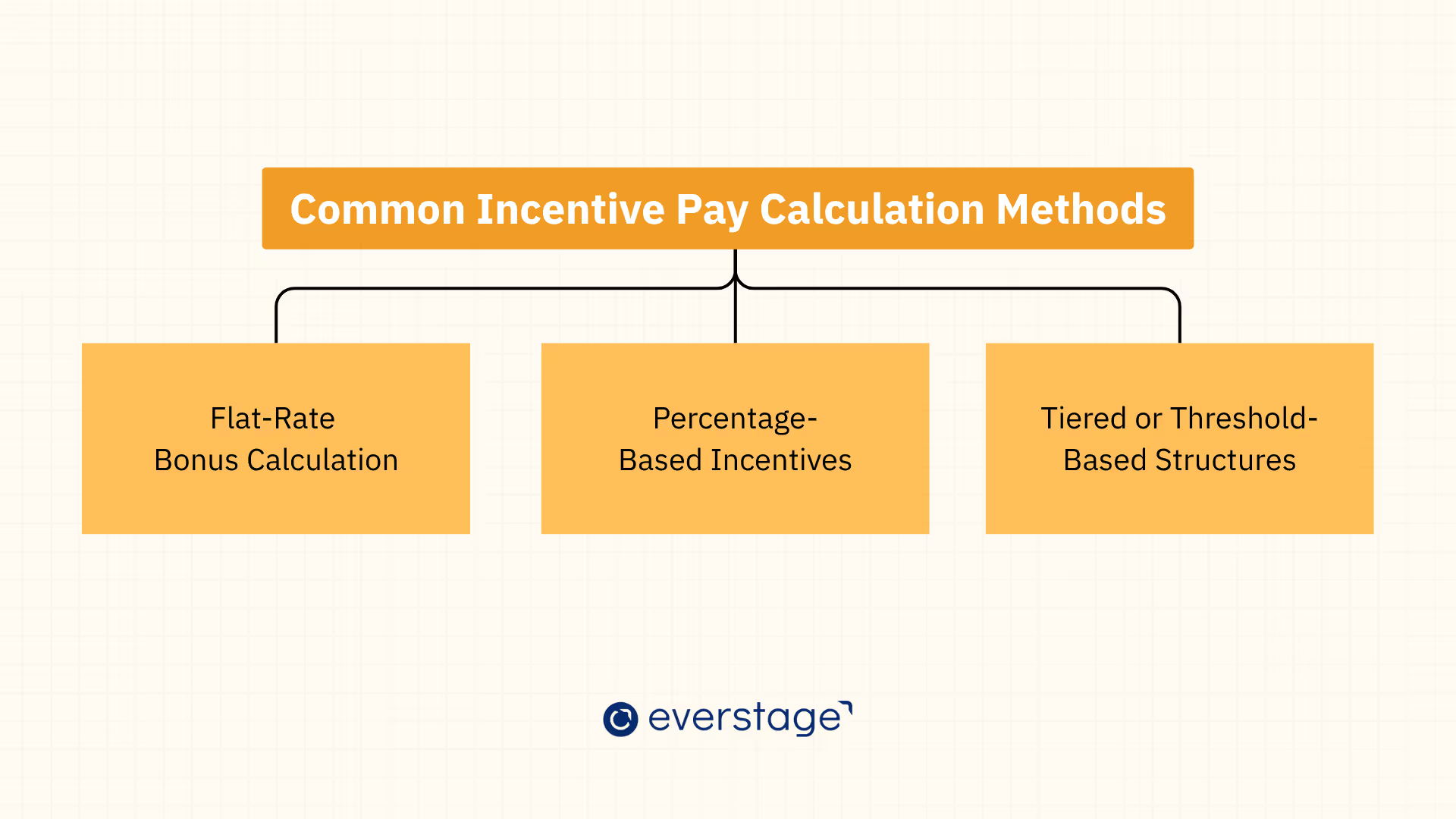
Organizations rarely rely on a single method for calculating incentive pay. The model depends on the role and the behaviors a company wants to encourage.
Each method carries distinct trade-offs. HR teams designing plans and employees checking their pay both need to understand them.
The following are the three most widely used calculation methods:
1. Flat-Rate Bonus Calculation
A flat-rate bonus is a straightforward, fixed amount paid to an employee once they meet or exceed a predetermined goal or milestone. The structure is simple to run. It works for short-term, goal-specific incentives like rewarding a completed project.
Key Features:
- Fixed Amount: The bonus remains the same regardless of the level of achievement, as long as the goal is met.
- Goal-Oriented: Typically tied to specific milestones or one-time tasks, making it ideal for project-based incentives or quarterly goals.
- Simplicity: Because it is easy to understand and implement, it's a good choice for smaller teams or roles where incentives are based on clear, short-term objectives.
A flat-rate incentive might give account executives a $1,000 bonus for closing a strategic logo or meeting a quarterly pipeline creation target. This gives reps a clear payout expectation while helping leaders focus behavior on a defined business priority.
Consider a product manager assigned to ship a launch by quarter end. If the launch lands on time, the company awards a $1,000 flat-rate bonus. The manager knows exactly what the goal is and what on-time delivery pays.
Flat-rate incentives fit roles measured against binary outcomes like project completion or quality scores. Their strength lies in predictability and ease of administration.
They fall short in environments where continuous overperformance is possible. Once the threshold is met, the financial motivation to go further disappears, which can cap productivity.
2. Percentage-Based Incentives
Percentage-based incentives tie employee earnings directly to measurable business results.
The formula is typically:
Incentive Pay = Performance Outcome × Incentive Rate
This method is most often used in sales or revenue-generating roles, where contributions are quantifiable. For instance, an account executive who closes $50,000 in eligible revenue at a 10% rate earns $5,000. That figure comes before taxes and adjustments like splits or clawbacks. Because payouts rise in direct proportion to performance, employees remain motivated to pursue higher results without an artificial ceiling.
Beyond sales, percentage-based incentives can also be applied in other functions and industries:
- Customer Service (CSAT-Based): A support rep may receive an incentive equal to a percentage of their monthly base salary for maintaining customer satisfaction (CSAT) scores above 95%.
- Manufacturing (Productivity-Based): Factory workers could earn an additional payout based on a percentage of units produced above a set productivity threshold. For example, exceeding production goals by 10% might trigger a 5% bonus on base pay.
- Project Management (Milestone-Based): Project managers may receive a bonus equal to a percentage of project profitability or total contract value upon delivering milestones ahead of schedule and under budget.
The challenge for employers is balancing fairness with sustainability. Percentage-driven plans get costly unless quotas and caps keep payouts aligned with performance.
For sales compensation teams, these principles get more complex once quotas and accelerators enter the calculation. That is where manual spreadsheets break down and automated incentive compensation platforms become essential.
3. Tiered or Threshold-Based Structures
A tiered or threshold-based incentive structure offers multiple levels of payout depending on the amount of performance achieved. The idea behind this model is to encourage overperformance by rewarding employees more as they exceed certain thresholds.
The method works best for scalable roles like sales, where more revenue means more commission.
Key Features:
- Multiple Payout Levels: Employees earn different percentages or bonuses based on how much they exceed specific thresholds or targets.
- Motivates Overachievement: By providing greater rewards as performance levels increase, this structure motivates employees to push beyond their basic targets.
- Clear Milestones: Thresholds are pre-defined and measurable, ensuring clarity for both employers and employees.
Example 1: Tiered Incentive Structure for Sales Teams
For example, in a tiered commission structure, a salesperson might earn:
- 5% commission on the first $10,000 in sales,
- 7% on the next $10,000,
- 10% on any sales above $20,000.
If the salesperson generates $30,000 in sales, they would earn:
- $10,000 × 5% = $500
- $10,000 × 7% = $700
- $10,000 × 10% = $1,000
Total Incentive Pay = $500 + $700 + $1,000 = $2,200.
Example 2: Tiered Incentive Structure for Manufacturing Teams
In manufacturing environments, for example, incentive structures often balance two key variables: output volume and product quality. A tiered system rewards workers for beating production targets while holding quality standards.
For example, a plant might set a daily target of 500 units per shift with a maximum defect tolerance of 2%. Incentives could be structured as follows:
- 100–110% of target output (500–550 units with ≤2% defects): 2% bonus on base pay
- 111–120% of target output (551–600 units with ≤2% defects): 4% bonus
- 121%+ of target output (601+ units with ≤2% defects): 7% bonus
If defect rates rise above 2%, the bonus drops to zero, regardless of output.
The approach drives efficiency and accountability. Workers push for productivity while watching quality checks. It also helps companies avoid the trap of speed at the cost of rework, where fast production creates downstream bottlenecks from defects.
Some companies extend this further by adding a team-based multiplier. For instance, if the entire production line meets its collective output and quality goals for the quarter, everyone earns an additional 2% performance bonus, reinforcing collaboration.
The structure works well for pushing employees past their goals. Tiered structures raise motivation when each new level brings a clear, larger reward.
A potential downside to this model is the risk of unrealistic target-setting. If the thresholds are too high, employees may become demotivated if they feel they're too far from reaching the next tier. It's essential to set achievable targets that both motivate and align with company objectives.
Flat-rate, percentage-based, and tiered methods compared by mechanics, pros, cons, and best use cases.
The right structure, communicated clearly, keeps incentive pay motivating for employees and sustainable for the business.
Incentive Pay Calculation Examples by Scenario
These worked examples show how the core formula applies across common scenarios. Each shows the math step by step.
- Salary-based incentive: Target incentive $20,000 × 90% attainment = $18,000
- Sales quota incentive: $120,000 eligible revenue × 5% commission = $6,000
- Flat bonus: $1,000 fixed payout for closing a strategic logo = $1,000
- Tiered commission: $30,000 in sales → (5% × $10K) + (7% × $10K) + (10% × $10K) = $2,200
- Team bonus pool: $10,000 pool split equally across 5 team members = $2,000 each
- Prorated new-hire payout: $6,000 earned incentive × 50% (joined mid-cycle) = $3,000
What Factors Affect Incentive Pay Calculations?
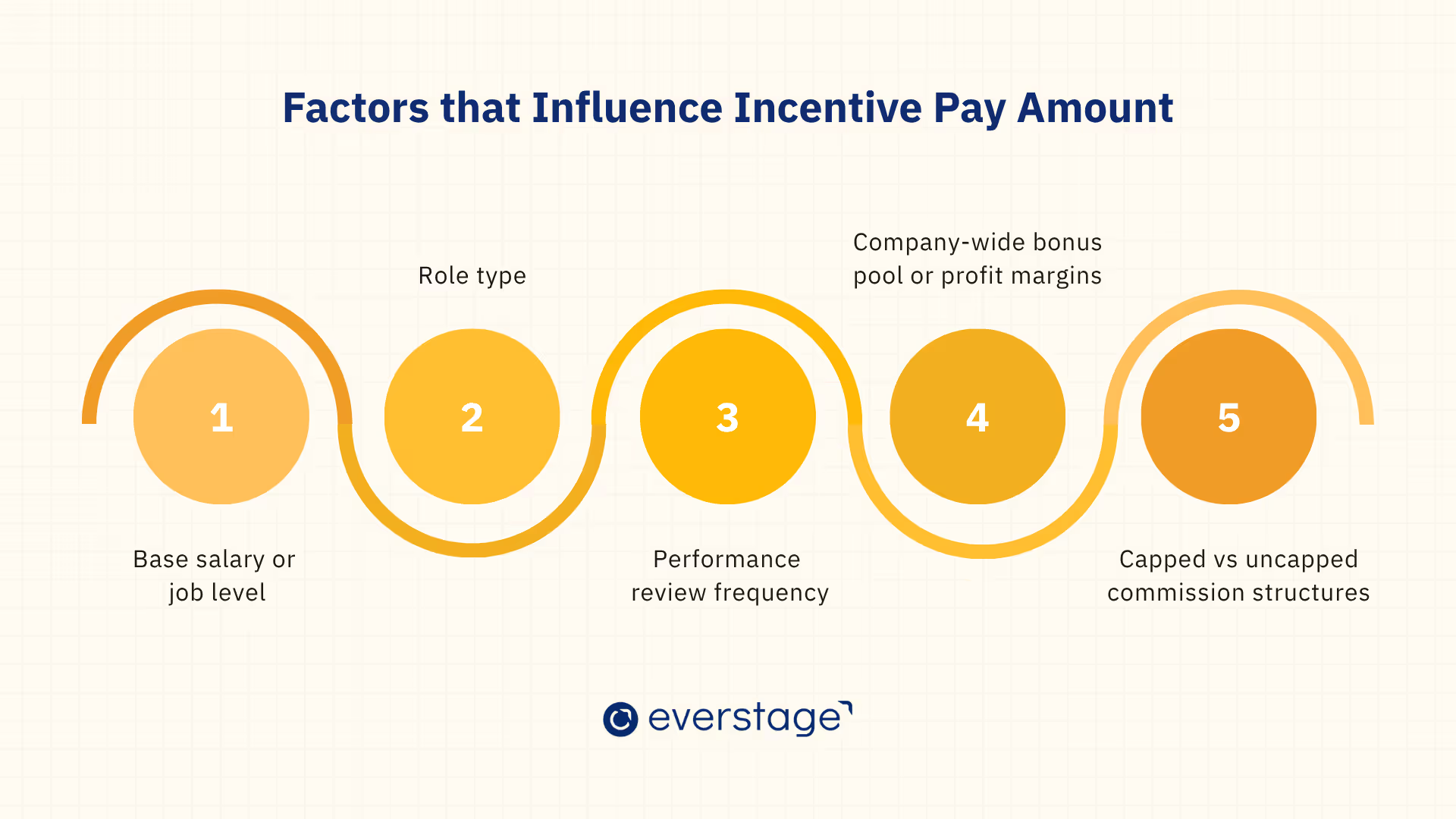
Even when employees achieve similar results, their incentive pay may differ because multiple variables affect the final calculation. Understanding these factors helps companies design fair systems and allows employees to set realistic expectations for their earnings.
1. Base Salary or Job Level
Seniority and base compensation shape how much incentive pay an employee earns. Senior-level employees may receive higher multipliers or larger bonus percentages because their responsibilities and impact on business outcomes are greater.
For instance, an executive responsible for a division's performance may earn a higher percentage of company profits, while an entry-level analyst might earn a flat bonus tied to task completion.
The approach keeps incentives proportionate to decision-making authority. Fairness gets tricky when junior employees see large gaps and miss the rationale behind them.
2. Role Type
The nature of the job strongly determines how incentive pay is calculated. Sales roles carry variable compensation like commissions and accelerators, because performance ties directly to revenue.
Support and operational teams usually carry capped bonuses, since their contributions are harder to measure in dollars.
For example, a call center agent may receive a quarterly performance bonus tied to service quality, while a sales executive's incentive is tied to closed revenue.
Designing incentives that reflect the unique value of each role ensures alignment with business priorities while maintaining fairness across functions.
3. Performance Review Frequency
Frequency of performance assessment affects both the size and timing of incentive payouts. Annual reviews often lead to larger, lump-sum bonuses tied to overall results for the year, which can feel rewarding but distant.
Quarterly or even monthly reviews break incentives into smaller, more frequent payouts, providing employees with regular feedback and reinforcing motivation. Organizations in fast-moving industries, such as technology or retail, favor shorter review cycles to keep employees engaged.
On the other hand, industries with long project timelines may prefer annual reviews to account for extended performance periods.
4. Company-Wide Bonus Pool
A company-wide bonus pool sets the ceiling on what any team can earn. Many organizations allocate a bonus pool that fluctuates with profitability or overall business performance.
In strong financial years, payouts may be generous across departments. In weaker years, even high-performing employees may see reduced bonuses because the pool is smaller.
The pool ties rewards to company health and links individual contributions to sustainability. It also introduces frustration when employees deliver strong results but payouts are limited by external financial conditions. Clear communication about how the bonus pool is determined is key to maintaining trust.
5. Capped vs. Uncapped Plans
Incentive pay structures can be capped, placing a ceiling on earnings, or uncapped, allowing top performers to earn without restriction. Capped plans help organizations control costs and maintain predictability, but they may reduce motivation once the ceiling is reached.
Uncapped plans drive extraordinary results, especially in sales roles, but they can also strain budgets if not carefully designed.
A sales rep might earn commission on every dollar sold with unlimited upside, while a service manager's bonus caps at a fixed percentage of salary.
The decision between capped and uncapped depends on the balance between cost control and the desire to encourage overperformance.
Each of these factors shapes how incentive pay is calculated in practice, and together they determine the perceived fairness and effectiveness of compensation plans.
Employees stay more motivated when they understand what they earn and why it differs from colleagues in other roles.
To put these factors into practice and design incentives that directly drive measurable revenue growth, this resource can help you get started.
Common Mistakes to Avoid While Calculating Incentive Pay
Even well-designed incentive pay systems can fail if their execution is flawed. Missteps in calculation or communication can quickly erode employee trust and reduce the motivational impact of incentives.
Below are some of the most common mistakes organizations make when determining how incentive pay is calculated and why avoiding them is essential.
1. Overcomplicating Formulas
Complex incentive structures with too many variables make it difficult for employees to understand how their pay is determined. When staff struggle to calculate their own earnings, they lose sight of the link between effort and reward.
For example, cramming revenue growth and client satisfaction into one formula sounds thorough but breeds confusion. Simpler, transparent formulas improve engagement and cut disputes over miscalculations.
2. Setting Unrealistic Goals
Another frequent mistake is setting targets that are unattainable. If employees repeatedly fall short despite strong performance, they begin to view incentive pay as meaningless. Over time, this leads to disengagement and turnover.
For instance, tying bonuses to revenue growth targets that exceed realistic market potential discourages teams instead of motivating them. The best systems set stretch goals that challenge employees while staying achievable. Employees then feel rewarded for incremental progress and peak performance.
3. Poor Communication
Even a fair and well-designed incentive plan can fail if it is not communicated clearly. Employees need to understand the eligibility criteria and when payouts occur.
Lack of communication leads to misunderstandings, with employees often assuming favoritism or hidden rules are in play. Rep disputes often begin here, when Finance reconciliation and CRM data errors surface gaps no one can trace. Strong organizations use consistent channels like onboarding sessions and dashboards to explain structures and track progress. Transparency reduces uncertainty and reinforces trust in leadership.
4. Ignoring Edge Cases
Incentive plans often overlook scenarios like mid-period hires and extended leave. Failing to account for these cases creates inequities where some employees are overpaid or underpaid relative to their contributions.
For example, a new hire who joins two months into a six-month cycle might expect a prorated bonus, but if the policy is unclear, disputes will arise. Addressing these situations with clear, written policies ensures fairness and prevents morale issues.
5. Failing to Review Regularly
Business priorities shift, and incentive pay plans should shift with them. A system that worked last year may fail today after shifts in market conditions or company goals. Companies that fail to revisit their incentive structures risk misalignment with current business strategy.
The challenge extends beyond compensation. A Gallup report found that 56% of employees review their performance goals with a manager once a year or less. Infrequent check-ins drive disengagement and misalignment. Incentive pay plans face the same risk when they are reviewed too infrequently.
For example, a bonus structure built for fast growth can fall out of step once the company shifts toward profitability. Regular reviews keep incentives relevant and financially sustainable.
Keep plans simple and current, and your pay-for-performance system does its job. It motivates employees while supporting long-term goals.
Tools for Calculating Incentive Pay: Spreadsheets vs. Automation
Calculating incentive pay manually can be prone to errors, especially as the complexity of performance metrics increases. Inconsistent calculations can trigger employee dissatisfaction and even legal disputes.
The right tools streamline the process and reduce human error, from a small team to a large sales organization.
1. Excel or Google Sheets: Simple but Effective
Excel and Google Sheets work well for smaller teams with simple compensation structures. These programs let companies customize formulas and calculate payouts with no specialized software.
Operational impact:
- Customizability: Ability to tailor the calculation methods to your specific needs. Easy to implement any type of compensation model.
- Cost-Effectiveness: They skip extra software and training costs, making them a low-cost, easy-to-use option.
- Transparency: Allows employees to easily access the formula and verify how their incentive pay was calculated. It fosters a sense of trust and clarity, especially in roles where performance and rewards are directly tied to measurable goals.
When Spreadsheets Stop Working for Incentive Pay Calculations
Spreadsheets can work for simple incentive plans and small teams. They grow harder to trust as plans add more roles and payout rules.
- When plans include accelerators, clawbacks, or split credits
- When reps need real-time earnings visibility
- When Finance needs audit-ready payout records
- When disputes increase because calculations are hard to verify
- When commission cycles take days or weeks to close
- When CRM, finance, and payroll data must be reconciled manually
Sales commissions rank among the most common and most complex forms of incentive pay. As teams add quotas and accelerators, commission calculations demand more governance than a standard bonus plan.
2. Incentive Compensation Software: Automation and Real-Time Adjustments
As businesses grow and the complexity of incentive pay systems increases, many companies move to more specialized incentive compensation software. Tools like Everstage offer a comprehensive solution for automating the entire incentive pay process.
These platforms handle large data volumes and provide real-time adjustments from performance data.
Operational impact
- Accuracy: Reduce manual errors, helping ensure that incentive pay is calculated correctly every time. These tools pull performance data from CRM and accounting systems, then apply the right formulas based on the company's compensation structure.
- Real-Time Adjustments: Ability to make real-time adjustments. Keeps the process flexible and responsive, ensuring that employees are rewarded as soon as their performance changes.
- Scalability: Easily scale with your organization, handling multiple roles and territories. It's especially useful for companies that employ complex tiered compensation structures or operate in multiple regions with different pay structures.
- Integration with Other Systems: Many software solutions integrate with other business systems, such as CRM tools and payroll systems. This helps streamline the entire process, ensuring that sales data and performance metrics are seamlessly connected to pay calculations.
Why teams automate incentive pay
As plans become more complex, manual spreadsheets make it harder to maintain accuracy and auditability. Incentive compensation platforms help teams standardize logic and give stakeholders a shared source of truth.
How Everstage Helps Automate Incentive Pay Calculations
Everstage helps compensation teams move past spreadsheet calculations. It automates plan logic and syncs performance data, giving reps and managers real-time visibility into earnings. For teams juggling quotas and accelerators, it cuts manual effort while improving payout accuracy and trust.
3. Custom Templates and Excel Integrations
Custom templates bridge the gap between manual methods and full automation. Many incentive compensation tools allow for custom Excel template integrations, where the base data can be managed in Excel, but the calculations and reporting can be automated through a centralized system.
Operational impact
- Flexibility: Offer the flexibility of using Excel for easy tracking, while the software handles complex calculations and real-time adjustments.
- Ease of Use: Allows businesses to retain familiarity with their existing workflows while benefiting from the accuracy and scalability of automated systems.
Calculating incentive pay accurately is critical to keeping employees motivated and ensuring that performance is fairly rewarded. Simple spreadsheets or advanced software, the goal stays the same. Build a system that is accurate and scalable.
When employees understand how their incentives are calculated and can see the results in real time, they're more likely to stay engaged and motivated. Companies that rely on performance-based pay find automated tools essential for maintaining fairness and consistency as they scale.
Make Incentive Pay Fair, Transparent, and Scalable
When calculated and communicated correctly, incentive pay becomes the most precise signal a company can send about what it truly values. The flip side holds too. Unclear incentive pay breaks trust faster than any missed bonus.
As businesses lean harder on performance-linked pay in roles like sales and customer success, precision becomes more than a finance task. It's a leadership responsibility. A misstep in the formula or payout logic is more than a compensation error. It's a culture risk.
Leading companies aim past calculating incentive pay. They engineer it. That means pairing clean math with clear goals. It means building systems that adapt as performance changes, so employees can audit their own earnings on demand.
Companies that get incentive pay right retain top performers and keep teams focused on the metrics that move revenue.
Incentive pay works best when every stakeholder understands the rules and sees how performance turns into rewards. For small teams, spreadsheets may be enough. As plans add quotas and accelerators, manual math gets harder to scale.
Everstage helps teams automate calculations and reduce disputes across the compensation cycle.
Book a free demo today to see how Everstage can simplify incentive compensation for your team.
Questions worth asking
The things most people want to know before they commit.
What is a 5% incentive?
A 5% incentive means the payout equals 5% of a defined base like salary or revenue. For example, a 5% commission on $50,000 in eligible revenue equals $2,500. Confirm which base the percentage applies to before you calculate.
What is a 20% incentive?
A 20% incentive means the payout equals 20% of a defined base like base salary or eligible revenue. For example, a 20% incentive on a $40,000 base salary equals $8,000. The plan design determines which base applies.
What is the difference between incentive pay and commission?
Commission is a specific type of incentive pay, usually a percentage of sales or revenue. Incentive pay is the broader category and also covers flat bonuses and team payouts. All commissions are incentive pay, though incentive pay stretches well beyond commission.
How can companies reduce disputes in incentive pay calculations?
Companies reduce disputes by documenting plan rules clearly and giving reps visibility into earnings. Source-of-truth data and an audit trail for changes help too. Disputes climb when payout logic lives in disconnected spreadsheets or exceptions get handled manually.
Can incentive compensation software handle accelerators, clawbacks, and split credits?
Yes. Incentive compensation software manages complex payout rules like accelerators, clawbacks, and split credits. Exact capabilities depend on the platform and implementation, so validate these requirements during evaluation.
What is an accelerator in incentive pay calculation?
An accelerator is a higher commission rate triggered after a rep surpasses their sales quota. For instance, a rep might earn 10% up to quota and 15% on revenue beyond quota. Accelerators are designed to reward and further motivate high performers.