
.avif)
TL;DR
Sales effectiveness strategy aligns people, processes, and technology to improve win rates, deal size, and revenue predictability across the entire sales cycle.
- Focus on doing the right things, not just more things, to drive consistent performance
- Build frameworks that measure effectiveness with outcome-based metrics
- Enable teams with AI tools, structured coaching, and data-led insights
- Align sales, marketing, and customer success for scalable growth
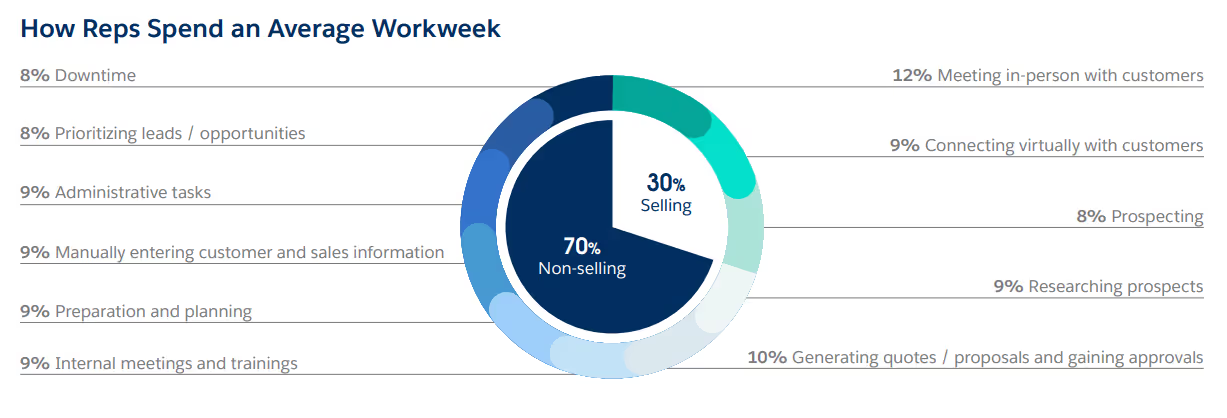
Here’s a hard truth: most sales teams confuse being busy with being effective. Reps often rush from one call to another, but activity doesn’t always equal impact. In fact, according to Salesforce’s State of Sales Report, reps spend just 30% of their week actually selling; the rest goes into admin tasks, meetings, and internal coordination.
In today’s complex B2B environment, where buying decisions involve 6–10 stakeholders and longer deal cycles, activity for the sake of volume simply doesn’t work. You can’t email your way to higher win rates.
The real challenge? Most sales leaders still rely on efficiency metrics like “calls made” or “emails sent” to gauge success. But those numbers don’t tell you if your team is targeting the right accounts or closing the right deals.
This blog dives into proven frameworks, models, and enablement levers you can use to turn effort into effectiveness and build a strategy that scales predictable, profitable growth.
To start, let’s define what a sales effectiveness strategy really means, and why it’s not the same as efficiency.
What Is a Sales Effectiveness Strategy?
A sales effectiveness strategy is a structured approach to aligning your people, processes, and technology so that your team consistently achieves desired outcomes, higher win rates, larger deal sizes, and shorter sales cycles. It’s about doing the right things, not just more things.
Think of it like this:
- Efficiency means doing things right, sending more emails, making more calls, and automating tasks.
- Effectiveness means doing the right things, focusing on the best-fit accounts, engaging the right stakeholders, and moving deals forward strategically.
For example, imagine two sales teams. Team A doubles its email volume this quarter but sees no meaningful pipeline growth. Team B, however, spends time refining its ICP, targets fewer but higher-value accounts, and increases deal size by 25%. That’s the sales difference between efficiency and effectiveness.
An effective strategy integrates data-driven insights, performance metrics, and continuous coaching to refine execution. It also ensures alignment across sales, marketing, and customer success, creating a seamless experience for buyers and driving consistent, predictable growth.
Now that we know what sales effectiveness really means, let’s explore why it matters more than efficiency in today’s evolving buying environment.
Why “Effectiveness” Matters Over “Efficiency” Today
Let’s be honest, efficiency alone doesn’t close deals anymore. Today, buyers are more informed, cautious, and collaborative than ever. According to Gartner, an average B2B purchase now involves 6 to 10 decision-makers, each armed with independent research before even talking to sales.
That means if your reps are only focused on activity volume, more calls, more demos, more emails, they’re likely spinning their wheels. You can have the most efficient team in the world, but without effectiveness, they’ll just become faster at losing deals.
Efficiency is about speed; effectiveness is about impact. Research from Salesforce shows that high-performing sales organizations are 2.3x more likely to document their sales effectiveness strategies than underperforming teams. The reason is simple: effectiveness is about impact, not output.
As sales coach Federico Presicci puts it, “Effectiveness is about the impact of seller actions on the buyer’s decision.” It’s not just about how fast you move; it’s about how intentionally you move.
So, how do you turn this idea into a repeatable, measurable system? It starts with building a sales effectiveness model that connects people, processes, and technology around shared goals.
Core Pillars of a Sales Effectiveness Model
.avif)
Every strong sales effectiveness strategy stands on four core pillars — People, Process, Technology, and Alignment.
When these elements work together, they turn a sales organization from reactive to repeatable, from effort-driven to outcome-driven.
1. People
Your people are the foundation of effectiveness. When sales teams have clear roles, continuous coaching, and structured training, they perform with confidence and clarity. Skill-based development ensures that every rep focuses on what drives outcomes, building trust, understanding buyer needs, and closing high-quality deals.
2. Process
Process gives structure to performance. A consistent sales methodology, whether it’s SPIN, MEDDIC, or Challenger, ensures that every stage of the buyer journey is executed with purpose. Standardized pipeline definitions, deal reviews, and opportunity scoring help teams make decisions based on sales data rather than intuition.
3. Technology
Technology enables scale and visibility. A well-adopted CRM paired with intelligent analytics helps leaders identify trends, measure performance, and predict outcomes accurately. Conversation intelligence, automation, and forecasting tools empower teams to focus on selling, not managing admin tasks.
4. Alignment
Alignment is where effectiveness truly compounds. When sales, marketing, and customer success operate with shared goals and metrics, they create a unified customer experience. This alignment improves lead quality, strengthens retention, and drives consistent revenue growth.
Each pillar directly impacts key outcomes:
- People → boosts win rates and rep performance
- Process → shortens B2B sales cycles and standardizes execution
- Technology → improves visibility and predictability
- Alignment → increases retention and deal quality
When these four pillars operate in sync, sales effectiveness becomes measurable, and scalable.
Now that you understand the pillars, the next question is: how do you know if your model is actually working? That’s where measurement comes in.
Metrics That Truly Measure Effectiveness
Sales effectiveness isn’t about how much your team does; it’s about what results their actions produce. Measuring effectiveness means shifting focus from volume metrics like calls or emails to outcome-based indicators that reveal the real impact of your strategy.
1. Win Rate
Your win rate reflects how effectively your team turns qualified opportunities into closed deals. A consistent increase in this metric signals stronger qualification processes, better buyer understanding, and more precise execution across the funnel.
2. Quota Attainment
This metric measures how many reps hit or exceed their targets. When a large percentage of your team meets sales quota, it shows that your sales systems, processes, enablement, and leadership are supporting performance, not hindering it.
3. Average Deal Size
Deal size tells you how effectively your reps identify and engage with high-value prospects. It also shows how well they can position your solution’s value to match complex buyer needs. Larger deal sizes often mean better targeting and deeper customer alignment.
4. Sales Cycle Length
Shorter sales cycles typically indicate that your team has refined its messaging, improved qualification criteria, and removed bottlenecks in the process. Long cycles can highlight issues in buyer alignment or unclear internal processes.
5. Customer Lifetime Value (CLV)
Sales effectiveness doesn’t end once the contract is signed. CLV tracks the revenue a customer generates over time, connecting sales performance to customer retention and advocacy. A focus on CLV ensures teams aren’t just chasing short-term wins but building long-term value.
Role-Based Metrics
Effectiveness also looks different across functions. SDRs can measure meeting-to-SQL conversion, AEs focus on pipeline-to-close ratios, and CSMs track renewal and expansion rates. Together, these create a 360° view of revenue impact.
The takeaway? Real sales effectiveness comes from combining qualitative insights, like buyer feedback and rep confidence, with quantitative metrics that show progress over time.
Once you’ve defined how to measure success, the next step is to design a framework that helps you improve these numbers consistently.
A Proven Framework to Build Your Strategy
.avif)
Building a sales effectiveness strategy isn’t about adding more tools or meetings; it’s about creating a repeatable system that helps your team sell smarter, not harder.
A structured framework keeps every effort aligned with outcomes that actually move the revenue needle. Here’s how to build it step by step:
1. Define Business Outcomes
Before diving into tactics, get crystal clear on why you’re building this strategy. What outcomes do you want to achieve: higher win rates, shorter sales cycles, or increased revenue per rep?
How to do it:
- Align with leadership on 2–3 measurable business goals.
- Translate those into sales metrics (e.g., “reduce sales cycle by 20%” or “improve win rate from 18% to 25%”).
- Document what success looks like for every function, SDRs, AEs, and CSMs, so everyone knows what they’re driving toward.
This step ensures your strategy has direction, not just motion.
2. Diagnose Current Effectiveness
You can’t fix what you don’t understand. This phase is about identifying what’s working and what’s holding your team back.
How to do it:
- Audit your sales process, from lead qualification to post-sale follow-up.
- Analyze rep performance data (win rates, deal velocity, activity levels).
- Conduct interviews or surveys with sales reps and managers to uncover pain points in tools, training, and enablement.
- Compare your current outcomes with industry benchmarks to find gaps.
This gives you a clear picture of where performance is lagging, whether it’s due to unclear messaging, lack of product knowledge, or poor CRM usage.
3. Design Your Enablement Blueprint
Once you know the gaps, it’s time to close them with structured enablement and process design.
How to do it:
- Build clear sales playbooks for different buyer personas and deal stages.
- Create training modules and bite-sized refreshers around negotiation, objection handling, and storytelling.
- Introduce content systems (like battle cards and ROI calculators) to help reps position value quickly.
- Pick tools that simplify work, CRMs with automation, conversation intelligence for coaching, and dashboards that visualize KPIs.
Think of this blueprint as your “sales GPS”, a guide that helps every rep stay on course, even as the market shifts.
4. Pilot Before Scaling
Rolling out change across your entire org can backfire if untested. A pilot phase lets you refine your strategy before full deployment.
How to do it:
- Select one team, segment, or geography for your pilot.
- Set a 60–90 day test window with clear KPIs (e.g., win rate, meeting-to-deal conversion).
- Collect both quantitative and qualitative feedback.
- Refine your process and playbooks based on real-world results.
A successful pilot builds momentum, internal champions, and proof of ROI before scaling company-wide.
5. Review and Refine Continuously
Sales effectiveness isn’t a “set it and forget it” strategy; it’s a living system. Regular reviews ensure it adapts to new products, market shifts, and buyer behaviors.
How to do it:
- Conduct quarterly effectiveness reviews using dashboards and team retros.
- Identify patterns, where reps excel and where deals stall.
- Refresh training content, update your playbooks, and revise sales goals based on insights.
- Encourage feedback loops between sales, marketing, and product teams to keep the strategy aligned.
The best sales teams treat optimization as culture, not a task.
When done right, this framework turns scattered sales efforts into a synchronized engine that drives consistent team performance. It helps every rep know what to focus on, how to execute better, and why their work matters.
Also read → 10 Sales Performance Tips That Actually Work in 2026
The Three Pillars of Sales Effectiveness: People, Process, and Technology
A great strategy only works when it’s powered by the right people, guided by the right processes, and supported by the right technology. Think of these as the three pillars that hold up your entire sales effectiveness system. When one weakens, performance drops. When all three align, you get predictable, scalable growth.
1. People: Building High-Performing Sales Teams
Even the best playbooks fail if your people aren’t empowered to use them. Your sales team is your growth engine, and their effectiveness depends on clarity, confidence, and continuous learning.
How to strengthen this pillar:
- Hire for potential, train for performance: Look beyond experience. Hire reps with curiosity, coachability, and resilience, and invest in training that sharpens skills around consultative selling and storytelling.
- Define clear roles and expectations: Avoid overlap between SDRs, AEs, and CSMs. When responsibilities are clearly divided, accountability improves, and handoffs become smoother.
- Create a coaching culture: Move beyond one-off performance reviews. Use regular 1:1s, peer shadowing, and call recordings to drive consistent skill development.
- Reward progress, not just results: Recognize effort that contributes to long-term success, like improved conversion rates or better qualification, not just deal volume.
Effective salespeople thrive in environments that balance autonomy with support, and your job as a leader is to build exactly that.
2. Process: Turning Chaos into Consistency
A repeatable process is what turns good salespeople into great ones. It removes guesswork and ensures everyone follows a proven path to close deals faster.
How to strengthen this pillar:
- Map the full sales journey: Document every stage, from lead handoff to post-sale follow-up. Define clear exit criteria at each step to eliminate bottlenecks.
- Standardize qualification: Use frameworks like BANT or MEDDIC to ensure reps focus on the right prospects. Consistency here improves forecast accuracy and deal quality.
- Build alignment across teams: Sync sales, marketing teams, and product around shared goals and messaging. This ensures every lead gets the same, cohesive experience.
- Document and refine: Create a living process document accessible to everyone, and update it quarterly based on data and team feedback.
When your process runs smoothly, reps stop wasting time reinventing the wheel and start closing faster.
3. Technology: Scaling Effectiveness Through Data and Automation
Technology doesn’t replace your team, it amplifies their impact. The right tools free reps from manual work, surface real-time insights, and help leadership make smarter, faster decisions. This is where Everstage becomes a core driver of sales effectiveness.
How to strengthen this pillar:
- Audit and simplify your tech stack: Remove redundant tools and ensure data flows seamlessly across CRM, enablement, and analytics platforms. Everstage integrates easily with your CRM to centralize performance data, automate calculations, and eliminate spreadsheet chaos.
- Automate repetitive tasks: Let automation handle commissions, data entry, and reporting. With Everstage, teams can automatically track earnings, goals, and performance dashboards, reducing admin time and boosting motivation.
- Leverage real-time analytics: Use Everstage’s insights to monitor quota attainment, incentive impact, and sales pipeline health in real time. This helps leaders identify performance gaps before they become revenue leaks.
- Enable transparency and trust: Everstage gives reps visibility into their earnings and progress, removing confusion around payouts and driving accountability across teams.
When you layer in a platform like Everstage Planning, you gain real-time visibility, streamline resource allocation, and align compensation with performance to lock in outcomes.
And when people, process, and technology work in harmony, your sales strategy becomes more than just a plan; it becomes a performance system.
Pitfalls & Alignment Challenges (and How to Overcome Them)
Even the most well-designed sales effectiveness strategy can fall apart in execution. Many organizations get stuck in the details, measuring too much, misaligning teams, or undervaluing enablement.
The good news? These pitfalls are fixable with the right systems and mindset.
Pitfall 1: Overcomplicating frameworks
When every metric seems important, nothing truly is. Teams often track 20+ KPIs, but reps can’t focus when goals shift constantly.
Fix: Limit your framework to fewer than six core KPIs that directly influence revenue, such as win rate, pipeline coverage, quota attainment, and deal velocity. Use Everstage dashboards to visualize these metrics and simplify what success looks like across the org.
Pitfall 2: Sales vs. Marketing misalignment
When Marketing measures MQLs and Sales measures closed deals, both teams pull in different directions. This gap creates friction and lost opportunities.
Fix: Align around shared revenue OKRs. Build a joint funnel where both teams own conversion metrics like SQL-to-opportunity rate or influenced pipeline. Regular syncs and unified dashboards foster shared accountability and faster feedback loops.
Pitfall 3: Underinvestment in training
Most companies treat sales training as a one-off event, not a continuous process. The result? Skills decay, and reps revert to old habits within weeks.
Fix: Create an ongoing enablement culture. Integrate micro-learning modules, peer-led sessions, and manager-led coaching into weekly rhythms. Recognize and reward reps who actively upskill, it builds consistency and confidence.
Pitfall 4: Obsession with volume metrics
Celebrating dials made or emails sent may look productive, but they don’t guarantee progress. Volume-driven KPIs reward activity, not impact.
Fix: Shift focus toward buyer outcomes. Track win rates, deal quality, and customer retention instead of raw activity. Use tools like Everstage to surface insights that tie performance back to meaningful results.
By avoiding these pitfalls, leaders can move from theory to execution, building teams that not only perform but perform with purpose.
Conclusion
Sales effectiveness isn’t about pushing harder; it’s about selling smarter. Throughout this guide, we’ve explored how aligning people, process, and technology helps teams close the right deals, improve win rates, and build predictable revenue growth.
You’ve seen how effectiveness is about quality, not quantity, doing the right things, with the right customers, at the right time.
Now, it’s time to put it all together. Start by defining what “success” looks like for your team, whether that’s improving win rates, shortening deal cycles, or boosting expansion revenue. Then, benchmark your current performance and identify the gaps. Use structured frameworks, consistent coaching, and integrated tools to close those gaps one step at a time.
Remember, effectiveness isn’t built overnight. It’s built through focus, alignment, and iteration. The best sales organizations don’t rely on luck; they rely on clarity, data, and execution.
And if you want to bring all of that together in one place, your planning, performance, and payout insights, book a demo with Everstage. You’ll see how Everstage helps sales leaders turn strategy into measurable success by aligning incentives, automating visibility, and driving accountability across every stage of the revenue process.
Questions worth asking
The things most people want to know before they commit.
What is a sales effectiveness strategy?
A sales effectiveness strategy is a structured framework that aligns people, processes, and technology to improve win rates, deal size, and overall sales performance. It focuses on doing the right things, not just more things, by optimizing execution, coaching, and data-driven decision-making to drive consistent, predictable revenue growth.
How do I build an effective sales effectiveness framework?
Building a sales effectiveness framework involves diagnosing performance gaps, defining measurable outcomes, and aligning enablement programs with business goals. The process includes standardizing workflows, introducing consistent coaching models, and using analytics to identify improvement areas. A well-built framework ensures teams are empowered to execute with precision and accountability.
What metrics should I track to measure sales effectiveness?
Essential metrics for measuring sales effectiveness include win rate, quota attainment, average deal size, pipeline velocity, and customer retention. These indicators focus on the quality of sales activities rather than volume, enabling leaders to identify where strategies are working and where intervention or training is needed.
How does sales effectiveness differ from sales enablement?
Sales enablement provides teams with the resources, tools, and training they need to sell effectively. Sales effectiveness, on the other hand, evaluates how well those efforts translate into measurable results. Enablement supports readiness; effectiveness measures impact and continuously optimizes for better outcomes.
How can data and analytics improve sales effectiveness?
Data and analytics enhance sales effectiveness by identifying performance bottlenecks, predicting deal success, and revealing which behaviors drive the best outcomes. Analytics enable real-time feedback loops and informed decision-making, helping teams focus efforts where they matter most and forecast revenue more accurately.
What are the 2026 trends shaping modern sales effectiveness?
In 2026, sales effectiveness is being reshaped by AI-driven performance insights, automation of administrative tasks, and stronger alignment between marketing and sales. Organizations are focusing on adaptive coaching, predictive analytics, and outcome-based enablement strategies that blend human expertise with intelligent tools to sustain growth.