


Spiff vs Performio: 2026 In-Depth Comparison
Modern sales compensation software presents organizations with strategic choices between commission calculation approaches and payout transparency. Spiff and Performio deliver automated processing through distinctly different methodologies.

Introduction
Sales teams and finance leaders rely on commission software to reduce manual work and improve accuracy in incentive payouts. Without it, organizations often fall back on spreadsheets or homegrown tools that create reconciliation errors and leave employees questioning their earnings. This has pushed companies to explore platforms like Spiff and Performio. Spiff positions itself as a solution that simplifies commission tracking, while Performio is marketed as a configurable platform with features designed to manage complex incentive plans. Both are intended to bring order to processes that otherwise consume valuable time and resources.
Once implemented, the tradeoffs become more apparent. Spiff can be quick to adopt but introduces rigid structures that limit flexibility and make scaling plans more difficult. Performio provides more configuration options but requires additional admin effort and can become tedious as complexity increases. Both tools address the core need of getting commissions calculated and paid, yet challenges in adaptability and ease of management remain. Everstage provides a modern alternative with no-code plan design, real-time processing, predictive insights, and rapid deployment, allowing organizations to bypass the issues that slow down traditional approaches.
If you are still building a shortlist rather than choosing between these two, start with the top Performio alternatives.

Head-to-Head Comparison
Setup & Admin Configuration
Functionality | Spiff | Performio | Everstage |
|---|---|---|---|
Data management | Syncs with Salesforce well, but integrations outside are still limited. | Imports from varied data sources, though setup can need admin effort. | Native integrations with CRMs, ERPs, HRIS with real-time bi-directional sync. |
Plan modeling | Low-code builder offers speed, but lacks sandbox for safe testing. | Block-based builder simplifies plans, though advanced use needs effort. | No-code drag-and-drop builder with sandbox and Time Machine simulations. |
Permissions & access | Record locks aid audits, but flexibility in custom roles is restricted. | Role-based access with audit logs, though customization is limited. | Granular RBAC with audit trails, combining flexibility and compliance. |
Quota management | Quotas tied to CRM objects, making it rigid beyond Salesforce usage. | Quotas and thresholds supported, though updates across roles are tedious. | Automated quota engine adjusts dynamically to territories and role changes. |
Commission Processing
Functionality | Spiff | Performio | Everstage |
|---|---|---|---|
Payout approvals | Lightweight approval flows work, but scaling is difficult for enterprises. | Approval workflows exist, but advanced conditional logic can be limited. | Automated workflows with customizable approvals for scaling across teams. |
Contextual overrides | One-off overrides are possible, but messy and hard to track at scale. | Overrides are logged with audit history, though complex ones add effort. | Flexible override system with full audit trails ensures compliance and agility. |
Query resolution | In-app commenting helps resolve disputes, but remains manual overall. | Queries handled in portal, though resolution still relies on admin input. | AI-powered query resolution provides instant and auditable responses. |
Contract management | No native contract workflows; often needs Salesforce-based add-ons. | Contract logic supported, though full lifecycle and e-signature are absent. | Built-in contract workflows with e-signature integrations and automation. |
User management | Bulk uploads supported, but Salesforce-heavy setup adds complexity. | Role and hierarchy management supported, though scaling can be rigid. | Lifecycle user management with granular control across roles and regions. |
Insights & Reporting
Functionality | Spiff | Performio | Everstage |
|---|---|---|---|
Real-time calculations | Provides real-time updates in Salesforce, but scale can create limits. | Real-time dashboards supported, though large volumes may cause delays. | True real-time processing across systems for instant payout visibility. |
Payout forecasting | Basic what-if tied to CRM deals, accuracy depends on clean CRM data. | Forecasting supported, though complex scenario modeling needs support. | Crystal-powered forecasting enables accurate, scenario-based simulations. |
Personalized dashboards | Rep dashboards exist, but customization options remain minimal. | Dashboards are configurable, though some users report feature limits. | BI-powered dashboards deliver predictive and customizable role insights. |
The Limitations of Spiff and Performio

Implementation & Time-to-Value

Flexibility & Integrations

User Experience

Pricing Transparency & Support

Scalability Challenges

Security & Compliance
Voice of the Customer
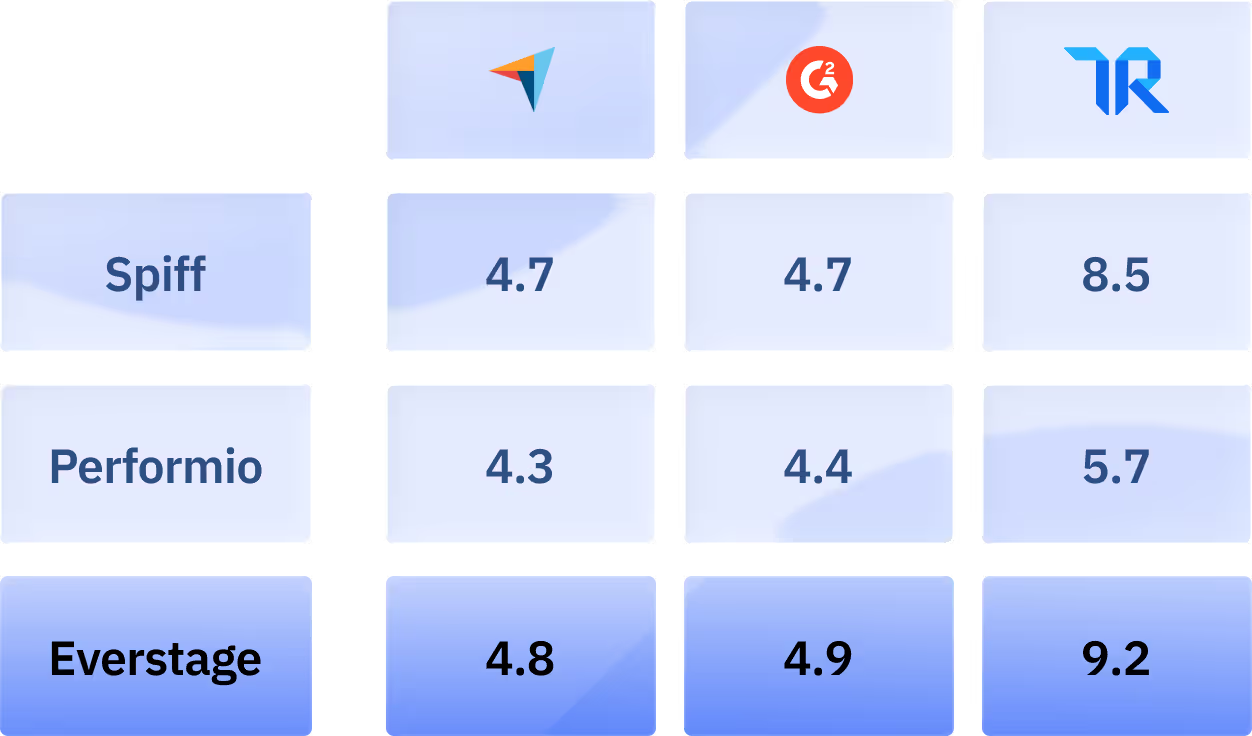
Customer reviews offer an unfiltered look at how each platform performs in real-world environments. Below is a snapshot of feedback themes taken from G2, Capterra, and TrustRadius.




Spiff vs Performio: Finding the Balance
Spiff and Performio both aim to replace spreadsheets in commission management, but they take different paths. Spiff positions itself around low-code interfaces, while Performio focuses on configurability to support incentive plans. Both approaches, however, can create hurdles when scaling programs, managing administrative workload, and maintaining seamless integrations.
Across evaluations, we often hear similar priorities:
- Finance leaders value faster implementation cycles and predictable costs.
- RevOps teams want reliable testing environments and intuitive plan design.
- Executives look for transparency, scalability, and clear ROI.


For organizations that want enterprise-grade capabilities without long rollouts or added complexity, Everstage is designed to provide that balance
Frequently asked questions
Is there a strong alternative to Spiff and Performio?
Yes. Everstage solves Spiff’s rigidity and Performio’s admin overhead. With no-code design, real-time processing, and predictive insights, Everstage balances flexibility, scale, and speed without long rollouts or complex upkeep.
Is Spiff better than Performio for simplicity?
Spiff provides a simplified experience for smaller teams, while Performio is configurable but admin-heavy. Everstage delivers both simplicity and configurability with no-code tools and real-time flexibility that scales with growing organizations.
Which platform manages integrations and data handling better between Spiff and Performio?
Spiff integrates well in narrow ecosystems but struggles beyond that. Performio handles varied sources but needs admin upkeep. Everstage offers seamless native integrations across CRMs, ERPs, and HRIS, with real-time sync and no manual work.
How do implementation timelines of Spiff compare with that of Performio?
Spiff rollouts often extend beyond 6 months due to partner reliance. Performio requires time for configuring multiple plans. Everstage goes live in 6–8 weeks with in-house onboarding, delivering faster adoption and predictable timelines.
What are the hidden costs I should watch for when evaluating Spiff or Performio?
Spiff adds onboarding surcharges, per-user fees, and partner costs. Performio adds services for data setup and admin effort. Everstage eliminates these with all-inclusive pricing, proactive support, and no hidden services or upgrade fees.
Between Spiff and Performio, which platform provides better ongoing support?
Spiff’s support quality dropped post-acquisition, and Performio often requires added services. Everstage includes proactive, in-house support as standard, with dedicated customer success managers for consistent help and faster resolutions.