


Quotapath vs Xactly: 2026 In-Depth Comparison
Commission platform evaluations contrast emerging transparent solutions with established enterprise systems. Quotapath and Xactly represent evolution from legacy calculation platforms toward simplified real-time visibility.

Introduction
Sales compensation software has evolved significantly, yet choosing the right platform remains complex for revenue teams. Quotapath and Xactly both operate in the commission management space, though they target different segments and take different approaches to solving similar problems. Xactly has been in the market for years, built on older infrastructure that reflects its origins. Quotapath emerged more recently with a focus on simplicity and commission tracking. Both aim to move organizations away from manual spreadsheets, but the path each takes comes with distinct considerations.
Each platform presents its own set of trade-offs. Xactly's legacy architecture results in long implementation cycles, heavy reliance on consultants, and limited flexibility when integrating with modern tech stacks. Quotapath, while easier to adopt initially, struggles with enterprise-scale complexity and lacks the robust admin controls needed for large, multi-tier commission structures. Both tools can calculate commissions, but gaps in scalability and operational efficiency remain. Everstage provides a modern alternative with no-code plan design, real-time processing, predictive analytics, and faster deployment, helping organizations avoid the constraints that slow both aging platforms and less scalable solutions.

Head-to-Head Comparison
Setup & Admin Configuration
Functionality | Quotapath | Xactly | Everstage |
|---|---|---|---|
Data management | Built for smaller teams, handles basic CRM sync but struggles with complex datasets and large volumes. | Handles commission data reliably, but setup often requires spreadsheets and manual reconciliation. | Native integrations with CRMs, ERPs, HRIS; bi-directional Salesforce sync without ecosystem lock-in. |
Plan modeling | Simple backend designer limited to basic calculations and requires support help for changes. | Provides modeling tools, though more rigid and less flexible for advanced scenarios. | No-code drag-and-drop with sandbox + Time Machine for safe simulations. |
Custom permissions & access control | Provides basic role separation for admins and users, lacks detailed audit control and granularity. | Supports role-based access, though customization depth is limited. | Granular RBAC with detailed audit trails, balancing flexibility and compliance. |
Quota management | Manages quotas and attainment but updates need manual intervention and lag in CRM reflection. | Handles standard quota assignments, but adapting to dynamic structures is challenging. | Automated quota engine adapts to territories, hierarchies, and role changes. |
Commission Processing
Functionality | Quotapath | Xactly | Everstage |
|---|---|---|---|
Payout approvals | Approval workflows exist but lack automation and scalability for complex structures. | Approval processes are supported, but often involve manual workflows. | Customizable automated workflows streamline approvals across the org. |
Contextual overrides | Limited override flexibility and audit transparency, leading to dependency on support teams. | Adjustments are possible, though they may rely on manual steps with limited auditability. | Flexible override system with compliance-friendly audit trails. |
Query resolution | Delay in syncing commission data creates confusion, requiring manual clarification via support. | Commission questions are addressed, but visibility is often delayed until end-of-period. | AI-powered query resolution with instant, auditable answers. |
Contract management | Plan distribution and sign-off available but no full workflow or version tracking. | Can support contract-linked payouts, though workflows are fairly basic. | Built-in contract workflows include e-signatures and automation. |
User management | Simple hierarchy mapping but changes or team reassignments often need support intervention. | Provides admin controls, though heavy reliance on IT or consultants adds overhead. | Full lifecycle management across roles and geographies with intuitive setup. |
Insights & Reporting
Functionality | Quotapath | Xactly | Everstage |
|---|---|---|---|
Real-time calculations | Data updates take hours to reflect, causing visibility delays for reps and managers. | Processes payouts accurately, though calculations often run in batches with delayed visibility. | True real-time calculations across systems, ensuring instant payout visibility. |
Payout forecasting | Offers deal-based forecasts but lacks accuracy for variable or multi-rate plans. | Offers forecasting, but primarily retrospective with limited scenario testing. | Crystal-powered forecasting with precise, scenario-based payout simulations. |
Personalized dashboards | Limited reporting and analytics requiring backend help; lacks granular role-based visibility. | Dashboards exist, but analytics are limited and often supplemented with spreadsheets. | BI-powered dashboards with predictive, customizable insights for every stakeholder. |
The Limitations of Quotapath and Xactly

Implementation & Time-to-Value

Flexibility & Integrations
User Experience

Pricing Transparency & Support

Scalability Challenges

Security & Compliance
Voice of the Customer
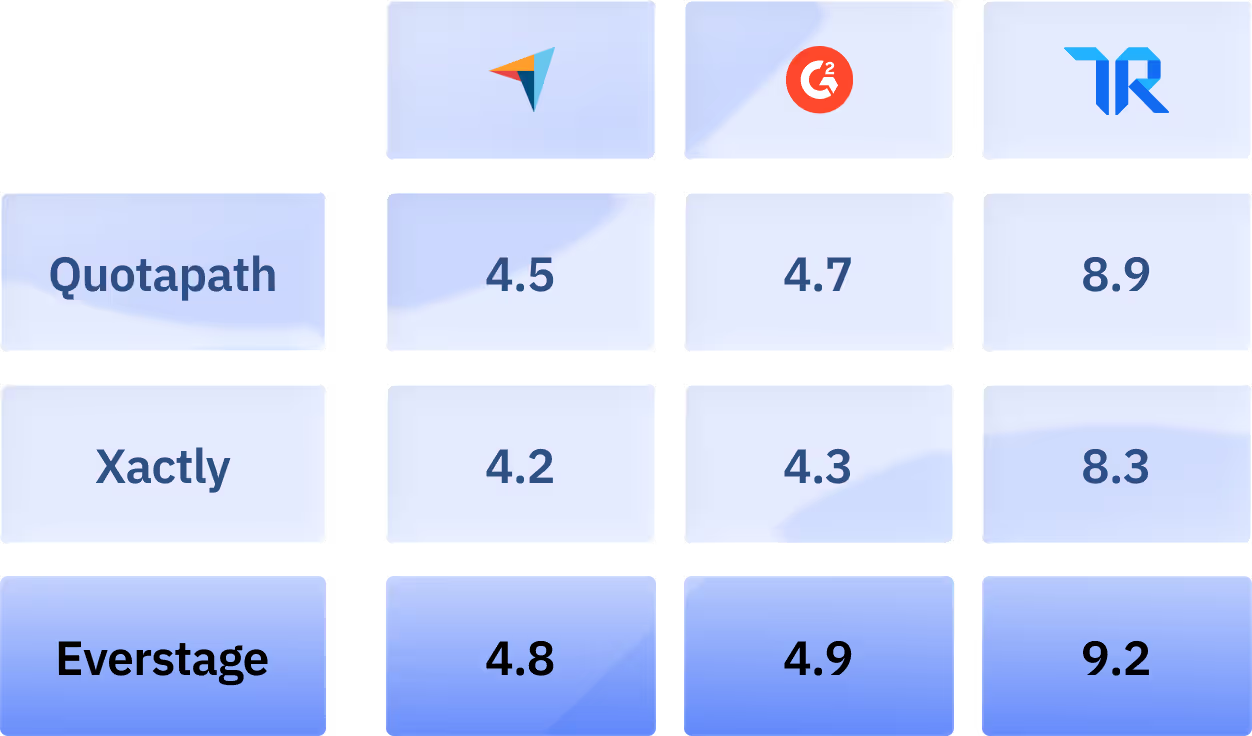
Customer reviews offer an unfiltered look at how each platform performs in real-world environments. Below is a snapshot of feedback themes taken from G2, Capterra, and TrustRadius.



Quotapath vs Xactly: Finding the Balance
Quotapath and Xactly serve different segments of the commission management market with contrasting design priorities. Xactly carries the infrastructure of systems built years ago, resulting in lengthy implementations and consultant dependencies. Quotapath simplifies the initial setup but lacks the depth required for sophisticated, multi-layered commission structures. Both platforms calculate commissions, but their operational models reveal different trade-offs between accessibility and capability.
Across evaluations, we consistently hear similar priorities:
- Finance leaders value faster implementation cycles and predictable costs without ongoing consultant dependencies.
- RevOps teams want reliable testing environments, intuitive plan design, and flexibility to adapt quickly without technical barriers.
- Executives look for transparency, scalability, clear ROI, and solutions that deliver enterprise capabilities without legacy complexity.



For organizations seeking enterprise-grade functionality without prolonged rollouts or structural limitations, Everstage is designed to provide that balance: combining fast go-live, proactive support, and complete visibility into every aspect of sales compensation
Frequently asked questions
How long does it take for teams to switch from Quotapath or Xactly to Everstage?
Most teams switching from Quotapath or Xactly to Everstage go live in 4 to 8 weeks. Everstage imports your historical commission data and preserves full audit trails from day one, so reps keep complete earnings visibility, and finance teams retain compliance records throughout the transition.
How do Quotapath, Xactly, and Everstage compare on AI capabilities?
Quotapath's AI is mainly a plan-building assistant. Xactly's Intelligence layer adds predictive and generative AI for enterprise plan modeling and dispute resolution. Everstage goes further with four production AI agents handling commission workflows end to end, plus Crystal forecasting and AI-generated statements that explain payouts to reps automatically.
Which platform handles complex commission calculations better, Quotapath and Xactly?
Both platforms cover tiered rates, splits, accelerators, and clawbacks. At scale, Xactly's flexibility relies on consultants for changes, while Quotapath leans toward simpler structures and gets harder to manage with highly layered logic. Everstage handles the same calculation types with admin-side flexibility built in.
How do implementation timelines of Quotapath compare with Xactly?
Quotapath usually goes live in 45 to 90 days, but it fits better for straightforward commission plans. Xactly takes 6 to 12 months because setup needs consultants. If you want enterprise-level capability without waiting that long, Everstage is the better choice, with a 6 to 8 week rollout.
What are the hidden costs when evaluating Quotapath or Xactly?
With Quotapath, watch for tier upgrade costs as you scale, since features like ASC-606 sit behind the Growth and Premium plans. With Xactly, the bigger surprise is implementation, which third-party benchmarks place at $15,000 to $150,000, plus consultant fees for plan changes. Everstage covers both upfront in one contract
Between Quotapath and Xactly, which platform provides better ongoing support?
Xactly support requires consultant escalations. Quotapath offers minimal guidance. Everstage includes proactive in-house support with dedicated customer success managers, ensuring fast resolution at no extra charge.