


Anaplan vs Quotapath: 2026 In-Depth Comparison
Incentive software decisions position enterprise modeling platforms against streamlined commission tracking tools. Anaplan and Quotapath represent opposing approaches between complex compensation frameworks and accessible visibility solutions.

Introduction
Commission software decisions often come down to choosing between enterprise planning systems and purpose-built tools. Anaplan and Quotapath represent these approaches. Anaplan positions itself as an enterprise platform with compensation embedded in broader sales performance management. Quotapath focuses specifically on commission tracking for scaling teams. Both promise to automate calculations and replace manual spreadsheet processes.
Challenges surface once these tools are in practice. Anaplan projects are weighed down by learning curves, modeling complexity, and infrastructure built for planning rather than agile execution. Quotapath offers simpler setup but introduces limitations in advanced forecasting and customization for enterprise complexity. While each manages the basics of paying commissions, teams seeking both strategic depth and operational simplicity may find them limiting. Everstage offers a modern approach with no-code design, real-time processing, predictive insights, and rapid deployment, removing barriers that slow planning-heavy and feature-limited platforms.

Head-to-Head Comparison
Setup & Admin Configuration
Functionality | Anaplan | Quotapath | Everstage |
|---|---|---|---|
Data management | Connectors handle many sources, but model upkeep grows heavy at scales. | Built for smaller teams, handles basic CRM sync but struggles with complex datasets and large volumes. | Native integrations with CRMs, ERPs, HRIS; bi-directional Salesforce sync without ecosystem lock-in. |
Plan modeling | Multi-dimensional rules work, but model builders are often required. | Simple backend designer limited to basic calculations and requires support help for changes. | No-code drag-and-drop with sandbox + Time Machine for safe simulations. |
Custom permissions & access control | Role security exists, but fine-tuning takes time and expert admins. | Provides basic role separation for admins and users, lacks detailed audit control and granularity. | Granular RBAC with detailed audit trails, balancing flexibility and compliance. |
Quota management | Purpose-built T&Q sets targets, but territory rework needs modeling cycles. | Manages quotas and attainment but updates need manual intervention and lag in CRM reflection. | Automated quota engine adapts to territories, hierarchies, and role changes. |
Commission Processing
Functionality | Anaplan | Quotapath | Everstage |
|---|---|---|---|
Payout approvals | Workflows are supported, but multi-step designs require model changes. | Approval workflows exist but lack automation and scalability for complex structures. | Customizable automated workflows streamline approvals across the org. |
Contextual overrides | Effective dating helps audits, but one-off fixes still add admin load. | Limited override flexibility and audit transparency, leading to dependency on support teams. | Flexible override system with compliance-friendly audit trails. |
Query resolution | Dashboards update fast, but deeper dispute context needs configured views. | Delay in syncing commission data creates confusion, requiring manual clarification via support. | AI-powered query resolution with instant, auditable answers. |
Contract management | Plan docs and versions track, but end-to-end contract flow needs add-ons. | Plan distribution and sign-off available but no full workflow or version tracking. | Built-in contract workflows include e-signatures and automation. |
User management | RBAC is robust, but bulk org changes pass through model specialists. | Simple hierarchy mapping but changes or team reassignments often need support intervention. | Full lifecycle management across roles and geographies with intuitive setup. |
Insights & Reporting
Functionality | Anaplan | Quotapath | Everstage |
|---|---|---|---|
Real-time calculations | Boards refresh rapidly, but heavy models slow iterative change cycles. | Data updates take hours to reflect, causing visibility delays for reps and managers. | True real-time calculations across systems, ensuring instant payout visibility. |
Payout forecasting | Scenarios support what-ifs, but accuracy depends on model maintenance. | Offers deal-based forecasts but lacks accuracy for variable or multi-rate plans. | Crystal-powered forecasting with precise, scenario-based payout simulations. |
Personalized dashboards | Visual boards are rich, but persona-level views need more setup. | Limited reporting and analytics requiring backend help; lacks granular role-based visibility. | BI-powered dashboards with predictive, customizable insights for every stakeholder. |
The Limitations of Anaplan and Quotapath

Implementation & Time-to-Value

Flexibility & Integrations
User Experience

Pricing Transparency & Support

Scalability Challenges

Security & Compliance
Voice of the Customer
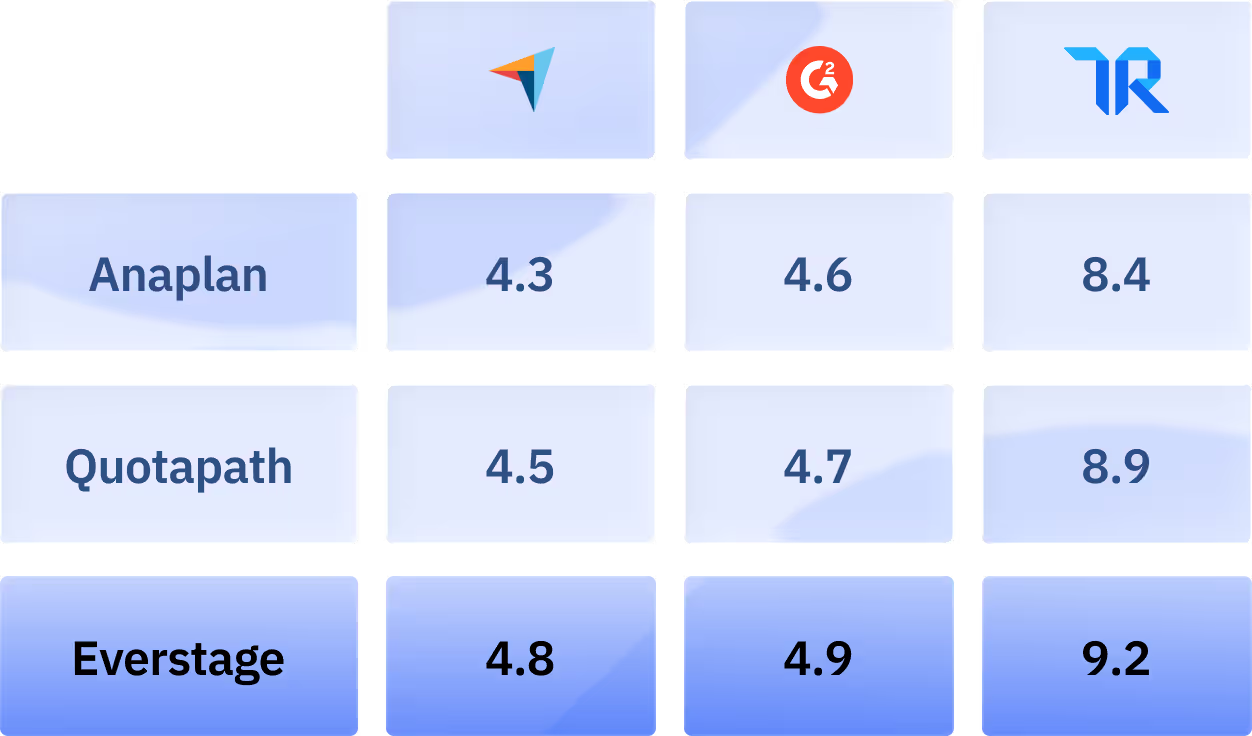
Customer reviews offer an unfiltered look at how each platform performs in real-world environments. Below is a snapshot of feedback themes taken from G2, Capterra, and TrustRadius.




Anaplan vs QuotaPath: Finding the Balance
Anaplan and QuotaPath represent different ends of the spectrum. Anaplan concentrates rules in model-driven builds that standardize logic but require specialist cycles for change. QuotaPath prioritizes straightforward tracking inside CRM flows but offers limited depth for complex structures. Both cover basics, while teams balance modeling rigor against day-to-day agility.
Across evaluations, we often hear similar priorities:
- Finance leaders value faster implementation cycles and predictable costs.
- RevOps teams want reliable testing environments and intuitive plan design.
- Executives look for transparency, scalability, and clear ROI.


For organizations that want advanced calculation capability without long rollouts or feature gaps, Everstage is designed to provide that balance. It delivers quick go-live, proactive support, and complete visibility into every aspect of sales compensation.
Frequently asked questions
What is the main difference between Anaplan and Quotapath?
Anaplan is an enterprise planning platform where sales compensation is one capability among many, alongside finance, supply chain, and workforce planning. Quotapath is built specifically for commission tracking, designed for scaling sales teams. Anaplan fits enterprises with broader planning needs. Quotapath fits smaller teams that want a focused commission tool.
Was Anaplan originally built for sales commission management?
No. Anaplan was originally built as a connected planning platform for finance, supply chain, workforce, and go-to-market planning. Sales compensation became one capability within that broader framework over time. Teams choosing Anaplan only for commission management often find it heavier than they need, since the platform is designed for full-scale planning.
Does Quotapath work if our sales data isn't in Salesforce or HubSpot?
Yes, but with extra setup. Quotapath's pre-built CRM integrations cover Salesforce and HubSpot directly. For other CRMs, the open API handles custom connections. QuickBooks pulls invoice and payment data, and CSV upload works for any deal data. Salesforce and HubSpot users get the smoothest setup.
Which is better for SMB and growing teams vs enterprise: Anaplan or Quotapath?
Quotapath fits SMB and growing sales teams that want a focused commission tracker with quick setup. Anaplan suits enterprises already invested in connected planning across finance, supply chain, and workforce. Mid-market teams that fall between the two often outgrow Quotapath's depth before they're ready to take on Anaplan's complexity.
How do teams migrate from Anaplan or Quotapath to Everstage?
Everstage's in-house team handles the migration. They rebuild your existing plans in a no-code test environment, import historical commission data, and validate payouts against your current system before go-live. Most teams complete the move in 4 to 8 weeks.
How does Everstage handle the gaps Anaplan and Quotapath leave?
Everstage closes the gaps with a no-code plan builder that handles complex plans without specialists, native integrations across CRM, ERP, and HRIS for real-time data, and built-in audit trails with role-based access. Sandbox testing lets business teams safely deploy plan changes.